
In the field of advanced manufacturing, the production of complex thin-walled shell castings from magnesium alloys presents significant challenges due to the material’s inherent properties and structural demands. This study focuses on ZM4 magnesium alloy, a Mg-rare earth-zirconium system known for its enhanced corrosion resistance and high-temperature creep performance, making it suitable for applications requiring airtightness, such as in aerospace components. The objective is to develop an effective low-pressure casting process for fabricating intricate shell castings with thin walls and intricate internal oil passages. We employ sand mold low-pressure casting with a slot gating system, incorporating large risers and chills to optimize filling and feeding. Through iterative adjustments of process parameters and gating design, we successfully produce defect-free shell castings that meet rigorous quality standards. This article details our methodology, parameter calculations, defect analysis, and improvements, emphasizing the critical role of controlled pressure and temperature in achieving high-integrity shell castings.
The ZM4 magnesium alloy contains zirconium, which refines grains and mitigates impurity effects, and rare earth elements that improve creep resistance. However, its wide solidification temperature range (approximately 100°C from liquidus to solidus) predisposes it to defects like shrinkage porosity, cold shuts, and oxidation. Low-pressure casting offers advantages such as controllable filling speed and pressure, promoting stable mold cavity filling and effective feeding during solidification, thereby yielding dense microstructures and superior mechanical properties. Our target shell casting weighs 15 kg, with dimensions around 300 mm in diameter and 200 mm in height, featuring wall thicknesses as thin as 5 mm and complex internal oil paths. These shell castings require flawless internal quality to pass fluorescence inspection, X-ray examination, and pressure leak tests post-machining. The complexity necessitates a meticulous process design.
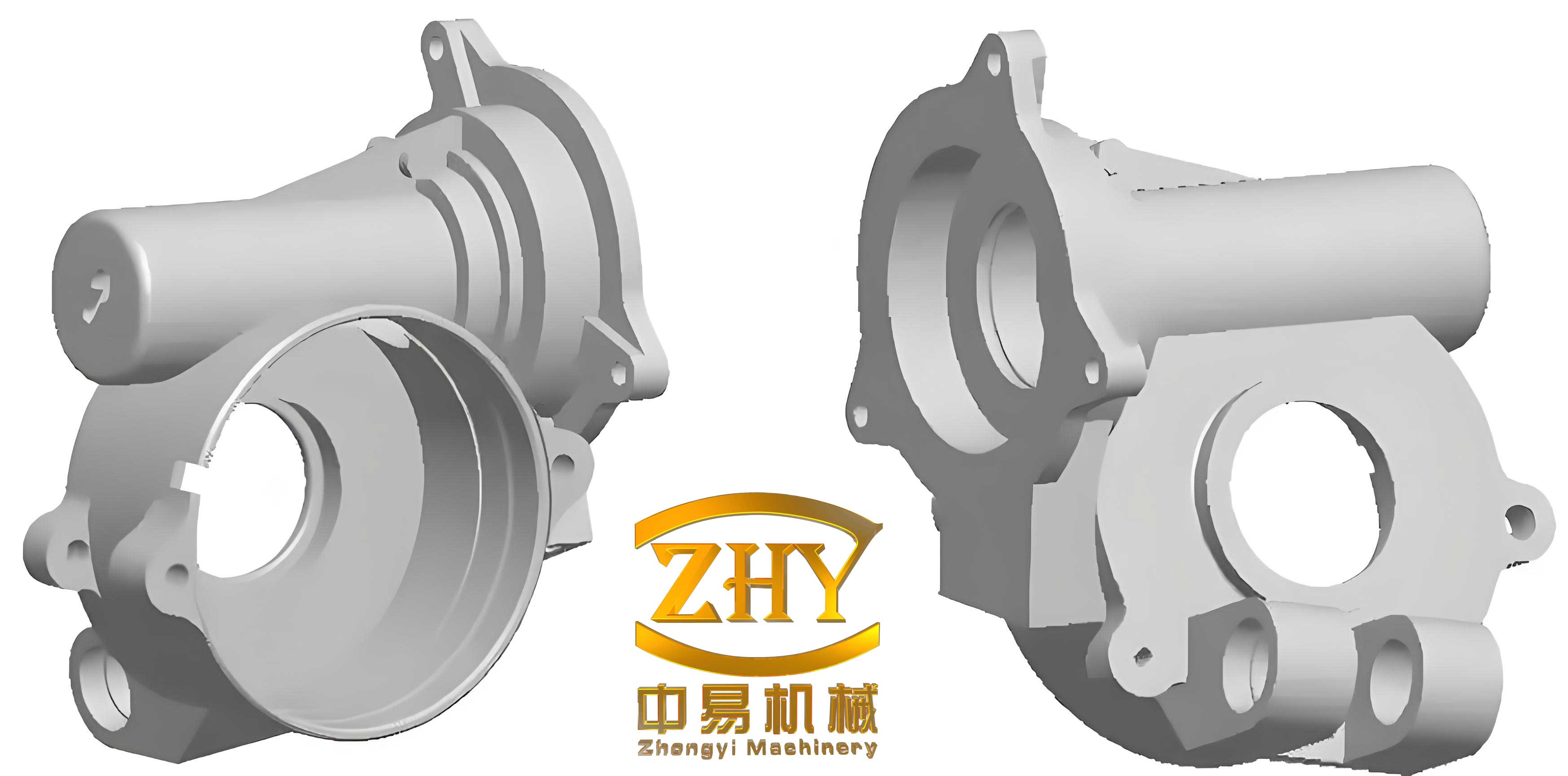
Our experimental setup utilizes an FT-300T-M752 low-pressure casting machine. The ZM4 alloy is melted under a protective atmosphere of SF6 mixed with dry compressed air to prevent combustion. The mold is made from self-hardening sand with added flame retardants (0.5–1.5% by weight) to inhibit reactions with molten magnesium. The shell casting design includes intricate core assemblies for forming internal oil passages; these cores are assembled on a core seat, aligned using height gauges, and integrated into the mold. The gating system is critical: we adopt a slot gating arrangement with a sprue (via a riser tube), a circular runner, multiple vertical cylinders (initially three, later four), slot gates, and a large top riser. This configuration directs metal upward from the bottom, ensuring gradual filling and feeding of the thin-walled regions. Chills are placed at thick sections like bottom bosses to promote directional solidification.
Low-pressure casting involves a precise pressure-time curve, divided into stages: liquid rise, mold filling, shell pressurization, shell pressure holding, crystallization pressurization, crystallization pressure holding, and pressure relief. We calculate key parameters using fundamental formulas. The pressure for liquid rise, \( P_1 \), is determined by the height from the molten metal surface to the riser tube outlet:
$$ P_1 = \rho (h_1 + \Delta h_1) \times 9.8 \times 10^{-3} $$
where \( \rho \) is the density of molten ZM4 alloy (approximately 1.7 g/cm³), \( h_1 \) is the static height, and \( \Delta h_1 \) accounts for metal level drop. For our shell castings, we set a rise speed of 1.2 kPa/s to prevent excessive cooling in the riser tube. The filling pressure, \( P_2 \), ensures complete cavity filling:
$$ P_2 = \rho (h_1 + \Delta h_1 + h_2 + \Delta h_2) \times 9.8 \times 10^{-3} $$
with \( h_2 \) being the height from the tube outlet to the top riser. A fill speed of 0.6 kPa/s balances flow stability and avoidance of turbulence, crucial for thin-walled shell castings. After filling, shell pressurization adds 1–2 kPa over \( P_2 \) to form a initial solidified shell, followed by a holding phase. Crystallization pressurization further increases pressure by 1–2 kPa to enhance feeding during solidification, with a prolonged holding time to eliminate shrinkage. The pressure-time profile is summarized in Table 1, with parameters tailored for ZM4 shell castings.
| Stage | Pressure (kPa) | Speed (kPa/s) | Time (s) | Description |
|---|---|---|---|---|
| Liquid Rise | \( P_1 \) (calculated) | 1.2 | Variable | Metal rises to mold entrance |
| Mold Filling | \( P_2 \) (calculated) | 0.6 | Variable | Cavity fills gradually |
| Shell Pressurization | \( P_2 + 2 \) | N/A | 4 | Increase for shell formation |
| Shell Holding | \( P_2 + 2 \) | N/A | 15 | Shell stabilizes |
| Crystallization Pressurization | \( P_2 + 4 \) | N/A | 4 | Additional pressure for feeding |
| Crystallization Holding | \( P_2 + 4 \) | N/A | 120 | Solidification under pressure |
| Pressure Relief | 0 | N/A | Instant | Release residual pressure |
Initial trials with a pouring temperature of 740°C revealed defects in the shell castings. Approximately 15% of shell castings exhibited gas bubbles near inclined oil passage inlets, despite venting channels, and slight mechanical sand burn-on occurred on surfaces. Analysis indicated that the high pouring temperature increased gas evolution from cores, trapping bubbles before they could escape to the riser. Additionally, excessive shell pressurization pressure (2 kPa) eroded mold coatings, causing metal penetration. To address this, we reduced the pouring temperature to 735°C and lowered shell pressurization to 1 kPa with a shorter time of 2 s. Furthermore, 20% of shell castings showed cold shuts on internal middle webs, traced to cold core seats lacking a proper sand layer. We modified the core seat preparation by sandblasting, coating with oil binder, applying self-hardening sand, and baking at 200°C for 2 hours to form an insulating layer, as shown in the improved process.
After implementing these changes, surface defects were eliminated, but X-ray inspection detected cold shuts in 30% of shell castings at thin-walled inclined oil passages. These passages are remote from gate locations, making them susceptible to premature solidification. Raising pouring temperature or fill speed risked gas defects or turbulence. Therefore, we redesigned the gating system by adding a fourth slot gate and vertical cylinder near the problematic oil passages, extending the circular runner to distribute metal flow better. This modification shortened feeding distances and enhanced local filling for these critical sections of the shell castings. The revised gating layout ensures more uniform temperature distribution and pressure application during solidification.
The final process parameters are detailed in Table 2. We emphasize that the density \( \rho \) of ZM4 alloy varies slightly with temperature; for calculations, we use an average value derived from experimental data. The pressure adjustments are critical for maintaining integrity in thin-walled regions of shell castings. The relationship between pressure and solidification quality can be expressed as:
$$ Q = k \cdot \int_{t_0}^{t_f} P(t) \, dt $$
where \( Q \) represents the feeding effectiveness, \( k \) is a material constant, \( P(t) \) is the time-dependent pressure, and \( t_0 \) to \( t_f \) is the solidification interval. Higher \( Q \) values correlate with reduced shrinkage in shell castings.
| Parameter | Value | Rationale |
|---|---|---|
| Pouring Temperature | 735°C | Minimizes gas evolution while ensuring fluidity |
| Rise Speed | 1.2 kPa/s | Prevents cooling in riser tube |
| Fill Speed | 0.6 kPa/s | Balances fill stability for thin walls |
| Shell Pressurization | 1 kPa over \( P_2 \) | Adequate shell formation without sand erosion |
| Shell Holding Time | 2 s | Sufficient for initial solidification |
| Crystallization Pressurization | 2 kPa over \( P_2 + 1 \) | Enhances feeding during solidification |
| Crystallization Holding Time | 120 s | Ensures complete solidification under pressure |
| Number of Slot Gates | 4 | Improves filling and feeding for remote sections |
| Core Seat Preparation | Baked self-hardening sand layer | Prevents cold shuts from heat absorption |
With these optimizations, we produced ZM4 magnesium alloy shell castings that passed all quality inspections. Fluorescence testing revealed no surface cracks or discontinuities. X-ray examination confirmed the absence of internal cold shuts, shrinkage porosity, or gas pockets in the shell castings. After machining, pressure leak tests were conducted using kerosene at 4–6 MPa and 20±10°C for 10–15 minutes; no leakage was observed, meeting the airtightness requirements for aerospace applications. Mechanical properties from attached test bars are summarized in Table 3, demonstrating compliance with standards. The successful outcomes validate our low-pressure casting process for complex thin-walled shell castings.
| Sample | Tensile Strength \( R_m \) (MPa) | Elongation \( A \) (%) | Standard Requirement | Result |
|---|---|---|---|---|
| 1 | 151 | 3.0 | \( R_m \geq 117.6 \) MPa, \( A \geq 2\% \) | Qualified |
| 2 | 139 | 2.0 | \( R_m \geq 117.6 \) MPa, \( A \geq 2\% \) | Qualified |
| 3 | 148 | 2.0 | \( R_m \geq 117.6 \) MPa, \( A \geq 2\% \) | Qualified |
| Average | 146 | 2.3 | \( R_m \geq 117.6 \) MPa, \( A \geq 2\% \) | Qualified |
The improvement in shell casting quality stems from precise control of thermal and pressure parameters. The solidification behavior of ZM4 alloy can be modeled using the Chvorinov’s rule modified for pressure-assisted casting:
$$ t_s = B \left( \frac{V}{A} \right)^2 – C \cdot P $$
where \( t_s \) is solidification time, \( B \) and \( C \) are constants, \( V/A \) is the volume-to-area ratio, and \( P \) is applied pressure. For thin-walled shell castings, a high \( V/A \) ratio in thick sections necessitates extended pressure holding to prevent shrinkage. Our process ensures that pressure is maintained throughout solidification, compensating for the alloy’s wide freezing range. Additionally, the slot gating system minimizes turbulence, which is crucial for magnesium alloys prone to oxidation. The strategic use of chills and risers further promotes directional solidification toward the feed gates.
In conclusion, our research establishes an effective sand mold low-pressure casting process for ZM4 magnesium alloy complex thin-walled shell castings. Key factors include a pouring temperature of 735°C, controlled pressure profiles with adjusted shell and crystallization stages, and a four-gate slot gating system with enhanced core preparation. These measures address defects like gas bubbles, cold shuts, and shrinkage, resulting in shell castings with excellent internal integrity and mechanical performance. The process is reproducible and suitable for industrial applications requiring high-quality shell castings. Future work could explore numerical simulation to optimize gating designs further and extend the process to other magnesium alloys. This study underscores the importance of iterative parameter refinement in achieving defect-free shell castings for demanding environments.
The success of this project highlights the viability of low-pressure casting for manufacturing intricate shell castings from challenging materials like ZM4 magnesium alloy. By integrating theoretical calculations with practical adjustments, we have developed a robust methodology that ensures reliable production of shell castings. The insights gained can be applied to similar casting projects, contributing to advancements in lightweight alloy manufacturing. Ultimately, the ability to produce high-integrity shell castings supports innovation in sectors such as aerospace and automotive, where performance and weight reduction are critical.