
In the industrial sector, compressors are critical equipment used to compress gases, generating compressed energy for transportation or creating necessary conditions for chemical reactions. Traditionally, compressor housings have been manufactured using stainless steel materials to meet operational demands. However, stainless steel is associated with high costs and relative difficulties in processing. To address these challenges, there has been a growing demand from users to develop alternative materials that offer comparable performance at a lower cost. This has led to the initiative to explore low-temperature high-strength and toughness steel castings as a viable replacement. In this study, we focus on the design, development, and validation of such steel castings, aiming to achieve optimal mechanical properties, including enhanced strength and toughness at sub-zero temperatures, while maintaining cost-effectiveness. The research encompasses alloy composition design, heat treatment optimization, and thorough mechanical and microstructural analysis to ensure the material meets stringent application requirements.
The primary objective is to formulate a steel casting material that can withstand the rigorous conditions of compressor operations, particularly in低温 environments. The target mechanical properties for the compressor housing castings are outlined in Table 1. These specifications serve as the benchmark for our material development efforts, guiding the alloy design and processing parameters. Achieving these properties requires a meticulous balance of chemical composition and heat treatment, as even minor deviations can significantly impact performance. Our approach involves laboratory-scale studies to simulate real-world conditions, followed by full-scale production trials to validate the findings. Throughout this process, we emphasize the importance of steel castings in modern engineering applications, highlighting their versatility and potential for innovation in heavy machinery components.
| Lower Yield Strength (MPa) | Tensile Strength (MPa) | Elongation (%) | Reduction of Area (%) | Room Temperature Impact Energy KU (J) | -46°C Impact Energy KV (J) | Hardness (HBW) |
|---|---|---|---|---|---|---|
| ≥ 295 | ≥ 490 | ≥ 20 | ≥ 35 | ≥ 45 | ≥ 20 | ≤ 230 |
The foundation of high-strength and high-toughness steel castings lies in precise alloy composition design. Each element plays a crucial role in determining the final microstructure and mechanical behavior. Carbon (C) is the most influential element for strengthening, but excessive amounts can detrimentally affect plasticity and toughness. To ensure a favorable balance, we control the C content within a narrow range of 0.20% to 0.25% by mass. Silicon (Si) enhances strength and hardness through solid solution strengthening and improves oxidation resistance; however, high Si levels can reduce toughness. Therefore, Si is limited to 0.30%–0.45%. Manganese (Mn) is essential for compensating strength loss from lower C content and improving toughness, but over-addition can increase hardenability and promote martensite formation, which harms low-temperature toughness. We set Mn at 1.10%–1.30% to optimize these effects.
Chromium (Cr) contributes to hardenability and secondary hardening, refining the microstructure when combined with other elements. Its content is maintained at 0.10%–0.30%. Nickel (Ni) is known for improving strength and toughness, especially at low temperatures, but its high cost necessitates careful usage, so we cap Ni at ≤0.30%. Molybdenum (Mo) enhances hardenability and prevents temper embrittlement, yet it can impair impact toughness if excessive; thus, Mo is restricted to ≤0.15%. Vanadium (V) is added for grain refinement, which boosts both strength and low-temperature toughness, critical for thick-section steel castings. The V content is controlled between 0.02% and 0.05%. The finalized internal control composition for the steel castings is summarized in Table 2. This composition is designed to achieve a fine-grained microstructure that supports the desired mechanical properties, leveraging synergistic effects among alloying elements.
| C | Si | Mn | P | S | Cr | Ni | Mo | V |
|---|---|---|---|---|---|---|---|---|
| 0.20–0.25 | 0.30–0.45 | 1.10–1.30 | ≤ 0.020 | ≤ 0.020 | 0.10–0.30 | ≤ 0.30 | ≤ 0.15 | 0.02–0.05 |
To understand the relationship between composition and properties, we can consider empirical formulas for strength prediction. For instance, the yield strength of steel castings can be approximated as a function of alloy content and grain size. A simplified model might be expressed as: $$\sigma_y = \sigma_0 + k_C \cdot C + k_{Mn} \cdot Mn + k_{Si} \cdot Si + k_{d} \cdot d^{-1/2}$$ where $\sigma_y$ is the yield strength, $\sigma_0$ is the lattice friction stress, $k_C$, $k_{Mn}$, $k_{Si}$ are strengthening coefficients for respective elements, and $d$ is the average grain diameter. This highlights the importance of both composition control and grain refinement through elements like V.
For sample preparation, we utilized a vacuum induction melting furnace to produce small-scale steel castings. Raw materials, including graphite electrodes, ferrosilicon, electrolytic manganese, metallic chromium, nickel plates, metallic molybdenum, ferrovanadium, and industrial pure iron, were melted according to the design composition to cast 40 kg ingots. These ingots, as shown in the figure below, were chemically analyzed to confirm composition adherence. Subsequently, they were sectioned into rectangular test blocks measuring 120 mm × 50 mm × 20 mm for heat treatment experiments. This small-scale approach allows for efficient screening of parameters before industrial application.
The heat treatment process is pivotal in tailoring the microstructure and properties of steel castings. We designed a series of normalization and tempering experiments to investigate the effects of temperature and cooling rate. Normalization was performed at temperatures above the Ac3 transformation point, followed by varying cooling methods to simulate different production conditions. Tempering was conducted at different temperatures to evaluate its influence on strength and toughness. The detailed experimental scheme is presented in Table 3. Each test block underwent specific treatments, after which standard tensile and Charpy V-notch impact specimens were machined for mechanical testing. All tests followed international standards, ensuring reliability and comparability of results.
| Test ID | Normalization | Cooling Rate Simulation | Tempering |
|---|---|---|---|
| 1 | Ac3 + 40°C × 3 h | Simulated air cooling (moderate) | 580°C × 6 h, furnace cool |
| 2 | Ac3 + 40°C × 3 h | Simulated air cooling (moderate) | 550°C × 6 h, furnace cool |
| 3 | Ac3 + 40°C × 3 h | Simulated air cooling (moderate) | 520°C × 6 h, furnace cool |
| 4 | Ac3 + 60°C × 3 h | Simulated air cooling (moderate) | 550°C × 6 h, furnace cool |
| 5 | Ac3 + 25°C × 3 h | Simulated air cooling (moderate) | 550°C × 6 h, furnace cool |
| 6 | Ac3 + 10°C × 3 h | Simulated air cooling (moderate) | 550°C × 6 h, furnace cool |
| 7 | Ac3 + 40°C × 3 h | Simulated still air cooling (slow) | 550°C × 6 h, furnace cool |
| 8 | Ac3 + 40°C × 3 h | Simulated oil quenching (fast) | 550°C × 6 h, furnace cool |
The mechanical properties of the treated steel castings were evaluated through tensile and impact tests. The results, compiled in Table 4, demonstrate that the designed material can meet the user requirements. Analysis of tests 1-3 reveals that under constant normalization parameters, decreasing the tempering temperature increases strength but reduces plasticity and impact toughness. Tempering at 580°C yields the best combination of strength and toughness. Comparing tests 4-6 and test 2, with fixed tempering, varying normalization temperature shows a slight peak in strength with minimal impact on toughness. Tests 7, 2, and 8 indicate that cooling rate significantly affects properties, with faster cooling promoting higher strength but potentially compromising toughness due to microstructural changes.
| Test ID | Lower Yield Strength (MPa) | Tensile Strength (MPa) | Yield Ratio | Elongation (%) | Reduction of Area (%) | -46°C Impact Energy KV (J) | Notes |
|---|---|---|---|---|---|---|---|
| 1 | 404 | 562 | 0.718 | 31.0 | 66 | 69, 77 | Effect of tempering temperature |
| 2 | 416 | 573 | 0.726 | 28.5 | 69 | 46, 56 | Effect of tempering temperature |
| 3 | 433 | 581 | 0.745 | 28.0 | 65 | 16, 30 | Effect of tempering temperature |
| 4 | 401 | 556 | 0.721 | 26.5 | 66 | 41, 59 | Effect of normalization temperature |
| 5 | 406 | 557 | 0.729 | 30.0 | 65 | 53, 42 | Effect of normalization temperature |
| 6 | 395 | 542 | 0.729 | 29.5 | 69 | 45, 56 | Effect of normalization temperature |
| 7 | 383 | 541 | 0.708 | 33.5 | 71 | 69, 45 | Effect of cooling rate |
| 8 | 443 | 596 | 0.743 | 26.0 | 66 | 21, 27 | Effect of cooling rate |
To quantify the impact of heat treatment on toughness, we can use an empirical relation for ductile-to-brittle transition temperature (DBTT), which is critical for steel castings operating in低温 environments. The DBTT can be approximated as: $$DBTT = T_0 – k \cdot \Delta G$$ where $T_0$ is a base temperature, $k$ is a material constant, and $\Delta G$ represents the grain boundary strengthening effect. Fine grains, achieved through V addition, lower DBTT, enhancing low-temperature toughness. This aligns with our observation that optimal heat treatment promotes a fine-grained microstructure.
Microstructural examination was conducted on selected impact fracture samples to correlate mechanical properties with phase constituents. Under simulated air cooling (Test 1 and 3), the microstructure consisted of ferrite, pearlite, and tempered bainite. With slower cooling (Test 7), the structure was primarily ferrite and pearlite, without bainite. Under oil quenching (Test 8), faster cooling increased bainite content. These variations explain the strength differences: higher bainite fraction elevates strength but may reduce toughness if not properly tempered. The micrographs illustrate the importance of cooling control in steel castings, as it directly influences phase transformation kinetics. For instance, the volume fraction of bainite ($f_B$) can be estimated using continuous cooling transformation (CCT) diagrams, governed by equations like: $$f_B = 1 – \exp(-k_B \cdot t^n)$$ where $k_B$ and $n$ are constants dependent on composition and cooling rate $t$.
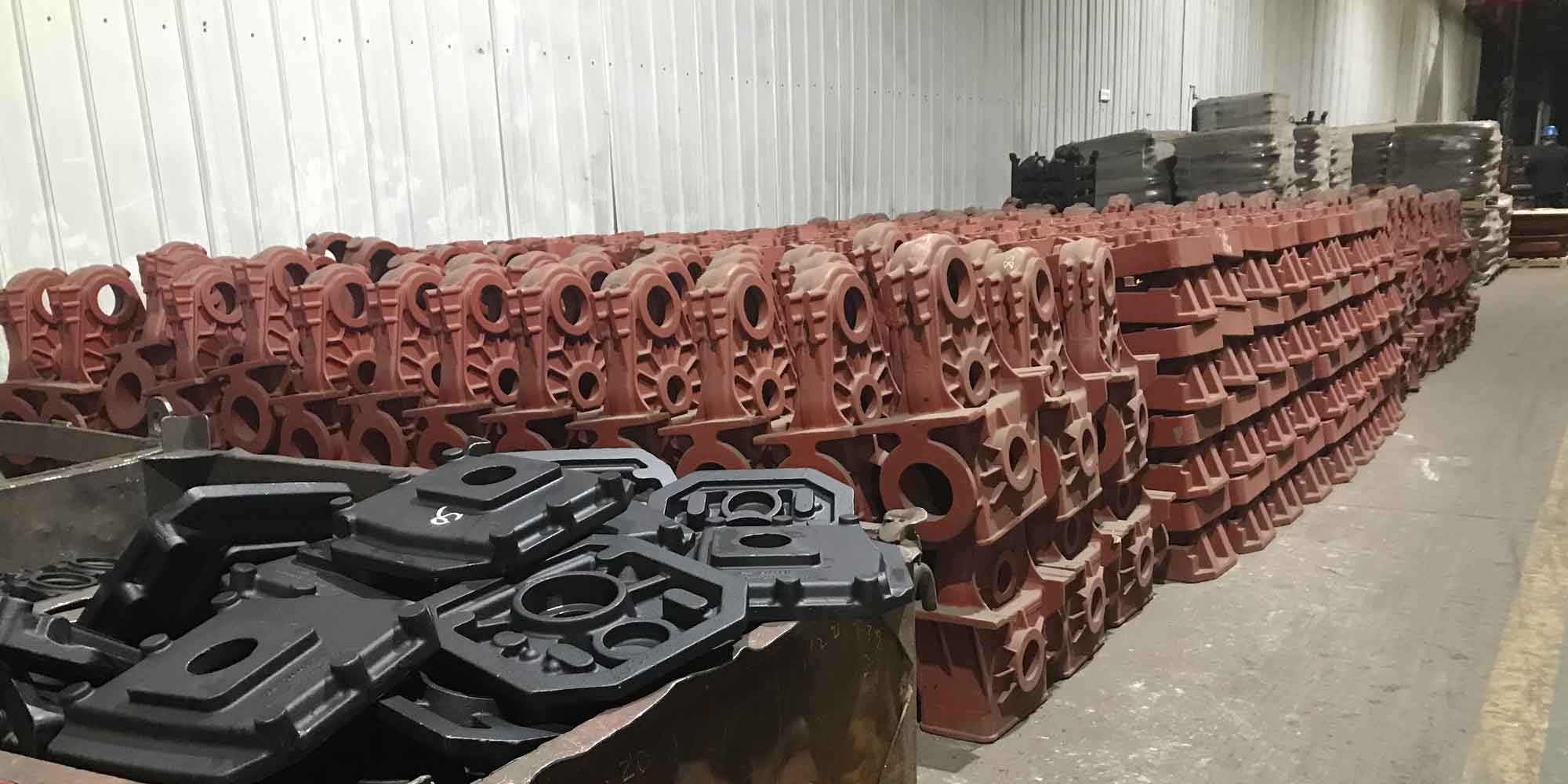
Based on the laboratory findings, we proceeded to full-scale production trials for compressor housing steel castings. The process involved molding, melting, pouring, cleaning, heat treatment, and finishing. A companion test block was heat-treated alongside the actual casting to verify properties. The results, shown in Table 5, confirm that the produced steel castings meet all specified requirements, demonstrating the scalability of our approach. This successful trial underscores the potential of these steel castings to replace stainless steel in compressor applications, offering cost savings without compromising performance.
| Property | Requirement | Measured Value |
|---|---|---|
| Lower Yield Strength (MPa) | ≥ 295 | 376 |
| Tensile Strength (MPa) | ≥ 490 | 550 |
| Elongation (%) | ≥ 20 | 30.0 |
| Reduction of Area (%) | ≥ 35 | 68 |
| Room Temperature Impact Energy KU (J) | ≥ 45 | 162, 146, 153 |
| -46°C Impact Energy KV (J) | ≥ 20 | 52, 49, 58 |
| Hardness (HBW) | ≤ 230 | 163 |
In conclusion, through systematic laboratory research on alloy composition and heat treatment parameters, we have established an internal control composition and optimized heat treatment process for low-temperature high-strength and toughness steel castings. The key findings are: First, with the composition range of C 0.20%–0.25%, Si 0.30%–0.45%, Mn 1.10%–1.30%, Cr 0.10%–0.30%, Ni ≤0.30%, Mo ≤0.15%, and V 0.02%–0.05%, the steel castings after normalization and tempering can satisfy the stringent low-temperature performance criteria. Second, tempering temperature plays a critical role; at 580°C, the best strength-toughness balance is achieved. Third, normalization temperature variations have a modest effect on strength, with negligible impact on toughness. Fourth, cooling rate is highly influential, with faster cooling promoting bainite formation and higher strength, but careful control is needed to maintain toughness. These insights pave the way for broader adoption of such steel castings in compressor housings and other低温 applications, contributing to cost-effective and reliable engineering solutions. The success of this research highlights the importance of integrated material design and processing optimization in advancing steel castings technology.
Future work could explore further refinement of alloying elements, such as microalloying with niobium or titanium, to enhance grain refinement and precipitation strengthening. Additionally, advanced heat treatment techniques like interrupted cooling or austempering could be investigated to tailor microstructures for specific applications. The development of predictive models using machine learning, based on composition and process parameters, could accelerate the design of next-generation steel castings. Ultimately, the continuous improvement of steel castings will drive innovation across industries, from energy to transportation, ensuring sustainable and efficient material usage.