
In my extensive study, I aimed to develop a robust casting process for nodular cast iron automotive steering knuckles that eliminates shrinkage porosity, a common defect in such multi-hot-spot components. The inherent mushy solidification characteristics of nodular cast iron often lead to shrinkage cavities and porosities, necessitating complex riser systems that reduce yield rates and increase production complexity. My approach leveraged graphitization expansion for feeding, precise control of melt chemistry, and advanced inoculation strategies to produce sound castings without risers, thereby enhancing process efficiency and economic viability.
The automotive steering knuckle, a critical linkage component between the wheel and suspension system, demands high mechanical integrity due to its load-bearing role under diverse conditions. Its complex geometry, featuring uneven sections and multiple hot spots such as main, secondary, and isolated thermal junctions, makes it prone to shrinkage defects during casting. Traditional solutions like added risers or chilled molds increase design difficulty and cost. Therefore, I focused on melt quality control through chemical composition adjustment and intensified inoculation to harness the self-feeding capability of nodular cast iron, ultimately achieving shrinkage-free castings with improved yield.
My investigation began with a detailed analysis of the steering knuckle’s structure and technical requirements. The castings, weighing 15–20 kg each, were specified to meet QT450-10 grade standards according to GB/T 1348-2009, with chemical composition limits (in wt%): 3.6–3.7% C, 1.7–1.8% Si, Mn ≤ 0.3%, P ≤ 0.05%, S ≤ 0.02%, 0.03–0.045% residual Mg, and 0.02–0.03% residual RE. Mechanical properties required tensile strength σb > 450 MPa, elongation δ > 10%, and Brinell hardness 160–210 HB, while microstructural criteria included a ferrite-dominated matrix (>85% ferrite), graphite spheroidization grades 1–3, and graphite size grades 5–8, with no allowances for cracks, cold shuts, shrinkage cavities, or porosity.
The production process involved charge materials of 30% pig iron, 40% scrap steel, and 30% returns, supplemented with graphitizing carburizer and 0.2% silicon carbide (SiC) pretreatment agent. The melt was tapped at 1,550°C without holding. Nodularization was achieved via wire-feeding for 60 seconds per ton of melt, followed by multiple inoculation stages: 0.2% ladle inoculation during transfer, and 0.1% conventional 75% ferrosilicon for stream inoculation. Pouring temperature was controlled at 1,380–1,420°C, with total pouring time limited to 10 minutes. This regimen, emphasizing high-quality raw materials, optimal tapping temperature, and effective inoculation, formed the core of my approach to minimize undercooling and enhance graphite nucleation, key to maximizing self-expansion for feeding.
To evaluate melt quality and process outcomes, I employed several analytical techniques. Chemical composition was assessed using a direct reading spectrometer, while thermal analysis curves were recorded with a dedicated thermal analyzer to derive critical parameters like eutectic temperature and undercooling. Microstructural examination was conducted via an inverted metallurgical microscope, tensile properties were tested on a hydraulic universal testing machine, and hardness was measured with a digital Brinell hardness tester. These methods provided comprehensive data for correlating process variables with casting integrity.
A central aspect of my work involved controlling the chemical composition to optimize the eutectic degree (Sc), defined by the formula:
$$S_c = \frac{\%C}{4.26 – 0.31 \times (\%Si) – 0.3 \times (\%P) – 0.40 \times (\%S) + 0.027 \times (\%Mn)}$$
This parameter critically influences the solidification behavior of nodular cast iron. By adjusting Sc close to 1, I aimed to promote near-eutectic solidification, which enhances graphite precipitation and self-expansion, thereby reducing shrinkage tendency. The table below summarizes the effects of varying eutectic degrees on microstructure and shrinkage porosity, based on my experimental observations.
| Eutectic Degree (Sc) | Graphite Morphology | Graphite Count (per mm²) | Shrinkage Porosity Severity | Remarks |
|---|---|---|---|---|
| 0.95 | Mixed sizes, some larger spheroids | ~150 | High, extensive in hot spots | Hypoeutectic, austenite dendrites form first |
| 0.98 | More uniform spheroids | ~250 | Moderate, reduced area | Approaching eutectic, improved nucleation |
| 1.00 | Uniform, fine spheroids | ~400 | Low to negligible | Near-eutectic, optimal graphite expansion |
| 1.02 | Slightly coarsened spheroids | ~300 | Low | Hyper-eutectic, some graphite flotation risk |
As shown, when Sc approaches 1, graphite spheroid counts increase significantly, leading to diminished shrinkage porosity. This aligns with the principle that near-eutectic compositions minimize the liquidus-solidus range, facilitating better feeding via graphite expansion. Additionally, I meticulously controlled residual magnesium levels to balance spheroidization and shrinkage: too low Mg impairs nodularization, while excess Mg increases contraction; my target range of 0.035–0.045% proved effective in maintaining high nodularity with minimal shrinkage risk.
Another critical factor was melt quality management through inoculation. I experimented with various inoculation combinations to enhance graphite nucleation, thereby increasing graphite counts and reducing undercooling. The thermal analysis curves provided insights into solidification dynamics. Key parameters included the liquidus temperature (tAL), eutectic temperature (tE), and eutectic undercooling (ΔT = tEG – tEU), where tEG is the theoretical graphite-austenite eutectic temperature and tEU is the actual eutectic nucleation temperature. Lower ΔT values indicate better nucleation, reducing shrinkage propensity. The table below details thermal analysis characteristics for different inoculation schemes I tested.
| Inoculation Combination | Liquidus Temp. tAL (°C) | Eutectic Temp. tE (°C) | C Content (wt%) | Si Content (wt%) | Eutectic Degree Sc | Undercooling ΔT (°C) | Nodularity (%) |
|---|---|---|---|---|---|---|---|
| SiC pretreatment + floating Si inoculation | 1,164 | 1,123 | 3.67 | 1.69 | 0.97 | 6.7 | 84 |
| Add wire-feeding inoculation | 1,161 | 1,122 | 3.68 | 1.75 | 0.98 | 5.6 | 87 |
| Add ladle inoculation | 1,155 | 1,123 | 3.64 | 1.75 | 0.99 | 1.7 | 88 |
| Add stream inoculation | 1,154 | 1,123 | 3.75 | 1.71 | 1.00 | 0.7 | 91 |
The data clearly demonstrate that progressive inoculation steps reduce ΔT markedly. Starting with SiC pretreatment, which provides nucleation sites during melting, and floating silicon inoculation that acts superficially, graphite counts were low (~100–200/mm²). Adding wire-feeding inoculation sharply increased graphite numbers and refined spheroids. Ladle inoculation, applied during transfer, further boosted nucleation by improving silicon absorption, while stream inoculation, as a late-stage treatment, minimized衰退 and ensured high effectiveness. The combined approach yielded ΔT values near zero, indicative of excellent nucleation and minimal undercooling, which is crucial for activating graphitization expansion to counteract solidification shrinkage.
To illustrate the microstructural outcomes, consider the following image showing typical nodular cast iron matrix with well-dispersed graphite spheroids, achieved through optimized inoculation and composition control.
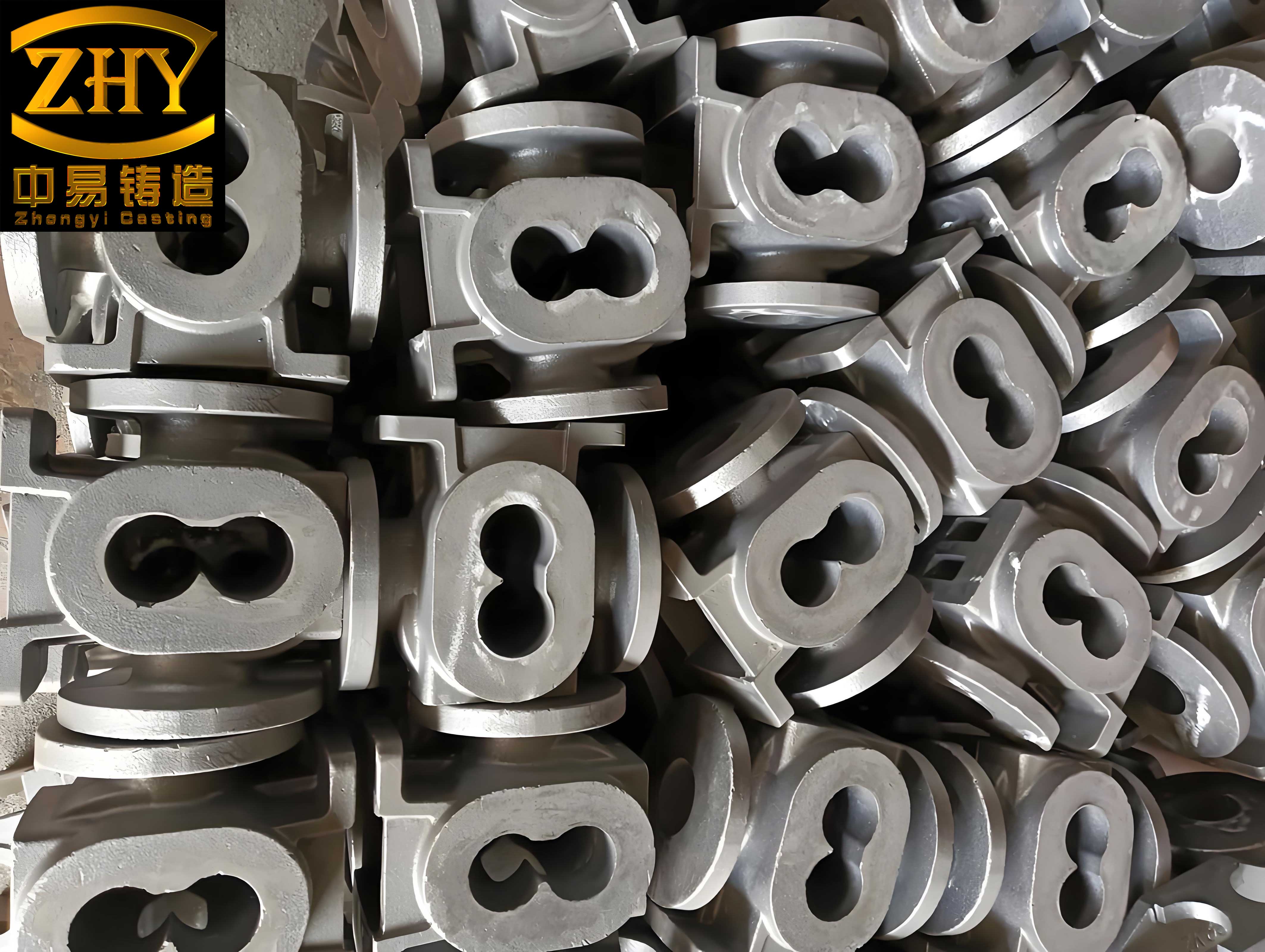
The effectiveness of these strategies was evident in the elimination of shrinkage defects in steering knuckle castings. Initially, with inadequate inoculation or suboptimal eutectic degrees, shrinkage porosity was prominent in main hot spots. However, by fine-tuning Sc to approximately 1 and employing multi-stage inoculation, I achieved sound castings free of macro- and micro-shrinkage. This was corroborated by mechanical testing, as summarized in the table below comparing properties between castings with and without shrinkage.
| Metallurgical Quality | Tensile Strength (MPa) | Yield Strength (MPa) | Elongation (%) | Hardness (HB) |
|---|---|---|---|---|
| Castings with shrinkage porosity | 463 | 328 | 12.6 | 174 |
| Sound, shrinkage-free castings | 508 | 360 | 20.0 | 188 |
The improvement is significant: tensile strength increased by 9.7%, yield strength by 9.7%, elongation by 58%, and hardness by 8%, underscoring the detrimental impact of shrinkage on ductility and the benefits of my optimized process. The high elongation, exceeding 20%, is particularly noteworthy for nodular cast iron applications requiring toughness, such as automotive components.
My findings emphasize the interplay between chemistry and inoculation in nodular cast iron production. The eutectic degree formula serves as a guide for composition adjustment, while thermal analysis provides real-time feedback on melt quality. The undercooling ΔT can be expressed as:
$$\Delta T = t_{EG} – t_{EU}$$
where tEG is derived from equilibrium phase diagrams and tEU is measured from cooling curves. Minimizing ΔT through vigorous inoculation enhances graphite nucleation, leading to more concurrent eutectic solidification and greater expansion pressure to feed shrinkage. This principle is vital for complex castings like steering knuckles, where traditional feeding methods are inefficient.
In practice, I implemented a controlled production routine: charge calculation to target Sc ≈ 1, SiC pretreatment for early nucleation, wire-feeding for consistent nodularization, and multiple inoculation steps to maintain high graphite counts throughout processing. Pouring temperature control ensured proper fluidity without exacerbating shrinkage. The result was a repeatable process yielding riser-free nodular cast iron steering knuckles with high integrity, achieving yield rates above 85% compared to lower values with conventional risered designs.
Further, I explored the effects of minor elements. For instance, sulfur levels below 0.02% reduce the demand for magnesium and improve inoculation response, while phosphorus kept under 0.05% minimizes embrittlement. The residual magnesium and rare earths were balanced to ensure spheroidization without excessive carbide formation. These refinements contributed to the consistent quality of nodular cast iron produced.
In summary, my research demonstrates that through meticulous control of eutectic degree and advanced inoculation strategies, shrinkage porosity in multi-hot-spot nodular cast iron automotive steering knuckles can be entirely eliminated. The process leverages the inherent graphitization expansion of nodular cast iron, eliminating the need for risers and chills, thereby simplifying tooling and boosting yield. This approach not only enhances mechanical properties but also offers economic and operational advantages for high-volume production. Future work could focus on automating thermal analysis for real-time process adjustment and extending the methodology to other complex nodular cast iron components.
The success of this study hinges on understanding the solidification dynamics of nodular cast iron. By prioritizing melt quality over external feeding, I have established a robust framework for producing high-integrity castings. The nodular cast iron microstructure, characterized by spherical graphite in a ferritic matrix, is key to achieving the desired combination of strength and ductility. Through continuous refinement of composition and inoculation practices, the potential for defect-free nodular cast iron castings in demanding applications like automotive steering systems is fully realizable.