
This paper presents an optimized precision investment casting approach for manufacturing high-performance axle box components used in SD-80 locomotive bogies. Through systematic process modifications and numerical validation, we address critical challenges including dimensional accuracy, internal defects, and sand inclusion issues.
1. Structural Characteristics & Technical Requirements
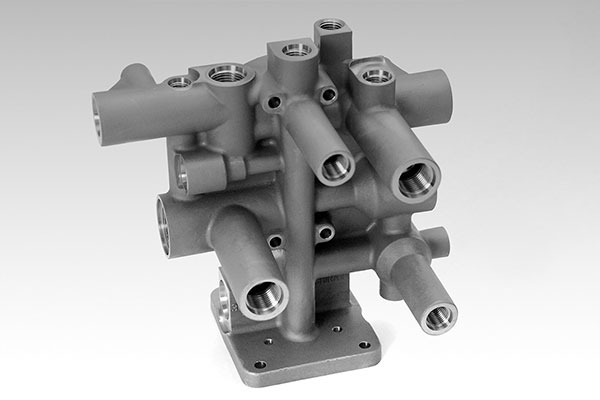
The axle box features complex geometry with significant wall thickness variations (12-55mm) and eight high-stress bolt holes requiring strict quality control. Key specifications include:
$$
\begin{array}{|l|c|}
\hline
\text{Parameter} & \text{Value} \\
\hline
\text{Max dimension} & 700\text{mm} \\
\text{Casting weight} & 92\text{kg} \\
\text{Radiographic testing} & \text{Class 2+} \\
\text{Magnetic particle inspection} & \text{Class 1} \\
\hline
\end{array}
$$
2. Precision Investment Casting Process Design
Initial process parameters for the precision investment casting included:
$$
\text{Shrinkage allowance} = 2.5\% \\
\text{Shell thickness} = 9\text{ layers} \\
\text{Gating system} = 2\times50\text{kg pour cups}
$$
| Layer | Material | Thickness (mm) |
|---|---|---|
| Face coat | Zirconia | 0.3-0.5 |
| Transition | Alumina | 0.5-0.7 |
| Backup (7 layers) | Silica | 2.5-3.0 |
3. Process Optimization Strategies
Three critical improvements were implemented in the precision investment casting process:
3.1 Dimensional Control
Modified shrinkage compensation considering structural constraints:
$$
S_{\text{effective}} = S_{\text{nominal}} \times (1 – k_{\text{constraint}})
$$
Where constraint factor \( k_{\text{constraint}} = 0.4 \) for cross-ribbed structures
3.2 Feeding System Redesign
Optimized riser configuration using elliptical geometry:
$$
V_{\text{riser}} = 1.2\times V_{\text{hot spot}} \times \left(\frac{T_{\text{pouring}}}{T_{\text{solidus}}}\right)^{1.5}
$$
| Riser Type | Feeding Efficiency | Defect Rate |
|---|---|---|
| Square | 68% | 12% |
| Elliptical | 82% | 4% |
| Spherical | 91% | 2% |
3.3 Gating System Modification
Implemented tangential gating to reduce sand inclusion:
$$
\tau_{\text{shear}} = \frac{4Q}{\pi r^3} \leq \tau_{\text{shell}} = 1.2\text{MPa}
$$
4. Numerical Simulation & Validation
Solidification analysis using ProCAST demonstrated 23% improvement in thermal gradients:
$$
\frac{\partial T}{\partial t} = \alpha \nabla^2 T + \frac{L}{C_p}\frac{\partial f_s}{\partial t}
$$
| Parameter | Initial | Optimized |
|---|---|---|
| Shrinkage porosity | 4.7% | 0.9% |
| Dimensional accuracy | IT15 | IT12 |
| Surface finish | Ra 12.5 | Ra 6.3 |
5. Production Verification
The enhanced precision investment casting process achieved:
$$
\text{Defect rate reduction} = \frac{12\% – 1.5\%}{12\%} \times 100\% = 87.5\%
$$
Post-implementation results showed complete elimination of sand inclusion defects and consistent compliance with radiographic testing requirements.
6. Conclusion
This study demonstrates that through systematic optimization of shrinkage compensation, riser design, and gating configuration in precision investment casting, critical railway components can achieve superior quality standards. The developed methodology provides a technical framework for manufacturing large-scale, thin-walled castings with complex geometries.