
In modern industrial sectors such as metallurgy, power generation, cement production, mining, and coal processing, wear-resistant materials play a critical role in ensuring the durability and efficiency of machinery components. These components, including pump impellers, crusher hammers, and grinding plates, are subjected to severe abrasive wear during material extraction, crushing, grinding, and transportation processes. Statistical data indicate that annual consumption of metal wear-resistant materials in China exceeds 5 million tons, with a growth rate of 15%, while friction and wear account for 30–40% of total energy consumption. Approximately 70–80% of machine component failures are attributed to various forms of wear, leading to direct economic losses of around 40 billion yuan annually. With increasing emphasis on energy conservation and environmental protection, industries are prioritizing the enhancement of wear resistance in components to reduce frequent replacements, minimize downtime, and achieve sustainable industrial development. Suspension casting has emerged as a prominent foundry technology to refine the microstructure of wear-resistant castings, thereby improving their mechanical properties, such as wear resistance, toughness, and hardness, and extending service life.
Suspension casting, also known as suspension pouring, micro-chilling, or stream inoculation, is a specialized foundry technology developed in the 1960s by Soviet experts. This method involves adding metal powders of specific composition, quantity, and particle size—referred to as suspending agents—into the molten metal stream during pouring. These agents act as internal chills, absorbing superheat and accelerating solidification, while also serving as nucleation sites for heterogeneous crystallization. The result is a refined microstructure with reduced defects like shrinkage porosity, segregation, and hot tearing, leading to enhanced mechanical properties. Key factors influencing suspension casting include the composition, amount, and particle size of the suspending agents. This foundry technology has been successfully applied to various materials, including carbon steel, cast iron, alloy steel, and non-ferrous metals.
Suspending agents can be categorized based on their characteristics and functions, as summarized in Table 1. These agents exhibit high surface activity and undergo physical and chemical interactions with the molten metal. When selecting suspending agents, two critical aspects must be considered: chemical composition and particle characteristics. Impurity elements such as oxygen, sulfur, and phosphorus should be strictly controlled to prevent the formation of non-metallic inclusions along grain boundaries, which can degrade mechanical properties. Typically, oxygen content should not exceed 0.5%, while sulfur and phosphorus levels should remain below 0.04%. Additionally, particle size distribution must be uniform and narrowly ranged, tailored to specific casting conditions, such as pouring weight and average wall thickness. In suspension casting, agents are not added directly to the ladle or mold cavity but are introduced into the gating system during pouring. A common method involves using a centrifugal mixing device in the runner, where the metal stream’s kinetic energy facilitates uniform dispersion of the agents.
| Category | Addition Amount (%) | Characteristics | Functions |
|---|---|---|---|
| Cooling Agent | 0.5–5.0 | Particles have identical chemical composition to the molten metal | Absorb superheat from the molten metal |
| Inoculant | 0.01–0.5 | Particles consist of active metals with high affinity for oxygen, reducing undercooling | Alter size, morphology, and distribution of microstructure; form new dispersed phases |
| Alloying Additive | 0.5–3.0 | Particles are non-active metals with different chemical composition | Form new phases and structures; increase alloying element content |
The effectiveness of suspension casting in foundry technology can be modeled using solidification kinetics. The nucleation rate (I) influenced by suspending agents is given by:
$$ I = I_0 \exp\left(-\frac{\Delta G^*}{kT}\right) $$
where \( I_0 \) is a pre-exponential factor, \( \Delta G^* \) is the activation energy for nucleation, \( k \) is Boltzmann’s constant, and \( T \) is temperature. The presence of suspending agents reduces \( \Delta G^* \), promoting finer grain structures. Additionally, the cooling rate enhancement can be described by:
$$ \frac{dT}{dt} = \frac{hA}{\rho V c_p} (T_m – T_0) $$
where \( h \) is the heat transfer coefficient, \( A \) is surface area, \( \rho \) is density, \( V \) is volume, \( c_p \) is specific heat, \( T_m \) is molten metal temperature, and \( T_0 \) is ambient temperature. Suspending agents increase the effective \( A \), accelerating solidification.
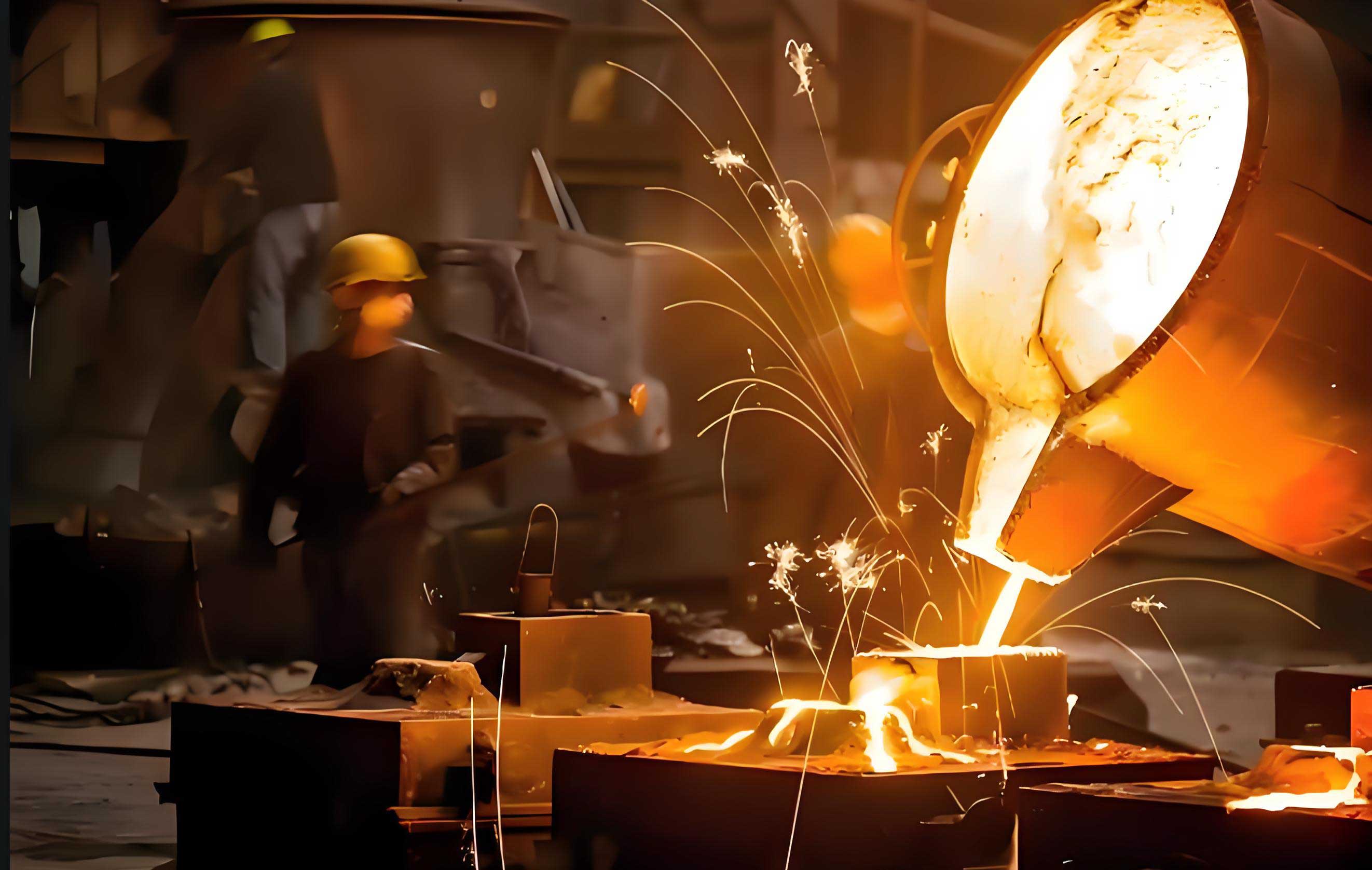
Suspension casting has been extensively applied to various wear-resistant materials, significantly improving their performance. In chromium white cast iron, which is widely used for its excellent wear resistance, suspending agents like chromium-iron powders refine carbide distribution. For low-chromium white cast iron (Cr < 5.0%), eutectic carbides transition from continuous networks to isolated particles, enhancing toughness and wear resistance. Studies show that adding 2.0–2.5% of 89% Cr-Fe suspending agent in expendable pattern casting (EPC) improves relative wear resistance by 35% and impact toughness by 24.5%. For high-chromium white cast iron (Cr > 12.0%), suspending agents such as 66% Cr-Fe at 1.5% addition reduce carbide size and increase impact toughness by 20–30%. In hypereutectic high-chromium iron (20% Cr), 2.1% high-carbon steel suspending agent refines primary carbides from 30 μm to 5.7 μm, doubling impact toughness. Medium-chromium white cast iron, though less studied, shows potential for similar improvements through this foundry technology.
| Material Type | Cr Content (%) | Suspending Agent | Addition (%) | Particle Size (mesh) | Wear Resistance Improvement | Impact Toughness (J/cm²) | Hardness (HRC) |
|---|---|---|---|---|---|---|---|
| Low-Cr Iron | 1.5–2.5 | 89% Cr-Fe | 2.0 | 40–60 | 35% increase vs. conventional EPC | 6.45 | 54.4 |
| High-Cr Iron | 16–18 | 66% Cr-Fe | 1.5 | 70–140 | 20% increase | 7.6 | — |
| High-Cr Iron | 13.95 | 98.84% Fe | 1.0 | 100–250 | 88.2% service life increase | 3.91 | 65.2 |
| Hypereutectic High-Cr Iron | 20 | High-carbon steel | 2.1 | 80–200 | — | 5.5 | — |
| High-Cr Iron Composite | 27.7 | WC particles | 7.0 | 40 | 3.04 times higher | 6.01 | 42.5 |
In tungsten cast iron, suspension casting addresses brittleness caused by shrinkage defects. Using a mixture of 90% pure iron powder and 10% tungsten-iron powder (2% addition, 35–80 mesh) refines the microstructure into fine equiaxed crystals, increases density by 2.083%, and improves impact toughness by 26.7% to 3.8 J/cm². Wear resistance under high-stress abrasive conditions enhances by 15.3–18.7%. For wear-resistant steels like high-manganese steel, suspending agents (e.g., iron powder with deoxidizers) added at 4.5–6.0% refine austenitic grains, increasing hardness from 207 HB to 255 HB and wear resistance by 85%. In ZG35 cast steel, 2.5% iron powder reduces shrinkage porosity volume by 39.2%, while in GCr15 bearing steel, suspension casting improves segregation and reduces defects. Lightweight wear-resistant aluminum alloys, such as high-silicon aluminum (20–35% Si), benefit from suspending agents of the same composition, which refine primary silicon crystals. For Al-5Fe alloys, adding 15% Al-Fe suspending agent increases hardness by 22.89% and wear resistance by 34.8% by transforming coarse needle-like phases into short rods or spheres.
Suspension casting has also been integrated into composite material production. For instance, iron- or steel-based composites incorporate reinforcing particles like SiC, Al₂O₃, or TiB₂ through suspending agents made from intermediate composites. This approach avoids particle floating due to density differences and ensures uniform distribution. In B₄C-QT500-7 composites, wear resistance improves, though FeB-Q235 composites show superior performance. Similarly, in aluminum matrix composites with 5% fly ash, adding 3% suspending agent at 800°C increases hardness by 13.10% and wear resistance by 20.10%. However, excessive suspending agents can lead to defects like inclusions and stress concentration, highlighting the need for optimized parameters in this foundry technology.
The innovation in suspension casting lies in its combination with other advanced foundry technologies. Lost foam-suspension casting integrates suspending agents into expandable polystyrene (EPS) patterns, addressing issues like coarse structures and carbon defects in EPC. For example, pre-placing chromium-iron suspending agents in EPS models refines low-chromium white iron, increasing impact toughness to 5.9 J/cm² and hardness to 54.5 HRC. Electromagnetic-suspension casting employs electromagnetic stirring to enhance suspending agent dispersion in molten metal. In magnesium alloys, adding 2% magnesium powder (150 μm) with 2-minute electromagnetic stirring reduces grain size to 57.5 μm, improving tensile strength by 20%, yield strength by 30%, and elongation by 50%. These hybrid approaches overcome challenges like poor wettability, non-uniform mixing, and oxidation, which are common in traditional suspension casting. The optimization of parameters—such as addition amount, particle size, pouring temperature, and stirring time—is crucial for maximizing the benefits of this foundry technology.
Despite its advantages, suspension casting faces several challenges in wear-resistant material production. First, most studies focus on empirical parameter optimization rather than underlying mechanisms, such as the interactions between suspending agents and molten metal during solidification. Future research should investigate nucleation and growth kinetics using advanced modeling techniques. Second, combined processes like lost foam- or electromagnetic-suspension casting require deeper exploration of parameter interactions and equipment design. For instance, the optimal electromagnetic field intensity for stirring remains underexplored. Third, computational modeling of suspension casting is scarce; simulating fluid flow, heat transfer, and particle distribution could predict casting quality and reduce costs. Lastly, suspending agent oxidation and gas entrapment need mitigation through protective atmospheres or optimized addition systems. Addressing these issues will advance suspension casting as a sustainable foundry technology for high-performance wear-resistant materials.
In conclusion, suspension casting is a versatile foundry technology that significantly enhances the microstructure and mechanical properties of wear-resistant materials. By refining carbides in cast irons, improving toughness in steels, and enhancing lightweight alloys, it extends component service life and reduces economic losses. The integration with lost foam and electromagnetic stirring further expands its applications. However, mechanistic studies, parameter optimization, and computational modeling are essential for future development. As industries strive for efficiency and sustainability, suspension casting will continue to play a pivotal role in advancing wear-resistant material foundry technology.