
In my extensive experience within the manganese steel casting foundry industry, the challenges associated with traditional riser-based casting methods for high manganese steel (HMS) have long been a focal point of technical innovation. High manganese steel, renowned for its exceptional work-hardening capability, high impact toughness, and superior wear resistance, is indispensable for manufacturing critical wear-resistant components such as liner plates, jaw plates, and hammer heads. However, its pronounced casting shrinkage and low thermal conductivity necessitate large risers, leading to complexities in cutting, increased production costs, and logistical inefficiencies. Through years of research and practical application, our manganese steel casting foundry has pioneered and implemented a comprehensive riserless casting approach. This methodology, centered on controlled low-temperature pouring and optimized gating design, has revolutionized our production processes, yielding significant improvements in quality, efficiency, and cost-effectiveness. This article delves into the metallurgical rationale, detailed technical measures, and tangible benefits of riserless casting for high manganese steel components.
The foundational step in mastering riserless casting lies in a deep understanding of the unique properties of high manganese steel. Typically conforming to ASTM A128 or similar standards, HMS is a high-alloy steel with a nominal composition of 1.0-1.4% carbon and 11-14% manganese. This composition grants it an austenitic structure at room temperature after solution heat treatment (water quenching). The key characteristics influencing its casting behavior can be summarized as follows:
| Property | Typical Value for HMS | Comparison with Carbon Steel | Implication for Casting |
|---|---|---|---|
| Liquidus Temperature | ~1400°C | Similar | Dictates pouring range |
| Solidification Range | Narrow (~30-50°C) | Narrower than many alloys | Promotes directional solidification |
| Fluidity | Excellent | Superior | Allows for low-temperature pouring |
| Volumetric Shrinkage | High (~6-8%) | ~1.5 times higher | Traditionally requires large risers |
| Linear Shrinkage | ~2.5-3.0% | ~1.5 times higher | Requires pattern allowance |
| Thermal Conductivity | Low (~12 W/m·K) | ~1/3 of carbon steel | Slows heat dissipation, increases hot tearing risk |
| As-Cast Structure | Carbides in austenite matrix | Brittle | Requires heat treatment for toughness |
The high volumetric shrinkage, represented theoretically by the solidification contraction coefficient $$ \beta = \frac{V_l – V_s}{V_l} $$ where \( V_l \) is the liquid volume and \( V_s \) is the solid volume, is a primary driver for riser use. For HMS, \( \beta \) can approach 0.08. Simultaneously, the low thermal conductivity, quantified by Fourier’s law $$ q = -k \nabla T $$ where \( k \) is the thermal conductivity, impedes heat extraction, promoting columnar grain growth and thermal stresses. The traditional reliance on massive risers, often accounting for 40-60% of the total poured weight, created downstream bottlenecks in cutting and heat treatment within the manganese steel casting foundry.
The core principle enabling riserless casting is the strategic exploitation of HMS’s excellent fluidity and narrow freezing range to minimize liquid contraction and utilize the gating system for feeding. The total volume deficit requiring compensation, \( V_{shrink} \), can be expressed as: $$ V_{shrink} = V_{casting} \cdot \beta \cdot f_s $$ where \( V_{casting} \) is the casting volume and \( f_s \) is the solid fraction factor. By pouring at temperatures barely above the liquidus, the liquid contraction phase is drastically reduced. Furthermore, the solidification morphology shifts towards a more simultaneous or controlled directional pattern, reducing the isolated hot spots that demand extensive feeding. The gating system is designed to act as a feeder channel during pouring and the initial stages of solidification. This paradigm shift from “massive external feeding” to “distributed internal feeding via controlled solidification” forms the bedrock of our riserless methodology in the manganese steel casting foundry.
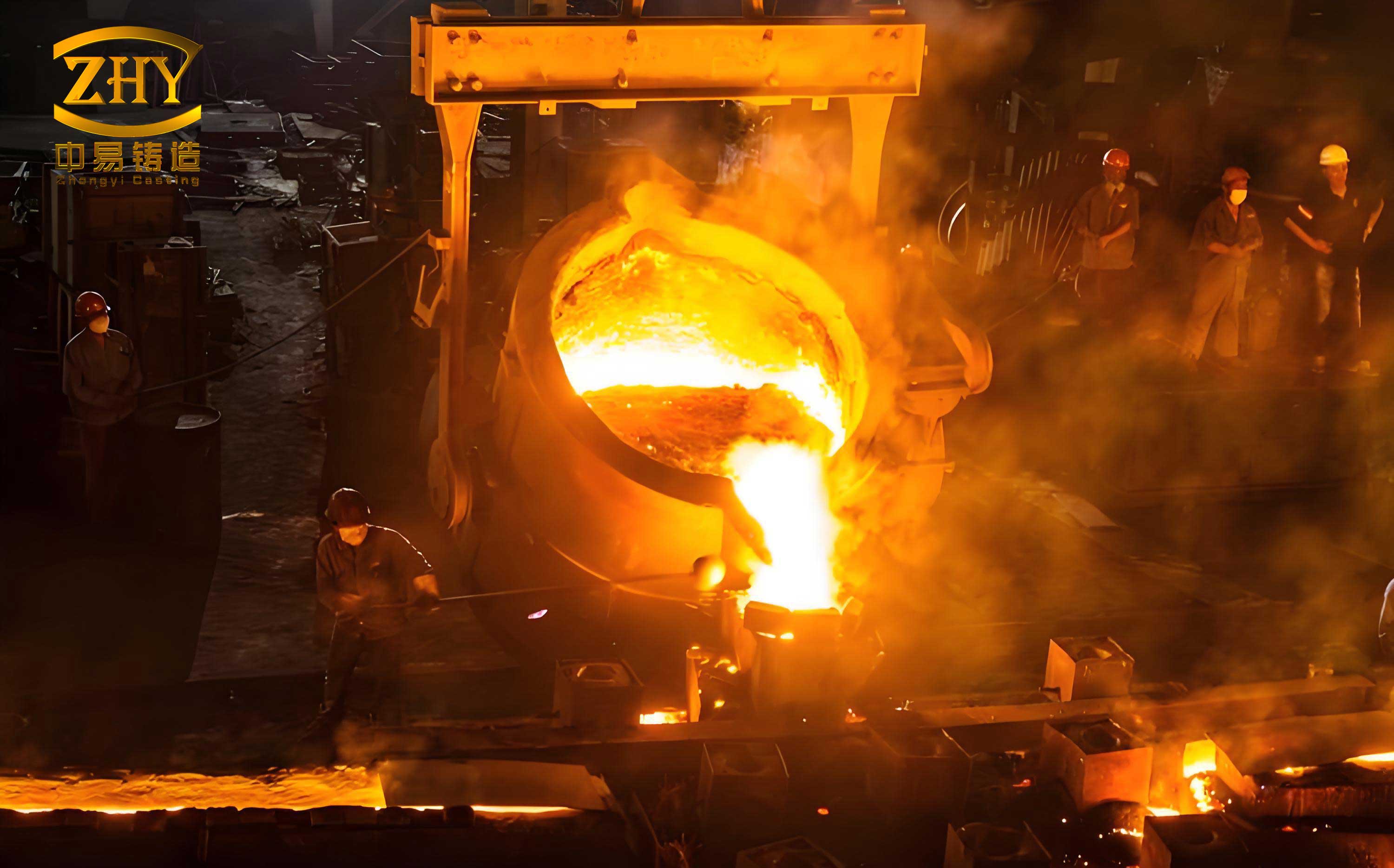
Implementing riserless casting requires a holistic set of interlinked technical measures, meticulously applied based on component geometry. The strategy diverges for thin-section and thick-section castings.
For Castings with Wall Thickness ≤ 80mm: The principle of simultaneous solidification is employed. Multiple ingates are uniformly distributed along one side or the perimeter of the casting. This design minimizes thermal gradients and leverages the distributed metal streams for interdendritic feeding. The cross-sectional area of the ingate is critical; it is typically designed to be 50-70% of the local casting wall thickness, within a range of 8-15mm. This ensures adequate feeding pressure while allowing the brittle as-cast portion to be easily knocked off after solidification. The sprue and runner are oversized to act as a thermal reservoir. The runner’s modulus \( M_{runner} \) is designed to be greater than the casting’s modulus \( M_{casting} \) at the connection points to delay its solidification: $$ M = \frac{V}{A} $$ where \( V \) is volume and \( A \) is cooling surface area. Practically, sprue diameter is increased by 20-30%, and runner height is increased by 25-40% compared to conventional carbon steel designs.
For Castings with Wall Thickness > 80mm: Complete riser elimination may be impractical. Here, we use specialized “knock-off” or washburn risers with refractory washburn cores. The core, typically 6-10mm thick, is made from a high-insulating ceramic material. The key is to pour directly through this riser, superheating the core and creating a thermally efficient feeding channel. The riser’s size is minimized using the modulus extension principle. After solidification but before heat treatment, these risers are easily removed with a hammer blow due to the notch effect and the brittleness of the as-cast HMS at the thin core section.
Critical Control of Pouring Temperature: This is the most vital parameter in riserless casting for manganese steel. The target is to pour as low as possible while maintaining complete mold filling. We have established rigorous protocols based on casting weight and section thickness, as detailed below:
| Casting Weight (kg) (including gating) | Average Wall Thickness (mm) | Optimal Pouring Temperature (°C) |
|---|---|---|
| ≤ 100 | ≤ 30 | 1380 – 1400 |
| 100 – 500 | 30 – 50 | 1360 – 1380 |
| ≥ 500 | ≥ 50 | 1340 – 1360 |
Temperature control is achieved through dedicated methods. For large batches (>500kg), we use pre-heated ladle furnaces or holding furnaces to precisely manage superheat. For smaller lots, transfer ladles are employed, and temperature is regulated by allowing holding time (cooling rate ~15-20°C/min) or by adding small, preheated HMS scrap chips to the stream. Temperature monitoring combines empirical methods like the “slag skin test” with direct pyrometer measurements.
Precision Pouring Speed and Post-Pour Supplementation: Pouring kinetics are meticulously controlled. Except for very thin sections (<20mm) requiring fast fill to avoid mistruns, a generally slow pour is adopted. The operational mantra is: “Start fast, stabilize, end slow, and supplement.” The initial pour is rapid to quickly cover the mold bottom and avoid cold laps. Once the metal has risen 20-30mm, the speed is reduced to a steady, uninterrupted stream to minimize turbulence. As the mold nears fullness, the pour rate is slowed further to allow maximal feeding from the gating system. Finally, after a brief pause of 10-30 seconds, one or two supplemental pours are added to the sprue/riser top to counter the final stage shrinkage. For heavy castings, an insulating exothermic compound (e.g., carbonized rice hulls) is added atop the feeding head after the final pour to enhance thermal efficiency.
Enhanced Mold Ventilation: To prevent gas entrapment—a risk exacerbated by slower pouring—mold permeability is maximized. Beyond standard venting, we design the gating to have one end as the pour point and the opposite end as an open vent or large exhaust channel. This ensures a smooth, laminar front advance and allows gases to escape freely, which is crucial for integrity in riserless manganese steel casting foundry operations.
The application of this integrated riserless system has been extensively validated across our product range. Components like cone crusher mantles, jaw crusher plates up to 800kg, and large grinding mill liners have been successfully produced. The microstructural benefits are pronounced. Low-temperature pouring refines the as-cast austenitic grain structure, suppresses the formation of continuous carbide networks at grain boundaries, and minimizes columnar crystal zones. This results in a more homogeneous structure post-heat treatment, with enhanced toughness and reduced susceptibility to cracking during water quenching. The elimination of large risers also means the heat treatment cycle can be optimized, often reducing the holding time at the critical 650°C precipitation range by 30-50%, further saving energy and reducing distortion.
The economic and operational advantages of adopting riserless casting in a manganese steel casting foundry are substantial and quantifiable. The following table contrasts key performance indicators between our former conventional process and the current riserless technology:
| Performance Metric | Conventional Process (with Large Risers) | Riserless Casting Process | Quantitative Benefit & Impact |
|---|---|---|---|
| Process Yield (Casting Weight / Total Poured Weight) | 55% – 65% | 78% – 85% | Average increase of >20 percentage points |
| Riser Removal Operation | Oxy-fuel cutting after quenching (often under water) | Knocking off in as-cast state before heat treatment | Eliminates complex, dangerous cutting; saves labor and equipment cost |
| Heat Treatment Holding Time at 650°C | 2.0 – 3.0 hours | 1.0 – 1.5 hours | Reduces energy consumption by ~35% |
| Casting Rejection Rate (primarily for shrinkage & cracks) | 5% – 8% | 2% – 3% | Quality improvement reduces waste and rework |
| Cleaning and Fettling Time | High (extensive grinding/cutting) | Low (minimal contact points) | |
| Metallurgical Quality | Risk of cut-off cracks, coarse grains | Finer grain, no thermal damage from cutting |
The financial impact is compelling. Based on our annual production volume of several thousand tons, the savings are multi-faceted. The increased yield directly saves liquid metal. For every ton of finished castings, the riserless process saves approximately 300-400kg of liquid steel, translating to significant raw material cost reduction. The elimination of post-quench cutting saves on gas, labor, and equipment maintenance. The shorter heat treatment cycle reduces natural gas or electricity consumption. A consolidated cost-saving model per metric ton of castings can be expressed as: $$ S_{total} = S_{metal} + S_{cutting} + S_{energy} + S_{rework} $$ where $$ S_{metal} = (Y_{new} – Y_{old}) \times W_{casting} \times C_{metal} $$ $$ S_{cutting} = (L_{old} \times R_{labor}) + C_{gas} $$ $$ S_{energy} = (t_{old} – t_{new}) \times P_{furnace} \times C_{energy} $$ and \( Y \) is yield, \( W \) is weight, \( C \) is cost, \( L \) is labor hours, \( t \) is time, and \( P \) is power rating. In our foundry, this sums to an average saving of over $150 per ton of castings produced, leading to annual savings exceeding $300,000, a transformative figure for operational margins in a competitive manganese steel casting foundry.
In conclusion, the transition to riserless casting for high manganese steel represents a paradigm shift grounded in a profound understanding of the alloy’s solidification physics. By prioritizing controlled low-temperature pouring, intelligent gating design that substitutes for risers, and meticulous process control, we have successfully overcome the historical drawbacks associated with this material’s large shrinkage. The benefits permeate every stage: simplified patternmaking and molding, streamlined cleaning and fettling, safer and faster heat treatment, and ultimately, a superior, more reliable casting with enhanced mechanical properties and service life. This methodology underscores the continuous innovation possible within a modern manganese steel casting foundry, turning a longstanding production challenge into a source of competitive advantage through smarter, more efficient metallurgical and engineering practices. The principles outlined here—focusing on feeding demand minimization rather than just feeding supply maximization—offer a valuable framework for advancing casting techniques for other challenging alloys as well.