
Large-scale electric shovels serve as primary excavation equipment in open-pit mining, where bucket teeth directly interact with high-hardness ores. Frequent impact loads cause tooth fracture or detachment, posing severe safety hazards and economic losses. This study integrates field investigations, numerical simulations, and electromagnetic analysis to address bucket tooth failure mechanisms and develop a real-time monitoring solution.
Hazard Source Identification in Electric Shovel Operations
Operations involve complex interactions among equipment, personnel, and environments. Hazard sources are categorized using dual-classification theory:
| Hazard Type | Specific Manifestation | Consequence |
|---|---|---|
| Mechanical Energy | Detached bucket teeth, fractured boom components | Strike injuries, equipment damage |
| Electrical Energy | Exposed high-voltage cables, motor leakage | Electrocution, fire |
| Chemical Energy | Hydraulic fluid leaks, lubricant ignition | Combustion, corrosion |
| Environmental Factors | Unstable benches, airborne dust | Slope collapse, respiratory disease |
MES Risk Assessment Methodology: Evaluates hazard severity through three parameters:
$$R = M \times E \times S$$
- Control Measure Status (M): Scored 1 (preventive), 3 (mitigative), or 5 (none)
- Exposure Frequency (E): Ranges 10 (continuous) to 1 (annual)
- Consequence Severity (S): 2 (equipment damage) to 10 (multiple fatalities)
Bucket tooth detachment scored highest (R=180), classified as Level I hazard due to absence of control measures.
Mechanism of Bucket Tooth Detachment
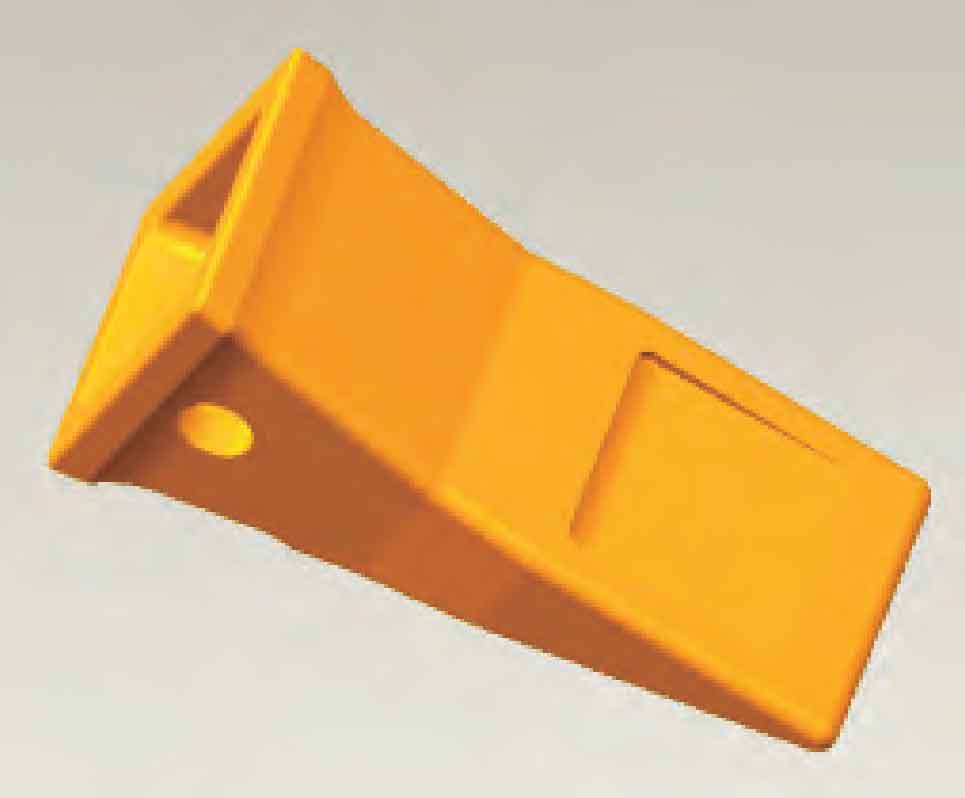
Finite element analysis using ANSYS Workbench simulated stress distribution under operational loads. The high-manganese steel bucket tooth model (ZGMn13Gr2) was subjected to 10,000N vertical load:
| Parameter | Value | Unit |
|---|---|---|
| Elastic Modulus | 2.0×10⁵ | MPa |
| Poisson’s Ratio | 0.3 | – |
| Yield Strength | 390 | MPa |
| Tensile Strength | 735 | MPa |
Stress concentration factors were identified at critical zones:
$$\sigma_{max} = \sqrt{\frac{(\sigma_1 – \sigma_2)^2 + (\sigma_2 – \sigma_3)^2 + (\sigma_3 – \sigma_1)^2}{2}} = 25.108 \text{ MPa}$$
Maximum stress occurred at pin holes and tooth-adapter interfaces, initiating fatigue cracks. Failure modes include:
- Complete detachment: Pin shear failure due to loosening
- Partial fracture: Crack propagation at stress-concentrated zones
2.4GHz Wireless Bucket Tooth Loss Alarm System
A three-module system was developed for real-time monitoring:
| Module | Components | Function |
|---|---|---|
| Magnetic Base | NdFeB magnets (Ø25×12mm) | Generate 50mm-range magnetic field |
| Sensor Module | Reed switch, L24YK transmitter, CR2032 battery | Detect magnetic field disappearance |
| Alarm Module | Receiver, buzzer, LED indicator | Trigger visual/auditory alerts |
Electromagnetic Wave Propagation Analysis: HFSS simulated signal attenuation in mining environments. Friis transmission equation validated signal integrity at 40m:
$$P_r(dBm) = P_t(dBm) + G_t(dB) + G_r(dB) + 20\log\left(\frac{\lambda}{4\pi r}\right)$$
Where λ=0.125m (2.4GHz), r=40m, Gt=6.76dB, Gr=2.83dB. Minimum received power (-50.45dBm) exceeded receiver sensitivity (-95dBm).
Field Implementation and Validation
System deployment on WK-4C shovels confirmed:
- Sensor modules installed at high-stress zones detected 100% of detachment events
- 2.4GHz transmission remained stable despite dust/vibration
- 14-hour battery life exceeded operational requirements
Conclusion
This research establishes that bucket tooth detachment constitutes a critical Level I hazard in open-pit mining operations. Numerical analysis reveals stress concentrations at pin holes and adapter interfaces as primary failure origins. The developed wireless alarm system demonstrates reliability in harsh mining environments through:
- Strategic placement of magnetic sensing at fracture-prone zones
- Optimized 2.4GHz transmission overcoming material interference
- Effective power management enabling extended operation
Future work should incorporate dynamic load analysis and machine learning for predictive maintenance of bucket teeth. This approach significantly enhances safety management while reducing economic losses from downstream equipment damage.