
In the production of critical automotive components like crankshafts, achieving consistent and superior mechanical properties is paramount. Our focus has been on the manufacturing of a four-cylinder engine crankshaft using sand coated iron mold casting, a process known for its ability to produce dense, high-quality castings with rapid solidification characteristics. The material specification demanded a ductile iron grade QT800-2, requiring a minimum tensile strength (σb) of 800 MPa, elongation (A) ≥ 2%, a hardness range of 245–335 HBS, a nodularity rating better than grade 2, a pearlite matrix content exceeding 80%, and a graphite nodule size finer than grade 6. Despite the inherent advantages of the sand coated iron mold casting process, initial production trials revealed significant variability in the microstructural and mechanical properties of crankshafts, even within those poured from the same ladle. This inconsistency led to unacceptably low qualification rates. Our investigation pinpointed the post-casting cooling phase—specifically, the unpacking time (or temperature) and the subsequent cooling method—as the critical, yet previously overlooked, variables. This article details our systematic experimental approach to mastering this final phase of the sand coated iron mold casting process.
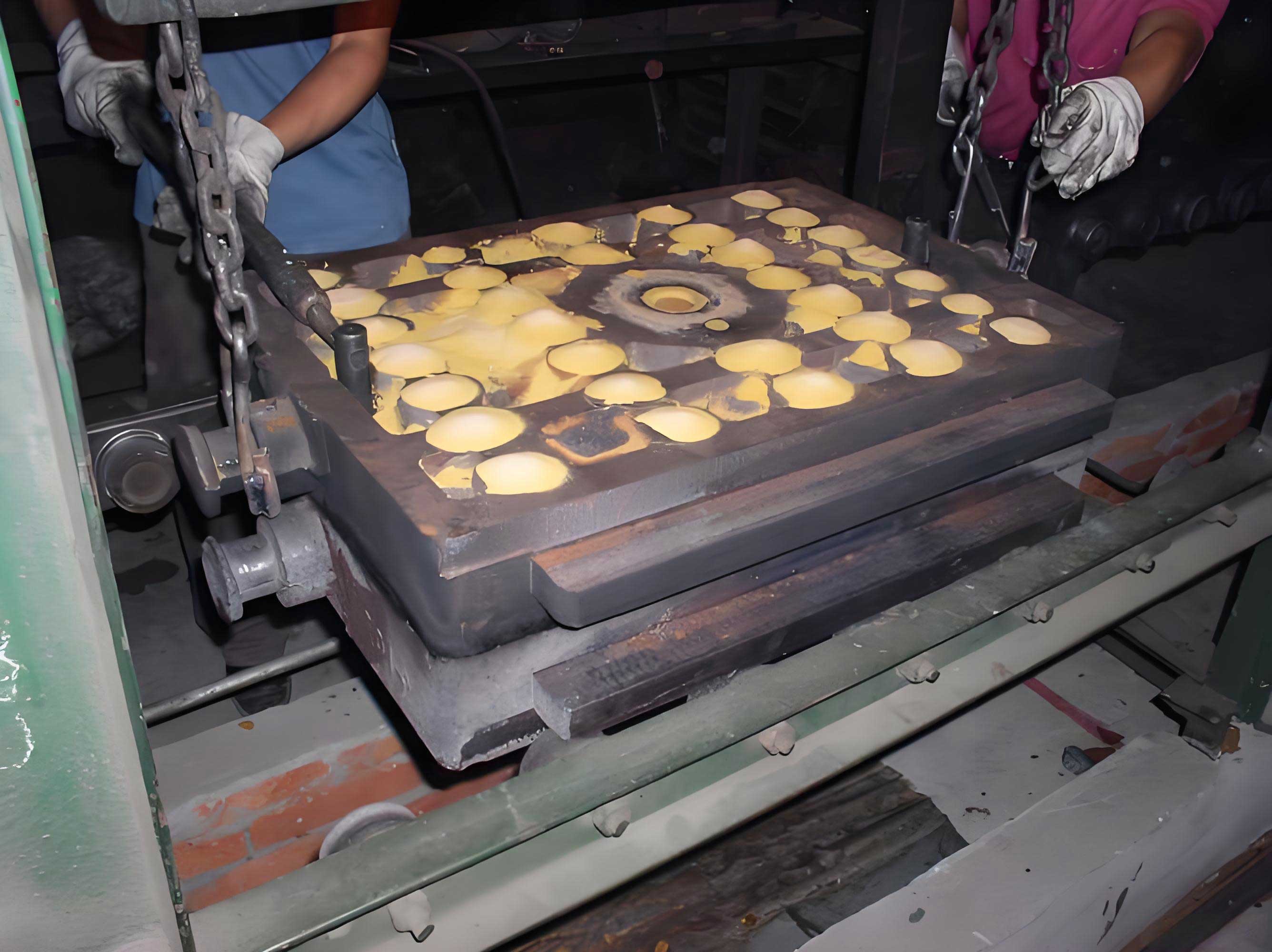
The sand coated iron mold casting process involves pouring molten ductile iron into an iron mold whose cavity is lined with a thin, precise layer of sand. This hybrid method combines the excellent heat dissipation and dimensional stability of a permanent metal mold with the flexibility and surface finish benefits of a sand mold. The rapid heat extraction by the iron mold promotes a fine, equiaxed grain structure and enhances graphite nodule count, which are foundational for high strength. However, this very rapidity also means the cooling curve post-solidification is steep and highly sensitive to external interventions. In our standard production setup, each mold contained two crankshafts, and eight molds were poured sequentially from a single ladle. The primary challenge was that after the initial solidification inside the mold, the cooling path was not controlled, leading to unpredictable microstructural transformations, primarily the austenite-to-pearlite transformation, which dictates the final pearlite content and mechanical properties.
The core issue stems from the principles of solid-state phase transformation in ductile iron. The final matrix structure is a function of the cooling rate through the critical temperature range, approximately between 750°C and 550°C (the upper and lower transformation temperatures for pearlite). The simplified kinetics can be related to the time-temperature-transformation (TTT) behavior. The progress of the pearlitic transformation, $X_p$, can be conceptually linked to temperature and time through an Avrami-type equation:
$$ X_p(t) = 1 – \exp(-k(T) \cdot t^n) $$
where $k(T)$ is a temperature-dependent rate constant, $t$ is time, and $n$ is a time exponent. A higher cooling rate shifts the transformation to lower temperatures and can refine the pearlite interlamellar spacing, increasing strength but potentially reducing ductility if driven too far. The goal in producing QT800-2 is to achieve a high pearlite fraction with a fine spacing. Therefore, controlling the cooling rate precisely after the casting has solidified but while it is still in the high-temperature transformation range is the key to consistency.
Experimental Investigation: Methodology
Our investigation was divided into two sequential phases: first, to determine the optimal cooling method after unpacking, and second, to identify the critical unpacking time/temperature window. All other process parameters—melting, nodularization, inoculation, mold coating, and pouring—were strictly standardized and controlled to isolate the effects of the cooling cycle.
Phase 1: Influence of Post-Unpacking Cooling Method
For the first phase, we fixed the unpacking temperature at a specific point and varied only the method by which the casting was cooled thereafter. We designed three distinct cooling protocols, as summarized below.
| Process ID | Unpacking Temperature (°C) | Post-Unpacking Cooling Method |
|---|---|---|
| I | ~650 | Free Air Cooling (Static Air) |
| II | ~650 | Forced Air Cooling (Industrial Fan) |
| III | ~800 | Forced Air Cooling (Industrial Fan) |
Process I represented the baseline, uncontrolled “shop floor” condition. Process II introduced active cooling at the same unpacking temperature. Process III tested the effect of unpacking at a significantly higher temperature (while still fully solid) followed by forced cooling. For each process, we conducted trials over three separate melts, resulting in a total of 48 crankshaft castings for evaluation. Tensile tests, Brinell hardness measurements, and metallographic analysis were performed on samples taken from designated locations on the crankshaft.
Phase 2: Influence of Unpacking Time/Temperature
Based on the results from Phase 1, which identified forced cooling as superior, we proceeded to optimize the unpacking parameter itself. Unpacking time directly correlates with the temperature of the casting at the moment it is removed from the sand coated iron mold casting mold. Earlier unpacking means a hotter casting, while later unpacking means a cooler one. We established a matrix of unpacking times, monitoring the corresponding surface temperature using infrared pyrometers.
| Sample Set | Unpacking Time Post-Pour (min) | Measured Unpacking Temperature (°C) | Post-Unpacking Cooling Method |
|---|---|---|---|
| A-1 / A-2 | 10 / 18 | ~725 / ~655 | Forced Air |
| B-1 / B-2 | 11 / 19 | ~727 / ~656 | Forced Air |
| C-1 / C-2 | 11 / 19 | ~719 / ~652 | Forced Air |
| D-1 / D-2 | 11 / 20 | ~705 / ~645 | Forced Air |
This design allowed us to compare the properties of castings unpacked at “early/hot” conditions versus “late/cool” conditions, all subjected to the same forced air cooling, across multiple production batches to ensure statistical significance.
Results and Analysis: Decoding the Cooling Impact
Findings from Cooling Method Study
The results from Phase 1 clearly demonstrated the profound impact of the cooling method within the sand coated iron mold casting process sequence.
| Process ID | Tensile Strength, σb (MPa) | Elongation, A (%) | Hardness (HBS) | Pearlite Content | Nodularity / Graphite Size |
|---|---|---|---|---|---|
| I (650°C + Air Cool) | 780.4 | 5.0 | 269 | ~80% Pearlite + Ferrite | Grade 1 / Grade 6 |
| II (650°C + Forced Cool) | 826.1 | 3.7 | 270 | ~85% Pearlite + Ferrite | Grade 1 / Mostly Grade 6 |
| III (800°C + Forced Cool) | 806.2 | 3.5 | 274 | ~75% Pearlite + Ferrite | Grade 1 / Grades 6-5 |
Process I (air cool) failed to meet the minimum tensile strength requirement, barely reaching 780 MPa. Its pearlite content was at the specification limit of 80%. Process II, with forced cooling at 650°C, successfully achieved the target tensile strength (>800 MPa) while maintaining acceptable elongation and pushing the pearlite content to 85%. Process III, despite the forced cooling, resulted in a lower pearlite fraction (75%) and a corresponding dip in tensile strength. This can be explained by the unpacking temperature of 800°C. At this temperature, the casting is still well above the pearlite transformation start temperature. The subsequent forced cooling, while fast, may not have been sufficiently rapid to fully suppress the formation of some ferrite or to complete the pearlite transformation with the finest possible spacing before the temperature fell below the transformation range. The high thermal mass and the initial temperature gradient might have allowed for a brief period of slower cooling in the core. The relationship between cooling rate ($\dot{T}$), transformation temperature ($T_{trans}$), and resulting interlamellar spacing ($\lambda$) in pearlite is often approximated by the Zener-Hillert equation:
$$ \lambda \propto \frac{1}{\dot{T}} $$
A higher cooling rate $\dot{T}$ results in a finer spacing $\lambda$, which increases strength according to the Hall-Petch type relationship for pearlite:
$$ \sigma_y = \sigma_0 + \frac{k_y}{\sqrt{\lambda}} $$
where $\sigma_y$ is the yield strength, $\sigma_0$ is a friction stress, and $k_y$ is a strengthening coefficient. Process II likely achieved the optimal combination: unpacking at a temperature where the casting was ready to transform, then applying a forced cooling rate sufficient to refine the pearlite and maximize its volume fraction.
Findings from Unpacking Time/Temperature Study
The data from Phase 2 provided the precise window for optimal unpacking. The results consolidated from multiple sample sets are presented below.
| Sample Condition (Time/Temp) | Avg. Tensile Strength, σb (MPa) | Avg. Elongation, A (%) | Avg. Hardness (HBS) | Typical Pearlite Content |
|---|---|---|---|---|
| Early Unpacking (11-12 min, ~700-720°C) | 832 – 870 | 3.5 – 4.6 | 255 – 275 | 80% – 90% |
| Late Unpacking (18-20 min, ~645-655°C) | 790 – 830 | 4.8 – 6.1 | 255 – 278 | 70% – 80% |
The trend is unequivocal. Castings unpacked in the “early/hot” window, specifically between 11 to 14 minutes after pouring corresponding to a temperature range of approximately 680°C to 710°C, consistently exhibited tensile strengths above the 800 MPa threshold, with many samples exceeding 850 MPa. Their elongation remained within the acceptable specified range (≥2%), typically between 3.5% and 5.0%. Crucially, the pearlite content reliably fell within or above the target of >80%.
In contrast, castings unpacked later, at lower temperatures (~645-655°C), showed greater variability and a clear tendency towards lower strength and higher elongation. The lower strength is directly correlated with the lower pearlite content (often only 70-75%). This occurs because by the time the casting cools to 650°C inside the well-insulating sand coated iron mold casting mold, a significant portion of the pearlite transformation may have already occurred under a relatively slow, uncontrolled cooling rate dictated by the mold’s thermal mass. The forced cooling applied after unpacking at this point has little effect on the already-transformed microstructure; it merely cools the casting faster to room temperature. The resulting pearlite is coarser, and the larger fraction of softer ferrite increases ductility at the expense of strength.
The optimal window of 680-710°C represents a thermal “sweet spot.” At this temperature, the casting is below the solidus and fully solid, yet still high enough within the pearlite transformation range that the transformation is not yet advanced. Removing it from the mold at this point and immediately applying forced air cooling allows us to impose a new, steeper cooling curve ($\dot{T}_{forced}$) on the entire casting volume uniformly. This accelerates and refines the remaining austenite-to-pearlite transformation, maximizing the pearlite fraction with a fine interlamellar spacing, thereby achieving the desired strength profile of QT800-2. The process can be summarized by comparing the critical cooling rate integrals. The effective cooling rate influencing transformation is the average rate between the unpacking temperature $T_u$ and a lower threshold like 550°C:
$$ \dot{T}_{eff} = \frac{(T_u – 550)}{\Delta t_{550}} $$
where $\Delta t_{550}$ is the time taken to cool from $T_u$ to 550°C. Forced cooling minimizes $\Delta t_{550}$, maximizing $\dot{T}_{eff}$.
Conclusion and Industrial Implementation
This systematic investigation into the sand coated iron mold casting process for crankshafts underscores that process control does not end at pouring. The post-solidification cooling cycle is a critical metallurgical processing step that dictates the final as-cast properties. Our trials conclusively proved that uncontrolled cooling leads to inconsistent, often sub-standard, microstructures and performance.
The optimized and now standardized production parameters derived from this work are:
- Unpacking Time: 11 to 14 minutes after pouring.
- Corresponding Unpacking Temperature: 680°C to 710°C.
- Post-Unpacking Cooling Method: Immediate forced air cooling using high-volume industrial fans.
This protocol ensures that every crankshaft produced via the sand coated iron mold casting route undergoes a consistent and optimized thermal history. The results have been transformative for production. The as-cast crankshafts now consistently meet all QT800-2 specifications: tensile strength ≥800 MPa (typically 820-870 MPa), elongation between 3-6%, hardness within the 245-335 HBS range, pearlite content consistently between 80-95%, and excellent nodularity. This eliminates the need for a subsequent costly and energy-intensive austenitizing heat treatment (quenching and tempering) solely to achieve the required strength and pearlite content, although stress relieving may still be employed.
The implementation of this controlled cooling strategy has dramatically increased the production qualification rate, ensuring batch-to-batch consistency. Fatigue testing on crankshafts produced with this optimized sand coated iron mold casting and cooling cycle has confirmed their reliability, leading to strong market acceptance. Mastering this final phase of the process has proven to be a key factor in leveraging the full potential of sand coated iron mold casting technology, delivering high-performance cast components in a cost-effective and reliable manner, thereby creating substantial economic benefit for the manufacturing operation.