
In the field of aero-engine design, the accessory gearbox housing plays a critical role in transmitting power to various subsystems such as fuel pumps, oil pumps, and generators. These housings, typically composed of front and rear sections, are large, thin-walled structures manufactured through casting processes. However, during service, deformation has been observed in these shell castings, particularly around bearing bore positions, leading to issues like misalignment and dimensional inaccuracies. Based on literature and empirical evidence, a primary contributor to this deformation is the residual stress generated during the casting process, which gradually releases under operational conditions, causing dimensional instability. This study focuses on the front housing of an accessory gearbox, aiming to investigate the magnitude and distribution of residual stress post-casting through a combination of experimental measurement and numerical simulation. Furthermore, an optimization technique—the hot-state spectral harmonic method—is applied to reduce and homogenize these stresses, thereby mitigating deformation risks. The insights gained are pivotal for enhancing the reliability and longevity of such shell castings in demanding aerospace applications.
Shell castings, due to their complex geometries and thin-walled nature, are inherently prone to residual stress accumulation during solidification and cooling. These stresses arise from thermal gradients, phase transformations, and mechanical constraints imposed by molds and cores. In the context of accessory gearbox housings, residual stress can lead to distortion over time, affecting critical tolerances and gear meshing performance. Therefore, understanding and controlling residual stress is essential. This work employs a multidisciplinary approach, integrating non-destructive testing with advanced finite element analysis to map residual stress fields. The simulation results are validated against experimental data, ensuring accuracy. Subsequently, a novel stress-relief technique is evaluated for its efficacy. Throughout this discussion, the term “shell castings” will be emphasized to underscore the broader applicability of these findings to similar cast components in engineering.
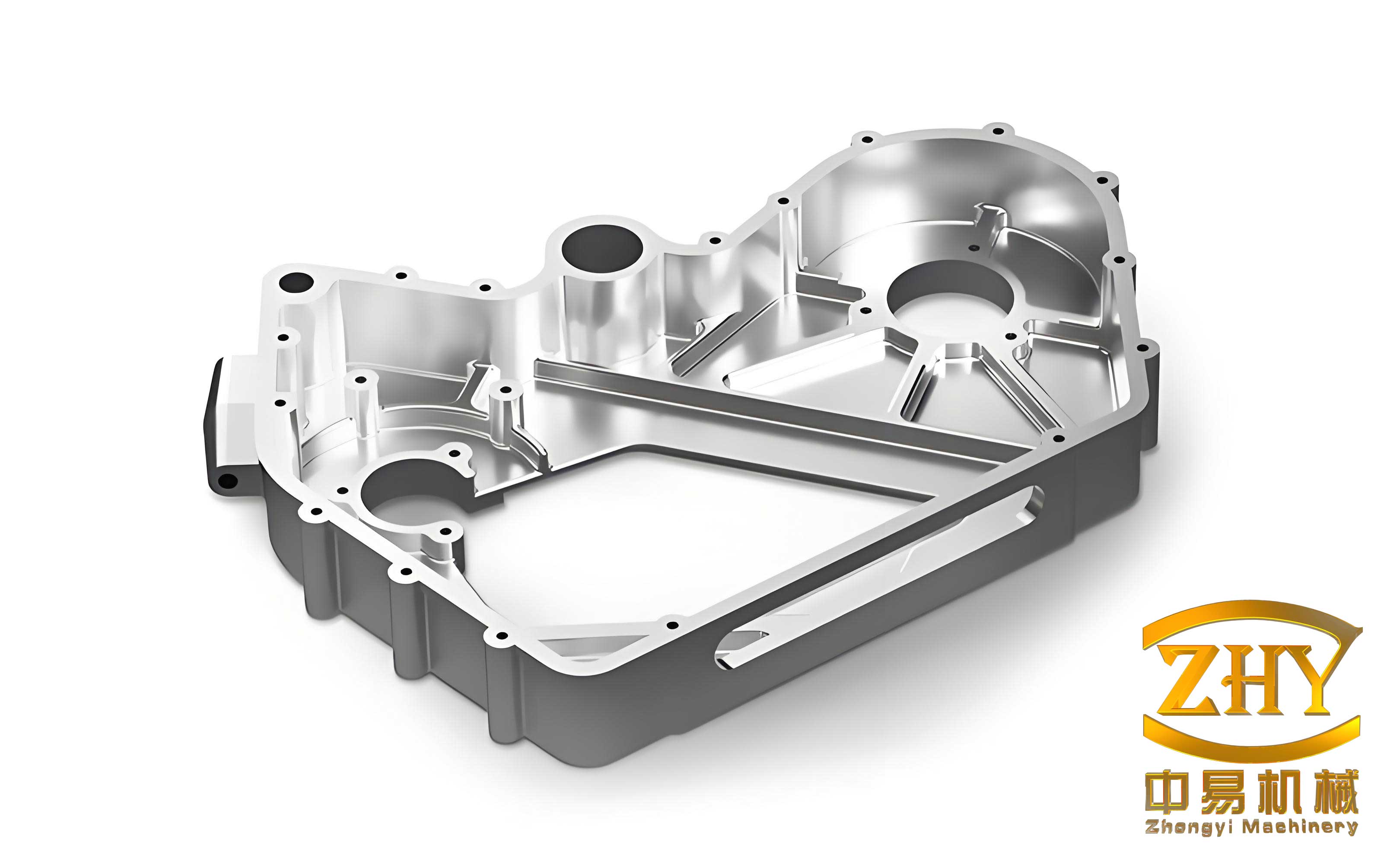
The investigation begins with the experimental measurement of residual stress in the front housing shell castings. Non-destructive evaluation is preferred to preserve component integrity. The X-ray diffraction (XRD) method is utilized, based on Bragg’s law, which relates the diffraction angle to lattice spacing changes induced by stress. The fundamental equation is:
$$n\lambda = 2d \sin\theta$$
where $\lambda$ is the X-ray wavelength, $d$ is the interplanar spacing, $\theta$ is the diffraction angle, and $n$ is an integer. When residual stress is present, the strain $\epsilon$ in a given direction alters $d$, leading to a shift in $\theta$. The stress $\sigma$ can be derived using elasticity theory. For a biaxial stress state, the relationship is expressed as:
$$\sigma_\phi = \frac{E}{1+\nu} \left( \frac{\partial \epsilon_\phi}{\partial \sin^2 \psi} \right)$$
where $E$ is Young’s modulus, $\nu$ is Poisson’s ratio, $\phi$ is the azimuthal angle, and $\psi$ is the tilt angle. A portable stress analyzer with a mechanical cantilever structure was employed to ensure precise positioning and high accuracy. Given the complexity of shell castings, 36 measurement points were selected across the front housing, with emphasis on bearing bore regions and other locations suspected of high stress concentration. The table below summarizes key measurement parameters and a subset of point locations.
| Measurement Point ID | Location on Shell Castings | Approximate Residual Stress (MPa) | Remarks |
|---|---|---|---|
| P1 | Bearing Bore A – Upper Rim | 58.2 | High stress concentration |
| P2 | Bearing Bore B – Lower Flange | 52.7 | Moderate stress |
| P3 | Side Wall Transition Zone | 67.3 | Stress hotspot |
| P4 | Mounting Ear Interface | 48.9 | Lower stress |
| P5 | Central Web Area | 41.5 | Relatively uniform |
| … (up to P36) | Various positions | Range: 35-70 MPa | Overall distribution |
The measured stresses varied significantly, highlighting the inhomogeneous nature of residual stress in these shell castings. However, experimental methods are limited in spatial coverage and cannot provide a full-field view. To address this, a comprehensive simulation of the casting process was conducted using ANSYS software with custom-developed modules for foundry applications. The simulation encompassed filling, solidification, mold opening, and removal of gating systems (sprues, risers, etc.). The model included the sand mold, chill plates, gating channels, and the front housing geometry. Meshing was performed with tetrahedral elements, ensuring fine resolution in critical areas of the shell castings. The material properties, boundary conditions, and process parameters (e.g., pouring temperature, cooling rates) were defined based on actual production data. The governing equations for thermal-stress analysis involve coupled heat transfer and mechanical deformation:
$$\rho C_p \frac{\partial T}{\partial t} = \nabla \cdot (k \nabla T) + Q_{latent}$$
$$\nabla \cdot \boldsymbol{\sigma} + \mathbf{F} = 0$$
where $\rho$ is density, $C_p$ is specific heat, $T$ is temperature, $t$ is time, $k$ is thermal conductivity, $Q_{latent}$ is latent heat release, $\boldsymbol{\sigma}$ is the stress tensor, and $\mathbf{F}$ is body force. The simulation tracked stress evolution from initial pouring to complete cooling. The results revealed that thermal stresses developed rapidly during solidification due to uneven cooling, exacerbated by constraints from the sand mold. Over time, as temperatures equilibrated, stresses stabilized but remained elevated due to shrinkage impediments. After mold opening and removal of gating systems (simulated at ~37,200 seconds), the residual stress distribution in the shell castings was obtained, ranging from 0 to 130 MPa, with pronounced concentrations at geometric transitions and wall junctions.
To validate the simulation, the computed residual stresses at the 36 measurement points were compared against experimental values. The correlation was assessed using relative deviation metrics. The table below presents a comparison for selected points and overall statistics.
| Point ID | Measured Stress (MPa) | Simulated Stress (MPa) | Relative Deviation (%) |
|---|---|---|---|
| P1 | 58.2 | 61.5 | 5.7 |
| P2 | 52.7 | 49.8 | 5.5 |
| P3 | 67.3 | 70.1 | 4.2 |
| P4 | 48.9 | 45.2 | 7.6 |
| P5 | 41.5 | 43.7 | 5.3 |
The overall trend showed good agreement, with 75% of points exhibiting relative deviations within 0-20%. This confirms the reliability of the simulation in capturing residual stress behavior in shell castings. The full-field simulation further illustrated stress inhomogeneity, with hotspots at side-wall corners and bore peripheries. Such gradients are problematic because stress relaxation during service can induce distortion. Therefore, post-casting treatment is necessary to mitigate these effects.
Optimization of residual stress in shell castings was pursued using the hot-state spectral harmonic method, a novel technique that combines thermal conditioning with vibrational stress relief. This method applies cyclic dynamic loads at elevated temperatures to promote dislocation movement and stress redistribution. The underlying principle can be described by a modified anelastic relaxation model:
$$\sigma(t) = \sigma_0 e^{-t/\tau} + \sigma_{ss}$$
where $\sigma(t)$ is the time-dependent stress, $\sigma_0$ is initial residual stress, $\tau$ is relaxation time (temperature-dependent), and $\sigma_{ss}$ is steady-state stress after treatment. The process parameters, including temperature, frequency spectrum, and excitation duration, were optimized for the front housing shell castings. Measurements were taken before and after treatment across the same 36 points. The results demonstrated a significant reduction in residual stress. The following table summarizes the key outcomes.
| Parameter | Before Treatment | After Treatment | Reduction/Homogenization Rate (%) |
|---|---|---|---|
| Mean Residual Stress (MPa) | 54.7 | 42.6 | 22.2 |
| Peak Residual Stress (MPa) | 66.6 | 57.9 | 13.1 |
| Standard Deviation (MPa) | 8.4 | 7.2 | 14.0 |
The hot-state spectral harmonic method effectively lowered the mean residual stress by 22.2% and the peak stress by 13.1%, while also improving homogeneity (as indicated by reduced standard deviation). This treatment is particularly beneficial for complex shell castings, as it addresses stress concentrations without inducing additional distortions. The mechanism involves the superposition of harmonic vibrations at resonant frequencies, which enhances plastic strain accumulation in high-stress zones. The temperature elevation (typically 150-200°C for aluminum alloys) further accelerates stress relaxation by increasing atomic mobility. The combined effect can be modeled as:
$$\epsilon_{plastic} = A \sum_{i=1}^{n} f_i \sin(2\pi \omega_i t) e^{-Q/RT}$$
where $A$ is an amplitude factor, $f_i$ and $\omega_i$ are frequency components, $Q$ is activation energy, $R$ is gas constant, and $T$ is absolute temperature. This approach represents a significant advancement over traditional thermal aging or shot peening for shell castings.
In conclusion, this study comprehensively analyzed residual stress in accessory gearbox front housing shell castings through experimental measurement and numerical simulation. The simulation, validated by X-ray diffraction data, provided a detailed map of stress distribution, revealing inhomogeneities and hotspots typical of such cast components. The application of the hot-state spectral harmonic method proved highly effective in reducing and homogenizing residual stresses, thereby minimizing the risk of service-induced deformation. These findings underscore the importance of integrated simulation and optimization in the manufacturing of high-integrity shell castings for aerospace applications. Future work could explore the long-term stability of treated components under cyclic loading and extend these techniques to other alloy systems. Ultimately, mastering residual stress control is key to enhancing the performance and durability of shell castings across industries.