
In the production of high-grade ductile iron crankshafts, such as those meeting QT800-2 specifications, the occurrence of slag inclusion defects on machined surfaces poses a significant quality challenge. These defects, often manifesting as point-like or crack-like inclusions on critical areas like oil hole edges and fillet radii, can lead to part rejection due to compromised fatigue strength and durability. As a practitioner involved in casting process management and quality control, I have extensively investigated the root causes of slag inclusion defects and implemented targeted solutions. This article delves into a comprehensive analysis of the issue, emphasizing process optimizations, material controls, and corrective actions, with the aim of providing insights for reducing slag inclusion defect rates in industrial settings. The keyword ‘slag inclusion defect’ will be frequently referenced to underscore its centrality in this discussion.
The manufacturing process for high-grade ductile iron crankshafts involves several meticulous steps, each influencing the final product’s integrity. Initially, molding is conducted using alkaline phenolic resin self-setting sand, which offers good dimensional stability and collapsibility. The pattern is typically split into upper and lower halves, with complex features formed using chill sand cores. This method streamlines production but requires careful control to avoid sand-related inclusions. Melting is performed in medium-frequency induction furnaces, where charge materials—including pig iron, scrap steel, returns (from crankshaft or vermicular iron), and alloys like ferrosilicon and ferromanganese—are meticulously proportioned. The base iron composition is tightly controlled to minimize harmful elements, as outlined in Table 1.
| Element | C | Si | Mn | S | P |
|---|---|---|---|---|---|
| Content | 3.6–3.8 | 1.2–1.5 | ≤0.6 | ≤0.022 | ≤0.06 |
This control is crucial because impurities can exacerbate slag formation. After tapping, treatment involves wire feeding with magnesium-bearing wire (e.g., 20% Mg) and inoculating wire to promote nodular graphite formation. Alloying elements like copper and antimony are added to enhance pearlite formation, resulting in the final casting composition shown in Table 2.
| Element | Si | Cu | Sb | Mg | RE |
|---|---|---|---|---|---|
| Content | 2.0–2.4 | 0.5–0.6 | 0.01–0.02 | 0.030–0.045 | 0.005–0.020 |
Pouring is carried out using automatic pouring machines with teapot ladles to minimize slag entrainment, at temperatures between 1380°C and 1400°C. To counteract inoculation fading and refine graphite, a secondary inoculation with silicon-zirconium is applied during pouring, with addition rates of 0.08% to 0.12%. The casting orientation is adjusted post-pour to upright positioning for effective feeding, with a target time of less than 100 seconds from pouring to upright placement. Subsequent processing includes shakeout after 24 hours, cleaning, and heat treatment—typically austenitizing at around 900°C followed by air cooling to transform the matrix into fine pearlite, thereby improving mechanical properties.
Despite these controlled steps, slag inclusion defects persist, often revealed only after machining and polishing. To understand their nature, scanning electron microscopy (SEM) and energy-dispersive spectroscopy (EDS) were employed on defect sites. The analysis consistently showed elevated levels of oxygen, silicon, magnesium, and aluminum at inclusion sites, indicative of oxide and sulfide formations. For instance, a typical slag inclusion defect might consist of MgO, SiO₂, and Al₂O₃ compounds, which form through reactions during molten metal handling or solidification. The presence of these elements aligns with the thermodynamic tendencies in ductile iron systems, where residual magnesium can react with oxygen or sulfur to generate inclusions. The formation of such slag inclusion defects can be described by reactions like:
$$2Mg + O_2 \rightarrow 2MgO$$
$$Mg + S \rightarrow MgS$$
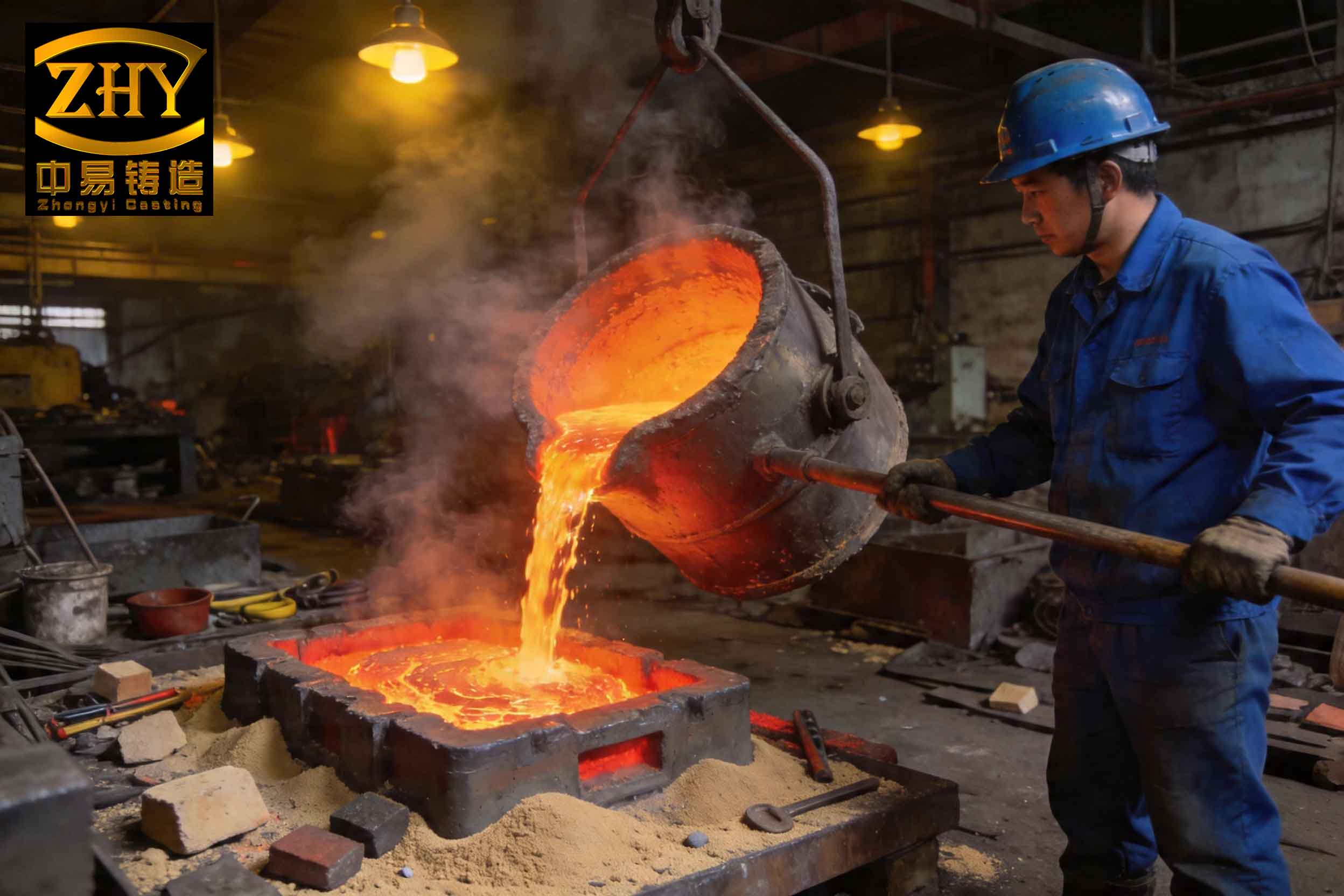
These reactions are influenced by factors such as melt chemistry, pouring conditions, and cooling rates. To visually represent the typical morphology of a slag inclusion defect, the following image is provided:
Slag inclusion defects are broadly categorized into primary and secondary types. Primary slag inclusions arise from inadequate slag removal after treatment or poor gating system design, allowing reaction products to enter the mold cavity. These are relatively easier to address through better ladle skimming and filter usage. However, secondary slag inclusions are more prevalent in our experience; they form during mold filling due to oxidation of the iron or reactions between melt elements and mold/core materials. Secondary inclusions often comprise oxides (e.g., MgO, SiO₂, Al₂O₃) and sulfides (e.g., MgS), whose formation kinetics can be modeled using equations like the Arrhenius relationship for reaction rates:
$$k = A e^{-E_a / (RT)}$$
where \(k\) is the rate constant, \(A\) the pre-exponential factor, \(E_a\) the activation energy, \(R\) the gas constant, and \(T\) the temperature. In practice, factors such as high residual magnesium content, sulfur levels, and turbulent flow exacerbate secondary slag inclusion defect formation.
To tackle these issues, we focused on three key areas: control of sulfur and residual magnesium content, raw material management, and mitigation of crankshaft bending. First, residual magnesium content was identified as a critical variable. While necessary for nodular graphite formation, excessive magnesium increases the risk of magnesium-based inclusions. Historical data showed that residual Mg levels were maintained between 0.030% and 0.045%, often leaning toward the upper limit. By optimizing wire feeding parameters, we reduced the magnesium addition, thereby lowering residual Mg to a tighter range centered around 0.035%, without compromising graphite nodularity. The effect on slag inclusion defect frequency was significant, as summarized in Table 3, which compares defect rates before and after adjustment.
| Parameter | Before Optimization | After Optimization |
|---|---|---|
| Residual Mg Range (%) | 0.030–0.045 (high bias) | 0.032–0.038 (controlled) |
| Slag Inclusion Defect Rate (%) | Baseline (100%) | ~40% reduction |
| Graphite Nodularity (Grade) | ≥3 | ≥3 |
Microstructural examination confirmed that graphite morphology remained acceptable, with nodularity grades of 3 or higher and graphite size grades of 5–7, per industry standards. The relationship between residual Mg and inclusion propensity can be expressed as:
$$P_{inclusion} \propto [Mg]_{residual}^n \cdot [S]$$
where \(P_{inclusion}\) is the probability of slag inclusion defect formation, \([Mg]_{residual}\) is the residual magnesium concentration, \([S]\) is the sulfur concentration, and \(n\) is an empirical exponent (typically >1). This underscores the importance of balancing magnesium and sulfur levels to minimize inclusions.
Second, raw material quality was enhanced to reduce impurity ingress. We transitioned to high-purity pig iron with low phosphorus and titanium contents, replacing conventional Q10 grade, and implemented strict batch management for all charge materials. This ensured compositional consistency and minimized trace elements that could catalyze slag formation. For returns, only clean, shot-blasted crankshaft gating systems and risers were used, avoiding contaminated scrap or foreign materials. The chemical specifications for upgraded raw materials are detailed in Table 4.
| Material | C | Si | P | S | Ti | Al |
|---|---|---|---|---|---|---|
| High-Purity Pig Iron | 3.8–4.2 | 0.8–1.2 | ≤0.03 | ≤0.015 | ≤0.02 | ≤0.005 |
| Scrap Steel | 0.1–0.3 | 0.1–0.3 | ≤0.03 | ≤0.02 | – | – |
| Returns (Cleaned) | 3.5–3.9 | 2.0–2.5 | ≤0.05 | ≤0.02 | – | – |
Third, crankshaft bending during heat treatment and cooling was addressed as an indirect contributor to slag inclusion defect revelation. Bending causes uneven machining allowances; areas with less material removal may retain subsurface inclusions that become visible post-polishing. We modified the process sequence by relocating riser cutting to before heat treatment, reducing gravitational distortion from unbalanced masses. Additionally, specialized fixtures were introduced to measure and correct excessive bending, with a tolerance limit set at 1 mm per meter of length. The correlation between bending magnitude and slag inclusion defect detection is illustrated in Table 5, based on empirical data from production runs.
| Bending Magnitude (mm/m) | Machining Allowance Variation (mm) | Slag Inclusion Defect Probability (%) |
|---|---|---|
| ≤0.5 | ≤0.3 | Low (~5%) |
| 0.5–1.0 | 0.3–0.6 | Moderate (~15%) |
| >1.0 | >0.6 | High (>30%) |
The bending effect can be modeled using beam theory, where deflection \(\delta\) under thermal stress is given by:
$$\delta = \frac{F L^3}{3EI}$$
Here, \(F\) is the force due to uneven cooling, \(L\) is the crankshaft length, \(E\) is Young’s modulus, and \(I\) is the moment of inertia. By minimizing \(F\) through process adjustments, bending-induced slag inclusion defect issues were curtailed.
Implementing these measures collectively reduced the overall slag inclusion defect rate by approximately 60%, based on statistical process control data over six months. This improvement underscores the multifaceted approach needed to combat slag inclusion defects in high-grade ductile iron castings. Beyond these steps, ongoing monitoring via spectral analysis, real-time temperature tracking, and advanced simulation software has been integrated to predict and prevent inclusion formation. For example, computational fluid dynamics (CFD) models help optimize gating designs to minimize turbulence, which is a known precursor to slag entrapment. The governing Navier-Stokes equations for fluid flow:
$$\rho \left( \frac{\partial \mathbf{v}}{\partial t} + \mathbf{v} \cdot \nabla \mathbf{v} \right) = -\nabla p + \mu \nabla^2 \mathbf{v} + \mathbf{f}$$
where \(\rho\) is density, \(\mathbf{v}\) velocity, \(p\) pressure, \(\mu\) viscosity, and \(\mathbf{f}\) body forces, are used to simulate mold filling and identify regions prone to slag inclusion defect formation.
In conclusion, addressing slag inclusion defects requires a holistic strategy encompassing chemical, material, and mechanical aspects. Key takeaways include: (1) stringent control of residual magnesium and sulfur levels to limit reactive slag formation; (2) adoption of high-purity raw materials with rigorous batch management; and (3) correction of crankshaft bending to ensure consistent machining allowance and inclusion removal. The repeated emphasis on ‘slag inclusion defect’ throughout this analysis highlights its persistence as a quality hurdle, but through systematic interventions, it can be effectively mitigated. Future work may explore advanced inoculation techniques, such as hybrid inoculants containing rare earths, or AI-driven process automation to further reduce variability. Ultimately, the goal is to achieve near-zero defect rates, enhancing the reliability and performance of ductile iron crankshafts in demanding applications.
To encapsulate the interplay of factors, a summary equation for slag inclusion defect risk (\(R_{slag}\)) can be proposed:
$$R_{slag} = k_1 \cdot [Mg]_{res} \cdot [S] + k_2 \cdot \frac{T_{turbulence}}{T_{pour}} + k_3 \cdot \delta_{bending}$$
where \(k_1\), \(k_2\), and \(k_3\) are constants, \([Mg]_{res}\) and \([S]\) are concentrations, \(T_{turbulence}\) is a measure of flow turbulence, \(T_{pour}\) is pouring temperature, and \(\delta_{bending}\) is bending deflection. By minimizing each term, the incidence of slag inclusion defects can be substantially lowered, as demonstrated in our production environment.