
In the production of aluminum alloy shell castings using permanent mold casting, shrinkage defects often arise, particularly in sections with varying wall thickness. These defects, such as shrinkage cavities or depressions, can compromise the structural integrity and aesthetic quality of the final product. As someone deeply involved in the development and optimization of casting processes, I have encountered these challenges firsthand. This article delves into the causes of shrinkage in shell castings and presents effective solutions, with a focus on implementing water-cooled cores to mitigate these issues. The insights shared here are based on practical experience and are aimed at enhancing the quality and reliability of shell castings in industrial applications.
Shell castings are critical components in various industries, including automotive, aerospace, and consumer electronics, due to their lightweight and high-strength properties. However, the geometry of shell castings often includes thick sections or hotspots that cool slower than surrounding areas, leading to localized shrinkage. In my work, we produced a shell casting with轮廓 dimensions of 240 mm by 190 mm by 166 mm, featuring a minimum wall thickness of 6 mm and a maximum of 15 mm. The thick cylindrical section, as illustrated below, consistently exhibited shrinkage defects at the upper region (referred to as the S-point), which became a major production hurdle. Understanding and addressing this issue required a systematic analysis of the casting process and innovative cooling strategies.
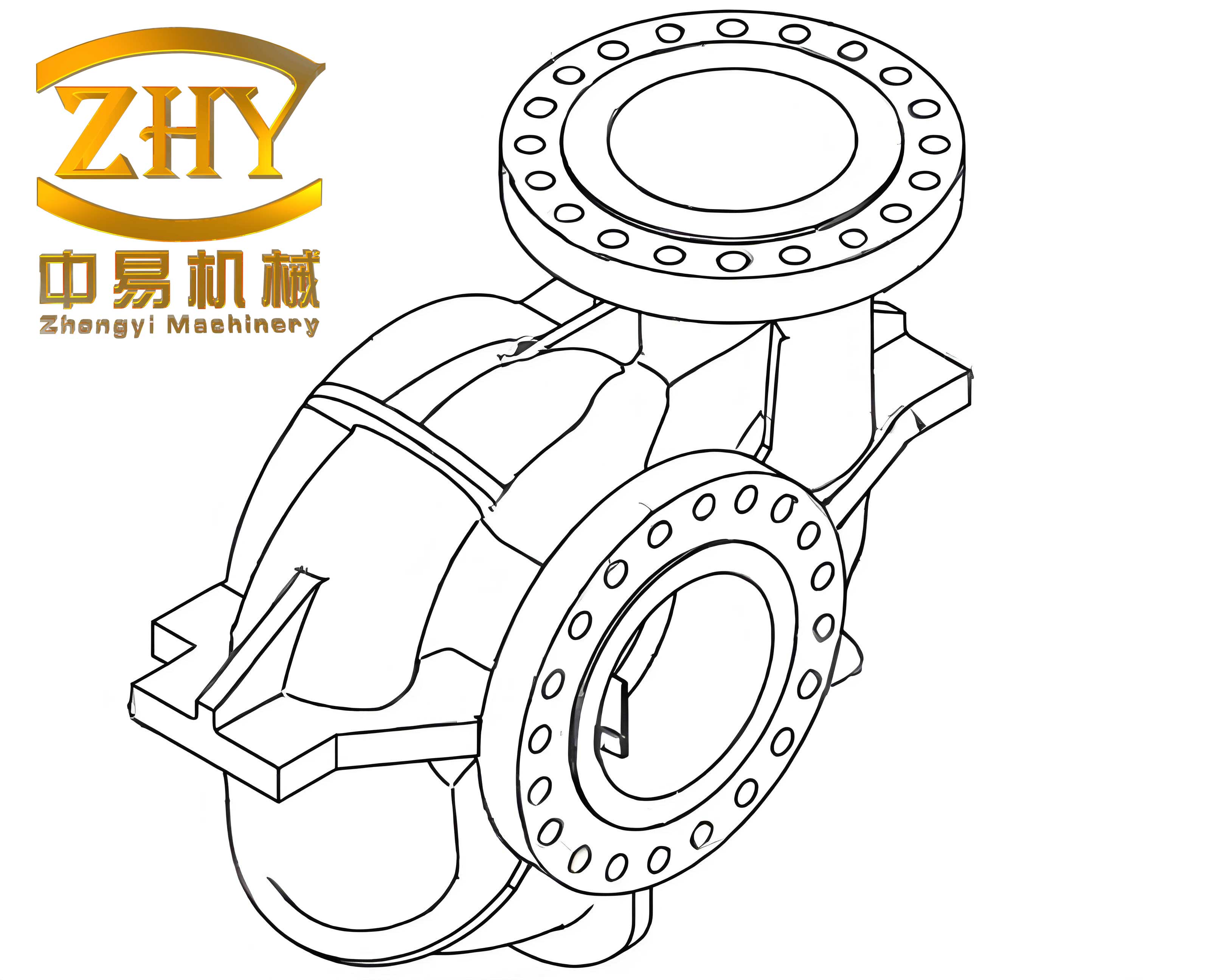
The shrinkage defect in shell castings primarily stems from non-uniform cooling during solidification. When molten aluminum alloy is poured into a permanent mold, heat extraction occurs through the mold walls and cores. In areas with thicker sections, the thermal mass is higher, causing slower cooling rates. This creates a thermal gradient where the thick section remains liquid longer than thinner adjacent areas, leading to insufficient feeding and subsequent shrinkage as the metal contracts upon solidification. For our shell castings, the cylindrical hub acted as a hotspot, exacerbating the problem due to the existing gating and venting design.
Initially, we attempted several conventional remedies to reduce shrinkage in shell castings, such as adding cooling fins on the metal core, using copper cores to enhance thermal conductivity, increasing the overall mold temperature, removing coatings from cores and applying air cooling, lowering the pouring temperature of the aluminum alloy, and strictly controlling the core extraction and mold opening times. While these measures slightly alleviated the defect, they did not eliminate it entirely. Instead, they introduced new issues like increased core extraction resistance and cold shuts or misruns in thin-walled sections of the shell castings. This highlighted the need for a more targeted approach to cooling the problematic hotspot.
To address this, we turned to water cooling, a method less commonly used in aluminum alloy permanent mold casting but highly effective for managing thermal gradients. Water cooling offers high cooling efficiency, precise control over cooling locations, and flexibility in pipe diameter requirements. We integrated a water-cooling system into the core design for the shell castings. The core was machined to include a water channel with an inner diameter of 16 mm, into which a 5 mm inner diameter metal flexible tube was inserted and sealed at the ends using copper welding. This system was connected to the inlet and outlet water pipes of the gravity die casting machine, allowing for circulating water flow during the casting cycle.
The effectiveness of water cooling in shell castings can be modeled using heat transfer principles. The rate of heat extraction from the casting to the core is governed by Fourier’s law of heat conduction and Newton’s law of cooling. The heat flux \( q \) from the casting to the water-cooled core can be expressed as:
$$ q = h \cdot A \cdot (T_c – T_w) $$
where \( h \) is the heat transfer coefficient between the core surface and the water, \( A \) is the surface area of the core in contact with the casting, \( T_c \) is the temperature of the casting at the interface, and \( T_w \) is the temperature of the cooling water. By increasing \( h \) through water flow and optimizing \( A \), we can enhance cooling at the hotspot. Additionally, the solidification time \( t_s \) for a section of a shell casting can be estimated using Chvorinov’s rule:
$$ t_s = C \cdot \left( \frac{V}{A} \right)^2 $$
where \( C \) is a constant dependent on the mold material and casting conditions, \( V \) is the volume of the section, and \( A \) is its surface area. For thick sections in shell castings, \( \frac{V}{A} \) is larger, leading to longer solidification times and increased shrinkage risk. Water cooling reduces \( t_s \) by effectively decreasing the thermal resistance at the core interface.
We conducted experiments to determine the optimal water flow rate and core temperature for our shell castings. The goal was to maintain the core temperature between 80°C and 120°C before each pour, ensuring adequate cooling without causing premature solidification in thin sections. The table below summarizes the key parameters and their effects on shrinkage defects in shell castings:
| Parameter | Range | Effect on Shrinkage in Shell Castings |
|---|---|---|
| Water Flow Rate | 0.5–2.0 L/min | Higher flow rates increase cooling, reducing shrinkage but may cause cracks if excessive. |
| Core Temperature | 80–120°C | Lower temperatures enhance cooling; temperatures below 80°C risk cold defects. |
| Pouring Temperature | 680–720°C | Lower temperatures reduce thermal gradient but can lead to misruns. |
| Cooling Time | 30–60 seconds | Longer times allow more heat extraction, but must align with production cycle. |
Implementing the water-cooled core system required careful monitoring and adjustment. We used thermocouples embedded near the core surface to track temperatures in real-time. The data collected showed that with water cooling, the temperature at the S-point hotspot dropped rapidly after pouring, aligning the cooling curve with thinner sections of the shell castings. This minimized the thermal gradient and promoted directional solidification toward the feeder areas, though no separate riser was used due to design constraints. The water cooling system’s performance can be further analyzed using the dimensionless Biot number \( Bi \), which compares internal thermal resistance to surface heat transfer:
$$ Bi = \frac{h L}{k} $$
where \( L \) is the characteristic length of the casting section, and \( k \) is the thermal conductivity of the aluminum alloy. For effective cooling, \( Bi \) should be sufficiently high to ensure that heat transfer is dominated by convection at the core surface. In our shell castings, with \( h \) enhanced by water flow, \( Bi \) increased, leading to more uniform cooling.
The results were significant: shrinkage defects in the shell castings were virtually eliminated, dropping from an initial occurrence rate of nearly 100% to less than 5%. Microscopic examination of sections from the cylindrical hub revealed a dense, fine-grained microstructure with no visible porosity, confirming the effectiveness of the water cooling approach. Additionally, other defects like cold shuts were reduced due to better temperature control. The table below compares defect rates before and after implementing water cooling for shell castings:
| Defect Type | Before Water Cooling (%) | After Water Cooling (%) |
|---|---|---|
| Shrinkage Cavities | 95 | 3 |
| Cold Shuts | 20 | 5 |
| Misruns | 15 | 2 |
| Overall Rejection Rate | 100 | 8 |
Beyond water cooling, we explored complementary strategies to further optimize the production of shell castings. For instance, modifying the gating system to ensure more uniform filling and reducing turbulence can enhance thermal management. Computational fluid dynamics (CFD) simulations were used to model molten metal flow in shell castings, helping us redesign the ingate positions to minimize heat concentration. The energy equation governing fluid flow and heat transfer in casting simulations is:
$$ \rho c_p \frac{\partial T}{\partial t} + \rho c_p \mathbf{u} \cdot \nabla T = \nabla \cdot (k \nabla T) + S $$
where \( \rho \) is density, \( c_p \) is specific heat, \( T \) is temperature, \( t \) is time, \( \mathbf{u} \) is velocity vector, \( k \) is thermal conductivity, and \( S \) represents heat sources. By solving this equation numerically, we predicted temperature distributions in shell castings and adjusted processes accordingly.
Another aspect is the material properties of the aluminum alloy used for shell castings. Alloys with wider freezing ranges are more prone to shrinkage, so selecting alloys like A356 with good feeding characteristics can help. The solidification shrinkage \( \epsilon \) can be expressed as:
$$ \epsilon = \beta \cdot \Delta T $$
where \( \beta \) is the coefficient of thermal contraction and \( \Delta T \) is the temperature drop during solidification. For aluminum alloys, \( \beta \) is approximately 0.00006 per °C, and \( \Delta T \) can be controlled through cooling rates. In shell castings, rapid cooling at hotspots reduces \( \Delta T \), thereby minimizing \( \epsilon \).
Furthermore, we considered the economic and practical implications of water cooling for shell castings. While initial setup costs for water-cooled cores are higher due to machining and integration, the long-term benefits include reduced scrap rates, lower material waste, and improved product consistency. Maintenance involves periodic cleaning of water channels to prevent scaling, which can impair heat transfer. We developed a schedule for flushing the system with descaling agents every 500 cycles for shell castings, ensuring sustained performance.
In conclusion, the integration of water-cooled cores into the permanent mold casting process for aluminum alloy shell castings has proven to be a highly effective solution for eliminating shrinkage defects. By addressing the thermal gradients at hotspots through enhanced cooling, we achieved a dramatic improvement in quality. This approach, combined with careful parameter control and process optimization, underscores the importance of tailored cooling strategies in advanced manufacturing. The success with shell castings demonstrates that even in aluminum alloys, water cooling can be leveraged to overcome traditional limitations, paving the way for more reliable and efficient production of complex components.
Looking ahead, ongoing research into adaptive cooling systems using real-time temperature feedback and machine learning could further refine the process for shell castings. As demand for high-integrity shell castings grows in sectors like electric vehicles and renewable energy, such innovations will be crucial. The lessons learned from this experience emphasize that a deep understanding of heat transfer mechanisms and a willingness to implement unconventional solutions are key to advancing casting technology and ensuring the durability of shell castings in demanding applications.