
In our manufacturing facility, which specializes in producing spheroidal graphite cast iron components using the iron mold coated sand process, we encountered a significant quality incident in October 2015. During the production of 436 crankshafts, subsurface blowholes appeared in 1,664 units over two consecutive shifts, resulting in direct financial losses exceeding 120,000 CNY. These defects were not only irreparable through machining but also visible on non-machined surfaces, as illustrated below. This event prompted an intensive investigation to identify root causes and implement permanent solutions, ensuring the reliability of our spheroidal graphite cast iron products.
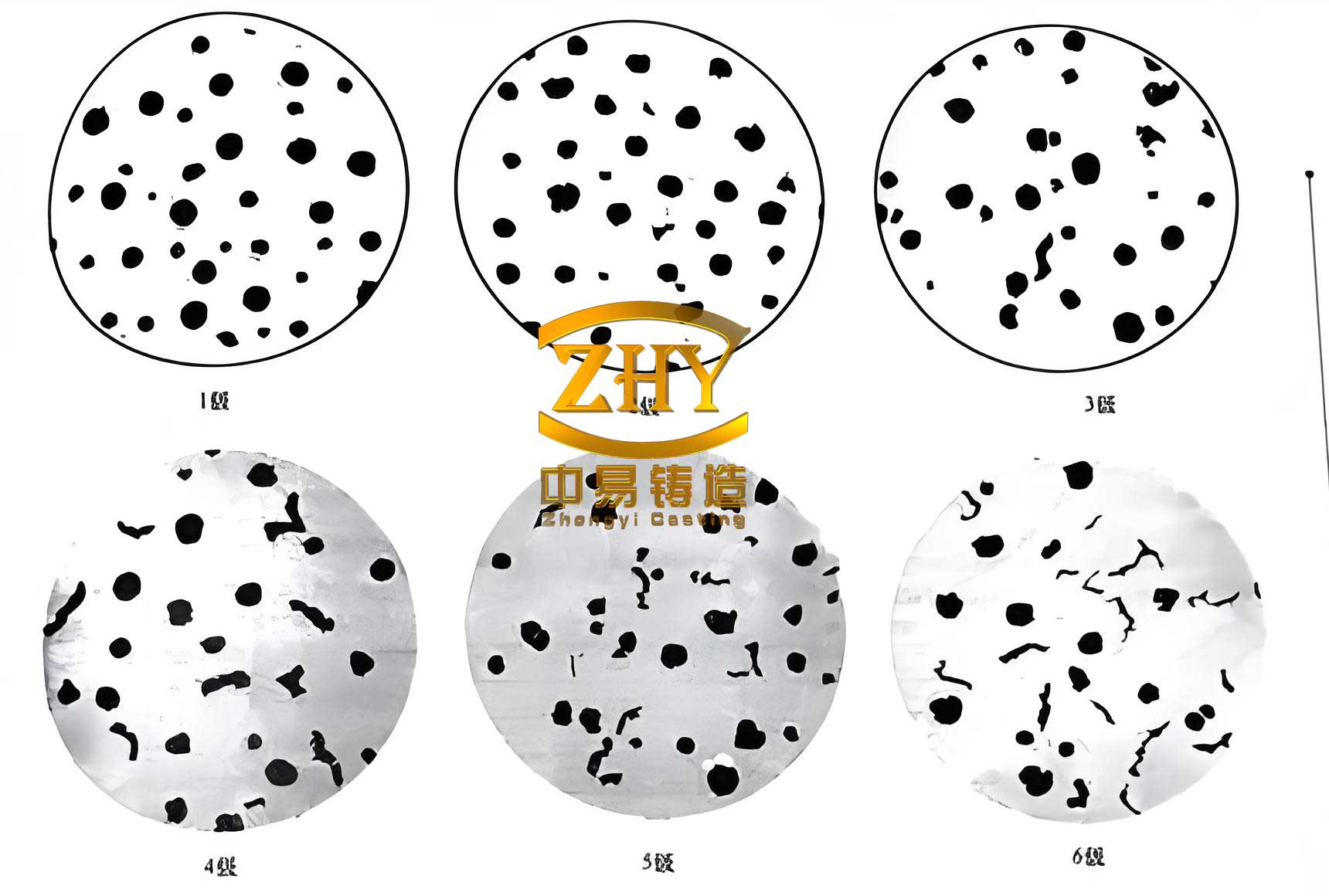
The iron mold coated sand process involves creating a thin layer of resin-coated sand on an iron mold, which is then used to produce high-precision castings like crankshafts, brake calipers, and compressor parts. Spheroidal graphite cast iron is favored for its excellent mechanical properties, but subsurface blowholes can compromise integrity. These blowholes typically form due to gas entrapment during solidification, often linked to process variables. Our investigation began with a systematic analysis of potential factors, leveraging theoretical principles and empirical data.
Defect Analysis and Potential Influencing Factors
Upon the defect occurrence, we formed a cross-functional team to analyze subsurface blowhole formation mechanisms. Based on literature and our process knowledge, we identified key factors that could contribute to gas invasion in spheroidal graphite cast iron. The primary suspects included raw material variations, molten iron temperature, sand mold gas evolution, mold venting efficiency, and undocumented process changes. We hypothesized that gas entrapment results from imbalances between gas generation and expulsion, often described by the following relationship for gas pressure in the mold cavity:
$$ P_g = \frac{n_g R T}{V} $$
where \( P_g \) is the gas pressure, \( n_g \) is the moles of gas generated, \( R \) is the gas constant, \( T \) is the temperature, and \( V \) is the cavity volume. Excessive gas pressure can force gases into the molten spheroidal graphite cast iron, leading to blowholes. Additionally, the surface tension of the molten iron plays a critical role; lower surface tension facilitates gas penetration. The surface tension \( \gamma \) can be approximated as a function of composition and temperature:
$$ \gamma = \gamma_0 – k_C C_C – k_S C_S + k_N C_N + k_O C_O $$
where \( \gamma_0 \) is a base value, \( k_i \) are coefficients, and \( C_i \) are concentrations of elements like carbon (C), silicon (Si), nitrogen (N), and oxygen (O). In spheroidal graphite cast iron, elements such as silicon reduce surface tension, while nitrogen and oxygen increase it, affecting gas susceptibility.
| Factor | Mechanism | Expected Effect on Blowholes |
|---|---|---|
| Raw Material Changes | Alters molten iron composition and surface tension | Increased risk if N/O rise or Si/F fall |
| Molten Iron Temperature | Higher temperature reduces surface tension and increases gas generation | Positive correlation with defect occurrence |
| Sand Mold Gas Evolution | Resin decomposition releases gases (e.g., H₂, N₂) | Directly increases gas pressure |
| Mold Venting | Poor venting traps gases, raising pressure | Higher pressure promotes gas invasion |
| Process Changes | Uncontrolled variables disrupt stability | Can trigger defects abruptly |
We prioritized these factors based on process records and began a stepwise排查. Our goal was to correlate theoretical models with practical observations to pinpoint the exact cause in our spheroidal graphite cast iron production.
Production Process Investigation and Systematic排查
We conducted a thorough review of production parameters from the defective shifts, comparing them with historical data. The排查 focused on material consistency, thermal conditions, and sand mold properties, all critical for spheroidal graphite cast iron quality.
Raw Materials Assessment
We verified that all raw materials—including pig iron, scrap, ferroalloys, and inoculants—were from consistent suppliers and batches. Chemical composition analysis confirmed that key elements in the spheroidal graphite cast iron met specifications, as summarized below.
| Element | Specification Range | Measured Value (Defective Shift) | Measured Value (Prior Shift) |
|---|---|---|---|
| Carbon (C) | 3.6–3.9 | 3.75 | 3.72 |
| Silicon (Si) | 2.0–2.4 | 2.18 | 2.21 |
| Manganese (Mn) | 0.2–0.4 | 0.31 | 0.29 |
| Phosphorus (P) | <0.05 | 0.03 | 0.03 |
| Sulfur (S) | <0.02 | 0.015 | 0.016 |
| Magnesium (Mg) | 0.03–0.05 | 0.042 | 0.041 |
| Trace Elements (e.g., N, O) | Monitored | Within limits | Within limits |
No significant deviations were detected, ruling out raw materials as a direct cause. The carbon equivalent (CE) was calculated using the formula:
$$ CE = C + \frac{Si}{3} $$
yielding values of approximately 4.4–4.5, which is typical for spheroidal graphite cast iron and did not indicate abnormalities.
Molten Iron and Pouring Temperature Verification
Temperature logs showed that pouring temperatures were within the specified range of 1,380–1,420°C. However, to test the hypothesis that elevated temperatures contributed to defects, we conducted controlled experiments by incrementally reducing the tapping temperature from 1,540°C to 1,500°C. The results, tabulated below, revealed that lower temperatures induced slag inclusions but did not eliminate blowholes, suggesting temperature was not the primary factor.
| Tapping Temperature (°C) | Pouring Temperature (°C) | Subsurface Blowhole Incidence | Other Defects |
|---|---|---|---|
| 1,540 | 1,410 | High | None |
| 1,530 | 1,400 | High | None |
| 1,520 | 1,390 | High | Minor slag |
| 1,500 | 1,370 | High | Significant slag |
This indicated that while temperature affects fluidity and gas solubility, it was not the root cause for our spheroidal graphite cast iron issues.
Resin-Coated Sand Mold Evaluation
The sand mold, made from thermosetting resin-coated sand, was suspected due to its potential for gas generation. The resin system uses hexamethylenetetramine (urotropine) as a curing agent, which decomposes at high temperatures to release ammonia and subsequently hydrogen and nitrogen gases. The decomposition reactions can be represented as:
$$ (CH_2)_6N_4 \rightarrow 6CH_2 + 4N + \text{intermediates} $$
$$ 2NH_3 \rightleftharpoons N_2 + 3H_2 $$
These gases can infiltrate the molten spheroidal graphite cast iron if generated excessively. We reviewed sand production records and found no changes in formulations. However, a dedicated trial with freshly prepared sand resulted in defect-free castings, pointing to a sand-related issue. We isolated sand from the defective period for further analysis.
Defect Verification and Root Cause Identification
To confirm the resin sand hypothesis, we replicated the suspected conditions by intentionally increasing urotropine content in test batches. The gas evolution volume \( V_g \) from sand can be estimated using the Arrhenius equation for decomposition rate:
$$ k = A e^{-E_a/(RT)} $$
where \( k \) is the rate constant, \( A \) is the pre-exponential factor, \( E_a \) is the activation energy, and \( T \) is the temperature. Higher urotropine concentrations increase \( A \), leading to more gas. We measured gas pressure in mold cavities using sensors and correlated it with blowhole formation.
| Urotropine Content (% of resin weight) | Theoretical Gas Pressure (kPa) | Observed Blowhole Frequency (%) | Remarks |
|---|---|---|---|
| 10 (Standard) | ~50 | 0 | Normal production |
| 15 | ~75 | 5 | Minor defects |
| 20 | ~100 | 30 | Severe defects |
| 25 (Defective batch) | ~125 | 100 | Massive blowholes |
Auditing仓库 records revealed a discrepancy: urotropine usage exceeded documented amounts by 23% during the defective shifts. This over-addition was traced to operator error and falsified records. Thus, excessive urotropine in the resin-coated sand was identified as the root cause, leading to high gas generation and invasion into the spheroidal graphite cast iron.
Corrective Measures and Process Controls
To prevent recurrence, we implemented stringent controls focused on sand preparation and process monitoring. The measures included:
- Urotropine Dosage Control: Limiting urotropine to a maximum of 15% of resin weight, as per the revised standard operating procedure. This ensures gas evolution remains within safe limits for spheroidal graphite cast iron.
- Process Adherence Enforcement: We launched a plant-wide campaign to emphasize strict protocol compliance, with heavy penalties for deviations. All personnel were retrained on the criticality of material proportionality.
- Change Point Management: A system was established to verify material批次 and usage consistency, requiring dual checks between warehouse issues and production logs.
These actions stabilized sand quality, and subsequent production of spheroidal graphite cast iron components showed zero subsurface blowholes for months.
Additional Factor: Iron Mold Temperature Influence
In January 2016, a smaller-scale defect recurrence (10.2% incidence) was observed during 436 crankshaft production. Investigation traced it to two ladles of spheroidal graphite cast iron, where the iron mold temperature was found to be 110–170°C, significantly below the specified 200–280°C. Low mold temperatures impair sand curing, leading to “green sand” areas with higher gas evolution. The relationship between mold temperature \( T_m \) and gas generation rate \( G \) can be modeled as:
$$ G = G_0 \exp\left(-\frac{T_c – T_m}{T_d}\right) $$
where \( G_0 \) is a base rate, \( T_c \) is the critical curing temperature, and \( T_d \) is a decay constant. Uncured sand generates more volatiles, increasing gas pressure. We confirmed this by testing molds at varying temperatures:
| Mold Temperature (°C) | Sand Curing Status | Gas Evolution (mL/g) | Blowhole Incidence |
|---|---|---|---|
| 110–170 | Incomplete | 25–30 | High (10–15%) |
| 200–280 | Complete | 10–15 | None |
| >280 | Over-cured | 8–12 | None |
To address this, we instituted mold preheating protocols, ensuring temperatures stay within range regardless of ambient conditions. This eliminated the low-temperature defect source, further securing the quality of our spheroidal graphite cast iron products.
Conclusion and Long-Term Stability
Through systematic analysis and验证, we resolved subsurface blowhole defects in spheroidal graphite cast iron produced via the iron mold coated sand process. The root causes were excessive urotropine in resin sand and inadequate mold temperatures. By controlling these variables and enforcing strict process disciplines, we have maintained defect-free production for years. This experience underscores the importance of holistic process control in foundry operations, particularly for sensitive materials like spheroidal graphite cast iron. Continuous monitoring and adherence to scientific principles, as encapsulated in the formulas and tables presented, are essential for manufacturing reliability. Our solutions have not only eliminated blowholes but also enhanced overall process robustness, ensuring that spheroidal graphite cast iron components meet the highest quality standards for automotive and industrial applications.