
In the realm of mechanical engineering, the precision and stability of machine tools are paramount, as they directly influence the quality of manufactured components and overall market competitiveness. To enhance the industrialization scale of machine tools, it is essential to address the stability of their accuracy, which is heavily dependent on the manufacturing precision and dimensional stability of large castings. Residual stresses within these machine tool castings can lead to deformations and accuracy loss over time, necessitating effective aging processes to eliminate such stresses. Traditional methods often involve thermal aging, but this approach has limitations in terms of energy consumption and environmental impact. This article explores the application of spectrum harmonic vibration aging technology, a novel method that utilizes specific harmonic frequencies to mitigate residual stresses in machine tool castings, thereby ensuring dimensional accuracy and preventing deformations. We will delve into the technical principles, experimental protocols, key challenges, comparative advantages, and broader implications of this technology, supported by empirical data and analytical models.
The foundation of spectrum harmonic vibration aging lies in its ability to analyze and apply low-order harmonic frequencies within a 100 Hz range, without the need for sweeping scans. By employing a spectrum harmonic aging device, we conduct a spectral analysis of the workpiece, identifying harmonic frequencies that can effectively reduce residual stresses. This process involves exciting the workpiece at these frequencies with controlled energy, leading to multi-dimensional stress relief. The core principle is based on Fourier analysis, which decomposes the vibrational characteristics of the machine tool casting into its frequency components. Mathematically, this can be represented as:
$$ X(f) = \int_{-\infty}^{\infty} x(t) e^{-j2\pi ft} dt $$
where \( X(f) \) is the frequency domain representation, \( x(t) \) is the time-domain signal from the accelerometer, and \( f \) denotes frequency. This allows us to select optimal harmonic frequencies for treatment, typically focusing on those below 6000 rpm to minimize noise and environmental impact. The process steps are automated: first, the controller collects data via accelerometers within a 1000 to 5000 rpm range to determine natural frequencies; second, it classifies and sorts these frequencies to choose the best ones; third, it applies the optimal load based on energy requirements; and fourth, it bypasses resonance frequencies during automated operation. This method ensures consistent results, independent of operator skill, and can handle complex geometries by addressing residual stresses from multiple directions through multi-mode vibrations.
Key technical features of spectrum harmonic vibration aging include its universality across various workpiece types, thanks to the Fourier analysis that enables the identification of at least five optimal resonant frequencies for automated processing. This expands the applicability from a mere 23% of workpieces to nearly 100%, effectively solving challenges associated with high-rigidity components. For instance, in complex machine tool castings, residual stresses often exist in multiple directions, and the multi-mode approach facilitates plastic deformation elimination or homogenization. The use of frequencies below 6000 rpm results in lower noise levels, aligning with environmental sustainability goals. To illustrate the frequency selection process, consider the following table summarizing typical harmonic frequencies used for different types of machine tool castings:
| Type of Machine Tool Casting | Optimal Harmonic Frequencies (Hz) | Vibration Acceleration (m/s²) |
|---|---|---|
| Planer Grinder Bed | 45, 60, 75 | 30-70 |
| Gantry Milling Machine Frame | 50, 65, 80 | 35-65 |
| Large Radial Drill Column | 55, 70, 85 | 40-70 |
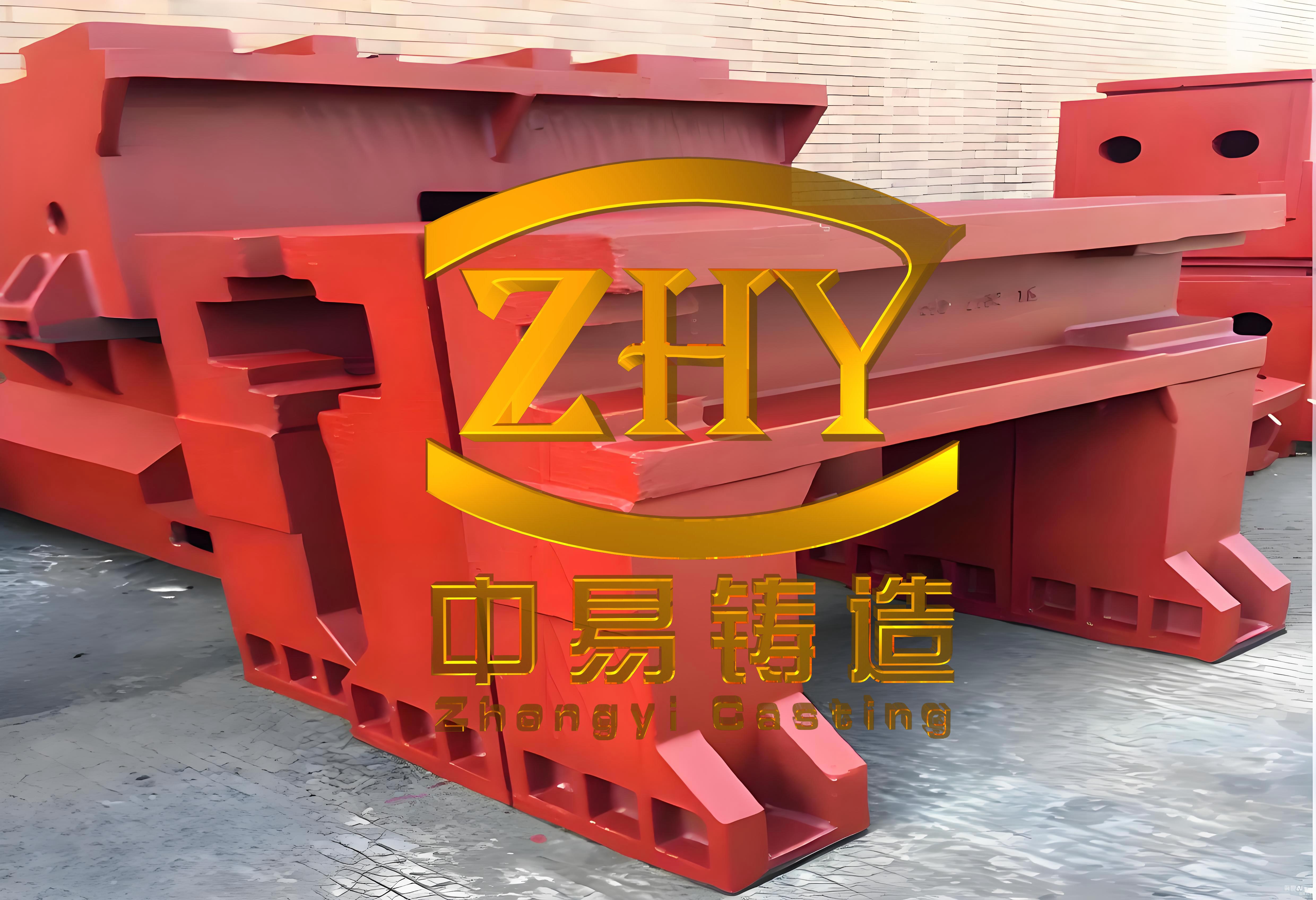
In our experimental phase, we developed a structured approach to validate and implement spectrum harmonic vibration aging for various machine tool castings, such as those used in planer grinders, gantry milling machines, and large radial drills. The technical route followed a sequence of process experimentation, verification, and promotion. For example, in the case of a planer grinder bed, we designed an aging process that involved initial treatment in the rough casting state to eliminate casting stresses, followed by a secondary treatment after rough machining to address machining-induced stresses. The setup included supporting the casting on three or four rubber pads, rigidly attaching an exciter using a bow clamp with a fastening force of 130-150 kgf, and connecting the control equipment to automate frequency selection. The vibration acceleration was maintained between 30 m/s² and 70 m/s², with parameters adjustable during operation. After treatment, we marked the workpieces and recorded parameters, printing aging curves for analysis. The same steps were applied post-rough machining to ensure comprehensive stress relief.
For process verification, we employed the acceleration-time parameter curve method to assess the effectiveness of spectrum harmonic vibration aging. This involved monitoring changes in acceleration over time during treatment, as shown in typical curves where stable patterns indicate successful stress reduction. Additionally, we evaluated dimensional stability by periodically measuring the accuracy of machine tool castings over time and under static and dynamic loads. The results were compared against thermal aging benchmarks and tolerance limits, confirming the viability of the vibration aging process. In one instance, for a large machine tool casting, the post-aging dimensional variation was reduced to within 0.05 mm, significantly below the allowable error of 0.1 mm, demonstrating the technology’s precision. The acceleration-time relationship can be modeled as:
$$ a(t) = A \sin(2\pi f t + \phi) $$
where \( a(t) \) is acceleration at time \( t \), \( A \) is amplitude, \( f \) is frequency, and \( \phi \) is phase shift. This equation helps in optimizing the treatment duration and energy input for different machine tool castings.
During the promotion phase, we extended the application of spectrum harmonic vibration aging to various large castings and welded structures in different machine tools, such as surface grinders and milling machines. After assembly and testing, the工艺 was formally incorporated into production processes, leading to improved efficiency and scalability. For instance, in high-volume production, we addressed batch handling challenges by developing specialized fixtures or platform clamping systems, which streamlined the aging process and reduced downtime. The following table outlines the key parameters optimized for different machine tool castings during this phase:
| Optimization Parameter | Description | Impact on Machine Tool Castings |
|---|---|---|
| Exciter Force | Adjusted to achieve vibration acceleration of 30-70 m/s² | Ensures uniform stress relief in large castings |
| Frequency Groups | Selected based on multi-mode principles | Targets residual stresses from multiple directions |
| Treatment Time | Determined by energy load and workpiece size | Minimizes cycle time while maximizing effectiveness |
Addressing key technical issues was crucial for the successful implementation of spectrum harmonic vibration aging. One major challenge was optimizing process parameters for diverse machine tool castings, such as ensuring the exciter force induced sufficient vibration acceleration and selecting the best frequency groups through intermittent excitation to capture resonant frequencies. We developed algorithms to automatically choose frequency sets based on real-time data, enhancing consistency. Another issue involved the clamping of批量关键零件 and welded components; for large-scale production, we designed dedicated工装 that simplified setup, reducing handling time by up to 30% and improving overall productivity. The relationship between exciter force \( F \) and vibration acceleration \( a \) can be expressed as:
$$ F = m \cdot a $$
where \( m \) is the effective mass of the machine tool casting. This formula guided our adjustments to achieve the desired acceleration range for different casting sizes.
When comparing spectrum harmonic vibration aging with sub-resonance aging technologies, the advantages become evident. Sub-resonance methods are limited to workpieces within the exciter’s speed range, covering less than 23% of cases, and often produce significant noise due to macroscopic vibrations. In contrast, spectrum harmonic aging handles over 90% of workpieces, utilizes at least five vibration modes for comprehensive stress relief, and operates at lower frequencies, resulting in quieter, environmentally friendly processes. The automation of parameter selection in spectrum harmonic aging eliminates reliance on operator expertise, making it easier to integrate into formal production lines. The following table provides a detailed comparison:
| Aspect | Sub-Resonance Aging | Spectrum Harmonic Aging |
|---|---|---|
| Frequency Range | Limited to exciter speed range; ineffective beyond | Effective for frequencies beyond exciter range via harmonics |
| Applicability | < 23% of workpieces | > 90% of workpieces, including high-rigidity machine tool castings |
| Vibration Modes | Few modes within range; none beyond | At least 5 modes, enabling multi-directional stress relief |
| Noise Level | High due to macroscopic vibrations | Low, as energy is absorbed internally; frequencies < 6000 rpm |
| Process Standardization | Requires skilled operators; hard to formalize | Fully automated; consistent results easily integrated |
| Effectiveness | Moderate, limited directional coverage | High, especially for aluminum alloys; superior stress homogenization |
The推广 prospects of spectrum harmonic vibration aging are substantial, with growing adoption in the machinery manufacturing sector. This technology offers a viable alternative to thermal aging, reducing energy consumption by up to 70% and cutting costs significantly. In our operations, applying this method to approximately 15% of large machine tool castings has resulted in annual savings of around 18.75 million yuan in thermal aging expenses, while boosting production efficiency by over 20% and expanding capacity by more than 10%. The environmental benefits, such as lower carbon emissions and noise pollution, further enhance its appeal for sustainable manufacturing. The economic impact can be quantified using a simple cost-benefit model:
$$ C_{savings} = C_{thermal} – C_{vibration} $$
where \( C_{savings} \) represents the cost savings, \( C_{thermal} \) is the cost of thermal aging, and \( C_{vibration} \) is the cost of vibration aging. For typical machine tool castings, \( C_{vibration} \) is often 30-50% lower, making it a financially sound investment.
In conclusion, our research demonstrates that spectrum harmonic vibration aging is a highly effective method for enhancing the dimensional stability and longevity of machine tool castings. By focusing on rough and semi-finished castings, we have achieved significant reductions in residual stresses across various machine tools, including planer grinders and milling machines. Although machine structures and accuracy requirements vary, the universal need for internal stress relief and size consistency in large castings makes this technology a valuable solution for common challenges in the industry. Future work will involve refining the automation algorithms and expanding applications to other material types, further solidifying its role in advanced manufacturing.