
In the realm of advanced foundry technology, squeeze casting has emerged as a pivotal process for producing high-integrity automotive components. This technique involves the application of high pressure during the solidification of molten metal, leading to denser microstructures and enhanced mechanical properties. As an expert in foundry technology, I have extensively studied the application of squeeze casting in various automotive structural parts, such as steering knuckles, airbag brackets, control arms, and engine mounts. The drive toward vehicle lightweighting, particularly with the rise of electric vehicles, necessitates the adoption of aluminum alloys to replace traditional iron and steel castings. Squeeze casting, as a sophisticated foundry technology, enables the production of components with performance levels comparable to forgings, while offering design flexibility and cost-effectiveness. In this article, I will delve into the principles, applications, and benefits of this foundry technology, supported by empirical data, tables, and mathematical models to illustrate its superiority in automotive manufacturing.
The fundamental principle of squeeze casting lies in the application of pressure during solidification, which suppresses gas porosity and shrinkage defects. This foundry technology can be implemented as direct or indirect methods, with the latter being more common for complex automotive parts. The pressure applied, typically ranging from 50 to 150 MPa, enhances the heat transfer coefficient and refines the microstructure. From a theoretical perspective, the effect of pressure on solidification can be described by the Clausius-Clapeyron relation, which relates the change in melting point to applied pressure: $$\Delta T_m = \frac{T_m \Delta V \Delta P}{\Delta H}$$ where $\Delta T_m$ is the change in melting temperature, $T_m$ is the equilibrium melting point, $\Delta V$ is the volume change upon solidification, $\Delta P$ is the applied pressure, and $\Delta H$ is the latent heat of fusion. This equation highlights how increased pressure elevates the melting point, promoting rapid solidification and finer grain structures. In foundry technology, this translates to improved mechanical properties, as evidenced by the Hall-Petch equation for yield strength: $$\sigma_y = \sigma_0 + k_y d^{-1/2}$$ where $\sigma_y$ is the yield strength, $\sigma_0$ is the lattice friction stress, $k_y$ is a constant, and $d$ is the average grain diameter. Squeeze casting reduces $d$, thereby enhancing $\sigma_y$, making it a cornerstone of modern foundry technology for automotive applications.
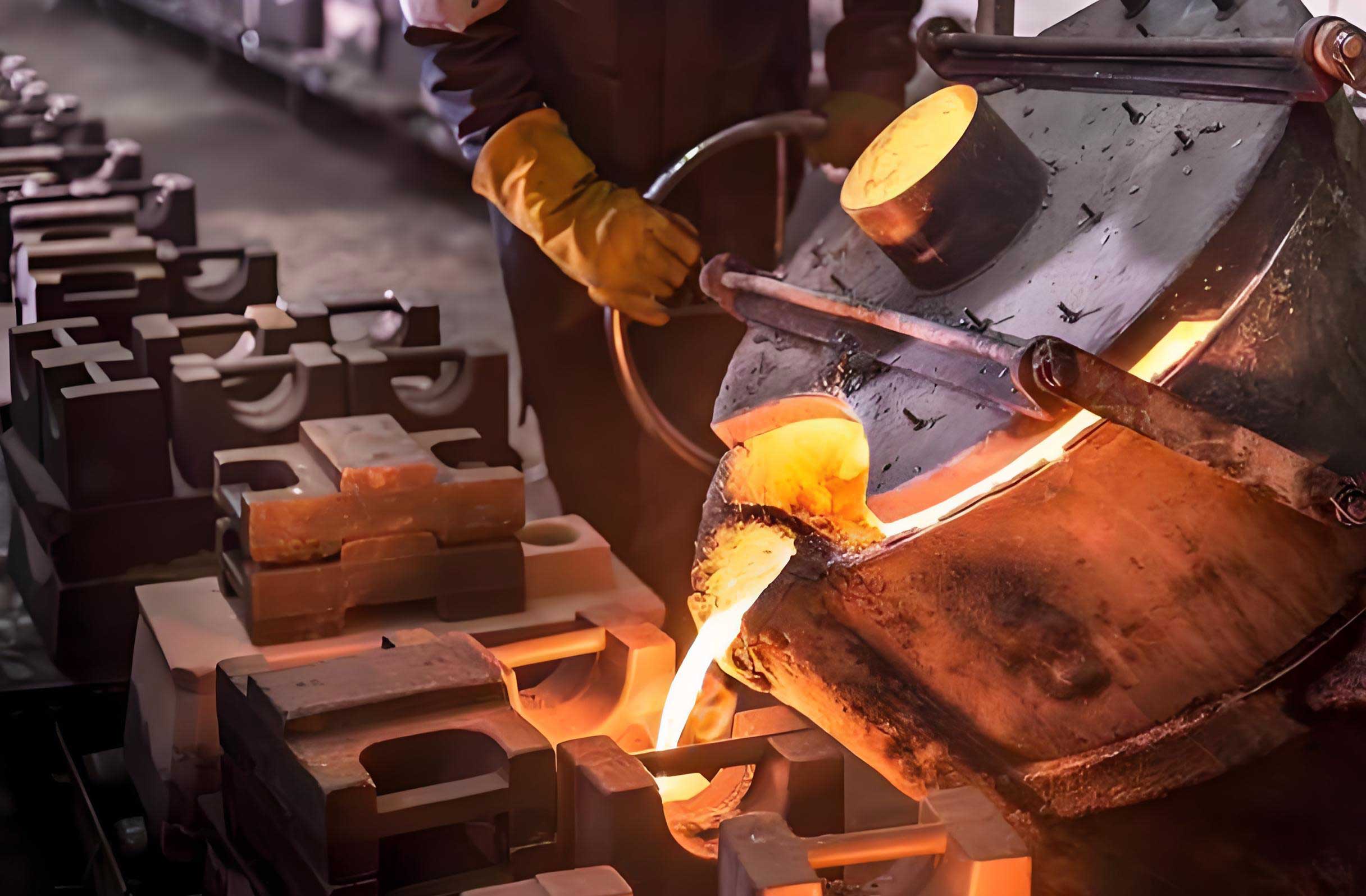
One of the most critical applications of squeeze casting in foundry technology is in the production of steering knuckles. These components are essential for vehicle suspension and steering systems, requiring high strength and fatigue resistance. Traditionally made from ductile iron, steering knuckles are now being fabricated from A356 aluminum alloy using squeeze casting, resulting in significant weight savings. In my research, I optimized the design through finite element analysis (FEA) to ensure compliance with various loading conditions. The squeeze casting process involved an indirect method with a pressure of 100 MPa, and the mold was equipped with cooling channels and local squeezing mechanisms to address thermal hotspots. The mechanical properties were evaluated from samples extracted from critical sections of the component, demonstrating consistent performance across different locations. The table below summarizes the tensile properties achieved, which meet the stringent automotive standards for such safety-critical parts.
| Sample Location | Tensile Strength (MPa) | Yield Strength (MPa) | Elongation (%) |
|---|---|---|---|
| Position 1 | 309 | 246 | 10.6 |
| Position 2 | 304 | 250 | 10.9 |
| Position 3 | 307 | 244 | 10.6 |
| Position 4 | 308 | 251 | 13.9 |
| Required Value | ≥303 | ≥230 | ≥10 |
Fatigue testing on servo-hydraulic equipment confirmed the durability of these components, with no failures observed under simulated driving conditions. This success underscores the capability of squeeze casting as a reliable foundry technology for producing lightweight, high-performance automotive structures. The integration of computational modeling in the foundry technology workflow allows for precise control of process parameters, such as pouring temperature and pressure duration, which can be optimized using the following empirical relation for solidification time: $$t_s = \frac{\rho L}{h(T_m – T_d)}$$ where $t_s$ is the solidification time, $\rho$ is the density, $L$ is the latent heat, $h$ is the heat transfer coefficient, $T_m$ is the melting temperature, and $T_d$ is the die temperature. By minimizing $t_s$ through elevated pressure, squeeze casting ensures a fine-grained microstructure, which is pivotal in foundry technology for enhancing component life.
Another notable application of this foundry technology is in airbag support arms, which are crucial for wheel-end drive axles in modern vehicles. These parts endure cyclic loads from suspension systems, and their failure can lead to catastrophic outcomes. Initially produced as iron castings, they were transitioned to forged aluminum for lightweighting, but squeeze casting offers a cost-effective alternative with similar performance. In my work, I encountered initial failures in prototype testing, which were mitigated through structural modifications. For instance, reinforcing certain boundaries and altering bolt hole geometries improved stiffness and stress distribution. The mechanical properties of the squeeze cast A35.2 aluminum alloy are presented in the table below, highlighting the consistency achieved through this advanced foundry technology.
| Sample Number | Tensile Strength (MPa) | Yield Strength (MPa) | Elongation (%) |
|---|---|---|---|
| 1 | 324.7 | 289.5 | 11.5 |
| 2 | 315.2 | 301.6 | 10.7 |
| 3 | 321.6 | 302.1 | 12.1 |
| 4 | 330.5 | 313.4 | 11.1 |
| 5 | 322.3 | 312.7 | 11.5 |
| 6 | 317.7 | 295.1 | 10.8 |
Bench testing involving over one million cycles validated the design, with no signs of cracking or deformation. This demonstrates how foundry technology like squeeze casting can replace forging for complex components, leveraging pressure-assisted solidification to achieve desired properties. The process parameters in foundry technology are critical; for example, the pressure $P$ applied during squeezing influences the density $\rho$ of the casting, which can be modeled as: $$\rho = \rho_0 (1 – \beta \Delta P)^{-1}$$ where $\rho_0$ is the density at zero pressure, and $\beta$ is the compressibility coefficient. This relation ensures that squeeze cast parts have minimal porosity, a key advantage in foundry technology for automotive applications where reliability is paramount.
Control arms represent another area where squeeze casting foundry technology excels. These components connect the suspension to the vehicle chassis and must withstand multidirectional forces. Using A356.2 aluminum, I developed a squeeze cast control arm with an optimized skeletal structure derived from topology studies. The indirect squeeze casting process incorporated local squeezing and water-cooling channels in the mold to manage solidification in thick sections. Microstructural analysis revealed a fine α-Al phase surrounded by eutectic silicon, with grain refinement attributable to the high pressure applied. The mechanical properties, consistent across various sections, are summarized in the table below, confirming the efficacy of this foundry technology.
| Property | Average Value | Required Value |
|---|---|---|
| Tensile Strength (MPa) | >300 | >300 |
| Yield Strength (MPa) | >230 | >210 |
| Elongation (%) | >8 | >8 |
X-ray inspection showed only minor micro-shrinkage in large bore areas, with no significant defects elsewhere. Fatigue testing exceeded one million cycles without failure, outperforming traditional cast steel versions in stiffness. This highlights the role of foundry technology in enabling lightweight designs without compromising performance. The solidification kinetics in squeeze casting can be described by the Fourier number for heat transfer: $$Fo = \frac{\alpha t}{L^2}$$ where $\alpha$ is the thermal diffusivity, $t$ is time, and $L$ is a characteristic length. By increasing heat transfer through pressure, squeeze casting reduces the Fourier number, leading to faster solidification and finer microstructures—a hallmark of advanced foundry technology.
In commercial vehicle engine mounting brackets, squeeze casting foundry technology proves indispensable for producing thick-walled components with high load-bearing capacity. For instance, an engine suspension bracket made from A356.2 aluminum requires withstanding extreme forces, such as 250 kN in destructive tests. Using an indirect squeeze casting machine with a capacity of 8000 kN, I produced brackets with an average wall thickness of 25 mm and maxima up to 55 mm. The mechanical properties, sampled from the thickest sections, are detailed in the table below, showcasing the uniformity achieved through this foundry technology.
| Sample | Tensile Strength (MPa) | Yield Strength (MPa) | Elongation (%) | Maximum Force (N) |
|---|---|---|---|---|
| 1 | 340 | 276 | 9.5 | 9,675 |
| 2 | 341 | 273 | 10.4 | 10,136 |
| 3 | 337 | 274 | 9.2 | 9,472 |
| 4 | 337 | 277 | 10.1 | 10,054 |
Sectioning of the bracket revealed no shrinkage or gas porosity, and fracture surface analysis showed a finer grain structure compared to gravity cast versions. Durability testing involved one million fatigue cycles with no issues, and destructive testing confirmed failure at loads exceeding 365 kN, well above the requirement. This exemplifies how foundry technology like squeeze casting can produce robust components for demanding automotive environments. The pressure in squeeze casting also affects the viscosity of the molten metal, which can be approximated for aluminum alloys using the Arrhenius-type equation: $$\eta = \eta_0 \exp\left(\frac{E}{RT}\right)$$ where $\eta$ is the viscosity, $\eta_0$ is a constant, $E$ is the activation energy, $R$ is the gas constant, and $T$ is the temperature. Applied pressure reduces effective viscosity, improving mold filling and reducing defects—a key benefit in foundry technology.
Throughout these applications, the advantages of squeeze casting in foundry technology are evident: enhanced mechanical properties, weight reduction, and the ability to replace ferrous materials with aluminum alloys. However, the success of this foundry technology depends on optimizing process parameters. For instance, the pressure-time profile must be carefully controlled to avoid defects. A generalized model for the required pressure $P$ to prevent shrinkage can be derived from the energy balance during solidification: $$P = \frac{\Delta H \rho}{C_p} \left( \frac{1}{t_s} – \frac{1}{t_c} \right)$$ where $C_p$ is the specific heat, $t_s$ is the solidification time under pressure, and $t_c$ is the solidification time without pressure. This equation underscores the importance of pressure in compensating for volumetric shrinkage, a critical aspect of foundry technology.
In conclusion, squeeze casting represents a transformative foundry technology for the automotive industry, enabling the production of high-integrity structural components that meet rigorous performance standards. As electric vehicles and lightweighting initiatives gain momentum, the adoption of this foundry technology will likely expand to include more complex parts. Future research in foundry technology should focus on integrating real-time monitoring and machine learning to further optimize squeeze casting processes, ensuring consistent quality and sustainability. The continued evolution of foundry technology will play a pivotal role in shaping the next generation of automotive manufacturing, driven by innovations in materials and processes like squeeze casting.