
In the manufacturing of precision equipment, the demand for high-quality machine tool castings has significantly increased due to their critical role in ensuring accuracy, durability, and performance. As a leading producer in this field, we have developed and refined processes to consistently manufacture machine tool castings that meet stringent requirements. These castings, often made from high-grade gray iron such as HT250, HT300, and HT350, must exhibit superior material properties, dimensional stability, and surface finish. The production of such machine tool castings involves a holistic approach, encompassing advanced melting techniques, meticulous sand control, optimized gating systems, and precise operational practices. This article delves into the key strategies we employ to achieve stable production of high-quality machine tool castings, supported by empirical data, tables, and mathematical models to illustrate the effectiveness of our methods.
The foundation of producing reliable machine tool castings lies in understanding the essential performance criteria. Firstly, the material quality must be exceptional, with high tensile strength, stiffness, and excellent machinability. Typically, machine tool castings utilize gray iron grades like HT250, HT300, and HT350, where the graphite structure is predominantly type A, and the matrix is largely pearlitic with minimal ferrite or phosphide eutectic. This ensures that the castings can withstand the mechanical stresses encountered in machining operations. For instance, the hardness of guideways and thin-walled machining surfaces must fall within specified ranges, such as 190-255 HBS for smaller castings, to prevent issues like tool wear or cracking during processing. Secondly, dimensional accuracy is paramount, as modern computer-controlled machining centers rely on precise casting dimensions to avoid errors in drilling or milling. Additionally, internal stresses must be minimized to maintain long-term dimensional stability, preventing distortions that could compromise the machine tool’s performance. Lastly, surface quality is critical; castings must have a roughness between Ra 12.5 and 50 μm, and defects on guide surfaces or machining areas are unacceptable, with arc welding repairs prohibited to ensure integrity.
To meet these demands, we have implemented a series of targeted measures in our production process. One of the most crucial aspects is the melting and composition control for machine tool castings. We utilize a combination of cupola and medium-frequency induction furnaces to achieve the desired iron quality. For example, base iron temperatures are maintained between 1,500 and 1,550 °C, with the cupola operating at 1,500-1,520 °C and subsequent overheating in electric furnaces to 1,550 °C. This high temperature is vital for refining the iron and reducing impurities. The charge composition is carefully calibrated, with scrap steel proportions increased to 53% for HT250 and 60% for HT300 grades, enhancing the mechanical properties by promoting a finer microstructure. Chemical composition is monitored using spectrometers and thermal analysis, ensuring elements like carbon, silicon, manganese, phosphorus, and sulfur are within optimal ranges. For instance, the carbon equivalent (CE) is a key parameter, calculated as: $$ CE = C + \frac{1}{3}Si $$ where C and Si represent the weight percentages of carbon and silicon, respectively. This formula helps in predicting the iron’s behavior during solidification. Inoculation is performed using 75% ferrosilicon or silicon-barium inoculants to control graphite formation and improve strength. The table below summarizes the typical chemical composition ranges for different grades of machine tool castings:
| Grade | C (%) | Si (%) | Mn (%) | P (%) | S (%) | Cu (%) | Cr (%) | Sn (%) |
|---|---|---|---|---|---|---|---|---|
| HT250 | 3.1-3.4 | 1.7-2.0 | 0.6-1.0 | <0.15 | <0.10 | – | – | – |
| HT300 | 3.0-3.3 | 1.6-1.8 | 0.8-1.1 | <0.15 | <0.10 | – | – | – |
| Alloyed (Cu-Sn) | 3.0-3.3 | 1.6-1.8 | 0.8-1.1 | <0.15 | <0.10 | 0.5-0.6 | – | 0.02-0.03 |
| Alloyed (Cu-Cr) | 3.0-3.3 | 1.6-1.8 | 0.8-1.1 | <0.15 | <0.10 | 0.5-0.6 | 0.15-0.25 | – |
The mechanical properties of these machine tool castings are rigorously tested, with data from φ30 mm separately cast specimens showing consistent results. For example, the tensile strength and hardness vary with CE, and we observe that higher scrap ratios and alloying elements like copper and chromium enhance strength. The quality factor, a measure of material performance, is calculated as the ratio of relative strength to relative hardness, often exceeding 1.1 for high-grade machine tool castings. The following table provides a statistical overview of the mechanical properties based on CE ranges:
| Grade | CE Range (%) | Avg. Tensile Strength (MPa) | Avg. Hardness (HBS) | Quality Factor | Sample Size |
|---|---|---|---|---|---|
| HT250 | 3.6-3.7 | 322.9 | 213.7 | 1.10 | 15 |
| HT250 | 3.7-3.8 | 314.5 | 213.4 | 1.10 | 71 |
| HT300 | 3.6-3.7 | 348.2 | 221.3 | 1.14 | 26 |
| HT300 | 3.7-3.8 | 332.6 | 216.4 | 1.14 | 71 |
| Alloyed (Cu-Cr) | 3.6-3.7 | 407.5 | 232.5 | 1.26 | 2 |
| Alloyed (Cu-Sn) | 3.7-3.8 | 353.6 | 227.1 | 1.16 | 47 |
Another critical aspect in producing high-quality machine tool castings is the control of molding sand and coatings. We use sea sand from Fujian with specific grain size distributions (e.g., 30/50 mesh comprising over 80% and 70 mesh over 10%) and low clay content (<0.2%). Furan resin with low nitrogen and formaldehyde content is employed as a binder, along with acid hardeners tailored to seasonal temperatures. The reclaimed sand is rigorously monitored for micro-powder content (≤0.5%) and loss on ignition (≤2%), ensuring consistent properties. The molding and core sand must exhibit a 24-hour tensile strength of 1.4-2.0 MPa and a usable time exceeding the molding duration, typically at least 3 minutes, to prevent brittleness. Coatings, such as alcohol-based graphite or zircon composites, are applied to achieve a seamless layer that masks sand capillary pores, reducing defects like veining or metal penetration. The performance of these sands can be modeled using equations like the one for sand strength: $$ \sigma = k \cdot e^{-\alpha t} $$ where \(\sigma\) is the strength, \(k\) is a constant, \(\alpha\) is a decay factor, and \(t\) is time. This helps in optimizing the sand mixture for machine tool castings.
The gating system design is pivotal for ensuring sound machine tool castings. We apply the theory of flow through large orifices to minimize turbulence and slag inclusion. For castings under 2 tons, the cross-sectional area ratios are set as ∑F_vertical : ∑F_horizontal : ∑F_ingate = 1.2 : 1.4 : 1, while for larger castings, it is 2 : 1.5 : 1. In big bed castings, a bottom-gated shower system is used, with ratios like ∑F_vertical : ∑F_horizontal : ∑F_internal_horizontal : ∑F_ingate = 2 : 1.5 : 1 : 1.5-2. This configuration reduces metal velocity during mold filling, promoting平稳 flow and decreasing dross defects. A gate cup is incorporated to trap primary slag, and pouring times are kept short—30 to 90 seconds for castings up to 15 tons—to prevent gas porosity. Pouring temperatures are maintained between 1,380 and 1,420 °C, which is essential for thin-walled machine tool castings to ensure complete filling and reduce cold shuts. The relationship between pouring temperature and defect incidence can be expressed as: $$ D = A \cdot e^{-B(T – T_0)} $$ where \(D\) is the defect rate, \(A\) and \(B\) are constants, \(T\) is the pouring temperature, and \(T_0\) is a reference temperature. This empirical formula underscores the importance of temperature control in producing defect-free machine tool castings.
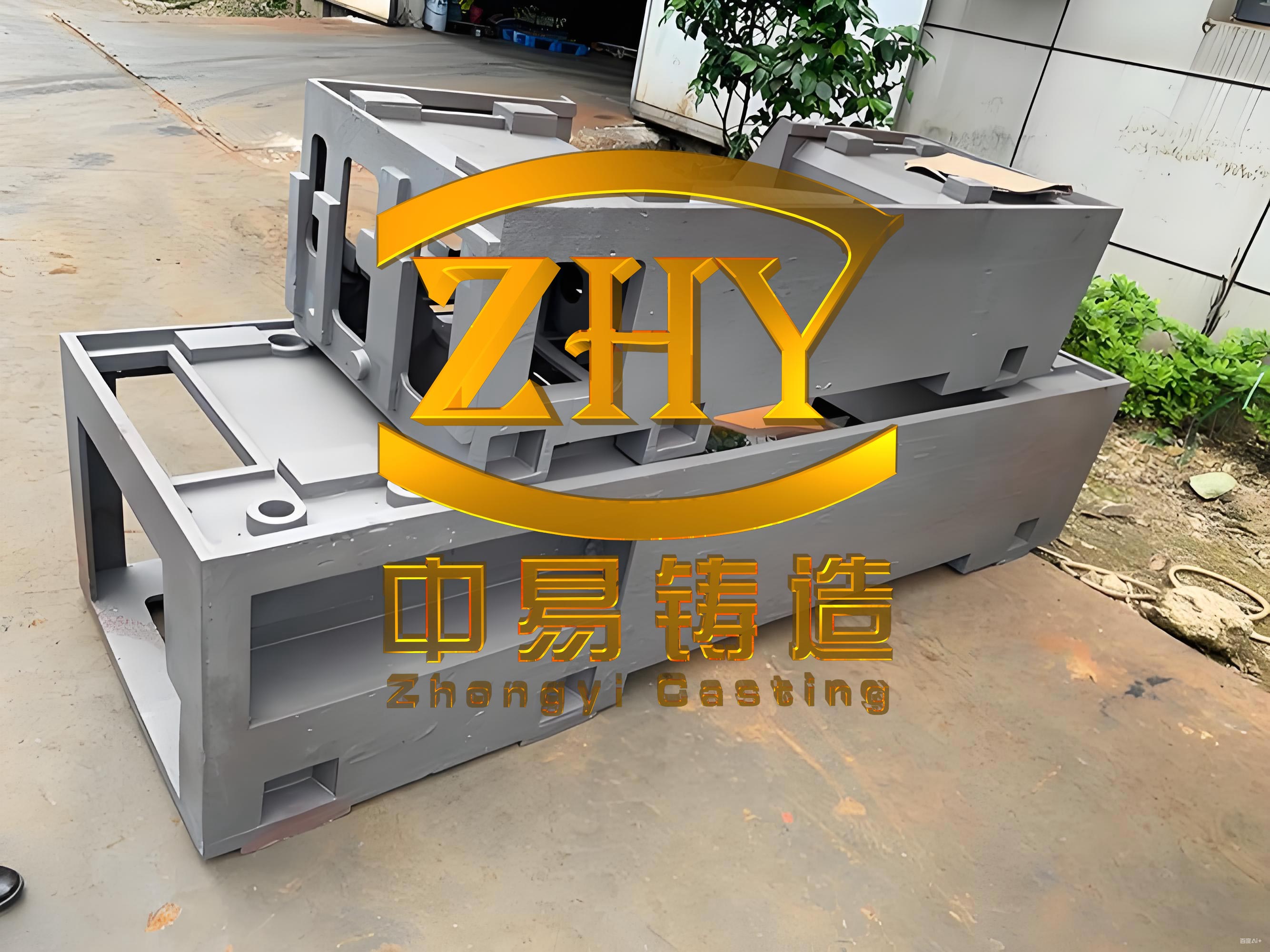
Operational practices in molding and mold assembly are equally vital for the stability of machine tool castings production. Sand compaction must be uniform, especially in recessed areas, to prevent sand inclusions and mechanical burns. For cores, we use a dedicated production line with vibration compaction tables to achieve consistent density. In molding, although manual compaction is often used for varied batches, we have implemented devices like screw or hydraulic jacks at the four corners of mold boxes to facilitate easy pattern removal, reducing damage and ensuring mold integrity. During mold assembly, it is crucial to verify that the parting surfaces are coplanar; misalignment can cause casting distortion, so adjustments are made to the foundation supports to maintain flatness. Additionally, vent channels in cores and molds must align to allow proper gas escape, minimizing porosity in machine tool castings. After rough machining, stress relief annealing is performed in computer-controlled natural gas furnaces, with precise temperature cycles to eliminate residual stresses and enhance dimensional stability. The annealing process can be described by the equation: $$ \sigma_r = \sigma_0 \cdot e^{-kt} $$ where \(\sigma_r\) is the residual stress, \(\sigma_0\) is the initial stress, \(k\) is a material constant, and \(t\) is time. This thermal treatment is essential for maintaining the accuracy of machine tool castings over time.
Through the implementation of these comprehensive measures, we have achieved significant improvements in the quality of machine tool castings. The surface roughness consistently meets Ra 12.5-50 μm, dimensional accuracy reaches CT11 grade in mass production, and the defect rejection rate has been reduced to 3%. Statistical process control data shows that the maturity degree, relative strength, and relative hardness of the castings align with international standards, confirming the effectiveness of our approach. For instance, the maturity degree (RG) is calculated as: $$ RG = \frac{\text{Actual Tensile Strength}}{\text{Theoretical Tensile Strength}} $$ and often exceeds 1.0, indicating superior material utilization. The table below illustrates the hardness values measured on guide surfaces of typical machine tool castings, demonstrating the uniformity achieved:
| Casting Type | Mass (kg) | Test Position | Hardness (HBS) |
|---|---|---|---|
| Japanese Machine Bed | 13,000 | End 1 | 176 |
| Middle | 200 | ||
| End 2 | 181 | ||
| Grinder Bed | 2,570 | Short V-Guide | 200 |
| Long V-Guide | 210 | ||
| Thin-Wall Machining Surface | 215 |
In conclusion, the stable production of high-quality machine tool castings requires an integrated approach that addresses every stage of the manufacturing process. From advanced melting techniques and precise composition control to optimized gating systems and meticulous operational practices, each element contributes to achieving the desired material properties, dimensional accuracy, and surface finish. The use of high scrap ratios, alloying elements, and controlled sand systems has proven effective in enhancing the performance of machine tool castings, as evidenced by the mechanical data and low rejection rates. By continuously refining these methods and adhering to strict quality standards, we can meet the evolving demands of the precision machinery industry, ensuring that our machine tool castings deliver reliability and longevity in critical applications. Future work may focus on further optimizing the cost-effectiveness and sustainability of these processes while maintaining the high standards required for machine tool castings.