
In my extensive involvement with manganese steel casting foundries, I have often encountered challenges stemming from the standards governing austenitic manganese steel castings. The release of GB/T5680-1998, which superseded earlier versions, was intended to harmonize specifications, yet a thorough analysis reveals several inconsistencies and ambiguities that can impede production and quality assurance in manganese steel casting foundry operations. This article delves into these issues, employing tables and formulas to summarize key points, while advocating for clearer, unified standards to benefit the entire manganese steel casting foundry industry.
The importance of standards in a manganese steel casting foundry cannot be overstated; they dictate chemical compositions, heat treatment protocols, mechanical properties, and testing methods, ensuring reliability and performance in applications like mining equipment, crusher liners, and railway components. However, when standards contain errors or allow multiple interpretations, they create confusion for designers, manufacturers, and end-users. Based on my review, GB/T5680-1998 exhibits several problematic areas that merit discussion.
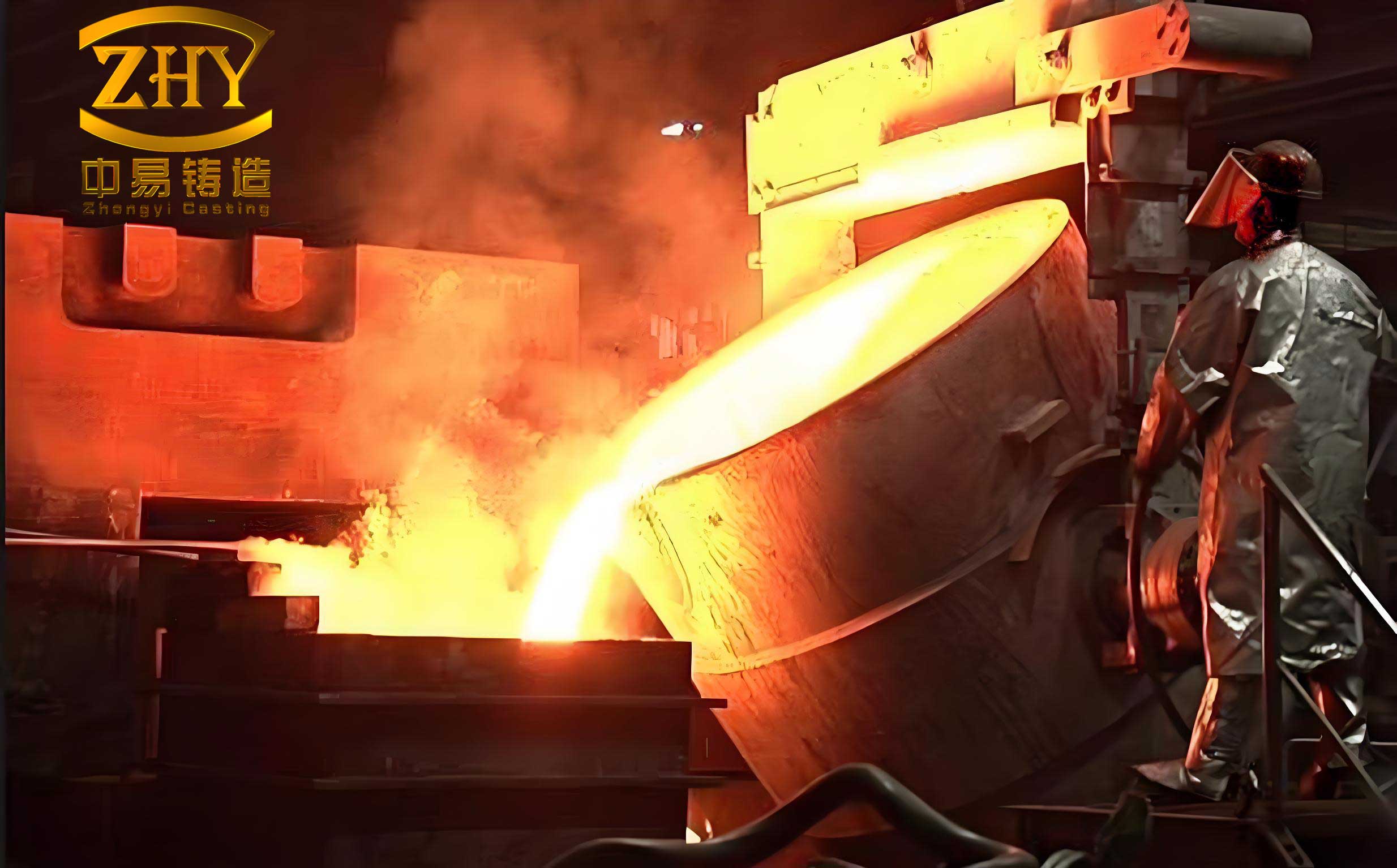
First, regarding steel grades, the standard claims to add ZGMn13-4 and ZGMn13-5, but ZGMn13-4 existed in the previous GB5680-85, and the consolidation with ZGMn13-2 alters its specifications. This can lead to misunderstandings in a manganese steel casting foundry when selecting materials. Moreover, the equivalence to foreign standards like JIS G5131 SCMnH11 and ANSI/ASTM A128E-1 raises questions about dual standardization. For instance, the chemical composition ranges for similar grades vary across standards, as shown in Table 1, which compares different standards for manganese steel casting foundry reference.
| Standard | Grade | C | Si | Mn | P ≤ | S ≤ | Cr | Mn/C Ratio ≥ |
|---|---|---|---|---|---|---|---|---|
| GB/T5680-1998 | ZGMn13-1 | 1.00–1.45 | 0.30–1.00 | 11.00–14.00 | 0.090 | 0.040 | – | – |
| JB6404-92 | ZGMn13-1 | 1.10–1.50 | 0.30–1.00 | 11.00–14.00 | 0.090 | 0.050 | – | – |
| YB3210-80 | ZGMn13-1 | 1.00–1.40 | 0.30–0.70 | 11.00–14.00 | 0.090 | 0.040 | – | 9.0 |
| GB/T5680-1998 | ZGMn13-4 | 0.90–1.30 | 0.30–0.80 | 11.00–14.00 | 0.070 | 0.040 | 1.50–2.50 | – |
| JB6404-92 | ZGMn13Cr2 | 1.05–1.35 | 0.30–1.00 | 11.00–14.00 | 0.070 | 0.050 | 1.50–2.50 | – |
| YB3210-80 | ZGMn13-Cr2 | 0.90–1.30 | 0.30–0.80 | 11.00–14.00 | 0.080 | 0.040 | 1.50–2.50 | – |
From Table 1, it is evident that even for the same nominal grade, composition limits differ, which can affect the microstructure and properties in a manganese steel casting foundry. The Mn/C ratio, for example, is specified only in YB3210-80, and its importance for austenite stability can be expressed as: $$ \text{Mn/C ratio} = \frac{\text{Mn content}}{\text{C content}} \geq 9.0 $$ This ratio influences the avoidance of carbide precipitation during water toughening, a critical heat treatment process in manganese steel casting foundry operations. Inconsistencies here may lead to varied performance outcomes.
Second, the standard cites reference standards with outdated or incorrect codes, such as GB229-1994 instead of GB/T229-1994. This might seem minor, but in a manganese steel casting foundry, accurate referencing is crucial for testing compliance. Furthermore, terminology misuse is prevalent. For instance, GB/T5680-1998 uses “yield strength” interchangeably with σs, but GB228-87 (tensile testing) replaces this with terms like proof stress (σp0.01). Similarly, “impact work” is used instead of “impact absorbed energy” (AK) per GB/T229-1994. Such discrepancies can confuse technicians in a manganese steel casting foundry when interpreting test results. The relationship between hardness and tensile properties might be approximated by formulas like: $$ \text{HBS} \approx k \cdot \sigma_y $$ where HBS is Brinell hardness, σy is yield strength, and k is a material-dependent constant. However, without precise terminology, correlations become ambiguous.
Third, several clauses in GB/T5680-1998 are vague or difficult to implement in a manganese steel casting foundry. For example, clause 4.3.2 states that castings should be “uniformly heated” during water toughening. In practice, achieving uniform heating in large or complex castings is challenging, and the standard lacks quantitative guidelines. This can be modeled using heat transfer equations: $$ \frac{\partial T}{\partial t} = \alpha \nabla^2 T $$ where T is temperature, t is time, and α is thermal diffusivity. Without specific parameters, a manganese steel casting foundry may adopt variable practices, leading to inconsistent properties.
Another vague term is “larger range” in clause 4.7.2 regarding weld repair extent. Without definition, it opens doors for disputes between suppliers and customers in manganese steel casting foundry transactions. Additionally, clause 5.6.1.2 on chemical analysis sample collection from the “ladle interior” is impractical; sampling during pouring is more feasible. These ambiguities hinder quality control in manganese steel casting foundries.
Fourth, the standard allows manufacturers to choose inspection items based on their testing capabilities (clause 6.5.4), contradicting Appendix A, which lists supplementary requirements like metallographic examination, mechanical tests, bend tests, and non-destructive testing as optional but negotiable. In a manganese steel casting foundry, this can lead to selective testing, compromising product integrity. For instance, bend test requirements in Appendix A specify a sample size of 13 mm × 19 mm (1/2 in × 3/4 in), but converting from inches: $$ 1 \, \text{in} = 25.4 \, \text{mm} \implies 0.5 \, \text{in} = 12.7 \, \text{mm}, \quad 0.75 \, \text{in} = 19.05 \, \text{mm} $$ The standard rounds these to 13 mm and 19 mm, which may seem trivial but affects test accuracy. Moreover, the term “cold bend” is used without reference to GB232-88 (bend test method), which specifies test temperatures. In manganese steel casting foundry contexts, bending behavior can be temperature-sensitive, described by: $$ \delta = f(T, \epsilon) $$ where δ is bend angle, T is temperature, and ε is strain.
Fifth, the coexistence of multiple standards—GB/T5680-1998, YB3210-80, JB6404-92, and JC401.1-91—creates hazards for the manganese steel casting foundry industry. As Table 1 shows, similar compositions have different grade designations (e.g., ZGMn13-4 vs. ZGMn13Cr2), while identical grades have varying compositions. This fragmentation complicates material selection, production planning, and international trade. For a manganese steel casting foundry, adhering to one standard might not satisfy clients following another, necessitating costly adjustments. The mechanical properties, such as impact toughness, can be affected by composition variations. The impact absorbed energy AK might relate to composition via: $$ A_K = \beta_0 + \beta_1 \cdot \text{C} + \beta_2 \cdot \text{Mn} + \beta_3 \cdot \text{Cr} $$ where β coefficients are derived from regression analysis. Inconsistent compositions thus yield unpredictable performance.
To illustrate further, consider the hardness requirements in GB/T5680-1998. Table A1 lists HBS ≤ 300 for some grades, but clause A4.1.3 states hardness as an acceptance condition only if agreed upon. This duality can confuse a manganese steel casting foundry during quality audits. Hardness after water toughening is critical for wear resistance, often correlated with work-hardening capacity: $$ \text{Hardening rate} = K \cdot \epsilon^n $$ where ε is strain, and K and n depend on composition and microstructure. Standardizing these relationships would aid manganese steel casting foundries in predicting service life.
In terms of metallurgical aspects, the standard calls for “metallographic structure inspection” (Appendix A3), but GB7232-87 uses “metallographic examination.” In a manganese steel casting foundry, proper terminology ensures consistent evaluation of austenite grain size and carbide distribution. The volume fraction of carbides Vc can be estimated from composition: $$ V_c \propto \text{C content} – \text{solubility limit in austenite} $$ Clear guidelines are essential for reproducibility.
Additionally, the standard’s proposal unit is listed as the former Ministry of Mechanical Industry, which should be updated to reflect current administrative bodies. Such oversights may not directly impact a manganese steel casting foundry’s daily operations but indicate a lack of revision rigor.
Looking beyond GB/T5680-1998, the broader issue is the proliferation of standards. For example, bend testing is categorized separately from mechanical testing in clause 6.5, though it is a mechanical test. This misclassification can lead to oversight in a manganese steel casting foundry’s testing regimen. The bending stress σb during testing can be calculated as: $$ \sigma_b = \frac{3FL}{2bd^2} $$ where F is load, L is span, b is width, and d is thickness. Standardizing test parameters across all standards would reduce confusion.
To address these challenges, I propose several recommendations for the manganese steel casting foundry sector. First, unify the grade system across all national and industry standards, consolidating similar compositions into single designations. This would simplify procurement and production planning in manganese steel casting foundries. Second, revise terminology to align with latest international norms, such as ISO standards for mechanical testing. Third, eliminate vague clauses by specifying quantitative limits—e.g., define “larger range” for weld repair as a percentage of casting surface area. Fourth, harmonize inspection requirements, making critical tests like chemical analysis and impact testing mandatory, regardless of a manganese steel casting foundry’s in-house capabilities. Fifth, update reference standards and administrative details to reflect current practices.
The benefits of such reforms are manifold. For a manganese steel casting foundry, streamlined standards reduce training costs, minimize rework, and enhance product consistency. They also facilitate exports by aligning with global standards like ASTM or JIS. Moreover, clear standards support innovation in manganese steel casting foundry processes, such as optimizing water toughening cycles using computational models: $$ T(t) = T_0 + (T_{\text{max}} – T_0) \left(1 – e^{-t/\tau}\right) $$ where T(t) is temperature over time, T0 is initial temperature, Tmax is soaking temperature, and τ is time constant.
In conclusion, the current landscape of standards for manganese steel castings presents significant hurdles for manganese steel casting foundries worldwide. Through detailed analysis of GB/T5680-1998 and comparison with other standards, I have highlighted issues ranging from terminology and composition inconsistencies to ambiguous clauses. By incorporating tables and formulas, this discussion underscores the need for precision and unity. As the manganese steel casting foundry industry evolves, embracing digitalization and advanced metallurgy, robust standards will be pivotal for quality, safety, and competitiveness. I urge standards bodies, manufacturers, and end-users to collaborate on creating a coherent framework that fosters growth and reliability in manganese steel casting foundry operations globally.