
As an analyst deeply embedded within the advanced manufacturing and aerospace sector, I observe the competitive landscape through the lens of technological capability and strategic execution. Howmet Aerospace Inc. stands as a paramount case study in this regard. Its evolution from a diversified industrial entity to a focused leader in precision investment casting and forged components offers critical insights. The imperative for companies, especially those in nations rapidly developing their aerospace industrial base, is not merely to emulate but to decode the underlying principles of Howmet’s success. This analysis synthesizes observable data, industry trends, and strategic frameworks to dissect Howmet’s positioning, with a particular focus on the core discipline of precision investment casting, and extrapolates actionable intelligence for peer enterprises.
I. Introduction: The Centrality of Advanced Manufacturing in Aerospace
The aerospace industry represents the apex of engineering complexity, where material science, thermodynamics, and precision manufacturing converge. In this ecosystem, companies that master the production of mission-critical components, particularly for propulsion and airframe structures, wield significant influence. Howmet Aerospace has carved its dominance precisely in this niche. Its journey underscores a critical thesis: sustainable leadership in modern aerospace is built not on scale alone, but on deep, proprietary mastery of processes like precision investment casting, coupled with a globally integrated operational model. For emerging aerospace manufacturers, the challenge is multifaceted—overcoming technological gaps, modernizing management paradigms, and executing a coherent global strategy. Analyzing Howmet provides a blueprint for navigating these challenges, transforming from participants into formidable competitors in the global supply chain.
II. Development Status and Financial Trajectory: A Quantitative Foundation
Howmet’s recent financial performance is the most direct indicator of its strategic health and market validation. The data reveals a consistent pattern of robust growth, significantly outpacing broader industrial production indices. This performance is fundamentally linked to the cyclical recovery and long-term growth of the commercial aerospace sector, where Howmet’s products are indispensable.
| Financial Metric | 2021 | 2022 | 2023 | 2024 (First Six Months) | CAGR / Growth Note |
|---|---|---|---|---|---|
| Total Revenue ($B) | ~5.0 (Est.) | 5.7 | 6.6 | 3.704 | CAGR ’21-’23: ~15% |
| Revenue Growth (YoY) | — | 14% | 17% | 13.93% (vs. H1 ’23) | Sustained double-digit growth |
| Commercial Aerospace Revenue Growth | — | 28% | 24% | N/A | Primary growth driver |
| Net Profit ($B) | N/A | 0.469 | 0.765 | 0.509 | Profit growth > Revenue growth in ’24 |
| Net Profit Margin | N/A | ~8.2% | ~11.6% | ~13.7% | Clear trend of margin expansion |
The table elucidates several strategic successes. First, the consistent revenue growth, particularly in the commercial aerospace segment, demonstrates strong alignment with market demand from OEMs like Airbus and Boeing as they ramp up production rates. Second, and more importantly, the expansion of net profit margin from 2022 to 2024 H1 indicates successful operational execution—likely through productivity gains, product mix enrichment towards higher-value components, and cost management. This margin expansion is a key financial hallmark of a company moving up the value chain, a movement inherently tied to advanced precision investment casting capabilities that command premium pricing and create high barriers to entry.
III. Innovation Strategy: The Engine of Technological Leadership
Howmet’s market position is defensible only through continuous innovation. Their strategy is not scattered but intensely focused on the domains that matter most for aerospace performance: advanced materials and the processes to shape them. A significant portion of this innovation orbits around advancing the art and science of precision investment casting.
1. Material Science as a Core Competency: The pursuit of superior alloys is relentless. The performance ceiling of engines is directly tied to the temperature capability of turbine blades, which are almost exclusively produced via precision investment casting using nickel-based superalloys. Howmet’s development of generations of single-crystal (SX) and directionally solidified (DS) alloys can be modeled as an optimization challenge. A simplified performance metric for a turbine blade alloy can be expressed as a function of key properties:
$$ \text{Alloy Performance Index } (API) = \frac{\sigma_y \cdot T_{melt} \cdot k_{creep}}{E \cdot \rho} $$
Where:
$\sigma_y$ = Yield strength
$T_{melt}$ = Melting temperature
$k_{creep}$ = Creep resistance coefficient (time-to-rupture at operational T/σ)
$E$ = Elastic modulus
$\rho$ = Density
Howmet’s R&D aims to maximize $API$. The introduction of rhenium and ruthenium into later-generation SX alloys dramatically improves $k_{creep}$ and $T_{melt}$. The shift to precision investment casting for these complex alloys is non-negotiable, as it is the only process that can create the intricate internal cooling channels and the controlled grain orientation necessary to withstand extreme conditions.
2. Process Innovation and Digital Integration: Innovation extends beyond chemistry into the physics of manufacturing. Howmet integrates digital tools to master the precision investment casting process:
- Digital Twin for Process Optimization: A virtual replica of the casting process is used to simulate solidification, predict defect formation (like porosity or freckles), and optimize parameters such as pouring temperature and mold heating before physical trials. This reduces scrap rates and development time.
- Additive Manufacturing for Tooling: While the final part may be a cast turbine blade, the ceramic cores and wax patterns used in precision investment casting are increasingly produced via 3D printing. This allows for more complex, conformal cooling channels that are impossible with traditional methods, directly boosting engine efficiency.
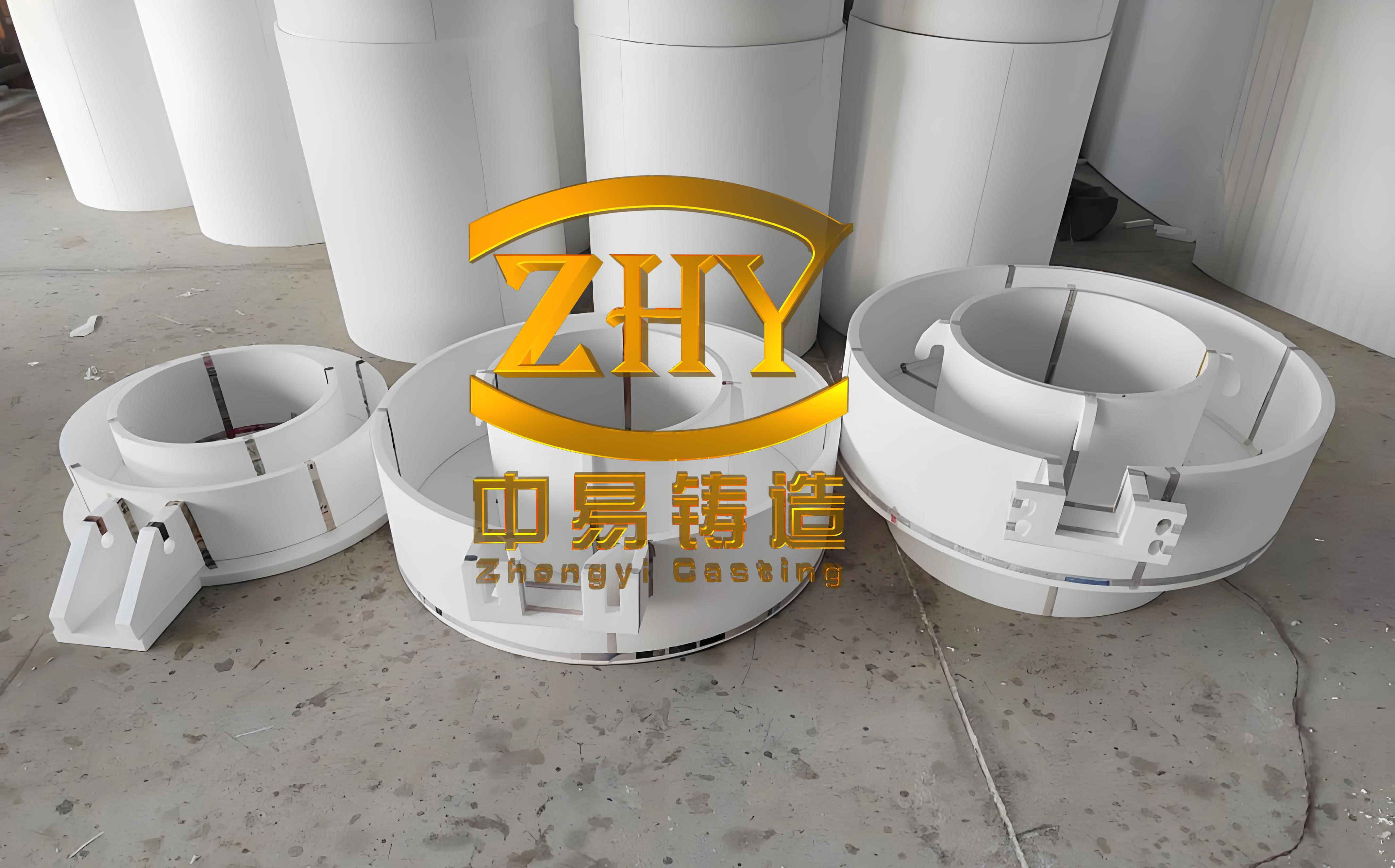
The following visual demonstrates the complexity inherent in a modern precision investment casting process flow, highlighting stages where digital intervention is critical:
3. The Collaborative “Innovation Ecosystem”: Howmet does not innovate in a vacuum. Its R&D is powerfully amplified through structured collaborations:
| Collaboration Type | Primary Partners | Strategic Objective | Outcome for Precision Investment Casting |
|---|---|---|---|
| Vertical Co-Development | OEMs (GE Aerospace, Rolls-Royce, Pratt & Whitney) | Integrate component design with engine architecture from inception. | New alloy/process development is demand-pulled, ensuring market readiness and performance validation. |
| Horizontal Research Alliances | Universities, National Labs | Explore fundamental material behaviors and novel process physics. | Access to foundational research on solidification dynamics, new refractory materials for molds. |
| Internal Cross-Pollination | Across its own global engineering centers | Leverage global talent pool and share best practices. | Rapid deployment of process improvements from one facility to all, standardizing excellence. |
This ecosystem ensures that billions of dollars in OEM R&D for next-generation engines flow directly into defining the requirements for the next generation of precision investment casting solutions.
IV. Global Strategic Layout: Integration and Risk Mitigation
Howmet’s global footprint of over 21 plants is a strategic asset, not merely a historical footprint. This network is orchestrated to achieve three primary objectives: proximity to key customers, optimization of production costs, and mitigation of geopolitical and supply chain risks.
| Region | Strategic Role | Key Competencies / Focus | Risk & Cost Calculus |
|---|---|---|---|
| Americas (USA, Mexico) | Home base & strategic capacity. Serves largest defense and commercial OEMs. | High-complexity casting and forging for engines (e.g., turbine blades, structural frames). Mexican operations often focus on components with higher labor content. | Proximity to Boeing, Lockheed Martin, GE. US operations carry higher cost but are essential for ITAR-controlled defense work. Mexico offers cost arbitrage. |
| Europe (UK, France, Germany, Italy) | Center of excellence for engine technology and Airbus supply chain integration. | Deep heritage in engine component precision investment casting. Close collaboration with Rolls-Royce, Safran, MTU. | Access to European talent and R&D networks. Mitigates currency risk and meets local content requirements for Airbus programs. |
| Asia (Growing presence) | Market access and growth hub. Supports rising COMAC demand and regional MRO market. | Initially may focus on components for regional jets and industrial gas turbines. Potential for future high-tech investment. | Taps into the fastest-growing aviation market. Lower-cost manufacturing base but faces intellectual property protection challenges. Strategic for long-term growth. |
The financial and operational benefit of this network can be framed as an optimization problem minimizing total landed cost while maximizing resilience. A simplified model for allocating production of a specific component might consider:
$$ \text{Total Cost}_{region} = (C_{labor} + C_{material} + C_{energy}) \cdot Q + C_{transport} + C_{tariff} + \rho \cdot C_{risk} $$
Where $\rho$ is a risk probability factor and $C_{risk}$ is the cost of disruption. Howmet’s global system allows it to dynamically evaluate this equation, shifting production weighting in response to changes in trade policy, energy costs, or regional demand spikes. This integrated supply chain is a formidable barrier to competitors with a single-region focus.
V. Implications and Strategic Recommendations for Aspiring Leaders
For aerospace manufacturers, particularly in developing industrial ecosystems, the lessons from Howmet are not about copying its footprint but about internalizing its principles. Success hinges on a triad of Technology, Talent, and Transformation.
1. Technology: Forge a “Research-to-Components” Pipeline. The goal must be to move beyond being a job shop to becoming a technology partner. This requires:
- Institutionalizing R&D Investment: Commit a fixed percentage of revenue (5-8%) to R&D, focused on precision investment casting process science. Establish national-level collaborative platforms with academia to share the burden of foundational research.
- Adopting a Digital-First Development Paradigm: Build a “Materials Informatics” database for casting parameters. Implement machine learning models to predict optimal gating and riser design, reducing the iteration cycle. The goal is to compress the development timeline for new castable alloys.
2. Talent: Architect a Global “Skill Supply Chain.” The workforce strategy must be as sophisticated as the manufacturing strategy.
| Tier | Role | Development Strategy | Retention Mechanism |
|---|---|---|---|
| Tier 1: Core Scientists | Drive fundamental material/process breakthroughs. | Recruit globally; establish “distinguished fellow” programs with university affiliations. | Project-based profit sharing; leadership in international technical committees. |
| Tier 2: Application Engineers | Translate R&D into production-ready processes. | “Project-in-Residence” model: embed engineers in OEM collaboration teams. | Clear technical career ladder parallel to management; international rotation programs. |
| Tier 3: Master Technicians | Execute complex precision investment casting operations. | Create accredited in-house “Casting Academy” with VR/AR simulation trainers. | Skill-based pay premiums; recognition as “company master.” |
3. Transformation: Execute a Holistic Digital and Green Transition.
- Full-Spectrum Digitalization: Move from isolated automation to a connected system. Implement IoT sensors on vacuum furnaces and thermal analysis stations. Use the data stream to feed AI-driven predictive maintenance models, minimizing unplanned downtime in critical precision investment casting units.
$$ \text{Predictive Maintenance Alert} = f(\text{Temp. Gradient}_{furnace}(t), \text{Cooling Rate Deviation}(t), \text{Heater Resistance}(t)) $$ - Supply Chain Digitization: Forge a blockchain-enabled platform with key raw material suppliers (e.g., nickel, cobalt, ceramic powder). This ensures traceability, verifies material pedigree (critical for quality), and provides real-time visibility into inventory buffers, enhancing resilience.
- Sustainability as a Competency: The precision investment casting process is energy-intensive. Innovations in rapid mold heating, waste shell recycling, and thermal energy recovery directly reduce the carbon footprint and operational cost. This green efficiency becomes a competitive advantage in tenders with environmentally conscious OEMs.
4. International Collaboration: Evolving from Subcontractor to Co-Developer. The path involves staged maturity:
- Stage 1 – Certified Supplier: Master quality and delivery for legacy components. This builds trust and demonstrates operational excellence.
- Stage 2 – Risk-Sharing Partner: Bid for packages on new engine programs, committing to development cost-sharing. This requires upfront investment in the precision investment casting technology needed for that specific engine.
- Stage 3 – Joint Technology Development: Establish joint venture R&D centers with OEMs or first-tier suppliers focused on next-generation materials and processes. This is the ultimate step towards capturing value and securing long-term positioning.
VI. Conclusion
The trajectory of Howmet Aerospace underscores a fundamental rule in 21st-century advanced manufacturing: leadership is sustained through the synergistic integration of deep process mastery, a globally optimized and resilient operational network, and an open yet strategic innovation culture. For competitors and aspirants, the call to action is clear. The focus must sharpen on owning the core science behind precision investment casting, transforming it through digitalization, and cultivating a world-class talent ecosystem. The strategies outlined here—from building digital twins for casting simulation to architecting a global talent pipeline—are not mere options but necessities for any enterprise aiming to transition from a component supplier to an indispensable engineering solutions partner. The future of aerospace manufacturing will be won by those who can optimally balance the equation of technological precision, operational intelligence, and strategic collaboration.