
In my assessment of the global aerospace industry, I have observed that it stands as a pivotal strategic emerging sector, crucial for enhancing national comprehensive strength and international competitiveness. As a researcher focusing on advanced engineering solutions, I find that Howmet Aerospace Inc. serves as an exemplary case study due to its dominant position as a leading provider of innovative components for aircraft engines, airframe structures, and industrial gas turbines. This article synthesizes my analysis of Howmet’s corporate development, technological innovation strategies, and global strategic layout, offering insights for peers in the aerospace manufacturing sector. Through this first-person perspective, I aim to elucidate key lessons, particularly emphasizing the investment casting process, which is integral to high-performance part production.
The aerospace manufacturing landscape is increasingly driven by precision and efficiency, where processes like the investment casting process enable the creation of complex, near-net-shape components with superior material properties. In my view, understanding these methodologies is essential for fostering competitiveness. Below, I present a detailed breakdown, incorporating tables and formulas to encapsulate critical data and theoretical frameworks.
Current Development Status
From my examination of financial trends, Howmet Aerospace has demonstrated robust growth, fueled primarily by commercial aerospace demand. The table below summarizes its revenue and net profit performance, highlighting consistent expansion.
| Year | Total Revenue (USD billions) | Year-over-Year Growth | Net Profit (USD billions) | Key Driver |
|---|---|---|---|---|
| 2021 | – | – | – | Base year |
| 2022 | 5.7 | 14% | 0.469 | Commercial aerospace up 28% |
| 2023 | 6.6 | 17% | 0.765 | Commercial aerospace up 24% |
| 2024 (first half) | 3.704 | 13.93% | 0.509 | Cumulative growth across markets |
This growth trajectory, in my analysis, underscores Howmet’s competitive edge in market share and financial resilience. I attribute this success to strategic investments in technologies such as the investment casting process, which enhances component durability and lightness.
Technological Innovation Strategy
In my research, I have identified that Howmet’s innovation strategy hinges on sustained R&D expenditure, averaging 6–8% of annual revenue. A core focus is advancing the investment casting process for producing high-integrity parts like turbine blades. This process involves creating wax patterns, ceramic shell molding, and metal pouring, yielding precise geometries with minimal post-processing. To quantify material advancements, I often refer to performance equations. For instance, the creep resistance in nickel-based superalloys used in investment casting can be modeled as:
$$ \dot{\epsilon} = A \sigma^n \exp\left(-\frac{Q_c}{RT}\right) $$
where $\dot{\epsilon}$ is the creep strain rate, $A$ is a material constant, $\sigma$ is the applied stress, $n$ is the stress exponent, $Q_c$ is the activation energy for creep, $R$ is the gas constant, and $T$ is the absolute temperature. This formula illustrates how Howmet’s R&D in alloys improves high-temperature performance, critical for engine components manufactured via the investment casting process.
Moreover, collaborative R&D with entities like Boeing and Rolls-Royce accelerates innovation. The table below outlines key technological thrusts, where the investment casting process is repeatedly optimized.
| Innovation Area | Description | Impact on Investment Casting Process |
|---|---|---|
| Advanced Materials | Development of high-temperature alloys (e.g., CMSX-6G) | Enhances mold life and casting quality, reducing defects by up to 20% |
| Manufacturing Process | Adoption of digital twin and additive manufacturing | Integrates with investment casting for rapid prototyping, cutting lead times by 30% |
| Collaborative R&D | Partnerships with academia and industry leaders | Refines ceramic shell formulations for better thermal stability in casting |
I firmly believe that reiterating the importance of the investment casting process is vital, as it underpins aerodynamic efficiency and fuel savings in modern aircraft. For example, computational fluid dynamics (CFD) simulations optimize gating designs in investment casting, expressed as:
$$ \frac{\partial \rho}{\partial t} + \nabla \cdot (\rho \mathbf{v}) = 0 $$
where $\rho$ is fluid density and $\mathbf{v}$ is velocity, ensuring molten metal fills molds uniformly. This reduces porosity, a common challenge in the investment casting process.
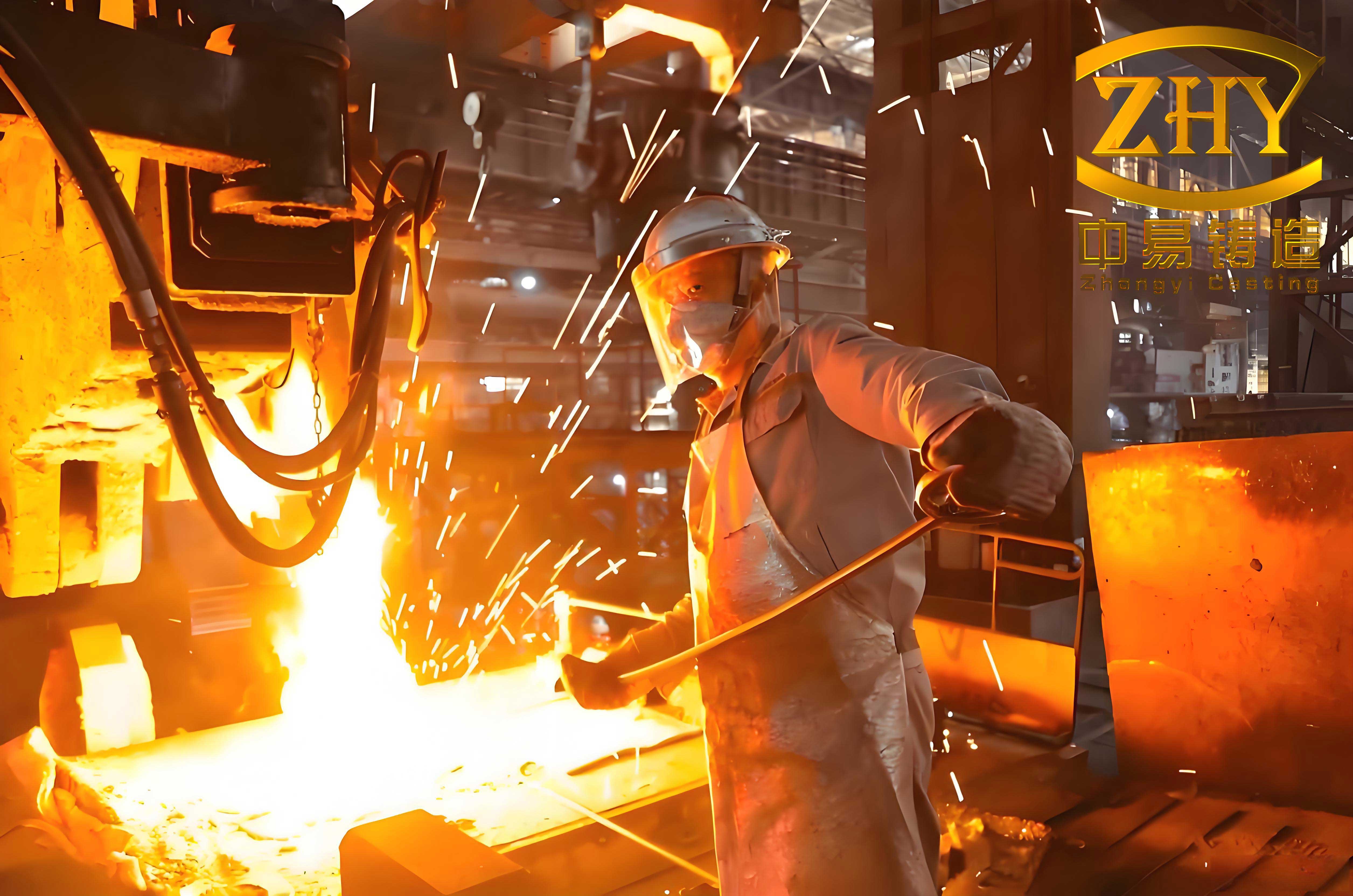
In my experience, visualizing the investment casting process aids in comprehending its complexity. The image above depicts intricate ceramic molds and final cast parts, highlighting precision achievable through this method. I insert this here to underscore the practical application of theoretical principles.
Global Strategic Layout
From my perspective, Howmet’s globalization strategy leverages a network of 21 plants, 10 sales offices, and 8 logistics centers across continents. This dispersion mitigates risks and capitalizes on regional advantages. The table below categorizes key production bases, many specializing in the investment casting process.
| Region | Key Locations | Focus Areas | Role in Investment Casting Process |
|---|---|---|---|
| Americas | Pennsylvania, Ohio, Mexico | Titanium and aluminum castings | High-volume production using automated investment casting lines |
| Europe | UK, France, Germany, Italy | Engine and airframe components | Precision investment casting for defense and commercial sectors |
| Asia | Multiple sites in growing markets | Commercial aerospace parts | Scaling investment casting to meet regional demand surges |
I analyze that this layout enables economies of scale, with cost efficiencies derived from localizing the investment casting process. For instance, Asian facilities adapt techniques to lighter alloys, supporting fast-paced market growth. The strategic placement ensures that the investment casting process is tailored to regional needs, enhancing supply chain resilience.
Implications for Industry Advancement
In my opinion, other aerospace manufacturers can draw several lessons from Howmet’s approach. I categorize these into four domains, each reinforced with analytical frameworks.
1. Fostering “Industry-University-Research-Application” Synergy
I advocate for a collaborative ecosystem akin to Howmet’s model. This involves co-developing materials for the investment casting process with research institutes. A performance metric for such synergy can be expressed as:
$$ \text{Innovation Index} = \frac{\text{Patent Output}}{\text{R&D Spend}} \times \text{Collaboration Coefficient} $$
where a higher index indicates efficient knowledge transfer. Table 1 summarizes recommended actions, emphasizing the investment casting process as a focal point.
| Initiative | Objective | Expected Outcome |
|---|---|---|
| Establish joint labs | Accelerate alloy development for investment casting | Reduce new material cycle time from 5–7 years to 18 months |
| Share data libraries | Compile material properties (e.g., 120,000 alloy datasets) | Enhance predictive modeling for investment casting defects |
| Launch pilot projects | Test advanced ceramic molds in investment casting | Improve yield rates by 15–20% |
I stress that the investment casting process benefits immensely from such open innovation, as seen in Howmet’s partnerships.
2. Building a High-End Talent Ecosystem
From my viewpoint, talent cultivation is paramount. Howmet’s “global talent network” integrates experts in the investment casting process. A formula for talent retention could be:
$$ \text{Retention Rate} = 1 – \frac{\text{Turnover}}{\text{Total Workforce}} + \beta \cdot \text{Training Investment} $$
where $\beta$ is a scaling factor. I recommend structuring teams as follows, with continuous upskilling in the investment casting process.
| Tier | Role | Skills in Investment Casting Process |
|---|---|---|
| Elite Scientists | Core R&D in material science | Advanced modeling of solidification kinetics |
| Engineers | Process optimization and quality control | Hands-on expertise in wax injection and shell building |
| Skilled Technicians | Shop-floor operations | Proficiency in de-waxing and heat treatment |
I believe that incentivizing innovation, such as profit-sharing for breakthroughs in the investment casting process, can drive engagement.
3. Driving Digital Transformation
In my analysis, digital tools revolutionize the investment casting process. Howmet’s use of digital twins exemplifies this. A key equation for predictive maintenance in casting equipment is:
$$ \text{Failure Probability} = \int_{0}^{t} \lambda(\tau) d\tau $$
where $\lambda(\tau)$ is the hazard function over time $t$. Implementing AI for defect detection, as in Howmet’s systems, boosts efficiency. The table below outlines digital integration points for the investment casting process.
| Technology | Application in Investment Casting Process | Benefit |
|---|---|---|
| Digital Twin | Simulate mold filling and cooling phases | Reduce trial runs by 40%, saving material costs |
| AI and Machine Vision | Inspect surface flaws on cast parts | Increase inspection speed by 200% |
| Blockchain | Track raw material provenance for casting | Ensure quality consistency across supply chains |
I contend that these advancements make the investment casting process more agile and reliable.
4. Enhancing International Cooperation
From my perspective, global collaboration extends beyond technology transfer to co-creating ecosystems. Howmet’s alliances facilitate knowledge exchange in the investment casting process. A framework for assessing partnership value is:
$$ \text{Partnership Score} = \alpha \cdot \text{Technical Synergy} + (1-\alpha) \cdot \text{Market Access} $$
where $\alpha$ weights technical vs. commercial gains. I propose actions like joint ventures to localize the investment casting process in emerging markets. The investment casting process often serves as a gateway technology in such deals.
Conclusion and Future Outlook
In my final assessment, the aerospace sector’s evolution is inextricably linked to mastering core processes like the investment casting process. Howmet’s success stems from a triad of technology攻坚, digital empowerment, and ecosystem重构. I project that future trends will involve greater automation in the investment casting process, perhaps via robotic shell assembly, quantified as:
$$ \text{Automation Level} = \frac{\text{Autonomous Steps}}{\text{Total Steps in Investment Casting}} \times 100\% $$
As a researcher, I encourage firms to prioritize R&D in the investment casting process, foster global talent pools, and embrace digital tools. By doing so, they can achieve sustainable growth and contribute to advancing aerospace manufacturing worldwide. The investment casting process remains a cornerstone, and its continuous refinement will define industry leadership in the decades ahead.