
In my experience at a railway component manufacturing facility, I have frequently encountered surface inclusion defects in high manganese steel castings, particularly in crossover components. These defects predominantly manifest on the vertical walls and base plates of the casting ends. The presence of such inclusions not only necessitates extensive repair welding, adversely affecting the surface quality, but also compromises the integrity of the matrix, leading to a reduction in the component’s overall strength. Historically, this issue resulted in an annual average scrap rate exceeding 100 pieces, translating to economic losses of over one million yuan. To address this persistent challenge, I led a series of investigative studies and experiments focused on the origin, composition, and elimination of these inclusions in high manganese steel castings. This article details the countermeasures we developed and implemented, which yielded significant improvements.
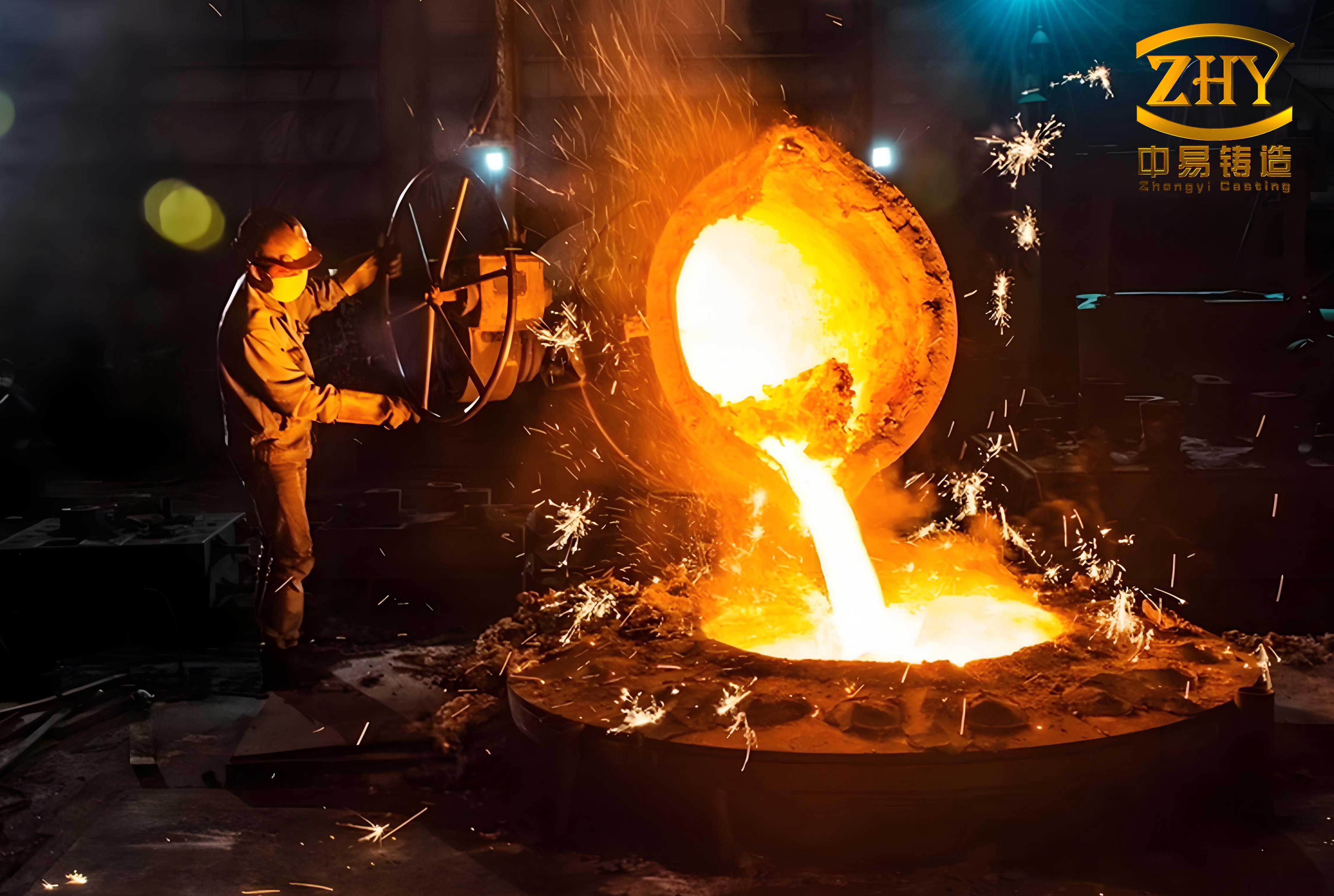
The production of high manganese steel castings is a complex process where controlling non-metallic inclusions is paramount for ensuring durability and performance. Our initial step was to conclusively identify the source of these detrimental surface inclusions. Chemical composition analysis of samples extracted from defective casting surfaces was conducted. The results indicated a high content of MgO, approximately 12% by mass, with only trace amounts of SiO2. This finding was pivotal, as it ruled out the molding sand (which primarily decomposes to SiO2) as the contamination source. Instead, it pointed unequivocally to the slag from the electric arc furnace refining process and the refractory materials lining the ladle used for molten steel transfer. This confirmed that the inclusions were endogenous, originating from within the metallurgical process rather than the mold environment.
Upon determining the source, we meticulously analyzed the morphology, color, and composition of the inclusions to classify their formation mechanisms. We identified three primary types, as summarized in the table below. This classification was crucial for devising targeted removal strategies.
| Type | Morphology & Color | Primary Composition | Formation Mechanism |
|---|---|---|---|
| A | Yellowish powder, often mixed with white granular material | Fireclay and Magnesite | Loose refractory materials placed on the ladle bottom are scoured by the turbulent stream during tapping, becoming entrapped in the molten high manganese steel casting. |
| B | Yellow-green, porous agglomerates | Furnace Slag | Incomplete separation of slag and steel during tapping (slag carry-over). The slag fails to float out of the molten high manganese steel casting before solidification. |
| C | Black, hard inclusions, sometimes with white grains | Ladle Lining Brick Spalls | Erosion or spalling of the ladle’s refractory lining bricks during tapping, with fragments entering the melt of the high manganese steel casting. |
Our observations indicated that Type A and B inclusions were the most prevalent on the surface of the high manganese steel castings, while Type C occurrences were relatively rare. Consequently, our research efforts concentrated on eliminating Type A and B defects. The successful production of clean high manganese steel castings requires a dual approach: preventing the introduction of exogenous particles and promoting the removal of endogenous ones.
Countermeasure 1: Reformation of Ladle Lining Practice to Eliminate Type A Inclusions
The traditional ladle preparation practice involved lining the bottom with fireclay bricks. To protect these bricks from direct impact and thermal shock during tapping, a layer of granular refractory material, approximately 80-100 mm thick, was rammed on top before each heat. This ramming mix typically consisted of magnesite, fireclay, and magnesium chloride brine. However, we discovered that this very layer was a primary source of Type A inclusions. During tapping, the high-velocity stream of molten high manganese steel violently fluidized and eroded this unconsolidated layer, dispersing fine refractory particles into the melt. These particles, especially when the slag viscosity was high, had limited buoyancy and remained suspended, ultimately being incorporated into the casting.
To eradicate this source, we revolutionized our ladle bottom construction. We replaced the conventional fireclay bricks with a new generation of Alumina-Magnesia-Carbon (Al-Mg-C) composite bricks. These bricks exhibit superior thermal shock resistance, erosion resistance, and mechanical strength at high temperatures. The key change was the elimination of the loose granular bedding layer entirely. With the new Al-Mg-C bottom, the molten steel directly impinges on a monolithic, durable refractory surface. The comparison of the old and new practices is detailed in the following table.
| Practice | Ladle Bottom Brick Material | Loose Bedding Material | Frequency of Type A Inclusions | Average Ladle Campaign Life (Heats) |
|---|---|---|---|---|
| Old Practice | Fireclay | Magnesite + Fireclay + Brine | High / Frequent | ~20 |
| New Practice | Al-Mg-C Composite | None | Virtually Eliminated | >60 |
The implementation of this countermeasure was immediately effective. The surface quality of subsequent high manganese steel castings showed a dramatic reduction in the yellowish powder-type defects. This single change addressed a significant root cause of contamination in our high manganese steel casting process.
Countermeasure 2: Optimization of Slag Practice to Eliminate Type B Inclusions
While eliminating Type A inclusions was a major step, Type B inclusions stemming from slag entrapment remained a challenge. Initially, we hypothesized that the type of reducing slag at tap—white slag versus carbide slag—was critical. Theoretical knowledge suggests white slag, with a composition high in CaO and SiO2, is more fluid and separates more easily from steel than a viscous carbide slag. We meticulously recorded slag conditions at tap for numerous heats of high manganese steel. Consistently, the slags were white, characterized by a white, powdery appearance upon cooling (typical basicity CaO/SiO2 > 2). However, the incidence of surface slag inclusions on the castings did not correlate strongly with this factor alone.
We then shifted our focus to the physical property of the slag: its viscosity and fluidity at tapping temperature. We established a clear empirical correlation: when the slag at tap was highly viscous and poorly fluid (evidenced by rapid crust formation or “boarding” in the ladle after tap), the resulting high manganese steel castings exhibited numerous and sometimes large slag inclusions. Conversely, heats tapped with fluid, freely flowing slag produced castings with markedly fewer such defects. The data from a series of experimental heats is summarized below.
| Heat Number | Tapping Temperature (°C) | Slag Color | Estimated Basicity (R=CaO/SiO2) | Slag Fluidity Observation | Relative Abundance of Type B Inclusions |
|---|---|---|---|---|---|
| 001 | 1560 | White | >2.0 | Poor (Rapid Boarding) | High, with large agglomerates |
| 002 | 1560 | White | >2.0 | Fair | Moderate |
| 005 | 1550 | White | >2.0 | Good (Free Flowing) | None Observed |
| 010 | 1550 | White | >2.0 | Poor | High |
The viscosity (η) of a slag is a critical factor influencing reaction kinetics and inclusion removal. According to classical slag theory, the viscosity is highly dependent on composition and temperature. A fundamental relationship for the temperature dependence is given by the Arrhenius-type equation:
$$ \eta = A \cdot \exp\left(\frac{E_{\eta}}{RT}\right) $$
where \(A\) is a pre-exponential factor, \(E_{\eta}\) is the activation energy for viscous flow, \(R\) is the universal gas constant, and \(T\) is the absolute temperature. For a given temperature, the composition dictates \(E_{\eta}\). The primary objective was to lower the slag’s melting point and viscosity to enhance fluidity and promote the coalescence and flotation of non-metallic inclusions from the high manganese steel casting melt.
Theoretical principles state that for a basic slag (high CaO), the addition of acidic oxides (like SiO2) or fluxing agents (like CaF2, FeO, MnO) can significantly reduce the melting point and viscosity. In our basic slag practice for high manganese steel, FeO and MnO levels are kept low during reduction to prevent re-oxidation, limiting their fluxing effect. While fluorspar (CaF2) is a powerful flux, its use can sometimes lead to overly thin slags, increased gas pickup, and environmental concerns. Our trials with CaF2 showed inconsistent improvement in the desired slag fluidity for high manganese steel casting.
We therefore experimented with the controlled addition of acidic oxides to our basic slag system. The addition of crushed firebrick (containing ~40% Al2O3, ~50% SiO2) or silica sand (high SiO2) during the reducing period proved highly effective. The SiO2 reacts with free CaO in the slag, forming lower-melting-point calcium silicates. This reaction can be conceptually represented by the shift in the ternary CaO-SiO2-Al2O3 phase diagram towards lower liquidus temperatures. The change in slag structure reduces its polymerization degree, lowering viscosity. The optimal addition range determined through experimentation was 10-30 kg of firebrick pieces and 5-10 kg of silica sand per heat. This practice resulted in a stable, foamy slag with fine bubbles—a sign of good reducing power and active slag-metal interaction.
The improved slag had a lower viscosity, which directly enhances the flotation velocity of non-metallic inclusions according to Stokes’ law, a cornerstone theory for inclusion removal in molten metals like high manganese steel casting. The terminal rising velocity (\(v_t\)) of a spherical inclusion in a quiescent melt is given by:
$$ v_t = \frac{2}{9} \frac{(\rho_m – \rho_i) g r^2}{\eta} $$
where \(\rho_m\) is the density of the molten high manganese steel, \(\rho_i\) is the density of the inclusion, \(g\) is acceleration due to gravity, \(r\) is the radius of the inclusion, and \(\eta\) is the dynamic viscosity of the slag/metal interface. By reducing \(\eta\) through slag optimization, we increased \(v_t\), allowing smaller inclusions to float out more rapidly before the high manganese steel casting solidified. The modified slag practice ensured that any slag carried over during tap remained fluid in the ladle, enabling it to quickly separate and form a protective layer on top of the steel, rather than being entrapped as discrete inclusions during mold filling.
Comprehensive Application Results and Economic Impact
The synergistic implementation of both countermeasures—the Al-Mg-C ladle bottom and the optimized fluid slag practice—produced a transformative effect on the quality of our high manganese steel castings. The surface inclusion defect rate plummeted. Previously, scrap due to these defects averaged around 100 pieces annually, accounting for roughly 4% of production. After full implementation, the defect-related scrap rate was reduced to below 0.5%. Metallographic examination of test coupons from production heats consistently showed non-metallic inclusion ratings at an acceptable Level 1 or better according to relevant standards, confirming the internal cleanliness improvement alongside the surface quality enhancement.
The economic benefits were substantial. The annual reduction in scrap directly saved over 1 million yuan in potential losses. Furthermore, the reduced need for repair welding lowered labor and consumable costs and improved production throughput. The extended campaign life of the Al-Mg-C ladle bottoms (from 20 to over 60 heats) also contributed to cost savings in refractory consumption and ladle maintenance downtime. The overall quality and reliability of the high manganese steel castings were significantly enhanced, strengthening product reputation in the market.
Conclusion and Theoretical Synthesis
Through systematic investigation and process innovation, we successfully identified and mitigated the primary causes of surface inclusion defects in high manganese steel castings. The key conclusions are as follows. First, the predominant sources of surface inclusions in these castings are exogenous refractory materials from the ladle and endogenous furnace slag that fails to separate. Second, the elimination of loose granular bedding in the ladle by adopting a monolithic, high-performance Al-Mg-C bottom lining is a highly effective measure to prevent refractory-origin inclusions. Third, controlling slag chemistry and fluidity during the reduction period is critical. The deliberate addition of acidic oxides (SiO2 via firebrick/silica sand) to a basic slag system lowers its liquidus temperature and viscosity, described by modifications to its ionic structure and quantified by reduced activation energy for viscous flow. This enhanced fluidity promotes slag-metal separation and inclusion flotation, governed by Stokes’ law dynamics, leading to cleaner high manganese steel casting.
The success of this project underscores the importance of a holistic view in metallurgical processing. It is not sufficient to focus solely on the melting and alloying; the transfer and handling of molten metal—the “secondary metallurgy” steps—are equally crucial for achieving high-integrity high manganese steel castings. The principles established here, combining robust engineering solutions (ladle design) with fundamental process metallurgy (slag control), provide a replicable framework for improving the quality and yield of similar steel casting operations. The continuous pursuit of such improvements is essential for advancing the manufacturing technology of critical components like railway crossings made from high manganese steel casting.