
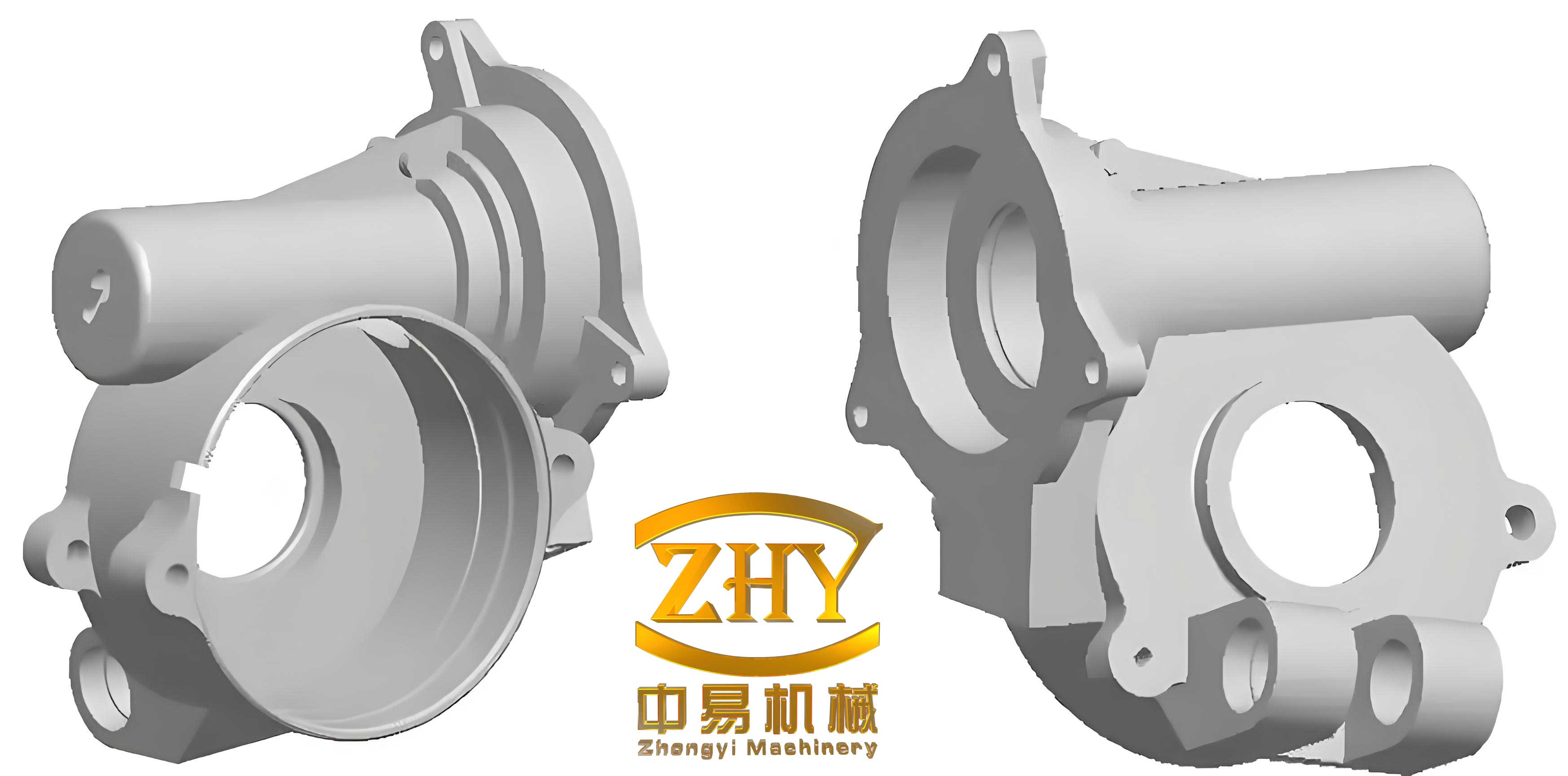
In modern high-voltage power systems, Gas-Insulated Switchgear (GIS) has gained widespread adoption due to its compact design, high reliability, excellent seismic resistance, low noise levels, and minimal maintenance needs. As a critical component within GIS, the disconnector ensures safe isolation of electrical circuits. The disconnector shell, typically fabricated as a casting from aluminum-silicon-magnesium alloy, must endure internal SF6 gas pressures ranging from 0.40 to 0.76 MPa during normal operation and withstand up to five times the design pressure without failure. Consequently, assessing the strength of these shell castings is paramount for ensuring structural integrity, safety, and cost-effectiveness. In this study, I employ a combination of finite element analysis (FEA) and experimental hydrostatic testing to evaluate stress distributions, perform strength assessments, and propose design enhancements for shell castings used in GIS disconnectors.
Shell castings are integral to numerous industrial applications, especially in power systems where they enclose vital components. The casting process involves pouring molten metal into molds, which can introduce inherent defects such as porosity, shrinkage, or inclusions. These defects may act as stress risers, potentially compromising the strength of shell castings. Therefore, non-destructive testing and advanced analytical methods like finite element analysis are essential to verify the integrity of shell castings. For disconnector applications, the complex geometry with openings and intersections presents unique challenges, making thorough strength analysis indispensable.
The strength analysis of shell castings focuses on their ability to resist deformation and failure under external loads. For geometrically intricate structures like disconnector shells with multiple openings and discontinuities, finite element analysis serves as a robust analytical tool. Openings in shell castings disrupt symmetry and induce stress concentrations, which can weaken the overall structure. Thus, understanding stress distributions at discontinuities is crucial for reliable design. This paper presents a comprehensive investigation into the strength of shell castings, incorporating stress classification based on pressure vessel standards, equivalent stress linearization techniques, and validation through hydrostatic testing.
According to established pressure vessel design principles, stresses in shell castings are categorized into primary stress, secondary stress, and peak stress. Primary stress arises from imposed loads and is necessary for equilibrium; secondary stress results from constraints or discontinuities; peak stress is highly localized and typically relevant only for fatigue analysis. Since peak stress is excluded from static strength assessment, the focus here is on primary and secondary stresses. The strength assessment criteria are summarized in Table 1, where $S_m$ denotes the allowable stress for the material.
| Stress Category | Allowable Limit |
|---|---|
| Primary Membrane Stress | $S_m$ |
| Primary Bending Stress | — |
| Primary Membrane + Primary Bending Stress | $1.5S_m$ |
| Primary Stress + Secondary Stress | $3S_m$ |
To perform strength assessment, equivalent stress linearization is required. This process involves selecting a stress evaluation path that originates at the point of maximum stress, traverses the entire thickness of the shell casting, and is perpendicular to the mid-surface of the cross-section. The path selection ensures that stresses are properly decomposed into membrane and bending components. For shell castings with openings or intersections, multiple paths may be analyzed to capture critical stress states.
The wall thickness $\delta$ of shell castings is calculated based on internal pressure $P_b$, inner diameter $D$, allowable stress $[\sigma]$, and safety factors. The formula is:
$$\delta = \frac{K \times P_b \times D}{2 \times [\sigma] – P_b} + C$$
where $K$ is a coefficient accounting for stress concentration at openings and manufacturing dispersity, and $C$ is an additional thickness for manufacturing tolerances. For the disconnector shell castings in this study, calculations yield a main cylinder wall thickness of 12 mm and a branch cylinder wall thickness of 20 mm. These dimensions ensure adequate strength under design pressures.
The finite element model of the shell castings was developed using NX software, based on a precise 1:1 scale三维 model. The model encompasses the shell, flange cover plates, and bolts. The material for the shell and flange is cast aluminum-silicon-magnesium alloy (ZL101A-T6), with parameters detailed in Table 2. Bolts are made of stainless steel, with parameters provided in Table 3. These material properties are critical for accurate simulation of shell castings behavior.
| Parameter | Value |
|---|---|
| Density (g/cm³) | 2.77 |
| Elastic Modulus (GPa) | 70 |
| Yield Strength (MPa) | 275 |
| Allowable Stress $S_m$ (MPa) | 55 |
| Poisson’s Ratio | 0.33 |
| Parameter | Value |
|---|---|
| Density (g/cm³) | 7.85 |
| Elastic Modulus (GPa) | 200 |
| Yield Strength (MPa) | 460 |
| Poisson’s Ratio | 0.3 |
The finite element analysis of shell castings was conducted using ANSYS software, which employs the finite element method to discretize the geometry into small elements. For accuracy, a mesh convergence study was performed to ensure results are independent of element size. The shell castings model was meshed with tetrahedral elements, with refinement at stress concentration regions. The total number of elements exceeded 500,000 to capture detailed stress gradients. Contact elements were used between the flange and bolts to simulate preload effects. The solution was obtained using static structural analysis, assuming linear elastic material behavior for the shell castings.
Internal pressure design considers temperature rise during operation. The rated pressure is 0.5 MPa, but at a maximum operating temperature of 80°C, the design pressure is set to 0.64 MPa for safety. Boundary conditions include fixing one end of the shell and applying pressure on the inner wall. Bolt preloads are also applied to simulate actual assembly conditions. The meshed model with applied loads and constraints is illustrated below, providing a visual representation of the shell castings setup:
After solving the FEA model, the stress distribution of the shell castings is obtained. Stress concentrations are observed at structural discontinuities, such as openings and intersections between cylinders. The maximum stress occurs at bolt holes on the flange, but this is considered compressive strength and thus acceptable for shell castings. For other critical areas, equivalent stress linearization is performed along selected paths. For instance, at two key locations (denoted as Point ① and Point ②), the linearized stresses are extracted. The stress components include membrane stress, bending stress, and their combinations.
To separate primary and secondary stresses, the load superposition method is used. By constructing a primary structure and applying loads stepwise, the sum of primary and secondary stresses is derived. This approach is essential for accurate strength assessment of shell castings. The results for Points ① and ② are summarized in Table 4.
| Stress Type | Stress at Point ① (MPa) | Stress at Point ② (MPa) | Strength Assessment |
|---|---|---|---|
| Primary Membrane Stress | 24.566 | 39.597 | $S_m = 55$ MPa |
| Primary Bending Stress | 6.7 | 5.3 | — |
| Membrane + Bending Stress | 75.934 | 75.953 | $1.5S_m = 82.5$ MPa |
| Primary + Secondary Stress | 82.634 | 81.253 | $3S_m = 165$ MPa |
All stress values are within allowable limits, indicating that the shell castings meet strength requirements. However, the analysis reveals that stress distribution depends on hole size and arrangement. Smaller holes cause localized stress concentration, while larger holes induce bending stress even far from the edges. Intersections between cylinders (e.g., main and branch cylinders) also exhibit stress concentration due to geometric discontinuities. Therefore, in designing shell castings, it is advisable to optimize hole sizes and positions, and increase transition radii at intersections to mitigate stress叠加. The stress concentration factor $K_t$ for holes in plates can be approximated by:
$$K_t = 3 – 3.14\left(\frac{d}{D}\right) + 3.667\left(\frac{d}{D}\right)^2 – 1.527\left(\frac{d}{D}\right)^3$$
where $d$ is the hole diameter and $D$ is the shell diameter. For shell castings with multiple holes, interaction effects must be considered in design optimization.
To further evaluate performance under varying conditions, stress values at different internal pressures are compared in Table 5. This table illustrates how shell castings respond to operational and extreme pressures, providing insights into safety margins.
| Internal Pressure (MPa) | Max Stress at Point ① (MPa) | Max Stress at Point ② (MPa) | Safety Factor Based on Yield Strength |
|---|---|---|---|
| 0.64 (Design) | 82.634 | 81.253 | 3.33 |
| 0.76 (Max Operating) | 98.123 | 96.456 | 2.80 |
| 3.2 (5x Design) | 410.567 | 402.345 | 0.67 |
Note: Safety factor is calculated as yield strength (275 MPa) divided by max stress. While the shell castings may yield at 5x design pressure, this is acceptable as per standards requiring no rupture.
To validate the FEA results, a hydrostatic test was conducted on the shell castings. Strain gauges were attached at multiple points, including Points ① and ② (corresponding to gauges #1 and #2). During pressure application, strain values in X and Y directions were recorded at incremental pressures. The stress at each point is calculated using the plane stress formula for shell castings:
$$\sigma_x = \frac{E}{1 – \mu^2} (\varepsilon_x + \mu \varepsilon_y)$$
$$\sigma_y = \frac{E}{1 – \mu^2} (\varepsilon_y + \mu \varepsilon_x)$$
where $E = 70$ GPa and $\mu = 0.33$. The hydrostatic pressure-strain/stress curves for Points ① and ② show that the combined stress $\sigma_{xy}$ remains below $1.5S_m$, confirming that the shell castings comply with design requirements. The experimental data align closely with FEA predictions, validating the finite element model for shell castings analysis.
The close agreement between simulation and test results underscores the reliability of the finite element approach for assessing shell castings. This methodology can be extended to optimize designs by parametric studies. For instance, varying wall thickness, hole diameters, or transition radii can reduce stress concentrations in shell castings. Finite element analysis enables rapid evaluation of design changes, facilitating iterative improvement for weight reduction and enhanced strength. Additionally, advanced manufacturing techniques, such as precision casting or additive manufacturing, may further improve the quality and performance of shell castings by minimizing defects.
In conclusion, the strength of shell castings for GIS disconnectors is thoroughly assessed through finite element analysis and hydrostatic testing. Key findings include: (1) stress concentrations primarily occur at structural discontinuities, influenced by hole geometry and intersections; (2) equivalent stress linearization and strength criteria confirm that the shell castings satisfy safety standards; (3) experimental validation supports the accuracy of the FEA model. For improved design, recommendations include careful planning of openings and enhancing transition radii in shell castings. This research contributes to the reliability and optimization of shell castings in power equipment, ensuring both safety and economic efficiency. Future work could explore dynamic loads, thermal effects, or fatigue analysis for shell castings, further advancing their application in high-voltage systems.