
In my extensive research and practical application within the field of wear-resistant materials, I have focused on addressing the complex service challenges faced by critical components. One prominent area involves parts for shot blasting equipment, where the relentless impact and abrasion from metallic shot create an exceptionally demanding environment. The core material of interest for such applications is white cast iron, renowned for its superior resistance to abrasive wear. This resistance is fundamentally attributed to the high volume fraction of hard carbides within its microstructure. However, the inherent brittleness of conventional white cast iron often limits its use under high-impact conditions. This has led to the development and optimization of alloyed white cast iron, specifically low-chromium varieties modified with rare earth elements, subjected to advanced heat treatment processes to achieve a more favorable balance of hardness and toughness.
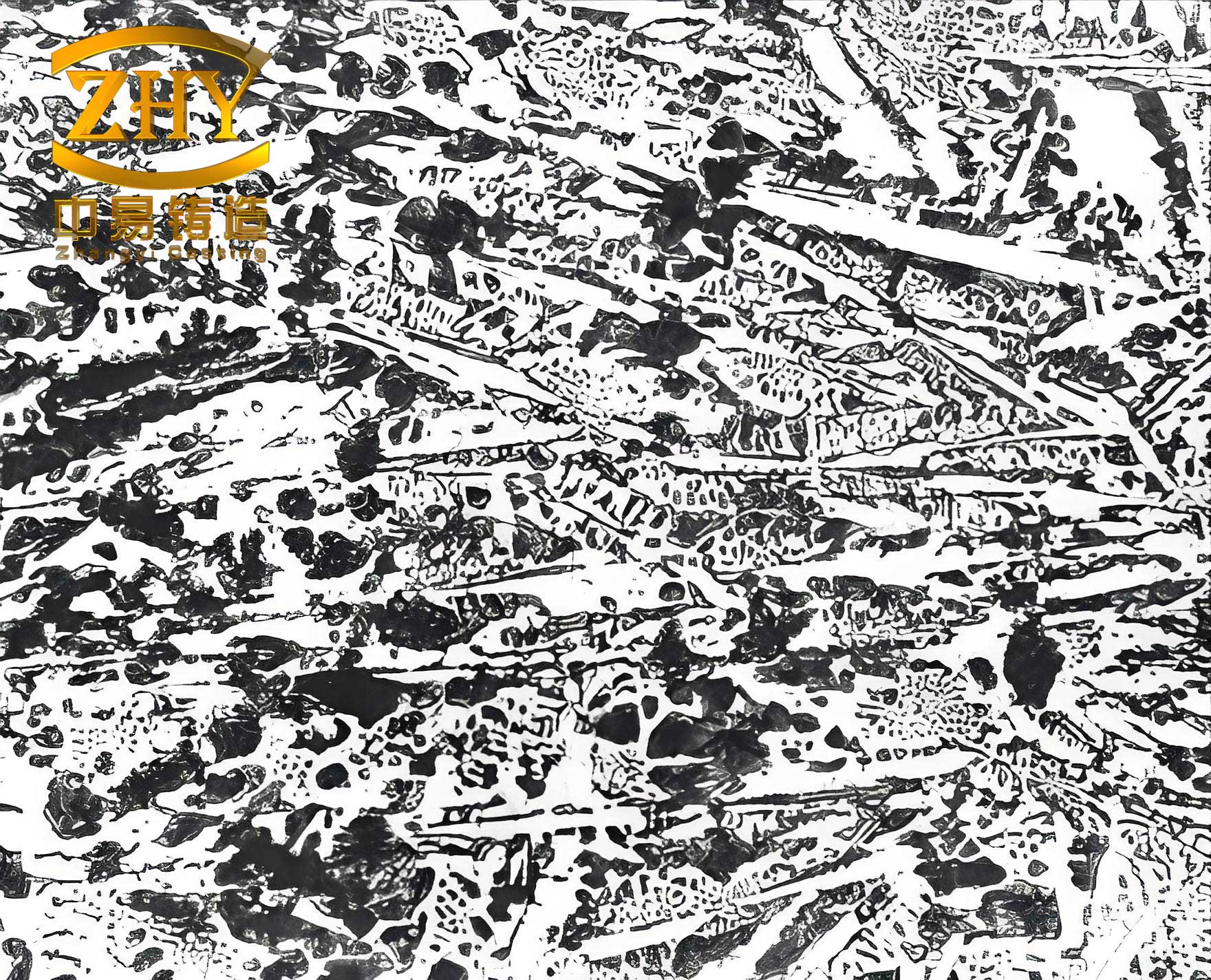
The primary function of a shot blasting blade is to propel metallic shot at high velocity under centrifugal force to clean or strengthen metal surfaces. Consequently, the blade material must withstand severe impact-abrasive wear from the shot itself, gouging and scratching from fractured shot and embedded debris, as well as vibrational stresses from high-speed rotation. This necessitates a material profile that combines high hardness for wear resistance with sufficient strength and, crucially, impact toughness to prevent catastrophic failure. Standard white cast iron, while hard, often lacks the necessary toughness. Therefore, the research centered on a low-chromium white cast iron inoculated with rare earth (RE), investigating the profound effects of a toughening heat treatment cycle on its microstructure and resultant mechanical properties.
The chemical composition of the base white cast iron is critical for defining its as-cast structure and its response to heat treatment. The alloy system was carefully designed with the following nominal composition ranges, which were precisely controlled during melting in a medium-frequency induction furnace:
| Element | Weight Percentage (wt.%) | Primary Function |
|---|---|---|
| C | 2.8 – 3.2 | Primary carbide former, controls hardness and carbide volume. |
| Si | 0.5 – 1.0 | Graphitizer (suppressed in white iron), solid solution strengthener. |
| Mn | 0.5 – 1.0 | Stabilizes austenite, improves hardenability. |
| Cr | 3.0 – 4.0 | Forms hard (Cr,Fe)7C3 carbides, improves corrosion/oxidation resistance. |
| RE (Residual) | 0.03 – 0.08 | Modifies carbide morphology, refines grains, purifies melt. |
| Fe | Balance | Matrix. |
The rare earth addition, typically in the form of a Fe-Si-RE alloy, was introduced via an in-mold inoculation or a ladle addition method using a bell jar to ensure good recovery and uniform distribution. The role of RE in white cast iron is multifaceted: it acts as a powerful deoxidizer and desulfurizer, refining the primary austenite grains during solidification. Most importantly, it alters the morphology of the eutectic carbides. In unmodified white cast iron, these carbides form a continuous, brittle network. RE modification promotes a discontinuous, isolated carbide structure, effectively embedding the hard carbides within a more continuous and ductile metallic matrix. This structural change is pivotal for enhancing toughness without sacrificing the essential wear resistance provided by the carbides.
The as-cast microstructure of the low-chromium RE white cast iron consists of primary austenite dendrites (which later transform to martensite and/or pearlite upon cooling) surrounded by a eutectic mixture of austenite and M7C3-type carbides. The RE modification makes this carbide network discontinuous. The initial hardness in this state is typically around 45-50 HRC. To unlock superior properties, heat treatment is essential. Two primary quenching paths were investigated and compared: conventional quenching & tempering vs. an austempering (isothermal quenching) process designed as a toughening treatment.
The conventional treatment involved austenitizing at 980°C, holding for sufficient time to saturate the austenite with carbon and chromium, followed by quenching in oil or a polymer medium, and finally tempering. The toughening treatment, central to this study, followed this sequence: Austenitizing at 950°C → Isothermal quenching in a nitrite-nitrate salt bath at 280-300°C → Holding at this temperature for 60-90 minutes → Air cooling to room temperature. This austempering process aims to transform the austenite to lower bainite, a microstructure known for its good combination of strength and toughness.
| Treatment Process | Key Parameters | Microstructural Features | Hardness (HRC) | Impact Toughness, *ak* (J/cm²) |
|---|---|---|---|---|
| As-Cast | – | Discontinuous carbides + Pearlite/Martensite matrix | ~47 | 4.0 – 5.0 |
| Conventional Quench & Temper | 980°C Quench, 200°C Temper | Discontinuous carbides + Coarse secondary carbides + Tempered martensite + Retained austenite | 58 – 62 | 5.5 – 6.5 |
| Toughening Treatment (Austempering) | 950°C → 280°C Salt (90 min) → Air Cool | Discontinuous carbides + Fine, uniformly dispersed secondary carbides + Lower Bainite matrix | 56 – 60 | 8.5 – 10.5 |
The data clearly demonstrates the significant advantage of the toughening process. While both heat-treated conditions achieve high hardness suitable for wear resistance, the impact toughness of the austempered white cast iron is approximately 50-60% higher than that of the conventionally quenched and tempered material. This dramatic improvement is directly linked to the refined and uniform microstructure.
Microstructural analysis reveals the underlying reasons. After conventional quenching, the secondary carbides that precipitate from the supersaturated austenite during heating and cooling tend to be coarse and non-uniformly distributed. The matrix is primarily tempered martensite, which is strong but less tough. In contrast, the toughening treatment promotes a far more desirable microstructure. The isothermal hold in the bainitic transformation range allows for the controlled, fine-scale precipitation of secondary carbides within the austenite before its transformation. This process can be conceptually linked to the driving force for precipitation. The chemical driving force $\Delta G_{chem}$ for precipitation of a carbide like M23C6 is related to the supersaturation of the austenite:
$$
\Delta G_{chem} \propto -RT \ln \left( \frac{C}{C_e} \right)
$$
where $C$ is the actual concentration of carbide-forming elements (Cr, C) in austenite and $C_e$ is their equilibrium concentration at the isothermal temperature. A lower isothermal temperature increases supersaturation ($C/C_e$), driving faster nucleation and leading to a finer, more numerous dispersion of carbide particles. These fine, uniformly dispersed secondary carbides contribute to dispersion strengthening without severely compromising toughness. Subsequently, the remaining austenite transforms to a fine, acicular lower bainite structure. This bainitic ferrite lath matrix, interlaced with stable austenite films, provides an excellent combination of strength and ductility, hence the superior impact toughness.
The role of chromium in this white cast iron is pivotal. Chromium partitions strongly into the carbides, forming (Fe,Cr)7C3 which is harder than cementite (Fe3C). The amount of chromium must be carefully balanced. It can be related to the carbide volume fraction $V_c$ which influences hardness $H$ and toughness $K_{IC}$:
$$
H \approx H_m (1 – V_c) + H_c V_c
$$
$$
K_{IC} \propto \frac{1}{\sqrt{\text{carbide spacing}}}
$$
where $H_m$ and $H_c$ are the hardness of the matrix and carbide respectively. Higher Cr increases $V_c$ and $H$, but if excessive, it leads to a coarse, continuous carbide network that drastically reduces the effective carbide spacing and thus $K_{IC}$ (toughness). A content of 3-4% Cr was found optimal, promoting sufficient hard carbides while allowing the RE modification to effectively break their continuity.
The performance validation was conducted through rigorous service-simulation testing. Sets of shot blasting blades, processed via both conventional and toughening treatments, were installed on industrial shot blasting machines for direct comparison. The service life was defined as the operational time until failure, either by wear-through or brittle fracture.
| Blade Type / Machine | Heat Treatment | Average Service Life (Hours) | Primary Failure Mode | Life Increase Factor |
|---|---|---|---|---|
| Large Blade (Q378 Type) | Conventional Quench & Temper | ~48 | Brittle Fracture | 1.0 (Baseline) |
| Large Blade (Q378 Type) | Toughening Treatment | ~96 | Progressive Wear-Through | 2.0 |
| Small Blade (Q034 Type) | Conventional Quench & Temper | ~12 | Brittle Fracture | 1.0 (Baseline) |
| Small Blade (Q034 Type) | Toughening Treatment | ~36 | Progressive Wear-Through | 3.0 |
The results are unequivocal. Blades subjected to the toughening treatment exhibited a service life increase of 100% to over 200% compared to conventionally treated blades. More importantly, the failure mode shifted from sudden, catastrophic brittle fracture to gradual wear-through. This is a critical indicator of enhanced reliability and operational safety. The superior toughness of the toughened white cast iron allows it to absorb the impact energy of the shot without cracking, enabling the component to wear down gradually and predictably, thereby fully utilizing its wear resistance potential.
The mechanism behind the improved wear resistance in the toughened material, despite a slight hardness reduction in some cases, is linked to the synergistic effect of the microstructure. In abrasive wear, material removal occurs by micro-cutting, ploughing, and fracturing. A model for abrasive wear resistance $W^{-1}$ can be simplified as:
$$
W^{-1} \propto \frac{H \cdot K_{IC}^{1/2}}{E^{1/2}}
$$
where $H$ is hardness, $K_{IC}$ is fracture toughness, and $E$ is elastic modulus. While the conventional treatment may yield a slightly higher $H$, its significantly lower $K_{IC}$ detrimentally affects the overall wear resistance under high-stress impact abrasion. The toughened white cast iron, with its optimal combination of high hardness (from fine, hard carbides and strong bainite) and markedly higher toughness, possesses a superior $H \cdot K_{IC}^{1/2}$ product. This makes it more resistant to the formation and propagation of micro-cracks under impact, reducing the likelihood of large-scale spalling or fracture. The fine, dispersed secondary carbides effectively resist micro-cutting, while the tough bainitic matrix provides robust support, preventing the carbides from being easily dislodged.
In conclusion, the application of a tailored toughening heat treatment, specifically an austempering process, to low-chromium rare earth modified white cast iron fundamentally enhances its microstructure-property relationships. This process transforms the matrix to a fine lower bainite structure while promoting a uniform dispersion of fine secondary carbides. The result is a remarkable synergy where the essential high hardness for abrasion resistance is maintained, while the impact toughness is increased by over 50%. This harmonious balance translates directly into a dramatic extension of service life for demanding components like shot blasting blades, with observed improvements of 2 to 3 times, and a shift from unpredictable brittle failure to predictable gradual wear. This work underscores the principle that for impact-abrasion applications, optimizing the toughness of white cast iron through microstructure control is as critical as maximizing its hardness, offering a highly effective pathway for engineering superior and reliable wear-resistant materials.