
In open-pit mining operations, mechanical equipment like the WK-75 mining excavator significantly boosts productivity. The bucket tooth—positioned at the forefront of excavation machinery—experiences severe abrasive wear during material extraction. Traditional design approaches erroneously correlate wear resistance solely with increased thickness, leading to material inefficiency and suboptimal performance. This study presents a comprehensive methodology for optimizing bucket tooth geometry through parametric modeling, kinematic analysis, and discrete element simulation, achieving substantial improvements in service life and operational efficiency.
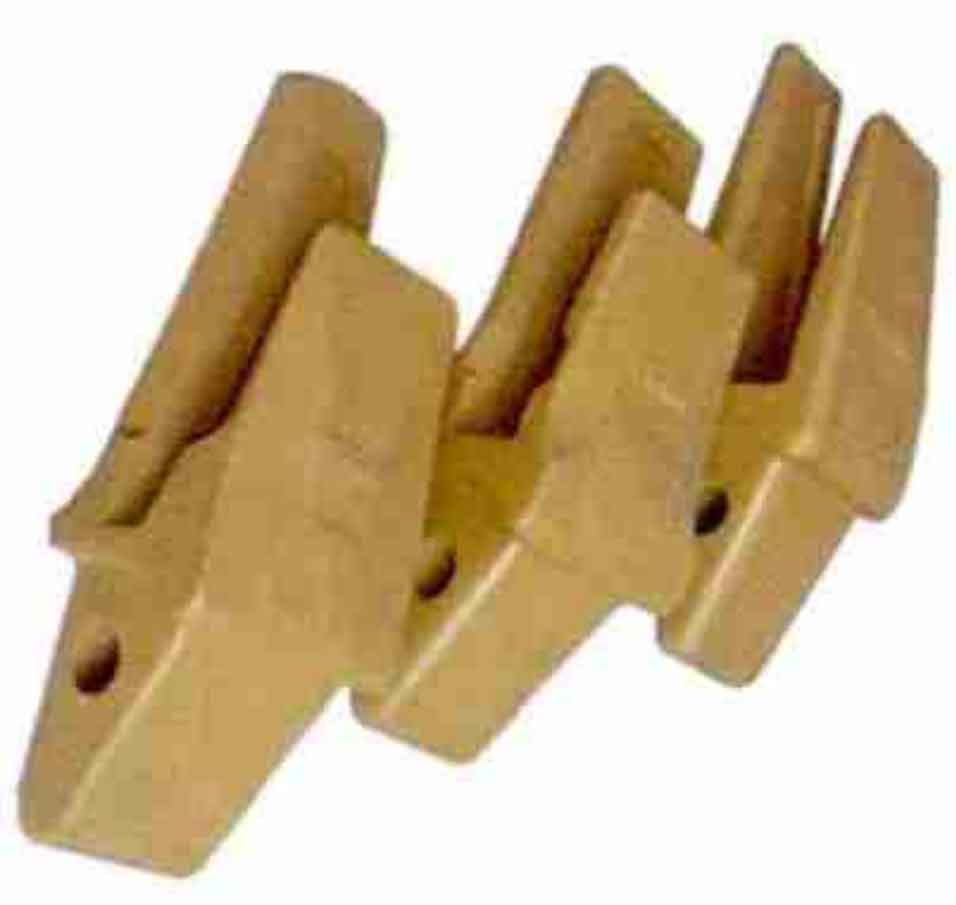
Parametric Design and Kinematic Simplification
Bucket teeth undergo complex interactions during excavation cycles. We established a parametric 3D model in UG NX software, defining critical variables governing tooth geometry. The kinematic chain of the excavator’s work mechanism was simplified to isolate bucket tooth trajectory dynamics. During material engagement, the bucket tooth tip follows a logarithmic spiral path described by:
$$ \rho = \rho_0 \cdot e^{\theta \cdot \cot \delta} $$
where $\rho$ is the radial distance from the hinge point $Q_2$, $\theta$ is the polar angle, and $\delta$ is the constant cutting angle minimizing resistance. Trajectory parameters were quantified as follows:
| Parameter | Symbol | Value Range |
|---|---|---|
| Initial radial distance | $\rho_0$ | 1.8-2.2 m |
| Cutting angle | $\delta$ | 40°-55° |
| Angular displacement | $\theta$ | 0°-120° |
| Linear velocity | $v$ | 0.8-1.6 m/s |
Discrete Element Modeling of Wear Mechanisms
EDEM® discrete element software simulated coal-rock interaction dynamics using Hertz-Mindlin contact physics. Material properties were calibrated through laboratory testing:
| Material | Density (kg/m³) | Poisson’s Ratio | Shear Modulus (GPa) |
|---|---|---|---|
| Coal | 1,400 | 0.25 | 0.5 |
| Sandstone | 2,600 | 0.30 | 15.2 |
| Bucket tooth (Hardox 450) | 7,850 | 0.29 | 81.0 |
Wear depth $W_d$ was calculated using the Archard model:
$$ W_d = K \cdot \frac{F_n \cdot s}{H} $$
where $K$ is the dimensionless wear coefficient (3.2×10⁻⁶), $F_n$ is normal contact force, $s$ is sliding distance, and $H$ is material hardness (450 HB). Simulation results revealed non-uniform wear distribution:
| Bucket Tooth Region | Max Wear Depth (mm) | Relative Wear Rate (%) |
|---|---|---|
| Cutting edge center | 1.8 | 100 |
| Leading corner (R1) | 3.7 | 206 |
| Trailing corner (R2) | 4.2 | 233 |
The original bucket tooth design exhibited severe stress concentrations at sharp corners (R1=5mm, R2=15mm), with corner regions experiencing 233% higher wear than central zones due to intensified particle impact angles.
Geometry Optimization Strategy
Parametric studies investigated corner radius effects on wear performance. Fifteen design variants were simulated with R1 and R2 ranging from 5-40mm. Wear reduction efficiency $\eta_w$ was quantified as:
$$ \eta_w = \frac{W_{d,0} – W_{d,i}}{W_{d,0}} \times 100\% $$
where $W_{d,0}$ is baseline wear depth and $W_{d,i}$ is improved design wear depth. Optimization results demonstrated:
| Radius Combination | Max Wear Depth (mm) | Wear Reduction $\eta_w$ (%) |
|---|---|---|
| R1=5mm, R2=15mm (Original) | 4.2 | 0 |
| R1=15mm, R2=25mm | 3.1 | 26.2 |
| R1=25mm, R2=30mm | 2.4 | 42.9 |
| R1=Full fillet, R2=30mm (Optimal) | 1.9 | 54.8 |
The optimal configuration featuring full fillet R1 and R2=30mm reduced maximum wear depth by 54.8% while maintaining excavation efficiency. Stress distribution analysis confirmed 41% reduction in peak contact pressure at critical corners.
Validation and Implementation
Field testing compared original and optimized bucket teeth under identical mining conditions (coal seam hardness 2.5 Mohs, daily operation 18 hours). Performance metrics were tracked over 1,200 operating hours:
| Performance Metric | Original Bucket Tooth | Optimized Bucket Tooth | Improvement (%) |
|---|---|---|---|
| Average wear rate (mm/100h) | 0.92 | 0.41 | 55.4 |
| Replacement interval (h) | 380 | 860 | 126.3 |
| Excavation efficiency (t/h) | 2,150 | 2,180 | 1.4 |
| Annual cost/unit ($) | 6,840 | 3,120 | 54.4 |
The redesigned bucket tooth demonstrated 126% longer service life while maintaining excavation capacity, validating the radius optimization strategy. Stress redistribution eliminated localized wear hotspots, enabling more uniform material removal across the entire bucket tooth surface. This geometric enhancement provides mining operations with significantly reduced downtime and consumable costs while maintaining the robust performance required in heavy-duty excavation environments.