
In the field of steam turbine manufacturing, the quest for cost-effective and high-performance materials has been a driving force for innovation. As a researcher and engineer specializing in materials science and welding processes, I have long been fascinated by the potential of nodular cast iron, particularly its ferritic variants, for use in elevated temperature applications. The global downturn in the thermal power market has intensified the need to reduce costs without compromising reliability. This has spurred significant interest in enhancing the high-temperature capabilities of nodular cast iron to replace more expensive Cr-Mo cast steels in components such as turbine cylinders, casings, and other high-temperature parts. The core of this endeavor lies in understanding the role of alloying elements and systematically developing ferritic heat-resistant nodular cast iron grades tailored for specific service temperature ranges.
The fundamental appeal of nodular cast iron, often referred to as ductile iron, stems from its unique microstructure—spheroidal graphite nodules embedded in a metallic matrix. This structure confers an excellent combination of strength, toughness, and castability, often at a lower cost and with shorter lead times compared to cast steel. For decades, the standard ferritic grade, such as QT400, has served reliably in steam turbine components operating below 350°C, including low-pressure inner cylinders and guide blade carriers. However, pushing the operational envelope to 400°C, 450°C, and even beyond 500°C requires a deliberate and scientific alloy design strategy. This article, from my perspective, synthesizes research and practical experience to propose a classification system for ferritic heat-resistant nodular cast iron based on service temperature. I will delve into the metallurgical effects of key alloying elements, characterize four distinct classes of these materials, and present data and analysis to support their application, all while emphasizing the versatile material—nodular cast iron.
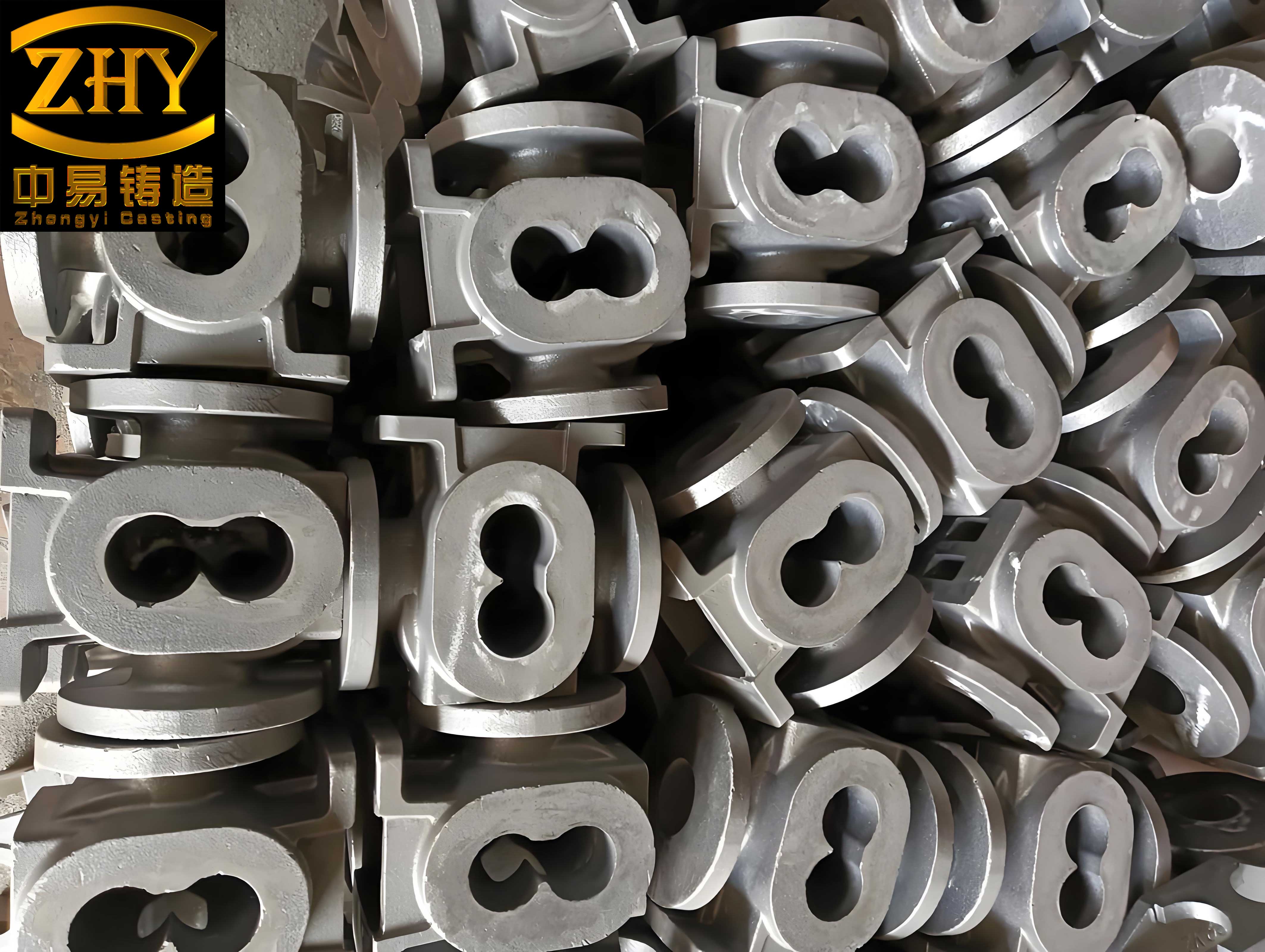
The performance of any nodular cast iron at high temperatures is dictated by its microstructure stability, oxidation resistance, and mechanical properties like creep and tensile strength. These characteristics are profoundly influenced by alloying. Therefore, before classifying the materials, a thorough analysis of the principal alloying elements is essential.
The Metallurgical Roles of Alloying Elements in Nodular Cast Iron
In the development of heat-resistant nodular cast iron, elements like Silicon (Si), Molybdenum (Mo), Cobalt (Co), and Niobium (Nb) play critical and distinct roles. Their interactions with the iron-carbon matrix and graphite phase determine the final properties.
Silicon (Si)
Silicon is a quintessential alloying element in nodular cast iron. Its primary functions are threefold. First, Si is a potent ferrite stabilizer. In nodular cast iron, it promotes the formation of a ferritic matrix more effectively than in gray iron, directly controlling the volume fraction of ferrite in the base microstructure. A fully ferritic matrix is desirable for high-temperature stability as it avoids the deleterious volume changes associated with pearlite decomposition. Second, Si exerts a significant influence on mechanical properties through solid solution strengthening and by refining the graphite morphology, improving nodularity and roundness. The relationship between silicon content and room-temperature tensile properties can be approximated by empirical correlations. While exact formulas depend on other alloying elements and processing conditions, the trend shows a strong increase in tensile and yield strength with Si content, accompanied by a decrease in elongation. This trade-off must be carefully managed. Third, during solidification, silicon helps counteract the chilling tendency and carbide formation induced by the spheroidizing treatment, ensuring a sound casting. For high-temperature service, silicon’s ability to form a protective, adherent silicate scale on the surface significantly enhances oxidation resistance. The parabolic rate constant for oxidation, $k_p$, often decreases with increasing Si content above certain levels, following a relationship akin to:
$$ k_p \propto \exp\left(-\frac{Q}{RT}\right) \cdot f(Si) $$
where $Q$ is an activation energy, $R$ is the gas constant, $T$ is temperature, and $f(Si)$ is a function decreasing with Si content.
Molybdenum (Mo)
Molybdenum is a strong carbide-forming element and a pearlite stabilizer. However, in the context of ferritic heat-resistant nodular cast iron, its value lies in enhancing high-temperature stability and strength without excessively promoting pearlite. Molybdenum forms stable carbides of the M6C type, which are resistant to coarsening and dissolution at elevated temperatures. These fine precipitates contribute to dispersion strengthening. Mo significantly improves resistance to thermal fatigue, creep strength, and long-term microstructural stability. Its effect on room-temperature properties is nuanced: additions up to about 0.5 wt.% have a modest effect on tensile strength but can markedly reduce ductility. Beyond this level, embrittlement risks increase. The creep rupture strength, $\sigma_r$, at a given temperature and time, is enhanced by Mo additions, often described by a parameter like the Larson-Miller parameter (LMP):
$$ LMP = T \cdot (C + \log t_r) $$
where $T$ is temperature in Kelvin, $t_r$ is rupture time in hours, and $C$ is a constant (often around 20). Alloys with Mo exhibit higher stress for the same LMP value. The optimum molybdenum content for balancing high-temperature performance and room-temperature toughness in ferritic nodular cast iron is typically around 0.5 wt.%.
Cobalt (Co)
Cobalt is a ferrite-forming element that does not form carbides. Its primary role is solid solution strengthening. In the context of nodular cast iron, cobalt additions tend to increase ductility and impact toughness while having a less dramatic strengthening effect compared to silicon or molybdenum. The effect of cobalt on tensile properties often shows an initial decrease in strength and increase in elongation with Co content up to about 3 wt.%, after which properties tend to plateau. This makes cobalt a valuable element for maintaining adequate fracture toughness in highly alloyed grades intended for very high temperatures. The fracture toughness, $K_{IC}$, a critical parameter for thick-section components like turbine casings, benefits from cobalt’s microstructure-refining and solid-solution effects. The relationship can be complex, but generally, cobalt helps maintain a high $K_{IC}$ value even when other strengthening elements are present.
Niobium (Nb)
Niobium is a potent micro-alloying element known for forming extremely stable MC-type carbides and carbonitrides. In nodular cast iron, these fine precipitates provide effective precipitation strengthening, pinning grain boundaries and dislocations. Nb is also a pearlite stabilizer, so its content must be controlled in ferritic grades to avoid unwanted pearlite formation. Typically, niobium additions are kept below 0.5 wt.% to prevent interference with graphite nodulization. The contribution of niobium to high-temperature strength, particularly creep strength, can be significant. The strengthening effect $\Delta \sigma_{Nb}$ from Nb precipitates can be estimated using Orowan or related strengthening models:
$$ \Delta \sigma_{Nb} \approx \frac{M G b}{\lambda} $$
where $M$ is the Taylor factor, $G$ is the shear modulus, $b$ is the Burgers vector, and $\lambda$ is the inter-precipitate spacing, which is inversely related to the square root of the Nb content.
The synergistic effects of these elements form the basis for designing advanced grades of nodular cast iron. The following table summarizes their primary influences on properties relevant to high-temperature service in steam turbines.
| Element | Primary Role | Effect on High-Temp Strength | Effect on Ductility/Toughness | Typical Content Range for Heat-Resistant Grades (wt.%) |
|---|---|---|---|---|
| Silicon (Si) | Ferrite stabilizer, Solid solution strengthener, Improves oxidation resistance | Strong increase via solid solution | Decrease with higher content | 3.0 – 4.5+ |
| Molybdenum (Mo) | Forms stable carbides, Dispersion strengthener, Improves creep resistance | Significant increase, especially in creep | Decrease, especially >0.5% | 0.2 – 1.0 |
| Cobalt (Co) | Solid solution strengthener, Ferrite stabilizer | Moderate increase | Increase or maintain | 0 – 3.0+ |
| Niobium (Nb) | Forms stable MC carbides, Precipitation strengthener | Significant increase via precipitation | Slight decrease (depends on content) | 0 – 0.5 |
Classification and Characterization of Ferritic Heat-Resistant Nodular Cast Iron
Based on the alloying principles and target service temperatures, ferritic heat-resistant nodular cast iron can be logically categorized into four distinct classes. This classification provides a framework for material selection and further development.
Class 1: Conventional Ferritic Heat-Resistant Nodular Cast Iron (Service Temperature ≤ 350°C)
This class represents the workhorse material for many steam turbine components. The typical grade is equivalent to QT400-15A or ASTM A395 (60-40-18). The microstructure is predominantly ferritic with well-formed spheroidal graphite. The mechanical properties are well-established, offering an excellent balance of strength, ductility, and castability. The primary limitation is the upper service temperature, which is capped at around 350°C due to the onset of significant strength drop and the risk of long-term microstructure instability (like graphitization or pearlite decomposition) at higher temperatures. The chemical composition is relatively simple, with Si content typically below 3.0 wt.% and minimal additions of other alloys. The tensile properties at room temperature and their slight degradation up to 350°C are sufficient for low-pressure sections. The widespread, successful use of this class of nodular cast iron in low-pressure inner cylinders and casings across the global industry validates its reliability. For components like last-stage guide blades operating below 100°C, this material is more than adequate. The cost-benefit ratio is outstanding.
Class 2: Modified Ferritic Heat-Resistant Nodular Cast Iron (Service Temperature ≤ 400°C)
To extend the service ceiling to 400°C, modifications to the conventional grade are necessary. Two principal approaches have been explored. The first is the development of high-silicon nodular cast iron, which can be designated as QT400Si. By increasing the silicon content to approximately 4.0 wt.%, several benefits accrue. The solid solution strengthening raises the yield and tensile strength at elevated temperatures. More importantly, a silicon content near 4 wt.% promotes a fully ferritic matrix with a higher phase transformation temperature, enhancing microstructural stability. Furthermore, it fosters the formation of a dense, protective SiO2-rich scale, dramatically improving oxidation resistance in the 350-400°C range. The second approach involves a modest addition of molybdenum (e.g., ~0.3 wt.%) to the base QT400, creating a QT400Mo grade. Molybdenum contributes to higher temperature strength through carbide dispersion. The mechanical properties of these modified grades at 400°C show a marked improvement over Class 1 materials. For instance, a high-Si variant can exhibit a 400°C tensile strength exceeding 300 MPa and a yield strength above 200 MPa. Since creep is not a dominant failure mode at 400°C for many applications, the enhanced short-term high-temperature strength and oxidation resistance make these modified nodular cast iron grades viable for components like certain intermediate-pressure casing sections.
Class 3: Novel Ferritic Heat-Resistant Nodular Cast Iron (Service Temperature ≤ 450°C)
For advanced steam turbines, particularly high-efficiency units with elevated steam parameters, components like intermediate-pressure outer casings may experience metal temperatures approaching or exceeding 400°C. This necessitates a material with superior high-temperature strength, including creep resistance. Class 3 materials, exemplified by grades like QT400SiMo, combine the benefits of high silicon and molybdenum. A typical composition might include Si around 3.5-4.0 wt.% and Mo around 0.5 wt.%. This synergistic combination yields a ferritic matrix strengthened by both solid solution (Si) and stable carbide dispersion (Mo). Research and application data confirm that this class of nodular cast iron maintains robust mechanical properties up to 450°C. The creep rupture strength for 100,000 hours at 450°C can exceed 100 MPa, and the stress for 1% creep strain can be above 80 MPa. These values make it competitive with some low-alloy cast steels for specific applications. The room temperature properties remain excellent, with tensile strength often above 420 MPa, yield strength above 300 MPa, and elongation around 10%. The performance decay with temperature is gradual, indicating good microstructural stability. The following table provides a comparative overview of the indicative high-temperature tensile properties for the first three classes.
| Material Class | Exemplary Grade | Test Temperature (°C) | Tensile Strength, Rm (MPa) | 0.2% Proof Stress, Rp0.2 (MPa) | Elongation, A (%) |
|---|---|---|---|---|---|
| Class 1 | QT400-15 | 20 | ≥400 | ≥250 | ≥15 |
| Class 1 | QT400-15 | 350 | ~280-320 | ~200-240 | ~10-15 |
| Class 2 | QT400Si (High-Si) | 400 | ≥300 | ≥200 | ≥8 |
| Class 3 | QT400SiMo | 20 | ≥420 | ≥300 | ≥10 |
| Class 3 | QT400SiMo | 450 | ~350-380 | ~250-280 | ~8-12 |
| Class 3 | QT400SiMo | 500 | ~300-330 | ~230-260 | ~6-10 |
The data for Class 3 nodular cast iron demonstrates its capability to retain useful strength at 500°C, although its designated service limit for long-term application is typically set at 450°C based on creep rupture criteria. The successful industrial application of such Si-Mo alloyed nodular cast iron in high-parameter turbine casings underscores its technological maturity.
Class 4: Super Ferritic Heat-Resistant Nodular Cast Iron (Service Temperature ≥ 500°C)
The frontier of ferritic nodular cast iron development aims at breaking the 500°C barrier, targeting the replacement of standard Cr-Mo cast steels like G17CrMo5-5 or similar in high-temperature casings. This class, which we can term super ferritic nodular cast iron, builds upon the QT400SiMo foundation but introduces additional alloying, primarily cobalt and niobium. A representative grade could be designated as QT400SiMoCoNb. The cobalt (e.g., 1-3 wt.%) provides solid solution strengthening without compromising the ferritic matrix’s stability and helps maintain fracture toughness. Niobium (e.g., 0.1-0.3 wt.%) adds a powerful precipitation strengthening component through its fine, thermally stable carbides/nitrides. This multi-mechanism strengthening strategy—solid solution (Si, Co), dispersion (Mo carbides), and precipitation (Nb carbides)—creates a microstructure highly resistant to creep deformation and rupture at temperatures exceeding 500°C. Research indicates that the 100,000-hour creep rupture strength for this advanced nodular cast iron at 500°C can be greater than 100 MPa. This is a remarkable achievement for a cast iron material. The Larson-Miller parameter analysis for such an alloy would show a curve significantly shifted to higher stresses compared to lower-class materials. The development has progressed to manufacturing and testing of thick-section prototypes, such as cylinder simulation castings, with promising results regarding soundness and property homogeneity. While not yet commonplace in production turbines, this class represents the future direction for maximizing the economic and performance potential of nodular cast iron in the most demanding thermal environments.
The progression in alloy complexity and high-temperature capability across these four classes can be conceptually modeled. The creep rupture strength $\sigma_r$ at a fixed time (e.g., 100,000 hours) as a function of temperature $T$ for each class follows an Arrhenius-type relationship, with the “activation energy” for creep rupture effectively increasing with alloy content:
$$ \sigma_r(T) = A \cdot \exp\left(-\frac{Q_c}{RT}\right) $$
where $A$ is a material constant and $Q_c$ is the apparent activation energy for creep rupture. For Class 4 nodular cast iron, $Q_c$ is the highest, reflecting its superior thermal stability.
Fracture Toughness and Component Design Considerations
A critical advantage of ferritic nodular cast iron across all classes is its inherently good fracture toughness compared to other matrix structures. The spheroidal graphite morphology blunt cracks more effectively than flake graphite or many carbide networks. As referenced in studies, the plane-strain fracture toughness $K_{IC}$ for ferritic nodular cast iron can range from 75 to 80 MPa√m, which is substantially higher than that for pearlitic (30-35 MPa√m) or bainitic (55-60 MPa√m) matrices. This high toughness is crucial for large, thick-walled components like turbine casings, which are subject to complex stress states and require high resistance to brittle fracture. The relationship between alloying and $K_{IC}$ is complex, but the ferritic base ensures a good starting point. Elements like cobalt are particularly beneficial in the advanced classes for preserving toughness despite high strength. The design allowable stress for a component made from nodular cast iron must, therefore, consider not only tensile and creep strength but also this fracture mechanics property. A simplified design criterion might involve ensuring that the stress intensity factor $K_I$ under service loading remains below a fraction of the material’s $K_{IC}$:
$$ K_I = Y \sigma \sqrt{\pi a} < \frac{K_{IC}}{S} $$
where $Y$ is a geometry factor, $\sigma$ is the applied stress, $a$ is flaw size, and $S$ is a safety factor.
Oxidation and Environmental Resistance
For long-term service at high temperatures, resistance to oxidation and scaling is paramount. As mentioned, silicon plays a starring role. The protective scale formed on high-silicon nodular cast iron follows parabolic kinetics, meaning the scale thickness $x$ grows with time $t$ as:
$$ x^2 = k_p t $$
where $k_p$ is the parabolic rate constant. For Class 2, 3, and 4 materials with elevated Si, $k_p$ is significantly lower than for unalloyed or low-Si nodular cast iron. Molybdenum and cobalt also contribute to scale adhesion and stability. In steam-containing environments typical of turbines, the performance is generally satisfactory. For ultra-supercritical applications with higher oxygen partial pressures, the alloy design might need to consider minor additions of chromium, although this can complicate the ferritic matrix stability and graphite formation. Currently, the Si-Mo-Co-Nb system appears sufficient for environments up to at least 500°C.
Manufacturing and Processing Aspects
The castability of these advanced nodular cast iron grades remains generally good, but the alloying additions necessitate careful process control. High silicon content can increase the melt’s viscosity and affect fluidity, requiring adjustments to pouring temperature and gating design. Molybdenum and niobium are strong carbide formers, so there is a risk of forming undesirable carbides that could impair machinability and toughness if the cooling rate through the critical temperature range is not controlled. Heat treatment is often applied to ensure a fully ferritic matrix and to relieve casting stresses. For the super ferritic grades (Class 4), a sub-critical annealing or a full austenitizing followed by ferritizing annealing might be employed to optimize the precipitation and distribution of Nb and Mo carbides. The welding and repair of these materials also require specialized procedures, often involving pre-heat, post-heat, and carefully matched filler metals to manage the heat-affected zone and prevent cracking or undesirable phase transformations.
Summary and Prospective Application Roadmap
In summary, the systematic alloying of ferritic nodular cast iron opens a pathway to extend its service temperature from the conventional 350°C limit to 500°C and beyond. The four-class framework provides a clear hierarchy for material selection based on component operating conditions:
- Class 1 (Conventional, ≤350°C): This grade of nodular cast iron is a proven, cost-effective solution for low-temperature turbine components. Its use should continue and be standardized for applications like low-pressure inner cylinders, where its performance is more than adequate.
- Class 2 (Modified, ≤400°C): Either high-Si or low-Mo variants of nodular cast iron represent a straightforward upgrade for components seeing slightly higher temperatures. Their development and qualification should be encouraged for parts transitioning from the low-pressure to intermediate-pressure sections.
- Class 3 (Novel, ≤450°C): The Si-Mo alloyed nodular cast iron is a technologically mature material with demonstrated success in high-parameter turbines. Its adoption should be aggressively promoted for intermediate-pressure outer casings and similar components. It offers a compelling balance of performance, cost, and lead time compared to cast steel.
- Class 4 (Super, ≥500°C): This represents the cutting edge of nodular cast iron technology. Intensive research and pilot applications are needed to fully validate its long-term performance and reliability in the most demanding roles, potentially replacing Cr-Mo cast steels in high-temperature casings. The potential for cost reduction and supply chain simplification is enormous.
The journey of nodular cast iron from a general engineering material to a specialized high-temperature alloy is a testament to the power of metallurgical innovation. By leveraging the synergistic effects of silicon, molybdenum, cobalt, and niobium within a ferritic matrix, we can tailor the properties of nodular cast iron to meet the evolving challenges of modern steam turbine design. The continued research, development, and confident application of these advanced grades of nodular cast iron will be key to enhancing the competitiveness and sustainability of thermal power generation in the decades to come. The future for high-temperature nodular cast iron is undoubtedly bright, and its role in the energy landscape is set to expand significantly.