
In this comprehensive investigation, we delve into the intricate relationship between microstructure and mechanical properties in high chromium white cast iron, a material renowned for its exceptional wear resistance in demanding industrial applications. The superior performance of this white cast iron is primarily attributed to the presence of hard, discontinuous M7C3-type carbides within its matrix. This study systematically examines the as-cast, annealed, quenched, and tempered states, utilizing quantitative metallography, microhardness testing, and analytical models to elucidate the governing principles. The ability to tailor the matrix structure—through precise control of chemical composition and cooling conditions—to achieve austenite, martensite, bainite, pearlite, or their mixtures, makes this family of white cast iron particularly versatile.
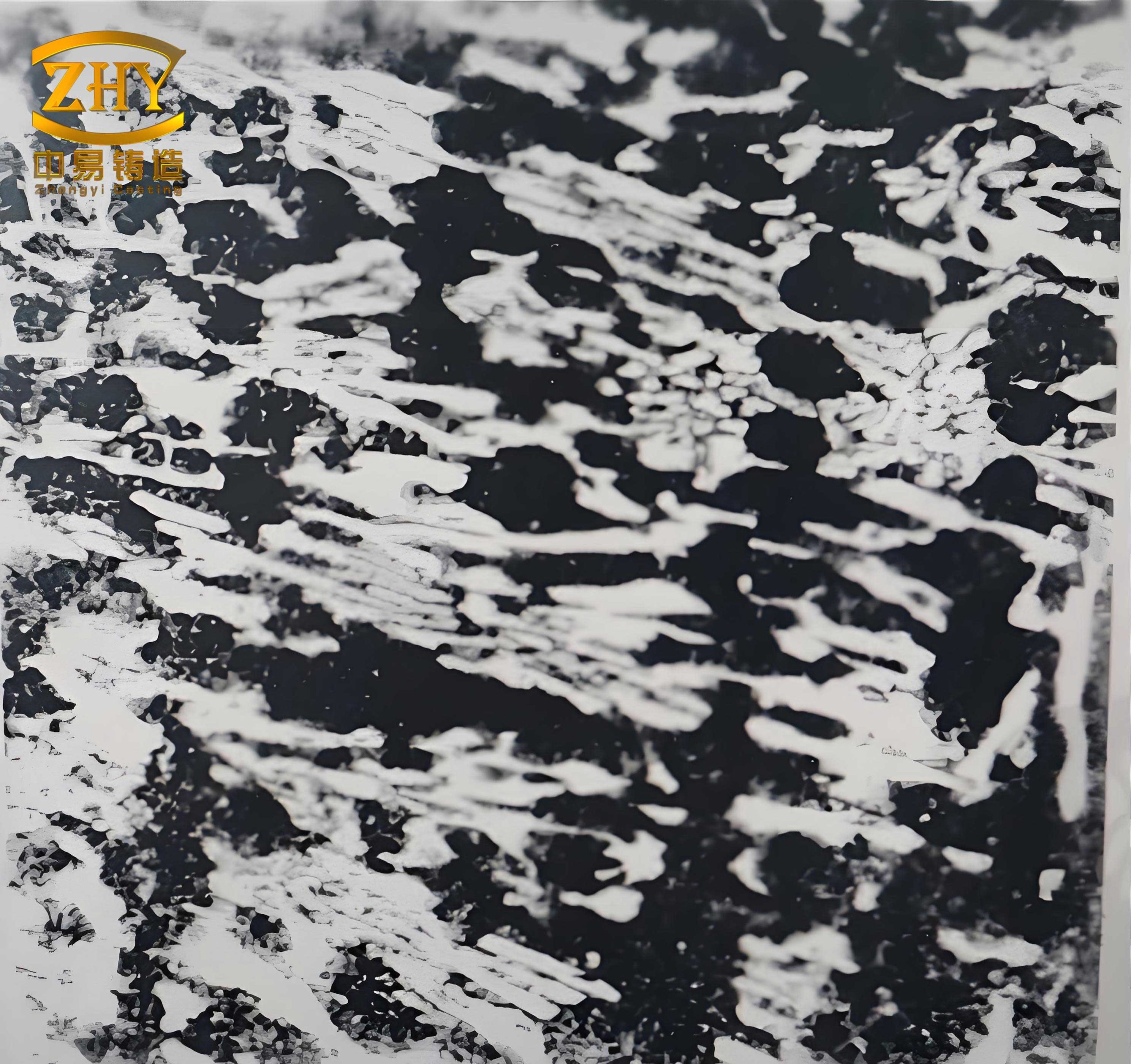
The foundational aspect of any white cast iron is its as-cast microstructure. For high chromium white cast iron, this is predominantly determined by the chromium-to-carbon ratio (Cr/C) and the content of other alloying elements like molybdenum, as well as the cooling rate imposed during solidification. In our experiments, several grades of high chromium white cast iron were melted in a medium-frequency induction furnace and cast into sand molds to produce test bars. The chemical compositions of these investigated white cast iron grades are summarized in Table 1.
| Alloy Designation | C | Cr | Mo | Si | Mn | Ni | Cr/C Ratio |
|---|---|---|---|---|---|---|---|
| A | 3.2 | 15.0 | 0.5 | 0.8 | 0.6 | 0.2 | 4.69 |
| B | 2.8 | 18.0 | 1.0 | 0.7 | 0.5 | 0.3 | 6.43 |
| C | 2.5 | 20.0 | 2.0 | 0.6 | 0.4 | 0.4 | 8.00 |
| D | 2.0 | 25.0 | 3.0 | 0.5 | 0.3 | 0.5 | 12.50 |
The as-cast microstructure of high chromium white cast iron consists of primary M7C3 carbides and a matrix that can be austenitic or its transformation products. The phase constitution map for sand-cast specimens, relating the Cr/C ratio and molybdenum content to the as-cast matrix structure, is conceptually represented. For instance, with a molybdenum content around 2%, a fully austenitic matrix can be obtained in the as-cast state for certain compositions. The volume fraction of carbides in this white cast iron increases with both carbon and chromium content. An empirical relationship to estimate the carbide volume fraction (Vc) is given by:
$$ V_c (\%) = 12.33(C) + 0.55(Cr) – 15.2 $$
where C and Cr are the weight percentages of carbon and chromium, respectively. This formula highlights the significant role of carbon in promoting carbide formation in white cast iron. Furthermore, the chemical composition of the austenitic matrix is not uniform. Electron probe microanalysis (EPMA) reveals significant partitioning of alloying elements. The austenite matrix is enriched in non-carbide forming elements like silicon and nickel, while the M7C3 carbides are rich in chromium, molybdenum, and other carbide formers. The chromium content in the austenite (Crγ) can be approximated by:
$$ Cr_γ \approx 0.65 \times \left( \frac{Cr}{C} \right) $$
Similarly, the molybdenum content in the austenite (Moγ) is roughly half of the nominal molybdenum content in the white cast iron alloy:
$$ Mo_γ \approx 0.5 \times Mo_{alloy} $$
The morphology of carbides in as-cast white cast iron varies. In hypereutectic compositions, coarse hexagonal primary carbides are observed. More commonly, in hypoeutectic white cast iron, the eutectic carbides manifest as interdendritic networks, chrysanthemum-like clusters, or blocky forms. The microhardness of the individual phases in the as-cast structure was measured and is presented in Table 2, alongside reference values from literature, underscoring the extreme hardness of the carbides which underpins the wear resistance of this white cast iron.
| Microstructural Constituent | Measured Value (This Work) | Typical Reference Range |
|---|---|---|
| M7C3 Carbide (Interdendritic) | 1450 – 1650 | 1300 – 1800 |
| M7C3 Carbide (Hexagonal Primary) | 1550 – 1700 | 1400 – 1850 |
| Austenite Matrix | 350 – 550 | 300 – 600 |
| Martensite (As-Quenched) | 750 – 950 | 700 – 1000 |
| Pearlite (As-Cast or Annealed) | 300 – 450 | 250 – 500 |
To improve machinability, high chromium white cast iron components are often subjected to an annealing heat treatment prior to cutting operations. The standard process involves slowly heating to 950–980°C, holding for several hours (e.g., 4–8 hours depending on section size), and then slowly cooling at a rate of about 30°C per hour to below 600°C before air cooling. The resultant annealed microstructure of this white cast iron consists of the unchanged M7C3 carbides embedded in a matrix of spheroidized or fine lamellar pearlite. X-ray diffraction confirms that the carbide in this pearlite remains of the M7C3 type. The microhardness of this annealed pearlitic matrix typically falls between 300-400 HV, significantly softer than the as-cast austenite, thereby facilitating machining of the white cast iron.
The primary route to achieve high hardness and optimal wear performance in high chromium white cast iron is through quenching heat treatments designed to transform the austenitic matrix into martensite. However, the high alloy content, especially chromium and molybdenum, imparts remarkable stability to the austenite in this white cast iron. Therefore, a “destabilization treatment” is essential. This involves austenitizing at a temperature high enough to dissolve carbon and alloy elements into the austenite, but also to promote the precipitation of secondary carbides. These secondary carbides, predominantly of the M23C6 and M7C3 types, deplete the surrounding austenite of carbon and carbide-forming elements, reducing its stability and lowering the martensite start (Ms) temperature, enabling transformation upon cooling.
We systematically studied the effect of austenitizing temperature on the microstructure and hardness of air-quenched white cast iron. Specimens were heated to temperatures ranging from 900°C to 1150°C, held for two hours, and then air cooled. The volume fraction of secondary carbides, residual austenite, and martensite, along with the bulk hardness, were characterized. The data for a representative alloy are consolidated in Table 3.
| Austenitizing Temperature (°C) | Secondary Carbide Vol.% (Estimated) | Residual Austenite Vol.% (XRD) | Martensite Vol.% (Balance) | Rockwell Hardness (HRC) | Matrix Microhardness (HV0.1) |
|---|---|---|---|---|---|
| 900 | ~8 | 15 | 77 | 54 | 780 |
| 950 | ~10 | 10 | 80 | 58 | 850 |
| 1000 | ~12 | 8 | 80 | 62 | 920 |
| 1050 | ~9 | 25 | 66 | 56 | 810 |
| 1100 | ~5 | 45 | 50 | 48 | 650 |
| 1150 | ~2 | 65 | 33 | 42 | 520 |
The relationship between austenitizing temperature and hardness exhibits a distinct peak, typically around 1000–1020°C for many high chromium white cast iron grades. This peak corresponds to an optimal balance between secondary carbide precipitation and austenite composition. At lower temperatures, excessive fine secondary carbides precipitate, leaving the austenite lean in alloy content, which results in a softer, less alloyed martensite upon cooling. At higher temperatures, dissolution predominates over precipitation; the austenite becomes highly enriched and stable, leading to large amounts of retained austenite and a corresponding decrease in hardness. This interplay can be modeled conceptually. The driving force for secondary carbide precipitation (ΔGppt) and the carbon content in austenite (Cγ) are key parameters influencing the final hardness (H) of the quenched white cast iron. A simplified relation can be expressed as:
$$ H \propto f_M \cdot H_M + f_{γ} \cdot H_{γ} $$
where \( f_M \) and \( f_{γ} \) are the volume fractions of martensite and retained austenite, and \( H_M \) and \( H_{γ} \) are their respective hardness values. \( f_M \) is inversely related to austenite stability, which is a function of austenite composition (Cγ, Crγ, Moγ). The carbon content in austenite after destabilization can be estimated from a mass balance considering the nominal carbon and the carbon sequestered in primary and secondary carbides.
Holding time at the austenitizing temperature is equally critical for this white cast iron. Prolonged holding allows for increased precipitation and coarsening of secondary carbides, making their distribution more uniform throughout the matrix. For instance, at 1000°C, extending the hold time from 1 hour to 4 hours significantly increases the population density of secondary carbides, particularly from the regions near eutectic carbides and grain boundaries towards the grain interiors. This homogenization of the matrix prior to quenching contributes to more consistent properties in the final white cast iron component.
The behavior of quenched high chromium white cast iron upon tempering is characterized by high tempering resistance due to the alloy-rich martensite and the presence of stable carbides. Tempering below 400–450°C generally induces only minor changes in hardness and microstructure. However, at higher temperatures, complex transformations occur, heavily influenced by the initial quench state. We investigated the tempering response of specimens quenched from two different temperatures: a conventional quench (1000°C) producing a matrix with high martensite and low retained austenite, and a high-temperature quench (1150°C) producing a matrix with predominantly retained austenite.
For the conventionally quenched white cast iron, tempering leads to a gradual decrease in matrix microhardness as the martensite decomposes to tempered martensite and eventually to tempered sorbitte. The high alloy content retards this softening, so hardness remains above 600 HV even after tempering at 400°C. For the white cast iron quenched from 1150°C, the tempering response is markedly different. In the range of 450–550°C, a pronounced secondary hardening peak is observed, where the matrix microhardness can jump from around 500 HV to over 800 HV. This phenomenon is attributed to the decomposition of the large volume of retained austenite into fine, secondary carbides and fresh, high-carbon martensite upon cooling from the tempering temperature (often termed “secondary quenching”). The tempering curves for these two conditions are summarized in Figure 1, represented conceptually through the following sigmoidal and peak-function approximations, respectively:
For conventionally quenched white cast iron (high initial martensite):
$$ HV(T) = HV_{as-quenched} \cdot \exp\left(-k_1 \cdot (T – T_0)^2 \right) \quad \text{for } T > 400°C $$
For high-temperature quenched white cast iron (high initial retained austenite):
$$ HV(T) = HV_{min} + A \cdot \exp\left(-\frac{(T – T_{peak})^2}{2w^2}\right) $$
where \( T \) is tempering temperature, \( HV_{as-quenched} \), \( HV_{min} \), \( A \), \( k_1 \), \( T_0 \), \( T_{peak} \), and \( w \) are material constants specific to the white cast iron composition and prior heat treatment.
Beyond 550°C, tempering leads to rapid overaging and coalescence of carbides, causing a steep decline in hardness for both conditions, with microhardness falling below 400 HV after tempering at 650°C. The final microstructure after high-temperature tempering consists of coarse spheroidized carbides in a ferritic matrix.
The wear resistance of this white cast iron, which is its primary asset, is not a single property but a complex function of the entire microstructure. A semi-empirical model linking abrasive wear resistance (WR) to key microstructural parameters can be proposed:
$$ WR \propto \frac{(H_m^{3/2} \cdot f_m) + (H_c^{5/2} \cdot f_c)}{K_{IC}^{1/2}} $$
where \( H_m \) and \( H_c \) are the hardness of the matrix and carbides, \( f_m \) and \( f_c \) are their volume fractions, and \( K_{IC} \) is the fracture toughness. This equation highlights the trade-off: extremely hard carbides in white cast iron provide wear resistance, but their volume fraction and morphology (which influence \( K_{IC} \)) must be optimized to prevent brittle fracture. The heat treatments described allow for precise engineering of \( H_m \) (via martensite formation) and \( f_c \) (via secondary carbide precipitation), enabling the development of white cast iron grades with tailored wear-toughness balances for specific applications like slurry pumps, crusher liners, and grinding media.
In conclusion, our study establishes clear processing-microstructure-property relationships for high chromium white cast iron. The as-cast structure of this white cast iron, defined by M7C3 carbides and an austenitic matrix, can be predicted using compositional ratios and cooling rates. Annealing transforms the matrix to a machinable pearlitic structure. Optimal wear resistance is achieved through a destabilization quench, where the austenitizing temperature and time are critical for controlling secondary carbide precipitation, thereby regulating the martensite-to-retained-austenite ratio and the final hardness. A peak hardness is typically found near 1000–1020°C for many white cast iron compositions. The tempering response of this white cast iron is highly dependent on the quench history, with secondary hardening observed in specimens with high initial retained austenite. Ultimately, the exceptional service performance of high chromium white cast iron stems from the synergistic combination of very hard, blocky M7C3 carbides and a strong, tailored matrix—a duality that can be meticulously engineered through informed foundry and heat treatment practices. This work provides a foundational framework for the continued development and application of advanced white cast iron alloys in extreme wear environments.