
In October 2015, our company, a specialized producer of nodular cast iron components using the iron mold-coated sand process, faced a severe quality crisis. During the third production shift for a 436 crankshaft product, a staggering 1,664 pieces across two consecutive full shifts were found to contain severe subsurface blowhole defects. The direct financial loss exceeded 120,000 currency units. These defects were not only irreparable by machining but were also faintly visible on non-machined surfaces, presenting a critical failure.
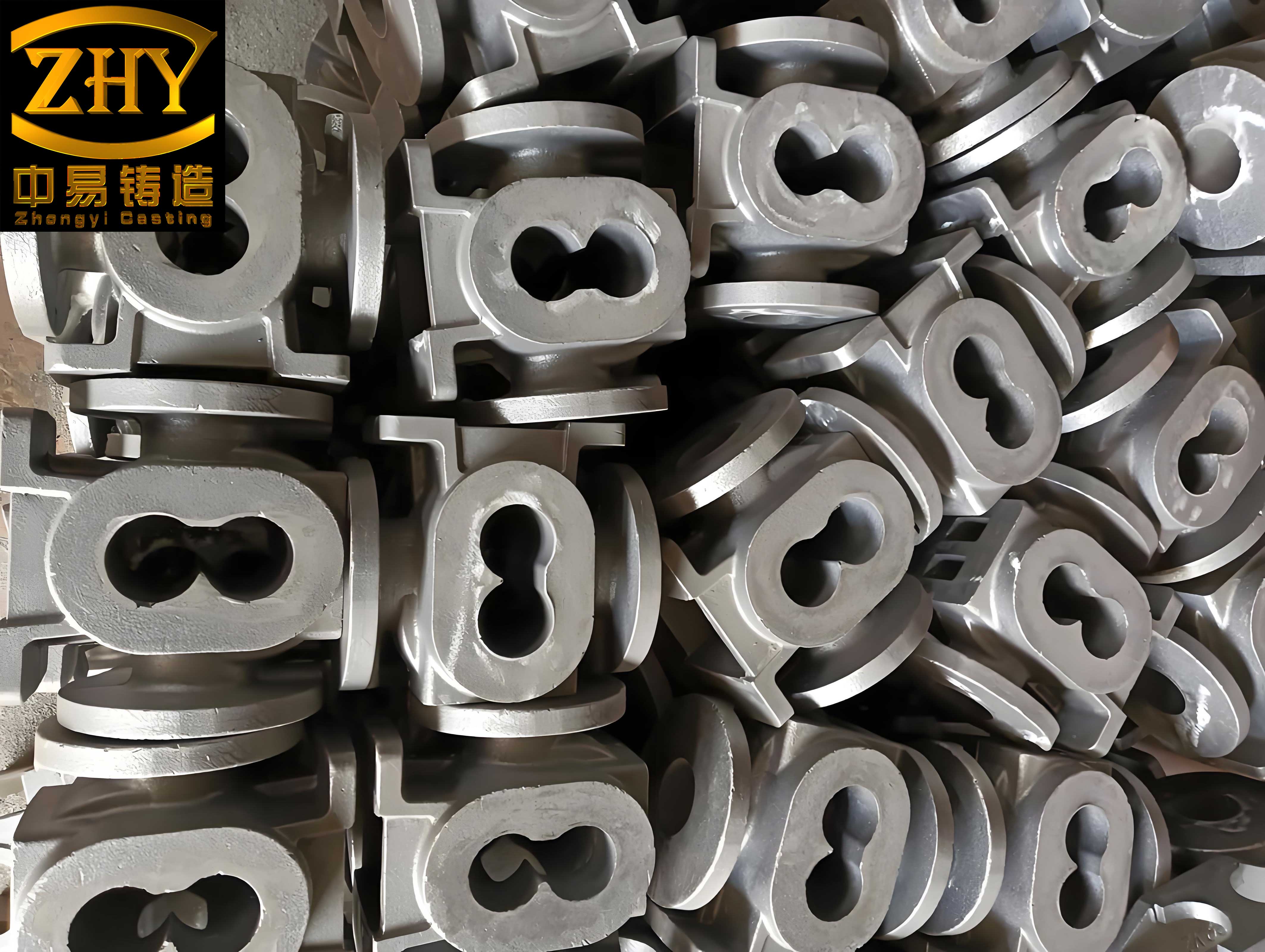
Following the incident, production was immediately halted, and a dedicated task force led by senior management was convened with a mandate to identify the root cause within one week, regardless of cost. The initial defect analysis meeting focused on the机理 of subsurface blowhole formation in nodular cast iron and its potential triggers within our specific process. Subsurface blowholes in castings are typically classified as either gas precipitation or gas invasion types. Given their location just beneath the casting skin and their cluster-like appearance, the defects in question were strongly suspected to be invasion-type blowholes. These form when gases generated from the mold or core infiltrate the solidifying metal front. The likelihood of such invasion is governed by factors affecting gas pressure at the metal-mold interface and the metal’s resistance to gas penetration.
A systematic failure mode and effects analysis (FMEA) was conducted, identifying and ranking potential contributing factors specific to our iron mold-coated sand process for nodular cast iron:
| Potential Factor | Hypothesized Mechanism | Priority for Investigation |
|---|---|---|
| Raw Material Change | Alteration in melt chemistry affecting surface tension, particularly trace elements like N, O, S, or alloying elements. A lower surface tension facilitates gas invasion. | High |
| Excessive Pouring Temperature | Higher temperature reduces melt viscosity and surface tension, increasing gas solubility and the kinetics of gas-melt reaction. | High |
| Excessive Sand Gas Evolution | Increased gas generation from the coated sand layer elevates interfacial pressure, forcing gas into the metal. | Critical |
| Inadequate Iron Mold Venting | Poor gas evacuation from the rigid iron mold increases back-pressure, promoting gas entrapment. | Medium |
| Unidentified Process Change Point | A sudden, batch-wide defect implies a significant, unrecorded deviation in a key process parameter. | Critical |
The investigation proceeded with a detailed, step-by-step verification of each hypothesis.
Phase 1: Process Verification and Initial Root Cause Hypothesis
The production team meticulously audited all records and parameters for the affected shifts against the baseline of previous successful shifts.
| Factor | Investigation Method | Finding | Conclusion |
|---|---|---|---|
| Raw Materials & Melt Chemistry | Batch traceability, spectrometer data review for C, Si, Mn, P, S, and trace elements (Mg, Cu, Sn, etc.). | No change in supplier, batch, or chemical composition. Carbon equivalent and key element ratios were within specification for nodular cast iron. | Ruled Out. |
| Pouring Temperature | Cross-calibration of pyrometers, review of logged temperatures. | Recorded temperatures were within the standard range (e.g., 1380-1420°C). No significant deviation found. | Initially Ruled Out. |
| Coated Sand (Resin Sand) Formula | Review of batch mixing logs for resin, catalyst, and additive ratios. | Documented formulas showed no deviation from the standard operating procedure (SOP). | Inconclusive (Documents appeared normal). |
| Iron Mold Condition | Physical inspection of molds and patterns for blocked vents or damage. | No maintenance had been performed; vents were clear. | Ruled Out. |
| General Process Records | Interview with operators (molding, closing, pouring), review of all shift logs. | No anomalies reported or recorded. Metallography showed acceptable nodule count and size for the nodular cast iron grade. | No obvious change point found. |
With raw materials, mold condition, and documented processes cleared, suspicion narrowed to two interacting factors: latent excess pouring temperature (despite logged data) and coated sand quality. The sand was considered critical because the iron mold-coated sand process relies on a thin layer (typically 4-8 mm) of thermally curing resin-bonded sand. Any abnormality in its curing or gas generation behavior would have a direct and magnified impact.
Verification Test 1 – Pouring Temperature: To conclusively test the temperature hypothesis, a controlled experiment was run. The furnace tap temperature was systematically lowered in 10°C increments from the standard 1540°C down to 1500°C, holding all other variables constant. Result: The subsurface blowholes persisted unabated. Furthermore, the lower temperature led to the formation of dross and slag defects due to impaired fluidity, confirming that the problem was not caused by high temperature. This counterintuitive result shifted the focus entirely to the coated sand system.
Verification Test 2 – Coated Sand: Our in-house sand plant produced the phenolic resin-coated sand using a hot-coating method. The catalyst used was hexamethylenetetramine (HMT), commonly known as urotropine. Literature and experience indicate that HMT is a prime suspect for causing hydrogen-nitrogen gas porosity. The mechanism involves thermal decomposition upon contact with the molten nodular cast iron:
$$ \text{(CH}_2\text{)}_6\text{N}_4 \xrightarrow{\Delta} \text{NH}_3 + \text{HCN} + \text{CH}_2\text{O} + \text{Hydrocarbons} $$
$$ 2\text{NH}_3 \rightleftharpoons \text{N}_2 + 3\text{H}_2 $$
The generated nitrogen and hydrogen gases can dissolve in the molten iron or form bubbles at the interface. If the gas pressure exceeds the ferrostatic pressure and the melt’s surface tension resistance, invasion occurs. The described small, round, clustered pores just under the skin perfectly matched our defect morphology.
A dedicated batch of coated sand was produced under full supervision, strictly adhering to the nominal formula. This sand was used in a trial production run. Result: Zero subsurface blowhole defects. Repeated small-batch trials confirmed the result. The root cause was isolated to the coated sand production process for the offending batches.
Phase 2: Root Cause Analysis and Quantification
A forensic audit of the sand plant’s records for the period corresponding to the defective batches was initiated. While batch logs showed standard HMT additions (typically 10-15% of resin weight), a discrepancy was discovered by cross-referencing inventory withdrawal records with production usage logs. The audit revealed that approximately 23% more HMT had been physically withdrawn from storage than was recorded as being used in production for those batches.
Conclusion: The mixing operator had violated the SOP by significantly over-addition HMT catalyst and had falsified the production log to hide the deviation. This excessive HMT led to a hyper-gas-generating sand layer. The gas evolution rate ($\dot{V}_g$) from the sand can be modeled as a function of catalyst concentration [C] and temperature (T):
$$ \dot{V}_g = A \cdot e^{-E_a/(R T)} \cdot [C]^n $$
Where $A$ is a pre-exponential factor, $E_a$ is the activation energy, $R$ is the gas constant, and $n$ is the reaction order. An over-addition of catalyst [C] would exponentially increase the instantaneous gas generation rate at the pouring temperature, creating a gas pressure ($P_g$) at the metal-sand interface that overwhelmed the local metallostatic pressure ($P_m = \rho g h$) and the capillary pressure ($P_\sigma$) resisting pore formation:
$$ P_g > P_m + P_\sigma = \rho g h + \frac{2\sigma \cos\theta}{r} $$
Where $\rho$ is the metal density, $g$ is gravity, $h$ is the ferrostatic head, $\sigma$ is the metal surface tension, $\theta$ is the contact angle, and $r$ is the pore radius. The low surface tension of nodular cast iron (further reduced by the presence of surface-active elements like magnesium and cerium from nodularizing treatment) results in a lower $P_\sigma$, making it particularly susceptible to gas invasion compared to other cast irons.
Phase 3: Corrective Actions and Control Plan
Based on the findings, immediate and long-term corrective actions were implemented:
- Catalyst Specification and Control: The technical department issued a mandatory upper limit for HMT addition, strictly capped at 15% of the resin weight by mass. A process control chart was established for daily monitoring of this ratio.
- Process Discipline Enforcement: A plant-wide campaign reinforcing “zero tolerance” for procedural violations was launched. The sand plant implemented a dual-verification system for material weighing, requiring a supervisor’s sign-off on catalyst addition for each batch.
- Enhanced Material Traceability Protocol: A new standard was issued mandating a three-way check for all critical materials:
- Batch/ID from incoming inspection must match production log.
- Physical inventory withdrawal (weight/volume) must match production log usage.
- Statistical reconciliation of monthly inventory must account for all recorded usage.
These measures successfully eliminated the defect, and production resumed normally.
Phase 4: Discovery of a Second Critical Factor – Iron Mold Temperature
In January 2016, during another production run of the same 436 crankshaft, a recurrence of subsurface blowholes was observed, affecting about 10.2% of a shift’s output (85 out of 832 pieces). A detailed lot traceability analysis pinpointed the defects to castings poured from two specific ladles. Investigation of the molding process for those specific molds revealed a critical, previously overlooked parameter: iron mold pre-temperature.
The SOP required the iron molds to be between 200°C and 280°C before the coated sand is blown and cured. However, due to cold winter ambient conditions, the molds for the affected lots had cooled to between 110°C and 170°C, well below the specification. This was an uncontrolled variable. A direct experiment was conducted:
- Test A: Use low-temperature molds (~150°C) → Subsurface blowholes reappeared.
- Test B: Pre-heat molds to the specified range (~240°C) → Defects disappeared.
Mechanistic Analysis: The iron mold temperature is critical for the complete and proper thermal curing of the thin resin sand layer. When the mold is too cold, the heat flux from the mold ($q”$) is insufficient to drive the curing reaction to completion before pouring. This can be approximated by considering the heat transfer and reaction kinetics:
$$ q” = k \frac{\partial T}{\partial x} $$
The temperature profile within the sand layer ($T(x,t)$) affects the local degree of cure ($\alpha$), governed by:
$$ \frac{d\alpha}{dt} = K(T) (1-\alpha)^m $$
$$ K(T) = A e^{-E_a/(RT)} $$
Where $K(T)$ is the temperature-dependent rate constant. Incomplete cure leaves “green” or under-cured sand with a high concentration of unreacted resin and catalyst. Upon contact with the molten nodular cast iron, these unreacted materials undergo rapid, violent decomposition, generating a massive, instantaneous surge of gas (H2, N2, CO, hydrocarbons). This burst of gas, combined with potentially lower resin strength from incomplete cure, makes invasion into the casting almost inevitable.
The corrective action was straightforward but essential: Implement mandatory pre-heating of all iron molds during cold weather or if they fall below the minimum threshold. This ensured the thermal energy required for adequate sand curing was always available, stabilizing the process against seasonal ambient variations.
Summary and Preventative System for Nodular Cast Iron Casting
This case study underscores the intricate interplay of factors in producing sound nodular cast iron castings via the iron mold-coated sand process. Two independent root causes for subsurface blowhole defects were identified and rectified:
| Root Cause | Mechanism | Critical Control Parameter | Corrective/Preventive Action |
|---|---|---|---|
| 1. Excessive Catalyst (HMT) in Coated Sand | Hyper-generation of N2/H2 gas due to over-catalyzed decomposition, leading to high interfacial gas pressure. | HMT/Resin weight ratio ≤ 15%. | Strict SOP, dual-verification weighing, material reconciliation audits. |
| 2. Suboptimal Iron Mold Pre-temperature | Incomplete sand curing leading to high volatile content and low strength, causing violent gas burst upon metal contact. | Mold Temperature: 200°C – 280°C before coating. | Mandatory mold pre-heating system and temperature monitoring. |
The fundamental lesson was that process control in foundry operations, especially for sensitive materials like nodular cast iron, must extend beyond the melting and pouring operations to encompass all supporting processes like sand preparation and mold conditioning. A holistic view is necessary. The establishment of a robust management system that includes:
- Clear, scientifically-backed specifications for all input materials.
- Foolproof verification steps for critical process additions.
- Comprehensive parameter monitoring, including environmental factors (like ambient temperature).
- A culture of rigorous data integrity and traceability.
…has proven essential. Since implementing these measures, our production of nodular cast iron components, including crankshafts, brake calipers, and balance shafts, has been completely free of batch-related subsurface blowhole defects, ensuring consistent quality and reliability for our automotive clients. The experience solidified the understanding that the quality of nodular cast iron castings is not determined by a single step but by the precise control and integration of every element in the manufacturing chain.