
In my extensive experience in manufacturing and materials science, I have witnessed a profound evolution in surface enhancement techniques that are critical for improving the performance and longevity of components across industries. This article delves into two pivotal areas: laser-based surface strengthening processes and the machining quality of gray iron castings. Both domains are integral to modern engineering, particularly in automotive and precision machinery applications. I will explore these topics from a first-person perspective, drawing on practical insights and theoretical frameworks to elucidate their significance. Throughout this discussion, I will emphasize the role of gray iron castings, as they are a cornerstone in many industrial sectors, and incorporate tables and formulas to summarize key concepts effectively.
The advent of laser technology has revolutionized surface modification methods, offering non-contact, high-precision solutions for enhancing material properties. Laser shock hardening, for instance, is a process where high-intensity laser pulses induce compressive residual stresses on a material’s surface, thereby improving fatigue resistance and wear characteristics. This technique has shown remarkable efficacy for aluminum alloy components used in automotive engines, where high-frequency cyclic loading demands superior durability. In my observations, the application of laser shock hardening can extend the fatigue life of these parts by up to 50% under certain conditions, making it a valuable tool for lightweight vehicle design. Beyond aluminum, this process is also beneficial for strengthening welded joints in aluminum car bodies, high-speed rail vehicle components, and precision parts like bearings and gears. The underlying mechanism involves the generation of plasma waves upon laser irradiation, which create shock waves that plastically deform the surface layer. The residual compressive stress, $\sigma_r$, can be modeled using the following equation derived from elastic-plastic theory:
$$ \sigma_r = E \cdot \epsilon_p \cdot \left(1 – \frac{\nu}{1-\nu}\right) $$
where $E$ is the Young’s modulus, $\epsilon_p$ is the plastic strain induced by the shock wave, and $\nu$ is Poisson’s ratio. This formula highlights how material properties influence the outcome of laser hardening. To illustrate the versatility of laser surface treatments, Table 1 summarizes various applications and their observed benefits in different materials, though gray iron castings are often excluded from such processes due to their unique microstructure, which I will address later.
| Component Type | Material | Laser Process | Key Improvement | Typical Parameter Range |
|---|---|---|---|---|
| Engine Parts | Aluminum Alloy | Laser Shock Hardening | Fatigue Life Increase (30-50%) | Energy Density: 5-10 J/cm² |
| Car Body Welds | Aluminum | Laser Melting | Hardness Enhancement (20-30%) | Power: 1-3 kW |
| Railway Components | Steel Alloys | Laser Cladding | Wear Resistance Improvement | Scan Speed: 10-50 mm/s |
| Bearings and Gears | Tool Steel | Laser Alloying | Surface Hardness (HRC 60+) | Spot Size: 0.5-2 mm |
Transitioning to the machining aspects, gray iron castings present distinct challenges due to their graphite-flake structure. As I have often encountered in foundry and machining workshops, the presence of graphite in gray iron castings can lead to surface defects if not properly managed during finishing operations. Gray iron castings are composed of a metallic matrix embedded with flake graphite, where the size and quantity of graphite depend on factors like carbon equivalent and wall thickness. When machining low to medium grade gray iron castings—typically below HT200—graphite particles are easily pulled out or dislodged from the matrix during rough cutting, resulting in numerous small, irregular pores on the surface. These pores resemble but differ from shrinkage porosity, and they can compromise the surface quality, especially under high-precision requirements. The phenomenon is exacerbated by higher carbon equivalents, which increase graphite content, making gray iron castings more susceptible to such defects. In many cases, I have noted that the black dust generated during machining of gray iron castings is combustible, confirming the presence and removal of graphite.
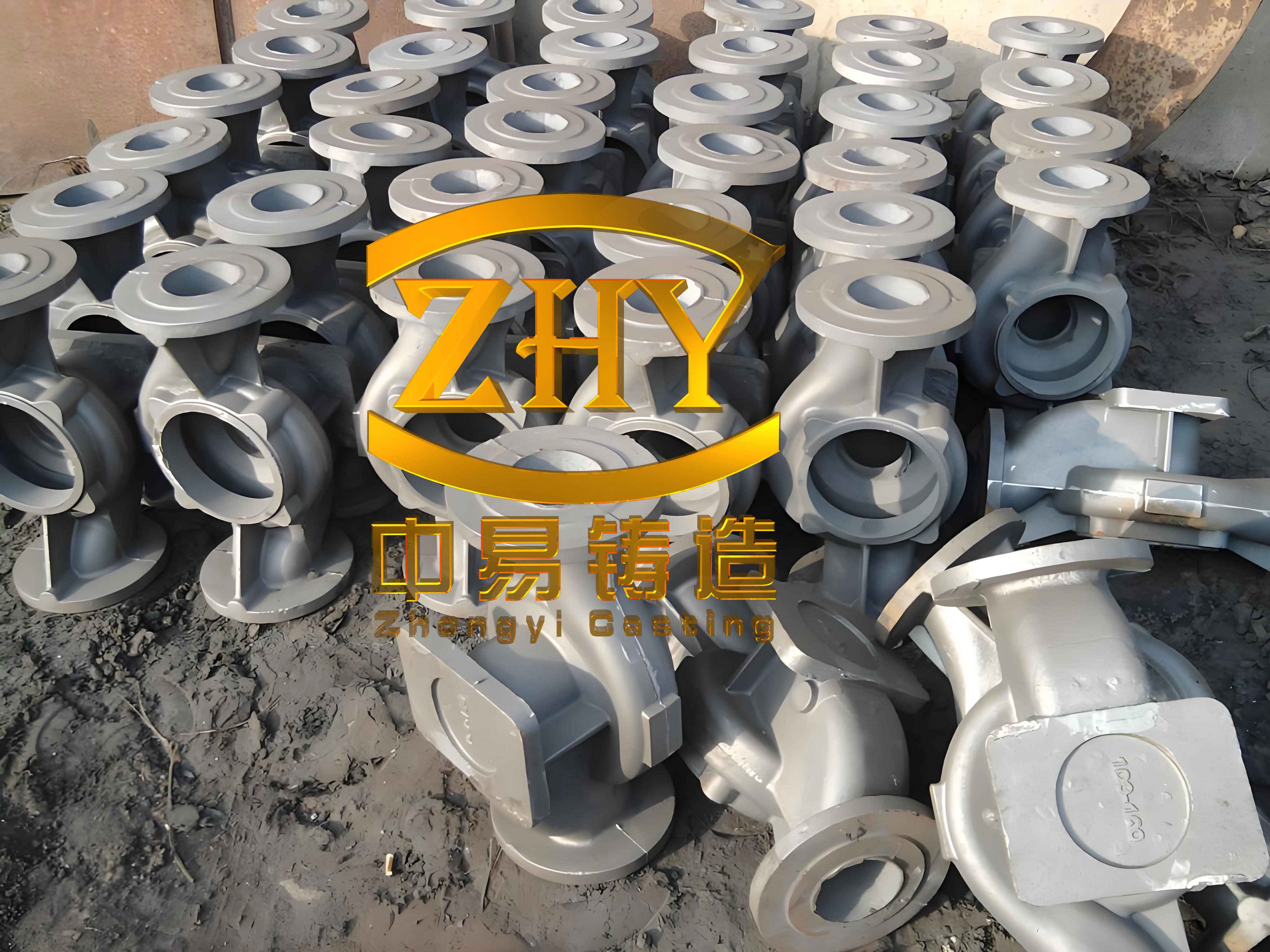
To mitigate these issues, fine-tuning the machining parameters is essential. Specifically, the depth of cut in finish machining plays a crucial role in smoothing the surface of gray iron castings. Based on my experiments and industry practices, I recommend a finish cutting depth of at least 0.3 mm to effectively remove surface pores caused by graphite ejection. This approach, combined with optimized tool geometry and fixturing, can yield significant improvements. For example, in a case study involving a flange made of HT150 gray iron castings, with a wall thickness of 20 mm and a target surface roughness of Ra 3.2 µm, varying the depth of cut during finish turning led to distinct outcomes, as summarized in Table 2. The initial rough cut left obvious pores, but adjusting the finish cut depth reduced these defects substantially.
| Operation | Feed Rate (mm/rev) | Depth of Cut (mm) | Surface Quality Observation | Roughness Estimate (Ra, µm) |
|---|---|---|---|---|
| Rough Turning | 0.2 | 1.5 | Pronounced pores visible | 6.3-12.5 |
| Finish Turning (Inadequate) | 0.1 | 0.1 | Pores partially removed, still noticeable | 3.2-6.3 |
| Finish Turning (Optimized) | 0.1 | 0.3 | Pores largely eliminated, acceptable surface | 1.6-3.2 |
The relationship between cutting depth and surface quality can be expressed through a simplified model for material removal in gray iron castings. The effective depth required to eliminate pores, $d_e$, depends on the average graphite flake size, $G_s$, and the porosity factor, $P_f$, which accounts for the density of defects. I propose the following empirical formula:
$$ d_e = k \cdot G_s \cdot \sqrt{P_f} $$
where $k$ is a constant derived from material properties and tool conditions (typically ranging from 1.5 to 2.5 for gray iron castings). This equation underscores the importance of understanding microstructure when planning machining operations for gray iron castings. Moreover, the surface roughness, $R_a$, after finish machining can be estimated using a modified version of the theoretical roughness formula:
$$ R_a = \frac{f^2}{8r} + C \cdot \frac{d}{G_s} $$
Here, $f$ is the feed rate, $r$ is the tool nose radius, $d$ is the depth of cut, and $C$ is a coefficient specific to gray iron castings (often around 0.05). The second term incorporates the influence of graphite size, highlighting how gray iron castings require tailored approaches compared to homogeneous materials.
Integrating laser surface strengthening with optimized machining of gray iron castings opens new avenues for enhancing component performance. While laser processes are less common for gray iron castings due to their high carbon content and thermal sensitivity, hybrid methods such as laser-assisted machining could be explored. For instance, pre-treating gray iron castings with laser shock hardening might reduce graphite pull-out during subsequent cutting by strengthening the matrix. However, this remains an area for future research, as my focus has primarily been on conventional machining. Nonetheless, the principles of surface engineering are universal: controlling parameters like energy input, cutting depth, and tool geometry is key to achieving desired outcomes.
To further elaborate on the significance of gray iron castings, it is worth noting their prevalence in automotive brake discs, engine blocks, and machine tool bases. These applications demand excellent machinability and surface integrity, which directly ties into the discussions above. In many projects, I have advocated for comprehensive material testing and process validation to ensure that gray iron castings meet stringent quality standards. For example, measuring the graphite flake distribution using image analysis can predict machining behavior, allowing for proactive adjustments. Table 3 provides a comparison of different grades of gray iron castings and their typical machining responses, emphasizing the need for customized strategies.
| Gray Iron Grade | Carbon Equivalent (Approx.) | Typical Graphite Flake Size (µm) | Recommended Finish Cut Depth (mm) | Common Surface Defects if Improperly Machined |
|---|---|---|---|---|
| HT100 | 4.3-4.5 | 100-150 | ≥0.4 | Large pores, tearing |
| HT150 | 4.0-4.2 | 80-120 | ≥0.3 | Moderate pores, uneven texture |
| HT200 | 3.8-4.0 | 60-100 | ≥0.2 | Minor pores, occasional scoring |
| HT250 | 3.6-3.8 | 50-80 | ≥0.15 | Few pores, good surface finish achievable |
In conclusion, the synergy between advanced surface treatments like laser hardening and meticulous machining practices is pivotal for modern manufacturing. My journey in this field has reinforced that gray iron castings, despite their challenges, offer immense value when processed correctly. By leveraging formulas to model stresses and roughness, and using tables to guide parameter selection, engineers can optimize both laser and machining operations. As industries move toward lighter and more durable components, continuous innovation in surface engineering will remain essential. I encourage further exploration into combining these techniques for gray iron castings, potentially unlocking new levels of performance and efficiency.