
Surface hardening stands as a primary strengthening method for automobile panel stamping dies. Among the techniques commonly employed in die shops, induction hardening offers distinct advantages, including rapid, localized heating and efficient self-quenching. This article delves into an analysis of the surface induction hardening process for pearlitic spheroidal graphite cast iron, specifically the grade GGG70L. Through systematic experiments examining hardened case depth, we aim to summarize a rational and effective induction hardening procedure that meets the stringent technical requirements of modern die manufacturing.
1. Material Characteristics: Spheroidal Graphite Cast Iron GGG70L
The spheroidal graphite cast iron designated GGG70L is a German grade material. Owing to its favorable mechanical properties, excellent surface hardenability, and good weldability, it finds extensive application in the fabrication of major automobile panel drawing dies, such as dies, punches, and blank holders.
1.1 Chemical Composition Specifications
The chemical composition requirements for spheroidal graphite cast iron GGG70L across various international industrial standards are summarized in Table 1. The key alloying elements include carbon, silicon, and significant additions of copper and nickel to promote a pearlitic matrix, along with molybdenum for enhanced hardenability.
| Standard | Grade | C | Si | Mn | P | S | Cu | Ni | Mo | Mg |
|---|---|---|---|---|---|---|---|---|---|---|
| Germany (DIN) | GGG70L | 3.3–3.8 | 2.1–2.4 | 0.4–0.7 | ≤0.05 | ≤0.01 | 0.7–1.1 | 0.8–1.1 | 0.4–0.6 | ≥0.04 |
| Europe (EN) | EN-JS2070 | 3.2–3.6 | 1.8–2.4 | ≤0.8 | ≤0.05 | ≤0.01 | ≤1.0 | ≤1.0 | ≤0.5 | 0.04–0.06 |
| General Motors | GM338 | 3.0–3.8 | 1.6–2.6 | 0.3–0.8 | ≤0.08 | ≤0.015 | 0.6–1.2 | 0.7–1.2 | 0.3–0.8 | ≥0.03 |
| USA (ASTM) | A897 D7003 | 3.0–3.7 | 2.0–2.4 | 0.3–0.6 | ≤0.08 | ≤0.015 | 0.4–0.7 | 0.5–1.0 | 0.3–0.5 | 0.04–0.05 |
| China (GB) | QT700M | 3.4–3.8 | 2.0–2.8 | 0.3–0.8 | ≤0.06 | ≤0.02 | 0.3–0.7 | 0.9–1.0 | 0.4–1.0 | ≥0.03 |
1.2 Microstructure and Mechanical Properties
The required microstructure and mechanical properties for spheroidal graphite cast iron GGG70L are detailed in Table 2. A high percentage of pearlite in the matrix is crucial for achieving successful surface hardening.
| Standard / OEM | Grade | Nodularity (%) | Pearlite Content (%) | Tensile Strength (MPa) | Yield Strength (MPa) | Base Hardness (HBW) |
|---|---|---|---|---|---|---|
| Ford WDX / EN | GGG70L (EN-JS2070) | ≥90 (Grade 2) | >90 | ≥700 | ≥400 | 240–280 |
| BMW | GGG70L (EN-JS2070) | — | Sufficient pearlite | ≥700 | ≥400 | 240–280 |
| Mercedes-Benz | GGG70L (EN-JS2070) | Uniformly distributed graphite | >90 | 650–700 | 380–440 | 220–270 |
| Volkswagen | GGG70L (EN-JS2070) | — | — | 650–700 | 380–440 | 220–270 |
The typical microstructure of spheroidal graphite cast iron GGG70L used in automotive dies consists primarily of pearlite with a small amount of ferrite. The initial microstructure significantly impacts the hardening result. If the original structure is coarse, with ferrite present as large, unevenly distributed blocks, it can easily lead to austenite grain growth during heating. During the transformation of pearlite to austenite, cementite may not fully dissolve into the austenite, and the diffusion rate of carbon within the austenite decreases, adversely affecting the subsequent transformation to martensite. Therefore, castings with a high initial ferrite content exhibit lower thermal sensitivity and poorer hardenability. Under identical heating conditions, a finer and more uniform initial structure facilitates the attainment of homogeneous austenite and more stable undercooled austenite (martensite). The most suitable pearlitic structure for surface hardening is a relatively uniform, fingerprint-like lamellar morphology.
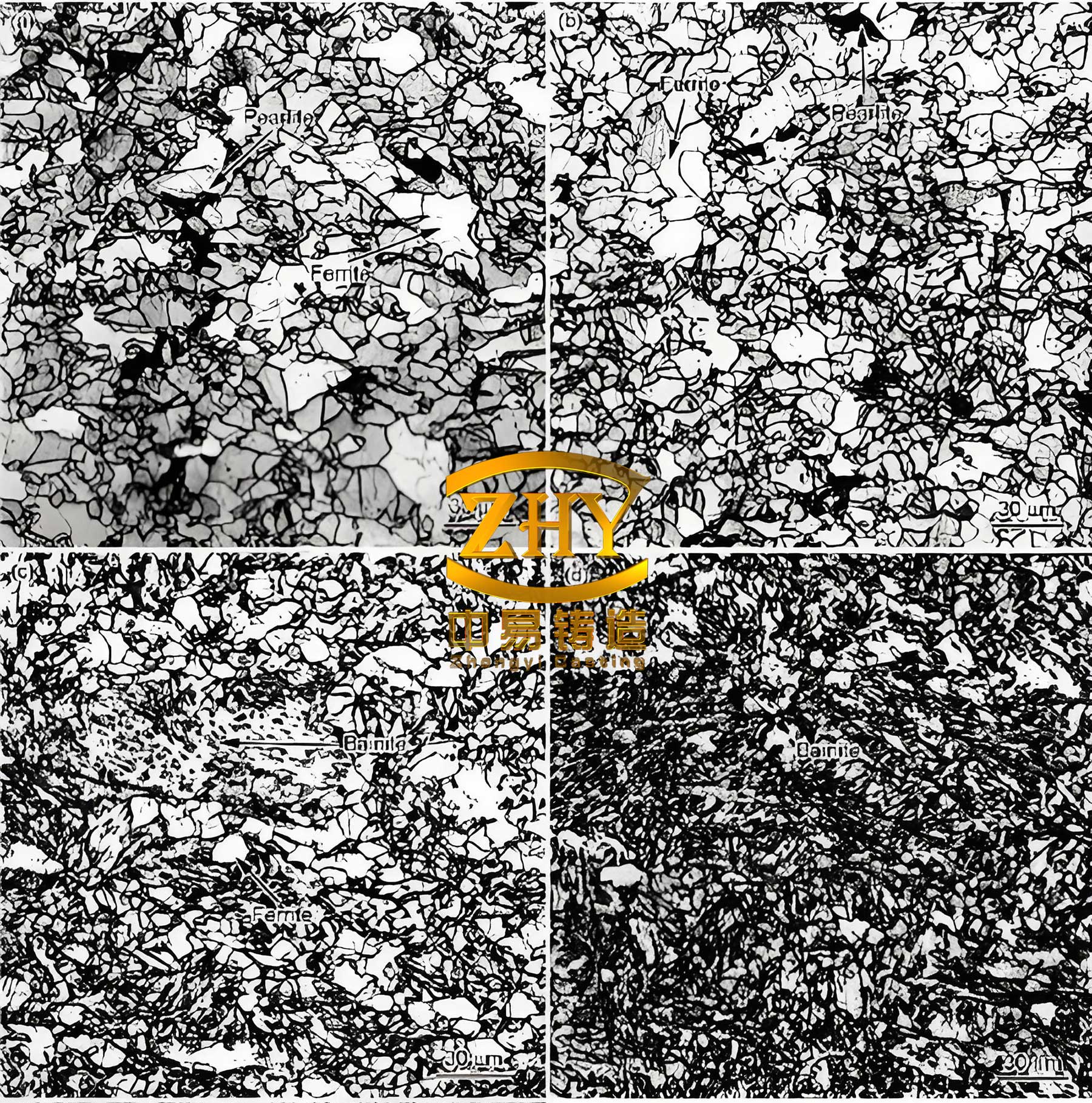
2. Fundamentals of Induction Hardening for Spheroidal Graphite Cast Iron
Induction hardening is a surface heat treatment technology that utilizes electromagnetic induction to generate eddy currents within a workpiece, resulting in rapid Joule heating. The process involves fast heating followed by self-quenching or spray quenching, providing a convenient and reliable method for surface strengthening. The heat source is concentrated in the workpiece surface layer, leading to high heating rates and thermal efficiency. The short heating time minimizes surface oxidation and decarburization, while localized heating reduces overall workpiece distortion.
The depth of the hardened case, δ, is a critical parameter and is influenced by the electrical frequency (f), the material’s electrical resistivity (ρ), and its relative magnetic permeability (μr). The standard depth of penetration (also known as skin depth) where the current density falls to 1/e (about 37%) of its surface value can be approximated by:
$$ \delta \approx 503 \sqrt{\frac{\rho}{\mu_r f}} $$
where δ is in meters, ρ is in ohm-meters, and f is in hertz. For spheroidal graphite cast iron at austenitizing temperatures, ρ is relatively high and μr drops to near 1 (non-magnetic), allowing for deeper heating penetration compared to steels at the same frequency. The required case depth for die applications typically ranges from 1.5 to 3.0 mm, which is achieved using medium frequencies (5–50 kHz).
The transformation during heating involves the dissolution of pearlitic cementite into austenite and the diffusion of carbon from the graphite nodules into the austenitic matrix. The austenitization temperature (Ac1) for spheroidal graphite cast iron is influenced by its silicon content and can be estimated. A common empirical formula for the lower critical temperature is:
$$ A_{c1} (°C) \approx 730 + 28(\%Si) – 25(\%Mn) $$
For a typical GGG70L composition with 2.2% Si and 0.5% Mn, Ac1 is approximately:
$$ A_{c1} \approx 730 + 28(2.2) – 25(0.5) \approx 730 + 61.6 – 12.5 \approx 779°C $$
In practice, a higher surface temperature (900–950°C) is required to ensure complete austenitization within the short heating cycle and to compensate for carbon diffusion kinetics from the graphite nodules.
3. Experimental Investigation: Materials and Methods
3.1 Test Material
The test blocks were made of spheroidal graphite cast iron GGG70L. The chemical composition of the supplied material, conforming to internal control standards, is shown in Table 3.
| Element | C | Si | Mn | P | S | Cu | Ni | Mo | Mg |
|---|---|---|---|---|---|---|---|---|---|
| Standard Range | 3.3–3.8 | 2.1–2.4 | 0.4–0.7 | ≤0.05 | ≤0.01 | 0.7–1.1 | 0.8–1.1 | 0.4–0.6 | ≥0.03 |
| Test Block (AN468-301) | 3.64 | 2.03 | 0.44 | 0.020 | 0.010 | 0.92 | 0.91 | 0.52 | 0.041 |
The microstructure exhibited a nodularity of approximately 90% and a pearlite content of 85–90%, which is considered suitable for induction hardening.
3.2 Equipment
The surface induction hardening was performed using a MICO mobile induction hardening unit (Model MICO-M18 MF). This equipment operates at a frequency range of 16–40 kHz, with a converter efficiency of >0.95. Hardness measurements were conducted using a TMVS-1S Vickers microhardness tester. For spheroidal graphite cast iron GGG70L, a surface hardness of ≥50 HRC after induction hardening is considered the standard operational hardness, sufficient to withstand the loads and abrasion encountered during stamping operations.
4. Experimental Procedure and Results
A series of four distinct induction hardening trials were conducted on the spheroidal graphite cast iron test blocks by varying the key process parameters: converter efficiency (power level) and traverse speed (quenching speed). The frequency was maintained around 30 kHz. After processing, cross-sections were prepared, and hardness traverses were performed from the surface to the core to determine the effective case depth, defined as the depth where the hardness reaches 50 HRC (approximately 513 HV). The results are summarized below.
4.1 Trial 1: Moderate Power, Medium Speed
- Parameters: Converter Efficiency: 0.80; Frequency: 29.8 kHz; Traverse Speed: 280 mm/min.
- Results: Average hardened case depth: 1.553 mm. Edge region effective depth: 0.833 mm. Center (fully heated) region effective depth: 2.047 mm. Surface hardness: 50–60 HRC.
Analysis: The relatively low converter efficiency resulted in lower power input. The significant difference between edge and center depths (0.833 mm vs. 2.047 mm) indicates non-uniform heating, likely due to edge effects (heat loss) and insufficient power to uniformly austenitize the entire track, especially at the edges where heat dissipates faster.
4.2 Trial 2: Increased Power, Slightly Reduced Speed
- Parameters: Converter Efficiency: 0.855; Frequency: 29.9 kHz; Traverse Speed: 260 mm/min.
- Results: Average hardened case depth: 1.648 mm. Edge region effective depth: 1.598 mm. Center region effective depth: 1.667 mm. Surface hardness: 54–61 HRC.
Analysis: Increasing the power (efficiency) and slightly reducing the travel speed provided more consistent energy input. The case depth became much more uniform between the edge and center (1.598 mm vs. 1.667 mm), and the surface hardness increased. This demonstrates improved process stability.
4.3 Trial 3: Higher Power, Original Speed
- Parameters: Converter Efficiency: 0.886; Frequency: 30.1 kHz; Traverse Speed: 280 mm/min.
- Results: Average hardened case depth: 1.521 mm. Edge region effective depth: 1.509 mm. Center region effective depth: 1.533 mm. Surface hardness: 52–60 HRC.
Analysis: With power increased to 0.886 and speed returned to 280 mm/min, the case depth uniformity remained excellent (1.509 mm vs. 1.533 mm), though the absolute depth was slightly lower than in Trial 2. This highlights the interplay between power and speed: P = (Energy per unit length) × v, where P is power and v is speed. Here, the increased speed at a slightly higher power resulted in similar energy input per unit length as Trial 2, yielding a comparable, uniform case.
4.4 Trial 4: High Power, Constant Speed
- Parameters: Converter Efficiency: 0.921; Frequency: 30.1 kHz; Traverse Speed: 280 mm/min.
- Results: Average hardened case depth: 2.041 mm. Edge region effective depth: 1.739 mm. Center region effective depth: 2.341 mm. Surface hardness: 52–64 HRC.
Analysis: The highest power setting (0.921 efficiency) at the same speed produced the deepest average case (2.041 mm). However, the disparity between edge and center depths increased again (1.739 mm vs. 2.341 mm). This suggests that at very high power densities, the center of the heated track may approach or exceed the optimal temperature range, leading to deeper austenitization, while the edges, due to heat loss, remain within a more controlled range. The high surface hardness range (up to 64 HRC) indicates full transformation to martensite, potentially with some retained austenite at the highest temperatures.
| Trial | Conv. Efficiency | Freq. (kHz) | Speed (mm/min) | Avg. Case Depth (mm) | Edge Depth (mm) | Center Depth (mm) | Surface Hardness (HRC) |
|---|---|---|---|---|---|---|---|
| 1 | 0.800 | 29.8 | 280 | 1.553 | 0.833 | 2.047 | 50–60 |
| 2 | 0.855 | 29.9 | 260 | 1.648 | 1.598 | 1.667 | 54–61 |
| 3 | 0.886 | 30.1 | 280 | 1.521 | 1.509 | 1.533 | 52–60 |
| 4 | 0.921 | 30.1 | 280 | 2.041 | 1.739 | 2.341 | 52–64 |
5. Comprehensive Process Analysis and Discussion
The theoretical austenitization temperature range for spheroidal graphite cast iron GGG70L is 840–870°C. However, practical induction hardening with the MICO unit requires controlling the surface temperature within 900–950°C for optimal results. This higher temperature compensates for the extremely short time at temperature and ensures adequate carbon diffusion from the graphite nodules into the austenite matrix, which is essential for achieving high martensitic hardness.
The relationship between process parameters and results can be modeled. The energy input per unit area (E) is a key factor:
$$ E \propto \frac{P}{v \cdot w} $$
where P is the net power (converter efficiency × rated power), v is the traverse speed, and w is the effective width of the inductor. The hardened depth (d) tends to increase with higher E, but follows a logarithmic relationship due to thermal diffusion:
$$ d \approx \alpha \sqrt{\frac{E}{\rho_m c_p (T_{aust} – T_0)}} $$
where α is a process constant, ρm is density, cp is specific heat, Taust is the required austenitization temperature, and T0 is the initial temperature.
From our trials on spheroidal graphite cast iron, we observe that converter efficiency settings between 0.90 and 0.92 (matching a net power level) generally yield the best combination of surface hardness and case depth uniformity for this specific equipment and material. The operator’s skill in maintaining a consistent, steady traverse speed is paramount to achieving uniform hardness and case depth. Visual observation of the heating zone is critical. The operator must distinguish between the “red-hard” zone (indicating austenitization, ~900-950°C) and a “bright-red” or “white-hot” zone (≥1100°C). Since the melting point of spheroidal graphite cast iron (1148–1400°C) is lower than that of steel, lingering too long in one area, creating a bright-red zone, will inevitably lead to surface defects such as melting, burning, overheating cracks, or severe graphitization.
6. Conclusions and Industrial Application Guidelines
Based on the experimental investigation and analysis of the spheroidal graphite cast iron GGG70L, the following conclusions and guidelines can be drawn for industrial die hardening:
- Material Precondition: The pearlite content in the base microstructure of the spheroidal graphite cast iron is a fundamental determinant of surface hardenability. Castings with low pearlite content (high ferrite) present a significant challenge. For such material, the operator must exercise precise control: using the upper limit of the heating temperature without causing burning, employing a slow and uniform traverse speed, and sometimes resorting to multiple passes. This multi-pass technique can have a normalizing effect, encouraging carbon dissolution to form sufficient austenite from the available carbon sources (graphite and pearlite), thereby improving the final淬火 hardness.
- Process Parameter Optimization: For manual induction hardening equipment, a uniform traverse speed is the single most critical operator-dependent factor for consistency. The optimal power setting must be determined for the specific machine and inductor configuration, typically corresponding to a converter efficiency of 0.90–0.92 for the tested spheroidal graphite cast iron grade, to achieve a surface temperature of 900–950°C. The relationship $$ \text{Case Depth} \propto \frac{\text{Power}}{\text{Speed}} $$ serves as a fundamental guide for process adjustment.
- Geometric Considerations: Functional areas of automobile panel drawing dies, such as drawbeads (on blank holders), convex radii on die ribs, character lines, and restrike surfaces, have varying geometries. These geometries significantly influence the electromagnetic field distribution (proximity effect) and heat dissipation during induction heating and subsequent quenching. The process parameters, inductor design, and quenching method must be adapted accordingly to ensure uniform hardening of all functional working surfaces of the die, guaranteeing the required operational hardness profile.
- Quality Target: For spheroidal graphite cast iron GGG70L used in stamping dies, a surface hardness ≥50 HRC with a reasonably uniform case depth of 1.5–2.5 mm, free from overheating defects, constitutes a successful induction hardening treatment that meets the demanding technical requirements of modern die manufacturing.