
In the realm of advanced manufacturing, the integration of ductile iron material with precision lost wax casting techniques offers unique advantages, attracting both producers and consumers to explore its potential. However, achieving high surface quality in such castings remains a challenge, with perspectives varying due to differing production conditions and control methods. This study delves into the critical factors influencing surface quality, emphasizing the role of refractory materials, binder-powder ratios, and pouring temperatures. Through systematic experimentation, we demonstrate that optimized precision lost wax casting processes can yield ductile iron components with surface quality superior to even steel castings.
The precision lost wax casting process, also known as investment casting, involves creating a wax pattern, coating it with ceramic slurry, and then melting out the wax to form a mold. For ductile iron, the interplay between material properties and casting parameters necessitates tailored approaches. Unlike steel, ductile iron has higher carbon and silicon content, lower pouring temperatures (approximately 250°C less), and exhibits a paste-like solidification with significant graphitization expansion. These characteristics reduce oxidation and enhance fluidity, but also increase sensitivity to mold surface defects. Thus, obtaining a dense and robust mold surface is paramount for superior surface quality in precision lost wax casting.
Our investigation employed wax patterns made from paraffin-stearic acid blends, with facecoat slurries using silica sol and sodium silicate as binders. Various refractory materials were tested as facecoat powders and sands. Sodium silicate shells were hardened with ammonium chloride (AC) or crystalline aluminum chloride (CAC), and we evaluated shell and casting surface quality under diverse工艺 conditions. Observations were made using stereomicroscopy and scanning electron microscopy (SEM). The sodium silicate had a modulus (M) of 3.2 and density (d) of 1.28 g/cm³, while silica sol contained 25–26% SiO₂, with d=1.16 g/cm³ and pH=9.9. AC hardening agent concentration was 20%, and CAC had Al₂O₃ content of 6–7%, pH=1.45, d=1.16. Hardening was done at room temperature (15–20°C) for 3 minutes. Slurry viscosity was measured with a flow cup viscometer (100 ml capacity, outlet diameter 5.1 mm).
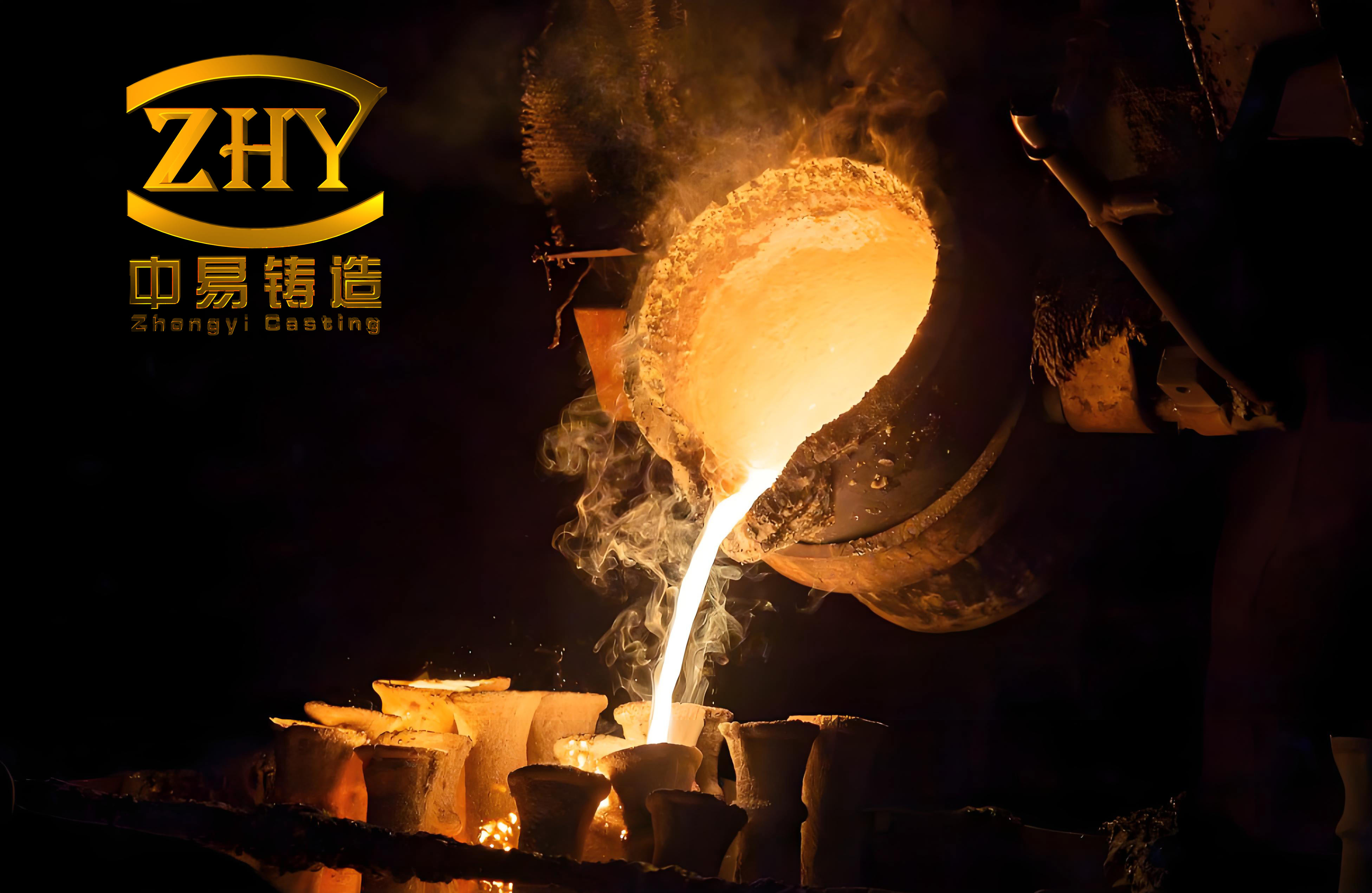
To comprehensively analyze the factors, we consider the following aspects integral to precision lost wax casting.
Binder Factors in Precision Lost Wax Casting
In precision lost wax casting, the choice of binder significantly affects shell surface integrity. We compared silica sol and sodium silicate binders. SEM images revealed that both produced smooth and dense shell surfaces after pouring ductile iron, with evenly distributed凹凸 on casting surfaces. However, for sodium silicate binders, two key considerations emerged: reducing the modulus and density to increase the powder-binder ratio (above 1.3) for enhanced surface density, and ensuring proper hardening to prevent defects. Meeting these criteria allows for excellent surface quality. Composite shells using both binders can yield optimized results. The relationship between binder properties and surface quality can be expressed through the gelation shrinkage, which impacts defect formation. For instance, the shrinkage strain ε can be modeled as:
$$ \epsilon = k \cdot \frac{\Delta V}{V_0} $$
where k is a material constant, ΔV is volume change during gelation, and V₀ is initial volume. Lower shrinkage promotes denser surfaces.
Refractory Material Factors in Precision Lost Wax Casting
Refractory powders and sands are pivotal in precision lost wax casting, influencing slurry rheology, powder-binder ratios, and interfacial reactions. While steel castings often use alumina or quartz, ductile iron benefits from aluminosilicate systems like bauxite. This is due to reduced FeO content in ductile iron, minimizing thermochemical interactions that cause burn-on. For example, the formation of low-melting phases like 2FeO·Al₂O₃·2SiO₂ (melting point 1140°C) is less prevalent, preventing adhesion and easing shell removal. Moreover, higher powder-binder ratios increase packing density, reducing voids from water evaporation. The volume fraction of powder φ in slurry relates to the weight ratio R as:
$$ \phi = \frac{R \cdot \rho_b}{\rho_p + R \cdot \rho_b} $$
where ρₚ is powder density and ρ_b is binder density. As R increases, φ rises, enhancing surface致密度. Table 1 summarizes slurry properties for different refractories.
| Refractory Type | Powder-Binder Weight Ratio (R) | Powder Volume Fraction (φ) | Powder Bulk Density (g/cm³) | Water Content in Slurry (wt%) |
|---|---|---|---|---|
| Bauxite Powder | 1.3 | 0.37 | 2.74 | 23.7 |
| Bauxite Powder | 2.0 | 0.48 | 2.74 | 19.0 |
| Quartz Powder | 1.27 | 0.27 | 2.65 | 24.7 |
| Alumina Powder | 1.27 | 0.26 | 3.95 | 24.9 |
Our experiments showed that bauxite-based slurries with R=2.0 yielded shells with fewer pores and cracks, and castings with smoother surfaces (Ra 3.2–6.3 µm), outperforming quartz-based systems for ductile iron in precision lost wax casting. Additionally, aluminosilicate sands improve shell thermal rigidity, reducing shrinkage defects. The advantages include faster hardening, higher green strength, and dimensional stability. To quantify surface roughness improvement, we propose a model linking powder-binder ratio to roughness Ra:
$$ R_a = A \cdot e^{-B \cdot R} + C $$
where A, B, and C are constants derived from empirical data. Higher R reduces Ra, emphasizing the importance of optimal slurry formulation.
Process Factors in Precision Lost Wax Casting
Process parameters such as hardening agents, drying, and pouring temperatures are crucial in precision lost wax casting. Pre-hardening drying of facecoat slurries, especially at high powder-binder ratios, enhances surface quality by allowing gradual dehydration and reducing gelation shrinkage. In our study, all samples were dried for 12 hours before hardening; in production, 2–4 hours at 15–20°C and 40–60% humidity suffices. The choice of hardening agent interacts with refractory type. For quartz-based shells, CAC hardening caused larger pits and worm-like defects due to high gelation shrinkage and poor diffusion, resulting in Ra up to 12.5 µm, whereas AC hardening gave Ra around 6.3 µm. However, for bauxite-based shells, CAC hardening performed well, as the inherent adsorptivity of aluminosilicates mitigates diffusion issues, and residual Al₂O₃ does not cause burn-on with ductile iron. Table 2 compares hardening effects.
| Hardening Agent | Refractory Type | Surface Roughness Ra (µm) | Key Observations |
|---|---|---|---|
| AC (Ammonium Chloride) | Quartz | 6.3 | Smooth surface, minor凹凸 |
| CAC (Crystalline Aluminum Chloride) | Quartz | 12.5 | Large pits, worm-like defects |
| CAC | Bauxite | 3.2–6.3 | Dense surface, no adhesion |
Pouring temperature and shell temperature significantly affect mold filling and replication. For hot-shell casting, pouring temperatures of 1300–1350°C are suitable for ductile iron. Shell temperature should align with desired microstructure: 400–600°C for ferritic matrix and 200–300°C for pearlitic matrix. Excessive shell temperatures slow cooling, degrading surface quality and microstructure, especially for sections thicker than 7 mm. The heat transfer during pouring can be described by the Fourier equation:
$$ \frac{\partial T}{\partial t} = \alpha \nabla^2 T $$
where T is temperature, t is time, and α is thermal diffusivity. Optimal temperatures ensure proper solidification without surface deterioration.
Experimental Insights and Mathematical Modeling
Our approach in precision lost wax casting involved systematic variation of parameters. We formulated slurries with different powder-binder ratios and measured viscosity η using the flow cup method. The viscosity correlates with powder loading as per the Krieger-Dougherty equation:
$$ \eta = \eta_0 \left(1 – \frac{\phi}{\phi_m}\right)^{-[\eta] \phi_m} $$
where η₀ is binder viscosity, φ is particle volume fraction, φ_m is maximum packing fraction, and [η] is intrinsic viscosity. This model helps optimize slurry for coating uniformity. Additionally, we evaluated shell strength via three-point bending tests, finding that bauxite shells with R=2.0 exhibited strength σ up to 5 MPa, calculated as:
$$ \sigma = \frac{3FL}{2bd^2} $$
where F is fracture load, L is span, b is width, and d is thickness. Higher strength reduces cracking during dewaxing and pouring.
To further elucidate surface quality, we analyzed the interfacial energy between metal and mold. The work of adhesion W_ad can be expressed as:
$$ W_{ad} = \gamma_{sg} + \gamma_{lg} – \gamma_{sl} $$
where γ_{sg}, γ_{lg}, and γ_{sl} are solid-gas, liquid-gas, and solid-liquid interfacial tensions, respectively. For ductile iron on bauxite, lower W_ad due to reduced FeO minimizes penetration, enhancing surface finish. This thermodynamic aspect is vital in precision lost wax casting for defect prevention.
Comprehensive Factor Analysis and Optimization
Integrating all factors, we identify primary influences on surface quality in precision lost wax casting of ductile iron. Using response surface methodology, we can model surface roughness as a function of key variables: powder-binder ratio (R), pouring temperature (T_p), and hardening time (t_h). A quadratic response model might be:
$$ R_a = \beta_0 + \beta_1 R + \beta_2 T_p + \beta_3 t_h + \beta_{11} R^2 + \beta_{22} T_p^2 + \beta_{33} t_h^2 + \beta_{12} R T_p + \beta_{13} R t_h + \beta_{23} T_p t_h $$
where β coefficients are determined experimentally. Our data suggests that R has the most significant effect, followed by T_p and refractory type. For bauxite systems, optimal conditions are R=1.8–2.2, T_p=1325°C, and t_h=3–5 minutes. Table 3 summarizes recommended parameters for precision lost wax casting of ductile iron.
| Parameter | Recommended Range | Effect on Surface Quality |
|---|---|---|
| Powder-Binder Ratio (R) | 1.8–2.2 | Increases packing density, reduces Ra |
| Refractory Type | Aluminosilicate (e.g., Bauxite) | Minimizes thermochemical reactions, improves finish |
| Binder | Sodium Silicate (low M and d) or Silica Sol | Enhances slurry stability and hardening |
| Hardening Agent | CAC for bauxite, AC for quartz | Prevents defects based on refractory compatibility |
| Pre-hardening Drying | 2–4 hours at 15–20°C, 40–60% RH | Reduces gelation shrinkage, increases strength |
| Pouring Temperature | 1300–1350°C | Ensures fluidity without excessive heat input |
| Shell Temperature | 400–600°C (ferritic) or 200–300°C (pearlitic) | Controls cooling rate and microstructure |
Moreover, the economic and environmental benefits of using aluminosilicate materials in precision lost wax casting are notable. Bauxite is often cost-effective and readily available, reducing reliance on imported quartz or alumina. The recycling of ceramic shells can also be optimized, with waste minimization models incorporating particle size distribution. The cumulative distribution function F(d) for refractory powders can be described by the Rosin-Rammler equation:
$$ F(d) = 1 – \exp\left[-\left(\frac{d}{d_c}\right)^n\right] $$
where d is particle size, d_c is characteristic size, and n is uniformity index. Proper grading enhances slurry performance and reduces material usage.
Conclusion
In summary, achieving high surface quality in precision lost wax casting of ductile iron hinges on meticulous control of refractory materials, slurry formulation, and process parameters. Our study proves that aluminosilicate systems like bauxite, combined with high powder-binder ratios and appropriate hardening, yield castings with surface roughness Ra as low as 3.2 µm, surpassing typical steel castings. The unique properties of ductile iron—low oxidation, good fluidity, and graphitization expansion—demand tailored approaches in precision lost wax casting. By optimizing these factors, manufacturers can produce ductile iron components with exceptional surface integrity, expanding applications in automotive, aerospace, and machinery sectors. Future work could explore nano-enhanced refractories or advanced binder systems to further push the boundaries of precision lost wax casting.
Throughout this investigation, the term precision lost wax casting has been emphasized to underscore the importance of accuracy and control in every step. From slurry preparation to final pouring, each aspect contributes to the superior surface quality that defines successful investment casting. As technology advances, continued research in precision lost wax casting will undoubtedly unlock new potentials for ductile iron and other alloys, driving innovation in manufacturing.