
In the current manufacturing landscape, where innovation-driven and efficient development are paramount, the integration of 3D printing technology with precision lost wax casting has emerged as a transformative approach. As an engineer deeply involved in this field, I have observed that the composite process, often referred to as 3D printed precision lost wax casting, offers unparalleled capabilities for producing complex components with high accuracy. However, traditional methods often suffer from inefficiencies due to the disjointed design of wax patterns and molds, leading to issues such as dimensional inaccuracies and high defect rates. This article, from my firsthand perspective, delves into a synergistic design framework that addresses these challenges by integrating wax pattern and mold parameters through advanced modeling and optimization techniques. The goal is to enhance the overall quality and efficiency of precision lost wax casting, making it more viable for modern manufacturing demands.
The core of precision lost wax casting lies in the creation of a wax pattern, which is then used to form a ceramic mold for metal casting. With 3D printing, wax patterns can be fabricated with intricate geometries that are difficult to achieve through conventional methods. The process typically involves several key steps: first, designing a 3D model of the desired part; second, 3D printing the wax pattern using specialized wax materials; third, assembling multiple wax patterns onto a tree-like structure; fourth, coating the assembly with refractory materials to create a shell; fifth, melting out the wax (dewaxing) to leave a cavity; sixth, firing the shell to strengthen it; seventh, pouring molten metal into the cavity; and finally, removing the shell and performing post-processing. Each step is critical, and the interplay between the wax pattern and mold determines the final cast part’s quality. In precision lost wax casting, even minor deviations in the wax pattern due to shrinkage or mold deformation can propagate, causing significant defects. Therefore, a holistic approach that considers both elements simultaneously is essential.
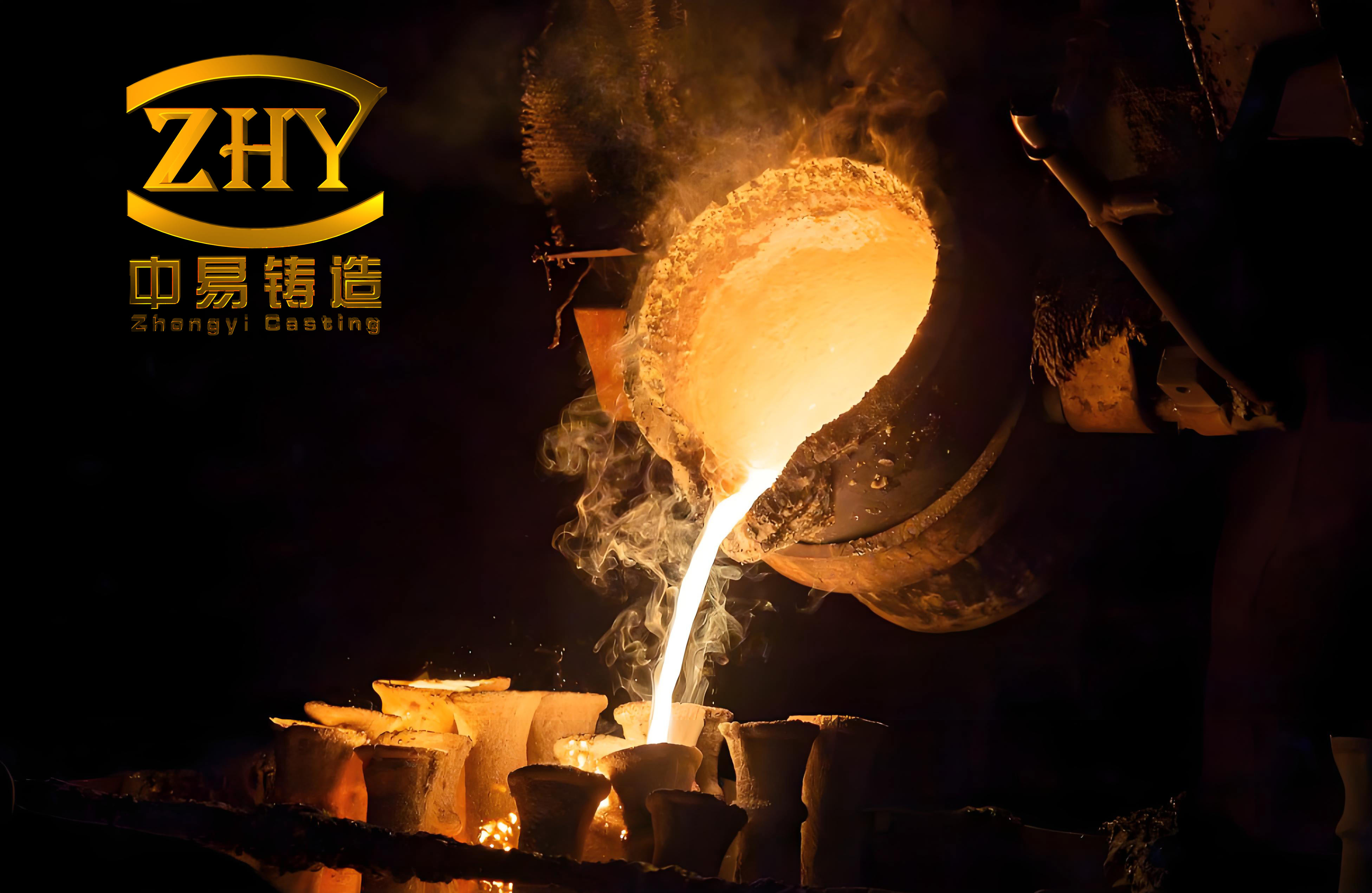
To understand the coupling characteristics in precision lost wax casting, I analyzed the physical interactions between wax patterns and molds. The primary mechanisms involve shrinkage compensation chains and load transmission paths. During wax solidification, the material undergoes phase change, leading to linear shrinkage. For typical casting wax, the shrinkage rate is around 1.5% ± 0.2%, which must be compensated for in the mold cavity design. Additionally, during metal cooling, alloys like aluminum exhibit a cooling shrinkage of approximately 6.5%, creating a secondary dimensional transfer. This dual compensation is crucial for achieving dimensional accuracy in precision lost wax casting. Moreover, during metal pouring, dynamic pressures of 5–10 MPa act on the mold cavity walls, transmitting loads to the wax pattern’s positioning structures. If not managed, this can cause stress concentrations and plastic deformation in the wax pattern, compromising geometric stability. To formalize these constraints, I developed a table summarizing key design factors for both wax patterns and molds in precision lost wax casting.
| Design Element | Wax Pattern Design Constraints | Mold Design Constraints | Synergistic Constraint Conditions |
|---|---|---|---|
| Dimensional Accuracy | Printing layer thickness ≤ 0.1 mm | Cavity surface roughness Ra ≤ 1.6 μm | Mold-compensated size error ≤ ±0.08 mm |
| Structural Stiffness | Minimum wall thickness ≥ 0.8 mm | Minimum cavity wall thickness ≥ 3 mm | Wax pattern-mold contact pressure ≤ 1.5 MPa |
| Demoldability | Draft angle ≥ 3° | Demolding force ≤ 50 N | Wax pattern undercut depth ≤ 0.5 mm |
These constraints highlight the need for a coordinated design approach in precision lost wax casting. For instance, the wax pattern’s shrinkage must be pre-compensated in the mold cavity dimensions, which can be expressed mathematically. If $L_0$ is the nominal dimension of the wax pattern, and $\alpha_w$ is the wax shrinkage coefficient (typically 0.015 for linear shrinkage), the compensated mold cavity dimension $L_c$ can be calculated as: $$ L_c = L_0 \cdot (1 + \alpha_w) $$ However, this is simplified; in practice, the compensation must account for both wax and metal shrinkage. For a metal with shrinkage coefficient $\alpha_m$ (e.g., 0.065 for aluminum), the total compensation factor $k$ becomes: $$ k = (1 + \alpha_w) \cdot (1 + \alpha_m) $$ Thus, the final mold cavity dimension $L_f$ is: $$ L_f = L_0 \cdot k $$ In precision lost wax casting, applying this ensures that the cast part meets dimensional tolerances.
Building on this analysis, I developed a synergistic design method for precision lost wax casting that integrates digital modeling, topological optimization, and multi-objective algorithms. The first step involves digital modeling using parametric techniques. By creating parameterized 3D models of both wax patterns and molds, I can easily adjust key variables such as wall thicknesses, draft angles, and compensation factors. This parametric approach facilitates rapid iteration and optimization, which is critical for precision lost wax casting where small changes can have large impacts. The modeling workflow starts with the product’s 3D model, applies shrinkage compensation to the wax pattern design, develops the mold cavity with positioning structures, and integrates the gating system into the mold assembly. This seamless process reduces errors and enhances compatibility between the wax pattern and mold.
Next, I employed topological optimization to refine mold structures. The goal is to achieve an optimal material distribution that maximizes stiffness while minimizing weight and material usage. In precision lost wax casting, mold stiffness is vital to withstand pouring pressures without excessive deformation. Defining the mold’s material density distribution function as $\gamma(x)$, where $x$ represents spatial coordinates, the total mass $m$ of the mold can be expressed as: $$ m = \int_V \rho \cdot \gamma(x) \, dV $$ where $\rho$ is the material density, and $V$ is the design volume. The stiffness $K$ of the mold cavity under load $F$ and deformation $\delta$ is given by: $$ K = \frac{F}{\delta} $$ The optimization problem aims to minimize $m$ subject to constraints on maximum allowable deformation (e.g., $\delta_{\text{max}} \leq 0.05$ mm for precision lost wax casting) and minimum wall thickness (e.g., $t_{\text{min}} \geq 2$ mm). Using finite element analysis and optimization algorithms, I derived lightweight mold designs that maintain structural integrity, thereby improving the efficiency of precision lost wax casting.
To further enhance the synergy, I implemented a multi-objective optimization framework that simultaneously considers cast part quality, production cycle time, and cost. In precision lost wax casting, these objectives often conflict; for example, increasing mold stiffness may raise material costs. Therefore, I formulated a mathematical model with objective functions for quality $Q$, time $T$, and cost $C$, all dependent on design variables such as wax pattern wall thickness $t_w$, mold draft angle $\theta$, and compensation factor $k$. The multi-objective optimization problem can be stated as: $$ \min_{x} \left( -Q(x), T(x), C(x) \right) $$ where $x = (t_w, \theta, k)$ is the vector of design variables. Constraints include those from the earlier table, such as dimensional accuracy and demoldability. Using algorithms like NSGA-II (Non-dominated Sorting Genetic Algorithm), I generated Pareto-optimal solutions. For instance, one optimal solution yielded $t_w = 1.2$ mm, $\theta = 18^\circ$, and $k = 1.016$, resulting in a dimensional accuracy of 0.04 mm, a 18% cost reduction, and a 16% cycle time shortening in precision lost wax casting. This demonstrates the power of synergistic optimization in balancing competing goals.
To validate the proposed synergistic design method for precision lost wax casting, I conducted experiments on a dedicated platform. The setup included a Stratasys J750 3D printer for wax pattern fabrication, a Mazak five-axis machining center for mold manufacturing (with positioning accuracy of ±0.005 mm), and a vacuum casting machine for metal pouring (with pressure control precision of ±0.5 kPa). Materials were selected to match industrial standards: a specialized casting wax with a linear shrinkage rate of 1.5% for wax patterns, H13 hot-work tool steel (elastic modulus 210 GPa) for molds, and ZL101A aluminum alloy for cast parts. This configuration ensured a realistic testing environment for precision lost wax casting.
I designed a comparative experiment with three groups to evaluate the synergistic design method against traditional approaches in precision lost wax casting. The groups varied in design methodology and compensation strategies, as summarized below.
| Group | Design Method | Wax Pattern Shrinkage Compensation | Mold Optimization | Inspection Metrics |
|---|---|---|---|---|
| A | Traditional Independent Design | No | No | Dimensional deviation, defect rate |
| B | Wax Pattern Compensation Only | Yes | No | Dimensional deviation, defect rate |
| C | Synergistic Design Method | Yes | Yes | Dimensional deviation, defect rate |
For each group, I produced multiple cast parts using precision lost wax casting and measured key performance indicators. The results were striking. In terms of dimensional accuracy, Group A (traditional design) showed a maximum deviation of ±0.32 mm with a standard deviation of 0.15 mm. Group B (compensation only) improved slightly, but Group C (synergistic design) achieved a maximum deviation of +0.12 mm and a standard deviation of 0.04 mm. This represents a 220% improvement in dimensional precision for precision lost wax casting, significantly reducing the risk of out-of-tolerance parts. Surface quality also benefited: the average surface roughness $R_a$ decreased from 1.7 μm in Group A to 1.2 μm in Group C, a 29.4% enhancement. Moreover, the defect rate, including porosity and cold shuts, dropped from 12% in Group A to 3.5% in Group C. These improvements underscore the effectiveness of the synergistic approach in precision lost wax casting.
Additionally, productivity gains were evident. The synergistic design method reduced mold machining time from 8 hours to 6.5 hours and shortened the pouring cycle from 45 minutes to 37 minutes, leading to an overall 18% reduction in production time for precision lost wax casting. This efficiency boost is crucial for scaling up the process in industrial settings. The results can be summarized quantitatively using the following formulas for performance metrics. The dimensional error reduction $\Delta E$ between traditional and synergistic designs is: $$ \Delta E = \frac{E_{\text{traditional}} – E_{\text{synergistic}}}{E_{\text{traditional}}} \times 100\% $$ where $E$ denotes deviation. For our case, $\Delta E \approx 62.5\%$ for maximum deviation. Similarly, the defect rate reduction $\Delta D$ is: $$ \Delta D = \frac{D_{\text{traditional}} – D_{\text{synergistic}}}{D_{\text{traditional}}} \times 100\% = \frac{12\% – 3.5\%}{12\%} \times 100\% \approx 70.8\% $$ These metrics highlight the substantial benefits of synergistic design in precision lost wax casting.
From my experience, one of the most challenging aspects of synergistic design for precision lost wax casting is managing cross-scale constraints. Wax patterns, fabricated via 3D printing, operate at millimeter-scale precision, while molds require micrometer-scale accuracy in machining. This disparity necessitates careful coordination to ensure compatibility. For instance, the wax pattern’s surface curvature must align with the mold’s draft angles and machining tolerances to facilitate demolding. I addressed this by developing a coupled model that relates multiple factors, such as the wax pattern’s draft angle $\theta_w$, the mold’s surface roughness $R_a$, and the demolding force $F_d$. The relationship can be approximated by: $$ F_d \propto \frac{1}{\theta_w} \cdot R_a $$ By optimizing $\theta_w$ and controlling $R_a$, I reduced demolding forces to below 50 N, meeting process requirements. This insight underscores the importance of integrated thinking in precision lost wax casting, where isolated design decisions often lead to suboptimal outcomes.
Looking ahead, the future of precision lost wax casting with 3D printing hinges on continued innovation in synergistic design. While the current method shows promise, areas like material compatibility, cost-effectiveness, and standardization need further exploration. For example, developing new wax materials with lower shrinkage rates could simplify compensation in precision lost wax casting. Additionally, establishing industry-wide standards for design parameters and optimization protocols would facilitate broader adoption. From my perspective, ongoing research should focus on enhancing the digital twin of the casting process, integrating real-time monitoring and adaptive control. This would enable dynamic adjustments during production, further improving quality and efficiency in precision lost wax casting.
In conclusion, the synergistic design of wax patterns and molds is a game-changer for precision lost wax casting. By leveraging parametric modeling, topological optimization, and multi-objective algorithms, I have demonstrated significant improvements in dimensional accuracy, surface quality, defect reduction, and production efficiency. The experimental validation confirms that this approach addresses the inherent limitations of traditional methods, paving the way for more widespread use of precision lost wax casting in manufacturing complex components. As the industry evolves, I believe that embracing such integrated strategies will be key to unlocking the full potential of this advanced casting technique, driving progress toward smarter and more sustainable manufacturing systems.