
As a professional in the field of manufacturing and materials science, I have extensively studied the critical role of machine tool castings in the production of high-precision machine tools. Machine tool castings form the backbone of equipment used in industries such as automotive, aerospace, and general manufacturing, where demands for accuracy, durability, and stability are paramount. The quality of these machine tool castings directly influences the performance, lifespan, and precision retention of machine tools, making their technical control a focal point in advancing global manufacturing capabilities. In this article, I will delve into the key aspects of controlling the properties of machine tool castings, drawing from international standards and practical experiences to highlight best practices. Throughout this discussion, I will emphasize the importance of rigorous control measures to ensure that machine tool castings meet the evolving needs of modern数控机床.
The performance requirements for machine tool castings are multifaceted, encompassing mechanical, physical, and processing characteristics. Firstly, machine tool castings must exhibit high compressive and tensile strength to withstand the rigorous forces encountered during machining operations. Secondly, excellent dimensional stability is crucial to maintain accuracy over time, especially in数控机床 applications where consistency is key. Thirdly, a high elastic modulus is essential for rigidity, reducing deformation under load and enhancing precision. Additionally, good wear resistance ensures longevity, while superior vibration damping properties minimize oscillations that could affect machining quality. Furthermore, machine tool castings should possess favorable machinability to facilitate efficient production processes, along with reliable casting properties to minimize defects. Lastly, high dimensional accuracy and low surface roughness are vital for seamless integration into advanced machine tools. These requirements collectively ensure that machine tool castings serve as reliable foundations in high-performance equipment.
To achieve these properties, control over the chemical composition of machine tool castings is fundamental. The stability of elements like carbon (C), silicon (Si), and molybdenum (Mo) plays a pivotal role in determining hardness and machinability. For instance, in数控机床 applications, fluctuations in composition can lead to inconsistencies in加工精度. Based on my observations, international foundries, such as those in Japan, maintain tight control with variations in C and Si content within ±0.1% and ±0.05%, respectively. This precision surpasses typical domestic ranges, where fluctuations can be as high as 0.4% for C and 0.7% for Si, leading to less predictable performance in machine tool castings. The carbon equivalent (CE) is another critical parameter, as it influences both strength and castability. Higher CE values, as seen in Japanese practices, often result in better铸造性能 without compromising strength. For example, the CE for FC30 grade machine tool castings ranges from 3.81% to 3.85%, whereas domestic HT300 averages around 3.68%. This highlights the need for optimized chemical control in producing high-quality machine tool castings.
| Grade | C Range (%) | ΔC (%) | Si Range (%) | ΔSi (%) | Average CE (%) |
|---|---|---|---|---|---|
| FC30 (Japan) | 3.15-3.25 | 0.1 | 1.80-2.00 | 0.2 | 3.83 |
| HT300 (Domestic) | 2.90-3.30 | 0.4 | 1.40-2.10 | 0.7 | 3.68 |
| FC35 (Japan) | 3.10-3.20 | 0.1 | 1.75-1.95 | 0.2 | 3.76 |
| HT350 (Domestic) | 2.80-3.10 | 0.3 | 1.30-1.90 | 0.6 | 3.48 |
In addition to chemical stability, the relationship between strength and carbon equivalent is vital for machine tool castings. Higher strength grades, such as HT350 and HT300, are increasingly used in数控机床 to enhance rigidity, but this often requires lower CE, which can impair castability. To address this, advanced foundries employ techniques like high-temperature melting, carburizing, and intensive inoculation to achieve high-strength machine tool castings with elevated CE. The Si/C ratio is another lever; increasing it from 0.4-0.5 to 0.7-0.8 can boost both strength and elastic modulus. This approach supports the trend toward lightweight machine tool castings with thinner sections, such as 8-10 mm for certain bed components, without increasing defect rates. Thus, precise chemical management is indispensable for balancing the mechanical and casting properties of machine tool castings.
Moving to mechanical properties, the tensile strength and elastic modulus of machine tool castings are paramount for ensuring structural integrity under dynamic loads. Internationally, machine tool castings often utilize grades like HT350 and HT300, which offer higher strength compared to domestic equivalents. However, stiffness, as measured by the elastic modulus, is even more critical than pure strength for数控机床, as it determines resistance to deformation during high-speed machining. The elastic modulus (E) correlates with tensile strength (σ_b), and this relationship can be approximated using empirical formulas. For instance, based on data, the elastic modulus increases with strength, but the rate of change varies. A simplified model can be expressed as: $$ E = k \cdot \sigma_b + c $$ where k and c are constants derived from material testing. For machine tool castings, this means that higher strength grades provide better dimensional stability, but the elastic modulus must be explicitly controlled, as it does not always scale linearly with strength.
| Tensile Strength, σ_b (MPa) | Elastic Modulus, E (GPa) | Recommended E for Design (GPa) |
|---|---|---|
| 155 | 103.5 | – |
| 185 | 111.7 | – |
| 215 | 120.0 | – |
| 265 | 129.7 | – |
| 310 | 137.9 | 130.0 |
| 355 | 141.4 | 140.0 |
| 400 | 144.8 | 145.0 |
Comparatively, international standards for machine tool castings specify higher elastic moduli. For example, HT250 machine tool castings may have an elastic modulus of 110-120 GPa, while advanced variants like those from the UK’s密烘铸铁 achieve 120-135 GPa for similar grades. This disparity underscores the importance of not only targeting high strength but also optimizing microstructural factors to enhance stiffness. In practice, the elastic modulus for machine tool castings is often evaluated at a stress level of one-quarter the tensile strength (i.e., σ/4), as this represents typical operating conditions in数控机床. Therefore, manufacturers must focus on comprehensive mechanical testing to ensure that machine tool castings meet both strength and rigidity demands.
The microstructure of machine tool castings, particularly graphite morphology and pearlite formation, significantly impacts their performance. In high-quality machine tool castings, graphite should be predominantly Type A, with a fine, uniform distribution to maximize strength and damping capacity. For instance, at a constant carbon equivalent of 3.27%, machine tool castings with coarse graphite may achieve a tensile strength of 205 MPa, whereas those with fine graphite can reach 295 MPa. Similarly, the pearlite matrix should be fine and densely spaced, resembling sorbitic or troostitic structures, to enhance hardness and wear resistance. Domestic specifications often require graphite lengths of grade 4-5, pearlite content over 95%, and carbide levels below 3%. However, international practices for machine tool castings emphasize even finer microstructures, achieved through controlled cooling and inoculation, resulting in superior mechanical properties. This microstructural refinement is essential for ensuring that machine tool castings maintain consistency in数控机床 applications.
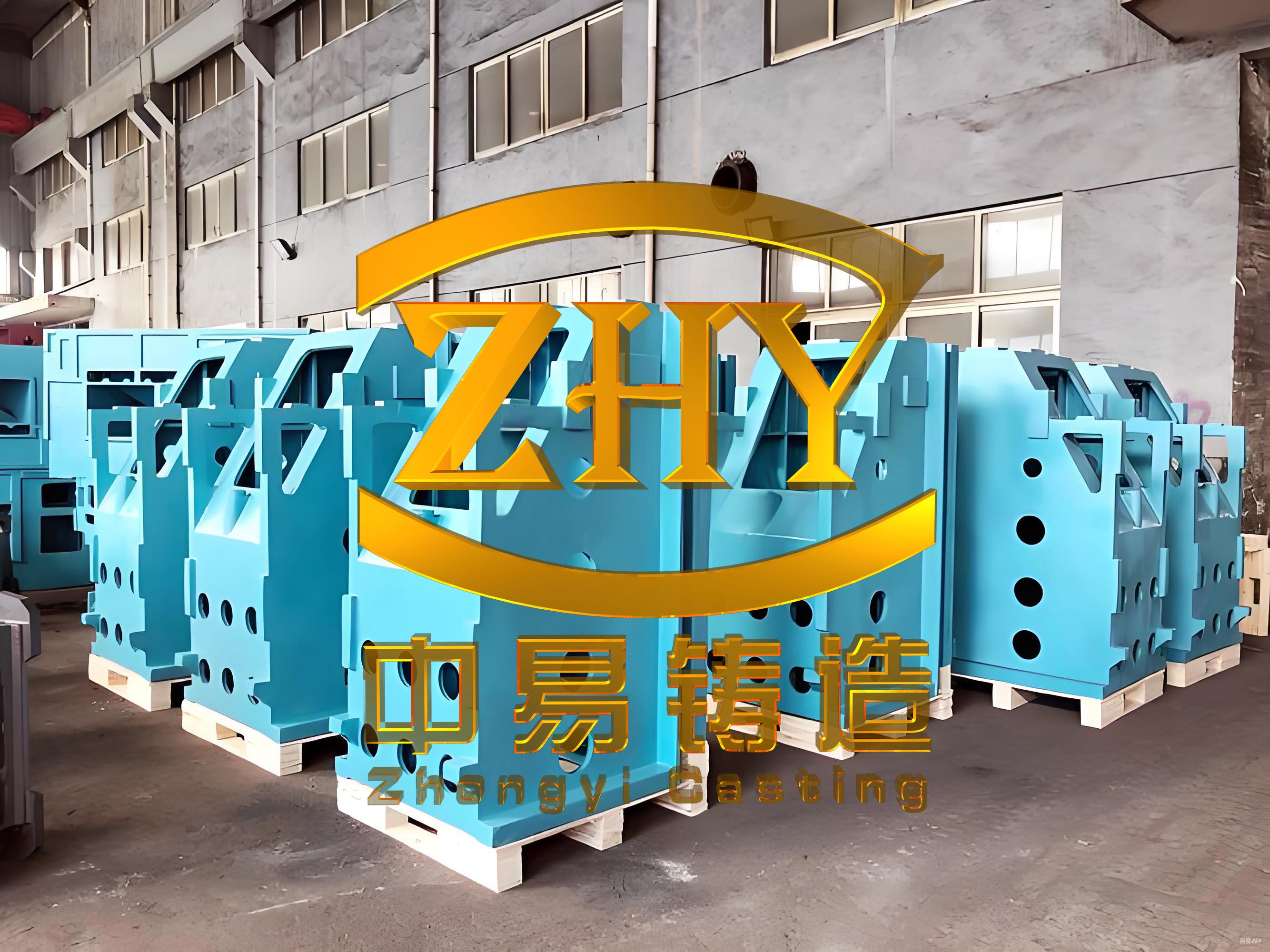
Dimensional accuracy is another critical aspect of machine tool castings, directly affecting the assembly and performance of数控机床. The use of resin sand molding has improved capabilities, with international foundries consistently achieving CT8 levels per ISO standards, where the dimensional tolerance is tight, and flatness deviations are less than 1 mm over any 600 mm span. In contrast, domestic production of machine tool castings often ranges from CT9 to CT10, with flatness up to 2 mm. This gap highlights the need for advanced pattern-making and process control to enhance the precision of machine tool castings. For integration into flexible manufacturing lines, achieving CT8 is imperative, as it ensures compatibility with automated systems and reduces post-machining requirements. Thus, investing in dimensional stability is a key step toward producing world-class machine tool castings.
Stress relief treatments, such as thermal aging or vibration aging, are essential for minimizing residual stresses in machine tool castings, which can cause dimensional changes over time. As strength increases in grades like HT350 and HT300, residual stresses also rise, necessitating effective aging processes. Thermal aging involves heating machine tool castings to specific temperatures based on the grade; for example,密烘铸铁 specifications recommend 560-590°C for GC/GB grades (280-320 MPa) and 590-620°C for GA/GM grades (350 MPa and above). Vibration aging offers an alternative for certain applications, but thermal methods remain prevalent for high-strength machine tool castings. By implementing these treatments, manufacturers can ensure long-term stability and accuracy in数控机床 components, reducing the risk of deformation during service.
| Cast Iron Grade | Tensile Strength Range (MPa) | Aging Temperature (°C) |
|---|---|---|
| GD/GE | 210-250 | 510-560 |
| GC/GB | 280-320 | 560-590 |
| GA | 350 | 590-620 |
| GM | >385 | 590-620 |
In conclusion, the technical control of machine tool castings is a multifaceted endeavor that requires meticulous attention to chemical composition, mechanical properties, microstructure, dimensional accuracy, and stress relief. As the demand for high-precision数控机床 grows, advancing these aspects will bridge the gap between domestic and international standards. By adopting rigorous control measures, such as tight compositional tolerances and optimized aging processes, the industry can produce machine tool castings that excel in strength, stability, and durability. Ultimately, continuous innovation in foundry practices will propel the transition from a manufacturing giant to a global leader in high-quality machine tool castings, supporting the evolution of modern manufacturing landscapes.