
As a materials engineer specializing in wear-resistant components, I have extensively worked with high manganese steel casting due to its exceptional properties, including high impact toughness, superior strength, and remarkable wear resistance under severe conditions. This alloy is widely employed in applications such as cement pump truck pipe fittings, where it must withstand high-pressure environments and abrasive wear from concrete slurry. The unique advantage of high manganese steel lies in its ability to undergo work-hardening upon impact, significantly enhancing surface hardness and durability. In this article, I will share my first-hand experiences and methodologies for producing high-quality high manganese steel castings, focusing on optimizing casting processes, controlling chemical composition, and addressing common defects to achieve internal denseness and improved service life. Through rigorous practice, we have enhanced the pressure test qualification rate and dimensional accuracy of these castings, surpassing previous welded structures in performance.
The high manganese steel casting process begins with a thorough structural analysis of the component. For instance, the thin-walled pipe fittings used in cement pump trucks exhibit significant wall thickness variations, with the thickest sections reaching up to 25 mm and the thinnest as low as 7.5 mm. This disparity poses challenges in achieving uniform solidification and avoiding defects like shrinkage porosity. Initially, these fittings were fabricated by welding separate cast parts, but transitioning to a monolithic high manganese steel casting design required meticulous planning. The primary goal was to ensure internal integrity to withstand pressure tests of up to 10 MPa without leakage. To accomplish this, we adopted a resin sand molding process, which offers excellent dimensional stability and surface finish. The mold design involved symmetric placement of two patterns in a single flask to facilitate core support and positioning, as illustrated in the following section.
In the high manganese steel casting process, the gating system design is critical to ensure smooth filling, minimize turbulence, and prevent slag inclusion. High manganese steel, with its high carbon content, exhibits good fluidity but significant solidification shrinkage of approximately 6%. This necessitates a carefully calculated open gating system with a pouring basin that acts as a slag trap. Based on empirical data, the pouring time for a 75 kg total weight of molten steel is determined using the formula: $$ t = C \sqrt{G} $$ where \( t \) is the pouring time in seconds, \( C \) is a coefficient typically set to 0.9, and \( G \) is the total weight in kg. For our application, this calculates to approximately 8 seconds. The average pressure head \( H_p \) is derived from: $$ H_p = H_0 – \frac{P^2}{2C} $$ where \( H_0 \) is the height from the pouring cup to the ingate, and \( C \) is the total height of the casting in the mold. In our case, \( H_p \) was maintained at around 13.9 cm to ensure adequate flow. The minimum cross-sectional area of the gating system is calculated as: $$ \sum F_{\text{阻}} = \frac{G}{0.31 \mu t \sqrt{H_p}} $$ where \( \mu \) is the resistance coefficient, taken as 0.6. This yielded a total area of 13.5 cm², with the sprue diameter set at 42 mm. The area ratios were optimized to \( \sum F_{\text{直}} : \sum F_{\text{横}} : \sum F_{\text{内}} = 1 : 1.38 : 1.43 \), incorporating a stepped riser design to enhance pressure distribution and reduce shrinkage defects.
Control over the chemical composition is paramount in high manganese steel casting to achieve the desired mechanical properties. The standard requirements for ZGMn13-2 grade include specific ranges for carbon, silicon, manganese, sulfur, and phosphorus, as outlined in Table 1. Maintaining a manganese-to-carbon ratio (Mn/C) between 9 and 11 is essential to prevent the formation of brittle carbides and ensure optimal toughness. Through iterative testing, we refined the composition to enhance performance, as detailed in Table 3. The mechanical properties, such as tensile strength, elongation, and impact toughness, must meet stringent standards, which we achieved through precise alloy adjustments, resulting in values listed in Table 4.
| Element | Composition (wt%) |
|---|---|
| C | 0.9–1.35 |
| Si | 0.3–1.0 |
| Mn | 11.0–14.0 |
| S | ≤0.04 |
| P | ≤0.07 |
| Property | Value |
|---|---|
| Tensile Strength | ≥685 MPa |
| Elongation | ≥25% |
| Impact Toughness | ≥147 J/cm² |
| Hardness (HBS) | ≤300 |
The molding process in high manganese steel casting utilizes low-nitrogen furan resin sand to achieve high strength and low gas evolution. Initially, resin addition was limited to 0.8% to reduce costs, but this resulted in insufficient mold strength and surface roughness. By increasing the resin content to 0.9–1.2%, we achieved a tensile strength of 0.6–0.8 MPa, improving dimensional accuracy. Additionally, the use of metal alignment pins instead of sand cones enhanced mold assembly precision. To prevent chemical burning-on caused by the reaction between manganese oxide (MnO) in the steel and silica in the sand, we applied a basic magnesia-based alcohol coating with a thickness of 0.8 mm. This coating was ignited immediately after application to ensure dryness and avoid gas defects, critical for maintaining the integrity of high manganese steel casting.
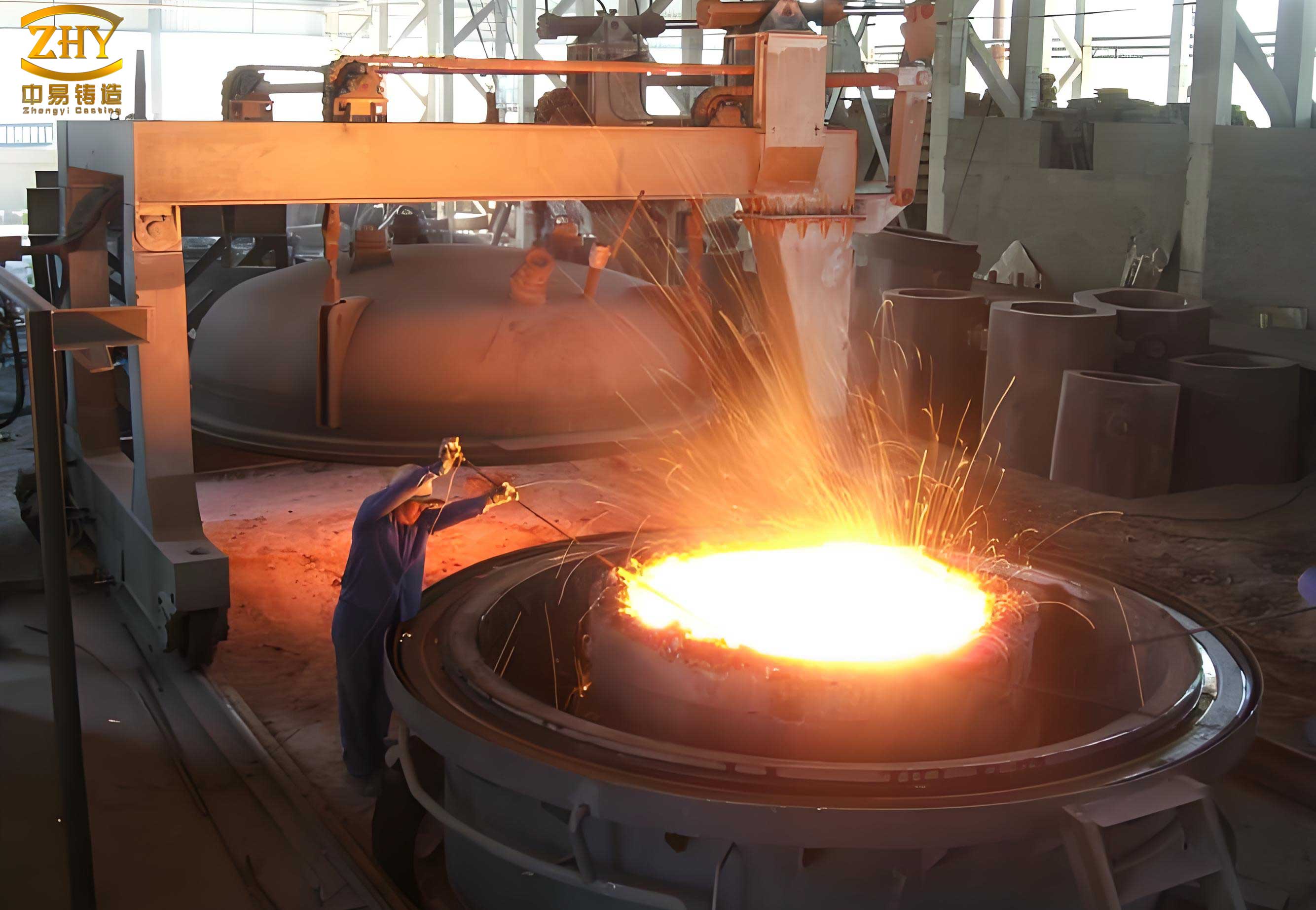
Melting practices for high manganese steel casting involve medium-frequency induction furnaces, where strict control over raw materials is necessary to minimize phosphorus content, as it can lead to brittle phosphide eutectics. Manganese iron and scrap steel are added in batches, with deoxidizers like silicon iron and rare earth elements used to reduce oxidation. The final deoxidation includes adding 0.5 kg of aluminum per ton of steel. The tapping temperature is maintained between 1,490°C and 1,520°C, and after pouring, the molds are loosened within 10 minutes to release stresses and prevent cracking. The relationship between temperature and solidification can be expressed using the Chvorinov’s rule for solidification time: $$ t_s = B \left( \frac{V}{A} \right)^2 $$ where \( t_s \) is the solidification time, \( B \) is a mold constant, \( V \) is the volume, and \( A \) is the surface area. This principle helps in optimizing riser design for high manganese steel casting.
During production, several defects were encountered in high manganese steel casting, such as sand sticking, shrinkage porosity, and cracking. Sand sticking occurred due to inadequate mold compaction and coating imperfections, allowing metal penetration. By enhancing compaction and implementing a wind separation system to remove iron fines from the sand, we improved mold quality. Shrinkage porosity, which initially caused a 40% failure rate in pressure tests, was addressed by modifying the gating system and using chill blocks in critical areas. The final composition adjustments, as shown in Table 3, along with optimized Mn/C ratios of 8–10, increased the pressure test qualification rate to over 85%. The improved mechanical properties are summarized in Table 4.
| Element | Composition (wt%) |
|---|---|
| C | 1.1–1.3 |
| Si | 0.3–0.8 |
| Mn | 11.0–14.0 |
| S | ≤0.04 |
| P | ≤0.07 |
| Property | Value |
|---|---|
| Tensile Strength | 725–780 MPa |
| Elongation | 28–35% |
| Impact Toughness | 160–195 J/cm² |
| Hardness (HBS) | 220–250 |
Cracking in high manganese steel casting often manifested as micro-cracks after water toughening treatment, potentially due to insufficient cooling rates or precipitation of carbides. The water toughening process involves heating to 1,050°C followed by rapid quenching in water at 25–45°C to dissolve carbides into austenite. The kinetics of carbide dissolution can be described by the Arrhenius equation: $$ k = A e^{-E_a / RT} $$ where \( k \) is the rate constant, \( A \) is the pre-exponential factor, \( E_a \) is the activation energy, \( R \) is the gas constant, and \( T \) is the temperature. By optimizing the heating rate and holding time, and ensuring timely tempering, we eliminated micro-cracks. The improved water toughening curve is represented as a function of time and temperature, emphasizing the critical cooling phase to avoid embrittlement.
In conclusion, the successful production of high manganese steel casting relies on a holistic approach encompassing detailed process design, precise chemical control, and proactive defect management. Through continuous refinement, we have achieved castings with superior internal density, enhanced pressure test performance, and extended service life up to 20,000 cubic meters in cement pump applications. The integration of advanced gating systems, proper mold materials, and optimized heat treatment protocols ensures that high manganese steel casting meets the demanding requirements of industrial wear components. Future work will focus on further optimizing the Mn/C ratio and exploring additive manufacturing techniques to push the boundaries of high manganese steel casting capabilities.