
Based on extensive production and usage experience in our manganese steel casting foundry, combined with scientific experimental results, we have developed these technical conditions through a collaborative effort involving workers, technicians, and management. Given the limitations of our production scope and the preliminary nature of some experiments, certain aspects may require further refinement in the future. In alignment with standardization principles, we have strived to harmonize our specifications with higher-level standards wherever feasible and reasonable. The focus of our manganese steel casting foundry is primarily on wear-resistant parts for mining machinery, and the following specifications are tailored to ensure optimal performance, safety, and manufacturability.
In our manganese steel casting foundry, the control of chemical composition is critical for achieving desired material properties. We have reviewed numerous domestic and international standards, noting significant variations in permissible ranges for key elements. For instance, carbon content limits differ widely, influencing the wear resistance and processability of castings. Our analysis and practical trials indicate that for mining equipment components, maintaining an appropriate carbon content is essential to enhance the strain-hardening capability, which directly impacts abrasion resistance. The relationship between carbon content and wear resistance can be expressed through the strengthening coefficient, which correlates with plastic deformation. Experiments conducted on components like jaw crusher plates and hammers demonstrate that increasing carbon content within a controlled range improves wear resistance. However, excessive carbon can lead to casting and heat treatment issues, especially in thick-walled sections. Therefore, in our manganese steel casting foundry, we control carbon content as follows: lower limit ≥ 1.15% to ensure adequate hardness, and upper limit managed to prevent quality degradation in medium to thick-walled castings.
Silicon content is another vital parameter. While some standards permit higher levels, our observations in the manganese steel casting foundry reveal that elevated silicon, particularly when combined with high carbon, can impede the dissolution of carbides during heat treatment, drastically reducing mechanical properties. For example, in acid induction furnace melts, silicon levels above 0.6% with carbon around 1.3% have led to unacceptable carbide retention and impact toughness below 10 kg·m/cm². Hence, we limit silicon to ≤ 0.6%.
Phosphorus content must be minimized due to its detrimental effects on hot ductility and room-temperature properties. In our manganese steel casting foundry, we find that phosphorus levels above 0.07% can promote hot cracking and the formation of phosphide eutectics, exacerbated by segregation in high-carbon, thick-walled castings. Practical experience shows that phosphorus ≤ 0.07% generally does not adversely affect quality, but we aim for even lower levels considering raw material influences. Our control is set at ≤ 0.07%.
The manganese-to-carbon ratio (Mn/C) is a debated aspect. While some specifications require Mn/C ≥ 10, others suggest ≥ 9.5. In our manganese steel casting foundry, we argue that for mining machinery parts, an excessively high Mn/C ratio may increase costs, promote coarse grain structures, and reduce work-hardening ability. Conversely, too low a ratio can destabilize austenite, leading to carbide precipitation during cooling. Tests on jaw crusher plates indicate that an optimal balance is necessary. We control Mn/C ≥ 9.5 to ensure adequate austenite stability without compromising wear resistance. The following table summarizes our composition controls compared to other standards:
| Element | Standard A Range | Standard B Range | Our Manganese Steel Casting Foundry Control |
|---|---|---|---|
| Carbon (C) | 1.0% – 1.3% | 1.1% – 1.4% | ≥ 1.15% (upper limit context-dependent) |
| Silicon (Si) | ≤ 0.5% | ≤ 0.8% | ≤ 0.6% |
| Phosphorus (P) | ≤ 0.08% | ≤ 0.06% | ≤ 0.07% |
| Manganese (Mn) | 11.0% – 14.0% | 11.5% – 14.5% | As per Mn/C ≥ 9.5 |
| Mn/C Ratio | ≥ 10.0 | ≥ 9.5 | ≥ 9.5 |
The wear resistance improvement with carbon can be modeled approximately by the relation: $$ \text{Wear Resistance} \propto \frac{\Delta \sigma}{\Delta \epsilon} $$ where $\Delta \sigma$ is the increase in stress and $\Delta \epsilon$ is the plastic strain, highlighting the role of carbon in enhancing the strengthening coefficient during deformation.
In our manganese steel casting foundry, casting quality control is geared toward ensuring easy installation for users, alongside production efficiency. Dimensional tolerances are primarily based on negative deviations for external dimensions and positive deviations for holes, allowing direct fitting without machining. This approach has proven successful in field applications. Surface quality requirements are standardized to maintain consistency across our manganese steel casting foundry outputs.
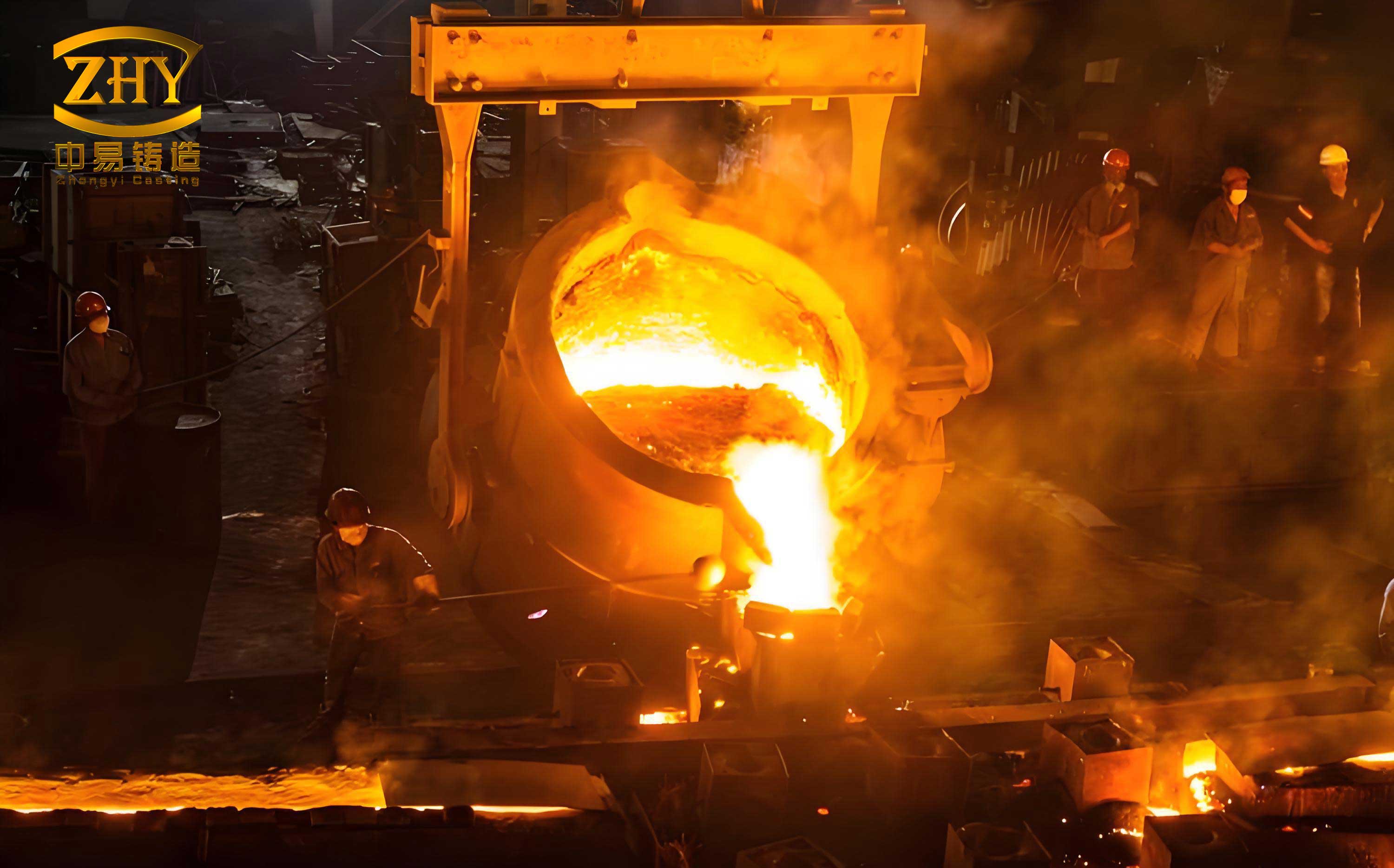
Mechanical performance assessment in our manganese steel casting foundry focuses on tensile strength ($\sigma_b$), elongation ($\delta$), and impact toughness ($a_k$). Yield strength and reduction of area are less critical due to the material’s behavior—yield point is often indistinct, and necking is minimal. For castings over 1000 kg, we routinely test these properties to ensure safety, particularly for load-bearing parts like bucket beams. However, for many wear-resistant components, the direct correlation between standard mechanical properties and abrasion resistance is weak. Thus, in our manganese steel casting foundry, we prioritize microstructural examination over hardness testing, as hardness readings can be misleading due to surface decarburization and inability to reveal carbide morphology. We do not mandate hardness checks but rely on metallographic analysis for quality assurance.
The control of grain size is imperative in our manganese steel casting foundry. Excessive columnar grain formation, often from high pouring temperatures, severely degrades mechanical properties. Our experiments show that as the proportion of columnar grains increases, strength, plasticity, and impact energy decline markedly. For instance, in jaw crusher plates, columnar grains exceeding 50% of wall thickness reduced wear resistance by up to 15%. We therefore restrict columnar grains: for sections ≤ 60 mm, they are not permitted; for thicker sections, columnar grain length must not exceed one-third of the wall thickness. Heat treatment overheating can cause coarse equiaxed grains, which also reduce strength but with less pronounced effects on toughness. We allow slight overheating but avoid severe cases. The relationship between grain size and properties can be expressed as: $$ \sigma_b \approx \sigma_0 + k \cdot d^{-1/2} $$ where $\sigma_b$ is tensile strength, $\sigma_0$ and $k$ are material constants, and $d$ is grain diameter, illustrating the Hall-Petch effect. However, in manganese steel, carbide presence complicates this, necessitating careful control in our manganese steel casting foundry.
Carbide residues in the microstructure are among the most sensitive indicators of quality in our manganese steel casting foundry. Both the amount and distribution of carbides affect performance. When carbides form continuous networks along grain boundaries, mechanical properties plummet, jeopardizing component safety. Even for less stressed parts like mill liners, carbide levels above Grade 3 can cause cracking. Our qualification threshold is set at Grade 3, where carbides do not form complete networks. Additionally, undissolved blocky carbides, while less harmful than boundary networks, still reduce properties when abundant. Tests on hammers and crusher plates confirm that lower carbide grades correlate with better wear resistance. We classify carbides into undissolved and precipitated types, with detailed ratings from Grade 0 to Grade 12. For example, Grade 1 denotes fine carbide particles at boundaries, while Grade 6 indicates a continuous network. The effect of carbides on impact toughness can be approximated by: $$ a_k \approx A – B \cdot C_c $$ where $a_k$ is impact energy, $C_c$ is carbide rating, and $A$, $B$ are constants, underscoring the need for stringent control in our manganese steel casting foundry.
Overburning is strictly prohibited in our standards, as it constitutes an irreparable defect. Although some foundries tolerate minor overburning, we maintain rigorous criteria to ensure high integrity. Regarding non-metallic inclusions, we adapt common rating systems to suit the as-cast state of manganese steel. In our manganese steel casting foundry, inclusion levels up to Grade 3 have not shown significant adverse effects on service life, based on field trials. We control inclusions within Grade 3 or lower, using a modified chart that emphasizes oxide distribution akin to international standards like the Swedish JK chart. The inclusion rating correlates with overall cleanliness, which is vital for consistent performance in our manganese steel casting foundry operations.
To further elucidate the interplay between composition, microstructure, and properties, we present additional data from our manganese steel casting foundry. The table below summarizes key experimental results on wear resistance relative to carbon content and carbide rating:
| Test Component | Carbon Content (%) | Carbide Rating | Wear Resistance (ton/kg) | Remarks |
|---|---|---|---|---|
| Jaw Crusher Plate | 1.20 | 2 | 350 | High work-hardening |
| Jaw Crusher Plate | 1.35 | 4 | 320 | Moderate carbide network |
| Hammer | 1.25 | 1 | 380 | Optimal microstructure |
| Hammer | 1.30 | 5 | 300 | Reduced due to carbides |
| Shovel Tooth | 1.15 | 3 | 340 | Acceptable for thick sections |
The wear resistance metric is defined as the amount of ore crushed per unit weight loss, a direct indicator of service life in mining applications. Our manganese steel casting foundry optimizes compositions to maximize this value, balancing carbon, manganese, and other elements. The influence of Mn/C ratio on wear resistance can be modeled as: $$ \text{Wear Resistance} = \alpha \cdot (\text{Mn/C}) + \beta \cdot (\text{C}) – \gamma \cdot (\text{Carbide Rating}) $$ where $\alpha$, $\beta$, $\gamma$ are coefficients derived from regression analysis of our foundry data. This empirical formula guides our production adjustments.
Heat treatment practices in our manganese steel casting foundry are designed to achieve a single-phase austenitic structure with minimal carbides. The continuous cooling transformation curve for high manganese steel indicates that insufficient cooling or reheating post-quench can precipitate carbides, initially at grain boundaries and then as acicular forms. We avoid such scenarios by严格控制 cooling rates and temperatures. For instance, the critical cooling rate to suppress carbide formation can be estimated using: $$ \frac{dT}{dt} \geq \frac{T_{\text{start}} – T_{\text{end}}}{t_{\text{critical}}} $$ where $T_{\text{start}}$ is the solutionizing temperature, $T_{\text{end}}$ is the ambient temperature, and $t_{\text{critical}}$ is the time window to avoid undesirable transformations. Our manganese steel casting foundry employs rapid water quenching to meet this criterion.
In terms of grain refinement, we have experimented with recrystallization annealing but found it ineffective for typical manganese steel compositions, especially in thick sections. Unlike boron-treated grades, ordinary high manganese steel does not readily refine grains through thermal cycling unless subjected to severe thermal shock. Therefore, our manganese steel casting foundry relies on controlling pouring temperatures and heat treatment parameters to manage grain size, rather than complex reprocessing.
The economic aspects of production in our manganese steel casting foundry also influence specifications. For example, higher manganese content increases material costs, so optimizing the Mn/C ratio to the minimum necessary level reduces expenses while maintaining performance. This balance is crucial for competitive pricing in the mining sector. Furthermore, by standardizing dimensional tolerances, we minimize post-casting machining, saving time and resources. Our manganese steel casting foundry continuously refines these practices based on feedback from field installations.
To summarize, the technical conditions outlined here are the result of iterative improvements in our manganese steel casting foundry. They encompass chemical composition limits, casting quality parameters, mechanical performance benchmarks, microstructural controls for grain size and carbides, and inclusion management. These specifications aim to deliver durable, safe, and cost-effective components for harsh mining environments. Future work will involve more detailed studies on the effects of trace elements and advanced heat treatment techniques to further enhance the capabilities of our manganese steel casting foundry. The integration of data from ongoing trials will ensure that our standards evolve with technological advancements and market demands, solidifying our position as a reliable supplier in the industry.