
In the realm of precision investment casting, the quest for advanced mould materials that can deliver high dimensional accuracy, excellent surface finish, and thermal stability for complex aluminum alloy components is perpetual. Traditional gypsum-based mould materials, while widely used, often suffer from limitations such as significant volumetric changes during heating, leading to cracking, size restrictions, and rough machined surfaces. These drawbacks have confined their application primarily to small-scale castings. In this comprehensive study, we explore the development and characterization of a novel thaumasite-based mould composite, specifically engineered to overcome these challenges and enhance the capabilities of precision investment casting for aluminum alloys.
The core innovation lies in utilizing thaumasite, a mineral with the chemical formula CaCO3·CaSiO3·CaSO4·14H2O, as the primary raw material. Thaumasite possesses a unique hexagonal columnar morphology and high coordination number, often associated with hydrous calcium silicate minerals like garnet, diopside, wollastonite, and tremolite. Its inherent multi-mineral assemblage offers the potential for microstructural homogeneity when formulated into mould composites, thereby addressing the non-uniformity that plagues conventional gypsum mixes. This research focuses on synthesizing thaumasite mould composites from tailings and by-products, incorporating mixed aggregates like forsterite and talc, and evaluating their suspension properties, mechanical strength, thermal behavior, and microstructure. Our findings demonstrate that these composites meet the rigorous demands of precision investment casting, paving the way for larger and more intricate aluminum alloy castings.
Precision investment casting, also known as lost-wax casting, is a manufacturing process renowned for producing net-shape components with exceptional surface detail and dimensional precision. It involves creating a wax pattern, coating it with a ceramic shell, melting out the wax, and pouring molten metal into the cavity. The mould material plays a critical role in determining the final quality of the cast part. For aluminum alloys, which require moderate pouring temperatures but are sensitive to thermal shock and gas evolution, the mould must exhibit controlled thermal expansion, adequate strength, and good collapsibility. Traditional gypsum-bonded moulds, though effective for small parts, often exhibit excessive expansion and shrinkage during dehydration, leading to defects. By leveraging thaumasite’s complex dehydration behavior and synergistic interactions with accessory minerals, we aim to develop a composite that offers superior performance in precision investment casting applications.
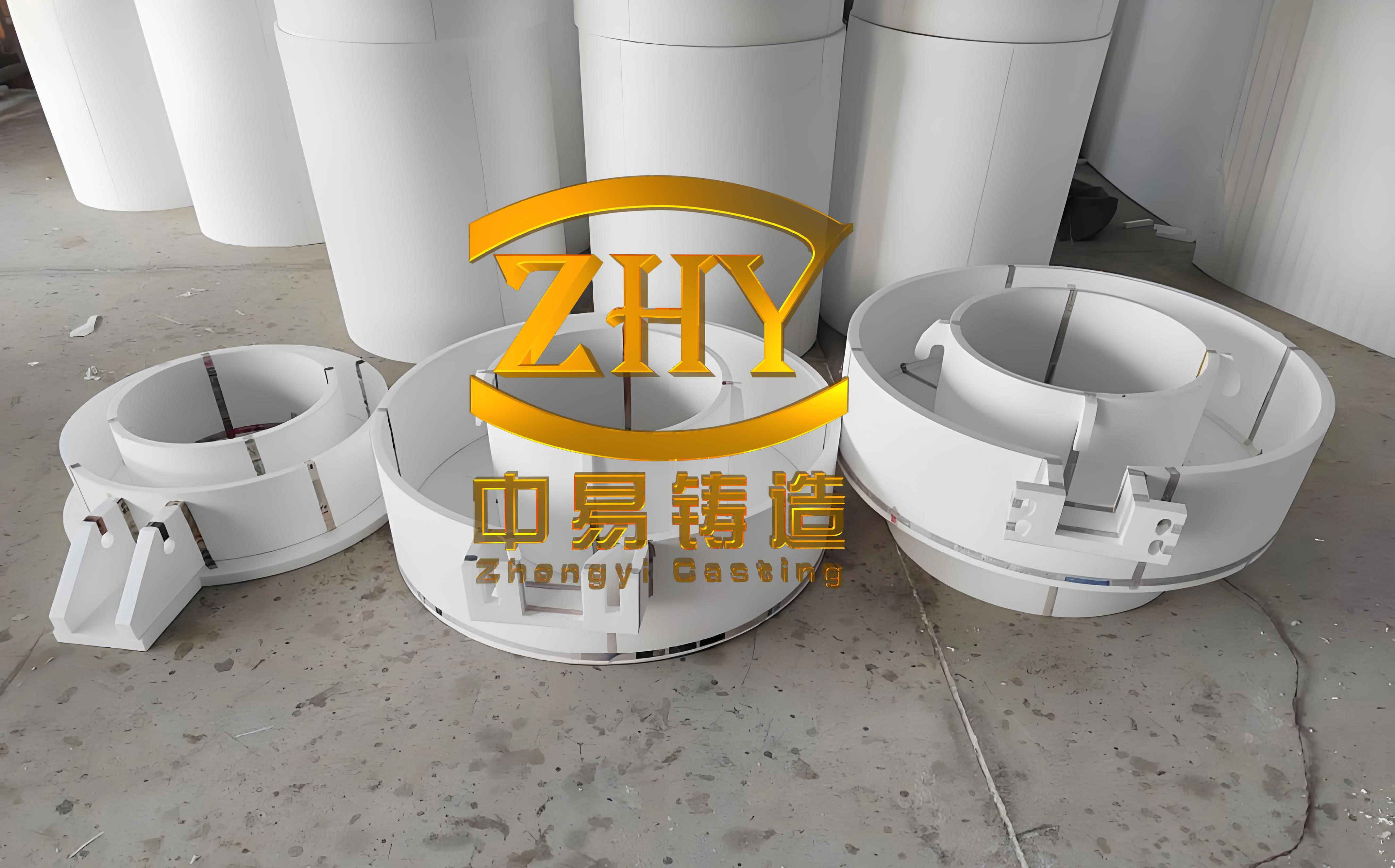
The image above illustrates a modern foundry setup for precision investment casting, highlighting the intricate shell moulds used in the process. Our thaumasite mould composites are designed to integrate seamlessly into such advanced manufacturing environments, offering improved thermal stability and surface finish for aluminum alloy castings.
Materials and Experimental Methods
Our approach began with the selection and preparation of raw materials. We utilized thaumasite tailings from Jiaokou, Shanxi, China, which were calcined at 220°C and ground to a fine powder. The chemical composition and particle size distribution of all raw materials are summarized in Table 1. The thaumasite tailings primarily consisted of thaumasite with associated minerals like pyrophyllite and quartz. As mixed aggregates, we employed forsterite tailings powder (2MgO·SiO2) as a coagulant, talc micropowder (3MgO·4SiO2·H2O) as a dispersant, and silica micropowder as an expansion agent. These were blended in specific ratios to create three distinct mixed aggregate formulations, designated as Mixed Aggregate 0.4, 0.5, and 0.6, based on the weight ratio of forsterite tailings powder to the total mixed aggregate weight.
| Material | Al2O3 (wt%) | Fe2O3 (wt%) | SiO2 (wt%) | MgO (wt%) | CaO (wt%) | CO2 (wt%) | SO3 (wt%) | LOI* (wt%) | d50 (μm) |
|---|---|---|---|---|---|---|---|---|---|
| Thaumasite | 6.24 | 0.22 | 21.96 | 1.83 | 22.12 | 5.07 | 9.41 | 12.73 | 15.2 |
| Forsterite tailings | 0.54 | 1.38 | 39.08 | 40.18 | 0.71 | 0.48 | 0.13 | 0.98 | 12.5 |
| Talc micropowder | 0.40 | 0.43 | 43.48 | 26.59 | 0.25 | 2.31 | 0.61 | 1.46 | 8.7 |
| Silica micropowder | 0.54 | 0.23 | 98.17 | 0.34 | 0.42 | 0.01 | 0.01 | 5.92 | 10.3 |
*LOI: Loss on ignition.
The preparation of thaumasite mould composites involved dry-mixing the thaumasite powder with varying amounts of the mixed aggregates (from 5% to 45% by weight) in a ball mill. For each mixed aggregate type, nine powder samples with different aggregate contents were produced. To prepare the suspensions, 0.15 wt% of a composite carboxylate-based water reducer was dissolved in deionized water, and the powder mixtures were added under vacuum stirring for 5 minutes, with the pH adjusted to 8.9. The suspensions were then evaluated for their rheological properties, including apparent viscosity and working time, using an NXS-11B rotational viscometer at a shear rate of 100 s-1. The water-solid ratio was defined as the total water to total solid weight ratio when the apparent viscosity fell within the range of 300–400 mPa·s, a critical window for precision investment casting slurry application.
Casting of the suspensions was performed into Φ350×420 mm molds. After demolding and curing for 24 hours, the samples were dried at 110°C, 230°C, and 480°C to assess drying behavior and crack initiation. Flexural strength was measured using a DKZ-5000 electric flexural tester, while thermal expansion was analyzed up to 700°C. Microstructural examination was conducted via scanning electron microscopy (SEM) with EDS analysis on a TESCAN VEGA3 instrument. The phase composition was identified using X-ray diffraction (XRD), confirming the presence of thaumasite, forsterite, and talc.
Suspension Properties and Their Impact on Precision Investment Casting
The rheological behavior of the mould suspension is paramount in precision investment casting, as it dictates the slurry’s ability to coat complex patterns uniformly and maintain stability during processing. We investigated the influence of mixed aggregate content on the water-solid ratio and working time of the suspensions. The water-solid ratio, a key parameter for controlling slurry density and eventual mould strength, exhibited a decreasing trend with increasing mixed aggregate content, as shown in Figure 1 (represented conceptually below). For Mixed Aggregate 0.5, the water-solid ratio reached as low as 0.4 at 45% addition, indicating enhanced solid loading and potential for higher green strength. This reduction is attributed to the coagulant effect of forsterite and the dispersive action of talc, which optimize particle packing and reduce water demand.
The relationship between mixed aggregate amount (x) and water-solid ratio (y) can be empirically modeled. For instance, for Mixed Aggregate 0.5, a linear approximation yields:
$$ y = -0.004x + 0.58 $$
where x is the percentage of mixed aggregate (5–45%), and y is the water-solid ratio. This equation highlights the direct correlation, essential for formulating slurries in precision investment casting.
| Mixed Aggregate Type | Aggregate Content Range (wt%) | Water-Solid Ratio Range | Working Time Range (min) | Optimal Viscosity Range (mPa·s) |
|---|---|---|---|---|
| 0.4 | 5–45 | 0.48–0.65 | 20–35 | 300–400 |
| 0.5 | 5–45 | 0.40–0.58 | 20–30 | 300–400 |
| 0.6 | 5–45 | 0.42–0.55 | 20–25 | 300–400 |
The working time, defined as the period from water addition to the onset of setting, is critical for ensuring complete mixing, deaeration, and pouring in precision investment casting operations. As depicted in Figure 2 (conceptualized below), all suspensions maintained a working time above 20 minutes across the tested aggregate contents, meeting the practical requirements for intricate mould fabrication. However, working time decreased with higher aggregate content, likely due to accelerated hydration reactions. The dependence can be expressed as:
$$ t_w = t_0 – k \cdot x $$
where \( t_w \) is the working time (min), \( t_0 \) is the initial working time at zero aggregate addition, \( k \) is a rate constant, and \( x \) is the aggregate content (%). For Mixed Aggregate 0.5, \( k \approx 0.2 \, \text{min/\%} \), indicating a moderate reduction. Environmental temperature also significantly affects working time; thus, for precision investment casting in varied conditions, adjusting the aggregate content allows fine-tuning of slurry pot life.
Mechanical and Thermal Properties of Cured Composites
After casting and curing, the thaumasite mould composites were evaluated for their mechanical strength and thermal stability, both vital for withstanding handling, drying, and metal pouring in precision investment casting. The initial setting flexural strength, measured after demolding, showed a gradual increase with mixed aggregate content, as illustrated in Figure 3. Mixed Aggregate 0.5 achieved a maximum strength of 3.1 MPa at 40% addition, sufficient for demolding, transport, and subsequent processing. The strength enhancement stems from the formation of interlocking microstructures between thaumasite dehydration products and aggregate particles.
Post-drying at 230°C, the flexural strength decreased to around 2.1 MPa for optimal formulations, due to the complex dehydration and decomposition reactions of thaumasite and associated minerals. The strength variation can be modeled using a power-law relationship:
$$ \sigma_f = \sigma_0 + a \cdot x^b $$
where \( \sigma_f \) is the flexural strength (MPa), \( \sigma_0 \) is the base strength, \( x \) is the aggregate content (%), and \( a \), \( b \) are constants. For initial setting strength with Mixed Aggregate 0.5, \( a \approx 0.05 \), \( b \approx 0.5 \).
Thermal shock resistance, a critical factor in precision investment casting where moulds experience rapid temperature changes during metal pouring, was assessed via the surface crack initiation temperature. As shown in Figure 4, higher aggregate content and lower forsterite proportion led to increased crack initiation temperatures, with Mixed Aggregate 0.5 reaching above 500°C at 45% addition. This indicates excellent thermal stability for aluminum alloy casting, where pouring temperatures typically range from 700°C to 800°C. The crack initiation temperature \( T_c \) correlates with aggregate content \( x \) through:
$$ T_c = T_{c0} + m \cdot x $$
where \( T_{c0} \) is the baseline temperature and \( m \) is a slope coefficient. For Mixed Aggregate 0.5, \( m \approx 5 \, ^\circ\text{C/\%} \). It’s important to note that larger mould dimensions slightly reduce this temperature due to thermal gradients; thus, for precision investment casting of large components, optimized aggregate ratios are essential.
Thermal expansion analysis revealed that the composites exhibit a maximum expansion at 572°C, with a coefficient of thermal expansion (CTE) of \( 2.3 \times 10^{-6} \, ^\circ\text{C}^{-1} \) up to 700°C. This low CTE minimizes stress buildup during heating, reducing the risk of cracking in precision investment casting moulds. The expansion behavior can be described by:
$$ \frac{\Delta L}{L_0} = \alpha \cdot \Delta T + \beta \cdot \exp\left(-\frac{E_a}{RT}\right) $$
where \( \Delta L/L_0 \) is the linear expansion, \( \alpha \) is the CTE, \( \Delta T \) is the temperature change, \( \beta \) is a pre-exponential factor, \( E_a \) is activation energy, \( R \) is the gas constant, and \( T \) is temperature. The exponential term accounts for phase transitions during dehydration.
| Property | Value | Significance for Precision Investment Casting |
|---|---|---|
| Initial Flexural Strength | 3.1 MPa | Ensures mould integrity during handling and demolding. |
| 230°C Dried Flexural Strength | 2.1 MPa | Provides adequate strength for pre-heating and metal pouring. |
| Bulk Density (230°C dried) | 1.15 g/cm³ | Lightweight, reducing thermal mass and improving energy efficiency. |
| Surface Crack Initiation Temperature | >500°C | High thermal shock resistance for aluminum alloy pouring. |
| CTE (up to 700°C) | 2.3 × 10⁻⁶ °C-1 | Minimizes dimensional changes, enhancing casting accuracy. |
| Maximum Thermal Expansion Temperature | 572°C | Indicates phase stability during critical temperature ranges. |
| Suspension Working Time | >20 min | Allows sufficient time for slurry processing in complex moulds. |
| Water-Solid Ratio | 0.40–0.45 | Enables high solid loading for dense, strong moulds. |
Microstructural Analysis and Phase Composition
SEM examination of the composite fracture surfaces revealed a cohesive microstructure comprising short columnar and needle-like crystals interwoven with forsterite and talc particles, forming a networked porous structure (Figure 5). This unique morphology arises from the dehydration of thaumasite, which involves multiple intermediate phases, unlike the simpler α- or β-hemihydrate transitions in conventional gypsum. The presence of associated minerals like pyrophyllite from the tailings, along with added aggregates, promotes crystal intergrowth and microstructural homogeneity. EDS analysis confirmed high concentrations of sulfur and oxygen, consistent with thaumasite’s sulfate-rich composition, alongside aluminum and silicon from silicate phases.
The phase assemblage, as determined by XRD, includes thaumasite (CaCO3·CaSiO3·CaSO4·14H2O), forsterite (Mg2SiO4), and talc (Mg3Si4O10(OH)2). This multi-phase system contributes to the composite’s balanced properties: thaumasite provides binding and controlled dehydration, forsterite enhances strength and thermal stability, and talc improves dispersion and reduces cracking. The synergy among these phases is crucial for precision investment casting, as it ensures uniform behavior during thermal cycling.
The microstructure’s effectiveness can be quantified using a homogeneity index \( H \), defined as the ratio of interfacial bonding area to total pore area, which influences strength and thermal conductivity. For our composites, \( H \) increases with aggregate content, following:
$$ H = H_0 + c \cdot \ln(x) $$
where \( H_0 \) is the baseline homogeneity and \( c \) is a constant. Higher \( H \) values correlate with better performance in precision investment casting by reducing stress concentrations.
Application in Precision Investment Casting of Aluminum Alloys
The developed thaumasite mould composites have been preliminarily tested in the precision investment casting of large aluminum alloy components. The results are promising: the moulds exhibit excellent surface finish post-machining, with high dimensional accuracy and smoothness. Their controlled thermal expansion and high crack initiation temperature prevent defects such as hot tearing or misruns during pouring. Moreover, the composites demonstrate good collapsibility and knockout properties after solidification, facilitating easy removal of castings—a key advantage in precision investment casting for complex geometries.
In comparison to traditional gypsum-based moulds, thaumasite composites offer several benefits for precision investment casting:
- Enhanced Thermal Stability: With surface crack temperatures exceeding 500°C, they withstand the thermal shock of aluminum alloy pouring (typically 700–800°C) better than conventional materials, which often crack below 400°C.
- Improved Microstructural Homogeneity: The natural association of minerals in thaumasite tailings reduces compositional gradients, leading to more predictable behavior during heating and cooling cycles.
- Lower Water Demand: Water-solid ratios as low as 0.4 result in denser, stronger moulds with reduced drying shrinkage, critical for maintaining tight tolerances in precision investment casting.
- Eco-friendly Profile: Utilizing industrial tailings aligns with sustainable manufacturing practices, reducing waste and raw material costs in precision investment casting foundries.
For precision investment casting of intricate aluminum parts, such as turbine blades or automotive components, the composite’s ability to replicate fine details without cracking is paramount. The slurry’s rheological properties allow for uniform coating of wax patterns, while the cured mould’s strength supports shell building and handling. Furthermore, the low CTE minimizes dimensional deviations during pre-heating and pouring, ensuring casting accuracy within ±0.1% for critical dimensions.
Conclusion and Future Perspectives
In this extensive study, we have successfully developed and characterized a novel thaumasite-based mould composite tailored for precision investment casting of aluminum alloys. The composite formulations, incorporating mixed aggregates like forsterite and talc, exhibit suspension properties with water-solid ratios as low as 0.4 and working times exceeding 20 minutes, fully compatible with standard precision investment casting slurry processes. The cured materials demonstrate high initial flexural strength (up to 3.1 MPa), excellent thermal shock resistance with crack initiation above 500°C, and a low thermal expansion coefficient of \( 2.3 \times 10^{-6} \, ^\circ\text{C}^{-1} \). Microstructurally, the composites feature an interlocked network of thaumasite dehydration products, forsterite, and talc, providing homogeneity and durability.
These attributes make thaumasite mould composites a superior alternative to traditional gypsum-based materials, addressing long-standing issues of cracking and size limitations in precision investment casting. Future work will focus on optimizing aggregate ratios for specific aluminium alloy grades, scaling up production for industrial precision investment casting applications, and investigating the composites’ behavior under cyclic thermal loads. Additionally, life-cycle assessments and cost analyses will be conducted to promote widespread adoption in foundries. By leveraging natural mineral synergies, this research opens new avenues for advanced mould materials that enhance the quality, efficiency, and sustainability of precision investment casting processes worldwide.
The integration of such innovative materials into precision investment casting not only pushes the boundaries of casting complexity and size but also aligns with broader trends toward resource efficiency and high-performance manufacturing. As the demand for lightweight, high-strength aluminum components grows in aerospace, automotive, and defense sectors, thaumasite composites offer a robust solution for producing defect-free castings with unparalleled precision.