
In my extensive experience within the foundry industry, few materials present as fascinating a challenge and opportunity as high manganese steel. The process of high manganese steel casting is a precise discipline, blending metallurgical science with practical craftsmanship to produce components capable of withstanding extreme abrasion and impact. This narrative delves into the core principles and refined practices that define successful high manganese steel casting, drawing upon years of hands-on application in producing critical wear-resistant parts.
The fundamental allure of high manganese steel, particularly the austenitic grades like ZGMn13, lies in its unique work-hardening capability. In its solution-treated state, the steel possesses a relatively soft and tough austenitic microstructure. However, when the surface of a component produced through high manganese steel casting is subjected to intense impact or compression during service, it undergoes a profound transformation. The austenite deforms plastically and undergoes strain-induced hardening, and can even transform to martensite, leading to a dramatic increase in surface hardness. This creates an exceptionally hard, wear-resistant outer layer, while the underlying material remains tough and ductile, absorbing impact energy and preventing catastrophic fracture. This self-renewing armor is the key to the longevity of components like crusher liners, railway crossings, and excavator bucket teeth.
The journey of a high manganese steel casting begins with its chemistry. While standard grades have their place, alloying is often employed to enhance performance. A common and effective modification is the addition of chromium. The composition range for such an alloyed high manganese steel is typically as follows:
| Element | Content (wt.%) | Primary Function |
|---|---|---|
| C (Carbon) | 0.9 – 1.3 | Solid solution strengthener; forms carbides for hardening. |
| Mn (Manganese) | 11.0 – 14.0 | Stabilizes austenite at room temperature; key to work-hardening. |
| Si (Silicon) | 0.3 – 0.8 | Deoxidizer; improves fluidity. |
| Cr (Chromium) | 1.5 – 2.5 | Strengthens austenite; promotes carbide formation for increased wear resistance. |
| P (Phosphorus) | ≤ 0.08 | Impurity; kept low to prevent embrittlement. |
| S (Sulfur) | ≤ 0.08 | Impurity; kept low to prevent hot tearing. |
The presence of chromium in high manganese steel casting not only strengthens the austenitic matrix but also influences the morphology and stability of carbides, ultimately contributing to a documented increase in service life—often 1 to 2 times that of the non-alloyed grade. The successful execution of high manganese steel casting hinges on meticulously controlling every step to manage this material’s distinctive characteristics: excellent fluidity but high shrinkage, and a pronounced susceptibility to hot tearing and cracking.
Designing the mold and gating system is a critical phase in high manganese steel casting. Shrinkage must be accurately compensated for, typically using a patternmaker’s contraction rule of 2.5% to 2.7%. The gating system must be designed to fill the mold quickly and smoothly to avoid cold shuts, while risers must provide adequate feed metal to compensate for solidification shrinkage. For complex shapes with varying wall thicknesses, like a bucket tooth, strategic use of chills—often made of iron or copper—is essential. These chills are placed in the mold near heavy sections or “hot spots” to accelerate local cooling, promoting directional solidification and reducing shrinkage porosity. For instance, if the thermal center of a section has a theoretical diameter of 120 mm, a chill with a thickness of around 80 mm might be used adjacent to it.
The interaction between the molten steel and the mold material is a particular concern in high manganese steel casting. The high temperature and reactivity of the melt can lead to severe chemical and mechanical penetration (burn-on/burn-in). To combat this, refractory coatings are applied to mold and core surfaces. A coating based on magnesite (MgO) is highly effective, creating a barrier that minimizes metal-mold reactions and ensures a cleaner casting surface, reducing subsequent cleaning effort.
Another practical innovation in high manganese steel casting is the use of “knock-off” or washburn cores for riser necks. Given the toughness of the heat-treated steel, removing conventional risers via cutting is laborious. A washburn core, a pre-formed refractory insert placed at the riser neck, creates a constricted, weaker section. After shakeout, the riser can be broken off cleanly at this point with a sharp impact, significantly reducing finishing time and cost. The pouring parameters are calculated based on the casting’s geometry. Key formulas govern this phase:
The pouring time \( t \) (in seconds) can be estimated from the casting weight \( W \) (in kg) and an empirical factor \( S \) which accounts for wall thickness:
$$ t = S \cdot \sqrt{W} $$
For medium-thickness steel castings, \( S \) typically ranges from 1.0 to 1.5.
The theoretical metallostatic pressure (static pressure head, \( P \)) at the base of the mold cavity is given by:
$$ P = \rho \cdot g \cdot h $$
where \( \rho \) is the density of liquid steel (~7000 kg/m³), \( g \) is acceleration due to gravity (9.81 m/s²), and \( h \) is the effective sprue height (in meters). This pressure must be sufficient to ensure proper filling but controlled to avoid mold erosion.
Typical process parameters for a high manganese steel casting like a bucket tooth are summarized below:
| Process Parameter | Typical Value/Range |
|---|---|
| Melting / Tapping Temperature | 1480 – 1520 °C |
| Pouring Temperature | 1400 – 1420 °C |
| Pattern Contraction Allowance | 25 mm/m (2.5%) |
| Mold Coating | Magnesite-based refractory wash |
| Riser Type | Top riser with washburn core |
| Shakeout Time | > 12 hours (to cool below ~300°C) |
However, the true defining step in the high manganese steel casting process is heat treatment, specifically the “water quenching” or “solution treatment.” The as-cast structure is entirely unsuitable for service. It consists of coarse columnar austenite grains with a network of brittle carbides (primarily (Fe,Mn)₃C) precipitated along the grain boundaries. This structure is weak and brittle. The objective of heat treatment is to dissolve these carbides back into the austenite and then “freeze” this supersaturated solid solution by rapid quenching, preventing the carbides from re-precipitating.
The heat treatment cycle is delicate due to the steel’s poor thermal conductivity and high coefficient of thermal expansion. The standard practice involves slowly heating the castings to an intermediate temperature (around 650°C) to relieve stresses and allow some initial phase transformation. It is critical to minimize holding in the range of 650-900°C, as this is where detrimental carbides can precipitate rapidly at grain boundaries, embrittling the steel. The castings are then heated rapidly to the solutionizing temperature, between 1050°C and 1100°C. At this temperature, the carbides dissolve into the austenite matrix. The holding time is determined by the casting’s section thickness to ensure complete dissolution. A common rule of thumb is 1 hour per 25 mm of section thickness.
The most dramatic moment follows: the water quench, or “water toughening.” The castings are rapidly transferred from the furnace to a agitated quench tank within 60-90 seconds. The violent quench preserves the carbon and alloying elements in a supersaturated solid solution, resulting in a uniform, single-phase austenitic microstructure. The quenching process must be vigorous to ensure high and uniform cooling rates; stagnant water can lead to vapor jacket formation and soft spots. The complete thermal cycle is outlined below:
| Stage | Temperature Range | Key Objective & Rationale |
|---|---|---|
| Slow Heating | Ambient to 650°C | Relieve casting stresses; avoid thermal shock cracking. Heating rate: ~100°C/h. |
| Hold (Optional) | ~650°C for 2-4 h | Stress relief; homogenization. |
| Rapid Heating | 650°C to 1080°C | Minimize time in carbide precipitation zone (650-900°C). |
| Solutionizing | 1080°C – 1100°C | Dissolve all carbides into austenite. Hold for 1h/25mm. |
| Quenching | Rapid to <~50°C | Preserve supersaturated austenite. Quench in agitated water. |
The successful outcome of this entire high manganese steel casting and heat treatment sequence is a component with a purely austenitic structure. This structure is non-magnetic and possesses remarkable toughness, with typical as-quenched hardness around 200 HB. It is in this condition that the casting is put into service.
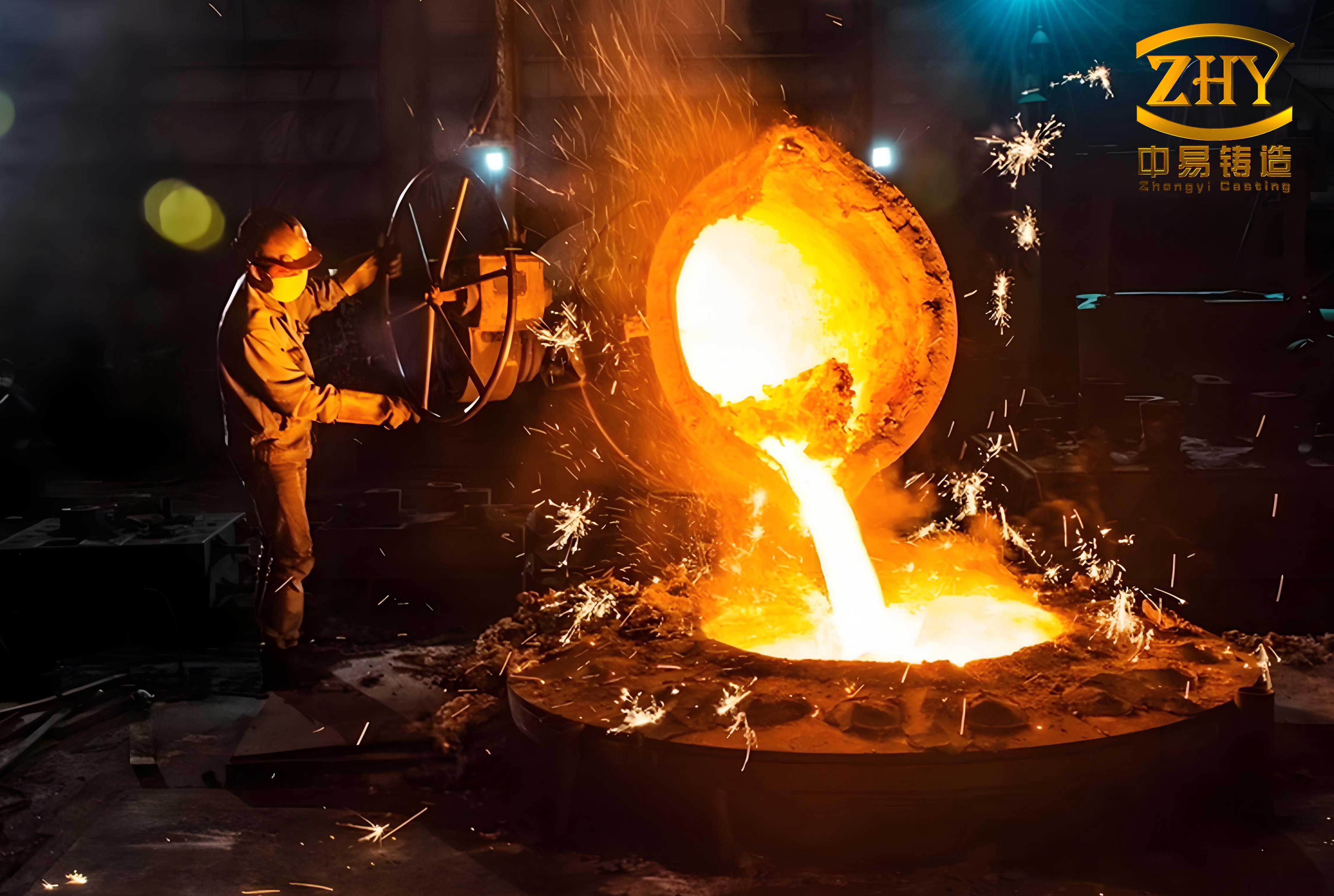
The magic of high manganese steel casting is fully realized in service. Under repetitive, high-stress impact or compression, the surface layer of the austenite undergoes severe plastic deformation. This deformation introduces a high density of dislocations and mechanical twins, and can induce a phase transformation to strain-hardened martensite (\(\alpha’\)-martensite). The surface hardness can skyrocket from 200 HB to over 500 HB. This hardened layer is continually worn away and regenerated from the underlying tough austenite, providing sustained resistance to abrasion. The depth and stability of this hardened layer \( d_h \) can be conceptually related to the impact energy \( E \) and the material’s work-hardening coefficient \( n \):
$$ d_h \propto \left( \frac{E}{\sigma_y} \right)^{1/n} $$
where \( \sigma_y \) is the yield strength of the austenite. Alloying with elements like Cr increases \( \sigma_y \) and \( n \), leading to a more pronounced and stable hardening effect.
The mechanical transformation is profound. The table below contrasts the properties in the as-cast, heat-treated, and in-service (work-hardened) states, illustrating the full spectrum of behavior achievable through proper high manganese steel casting and processing.
| Material State | Microstructure | Hardness (HB) | Key Property |
|---|---|---|---|
| As-Cast | Austenite + Grain Boundary Carbides | ~300-400 | Brittle, prone to cracking |
| Solution-Treated (Quenched) | Single-Phase Austenite | ~180-220 | High Toughness, Ductility |
| Work-Hardened (In-Service) | Deformed Austenite + Martensite (surface) | 500 – 600+ | Extreme Surface Hardness & Wear Resistance |
Quality control in high manganese steel casting extends beyond chemical analysis and dimensional checks. Microstructural examination is paramount. Etched samples must reveal a uniform, carbide-free austenitic grain structure post-heat treatment. Any residual carbides, particularly at grain boundaries, are indicators of an incomplete solution treatment or improper cooling, which will compromise toughness and lead to premature failure. Furthermore, non-destructive testing methods like magnetic particle inspection are useful, as the austenitic matrix is non-magnetic, but cracks or certain inclusions can create magnetic leakage fields.
The economic and operational benefits of mastering high manganese steel casting are significant. While the initial cost of the casting and its energy-intensive heat treatment is higher than for some alternative materials, the total life cycle cost is often lower. The extended service life of components like bucket teeth in mining applications reduces downtime for change-outs, increases machinery availability, and lowers the long-term cost per ton of material moved. The reliability of a well-made high manganese steel casting, with its predictable wear patterns and resistance to catastrophic fracture, is invaluable in heavy industry.
In conclusion, the production of high-performance wear parts via high manganese steel casting is a testament to applied metallurgy. It requires a deep understanding of the material’s idiosyncrasies—from its tendency to form detrimental as-cast structures to its transformative response to impact. Every step, from alloy design and mold engineering to the precise ballet of solution heat treatment and quenching, must be meticulously controlled. The culmination of this process is not merely a finished casting, but an engineered component with a dual personality: a rugged, ductile core capable of absorbing massive impacts, cloaked in a surface that transforms under duress into a shield of exceptional hardness. This dynamic capability, harnessed through skilled high manganese steel casting practices, continues to make it an indispensable material for the most demanding industrial applications worldwide. The ongoing refinement of these processes, including optimized alloying and advanced simulation of solidification and heat treatment, promises to further push the boundaries of performance for components born from high manganese steel casting.