
In the demanding field of aerospace component manufacturing, the production of high-integrity, complex geometry parts presents a significant challenge. This discussion details a comprehensive approach to manufacturing a critical pressure regulator end cap using the precision lost wax casting, or investment casting, process. The component, required to withstand high temperatures and pressure loads, is cast from ZL208, a high-strength heat-resistant aluminum alloy known for its challenging casting characteristics. Traditional methods using plaster or ethyl silicate-water glass molds resulted in low yield rates and environmental concerns. Our focus shifted entirely to perfecting a silica sol-based precision lost wax casting process, which ultimately achieved a dimensional accuracy and internal quality that surpassed previous benchmarks, yielding a success rate exceeding 85%. This narrative will explore the systematic engineering behind every stage, from initial design to final heat treatment, underscoring the critical factors that define success in modern precision lost wax casting.
Component and Alloy Analysis: The Foundation of Process Design
The success of any precision lost wax casting project begins with a deep understanding of the component and the material. The end cap, with an envelope dimension of 134 mm x 98 mm x 68 mm, features a complex internal structure with significant wall thickness variations, ranging from a substantial 22 mm down to a delicate 3 mm. This variation is a primary driver for defect formation, as thin sections are prone to mistruns and cold shuts, while thick sections are susceptible to shrinkage porosity.
The material of choice, ZL208 (conforming to ZAlCu5Ni2CoZr), is a pinnacle of aluminum alloy design for elevated temperature service. Its chemical composition is detailed below:
| Element | Composition (wt.%) |
|---|---|
| Cu | 4.5 – 5.5 |
| Mn | 0.2 – 0.3 |
| Ni | 1.3 – 1.8 |
| Ti | 0.15 – 0.25 |
| Zr | 0.1 – 0.3 |
| Co | 0.1 – 0.4 |
| Sb | 0.1 – 0.4 |
| Si (max) | 0.3 |
| Fe (max) | 0.5 |
| Al | Balance |
The alloy’s high temperature stability, capable of operating up to 400°C after T7 heat treatment, is derived from the complex intermetallic phases formed by Cu, Mn, Ni, Co, Zr, and Sb, which pin grain boundaries and inhibit slip. However, this very complexity severely impairs its fluidity and feeding characteristics during solidification, making it notoriously difficult to cast soundly. This inherent challenge makes the controlled environment of precision lost wax casting not just an option, but a necessity.
Gating and Feeding System Design: Engineering the Thermal Gradient
The design of the gating and feeding system is arguably the most critical step in precision lost wax casting, as it dictates the thermal profile during filling and solidification. Initial trials with a simple top-pour system led to turbulent filling, oxide entrapment, gas entrainment, and severe shrinkage in the thick sections due to localized overheating.
The redesigned system employs a combined bottom and side gating principle. A central downsprue feeds into a horizontal runner, which connects to five separate ingates at strategic points around the component’s base. This multi-ingate design serves multiple purposes: it promotes rapid, laminar, and simultaneous filling of the thin sections to prevent mistruns; it distributes the heat input more evenly, preventing severe hot spots; and it establishes a controlled temperature gradient. A single top riser is positioned directly over the thickest section (22 mm) to act as a thermal and metallurgical reservoir, feeding liquid metal to compensate for solidification shrinkage. Furthermore, external chills were strategically placed on other substantial bosses to accelerate local cooling and promote directional solidification towards the riser. The governing principle for riser efficacy can be summarized by Chvorinov’s Rule, where the solidification time t is proportional to the square of the volume-to-surface area ratio (V/A)2:
$$ t = k \left( \frac{V}{A} \right)^2 $$
Here, k is the mold constant. The riser is designed to have a V/A ratio larger than that of the section it feeds, ensuring it remains liquid longest. This scientifically informed layout is fundamental to achieving sound internal quality in precision lost wax casting.
Pattern Assembly and Wax Process Control
Pattern quality sets the ceiling for final casting dimensional accuracy. A medium-temperature wax (C-162H) was selected for its balance of detail replication and stability. Injection parameters were rigorously controlled:
| Parameter | Value |
|---|---|
| Wax Pot Temperature | 53.5 ± 1 °C |
| Injection Pressure | 30 ± 5 kg/cm² |
| Hold Time | 40 s |
After injection and a brief cooling period, patterns were carefully extracted and inspected. All parting lines and injection points were meticulously cleaned and smoothed. The patterns were then assembled onto a central wax runner and riser system using a heated spatula. All junctions were filleted (R2 to R5) to avoid stress concentration and potential shell cracking. The completed cluster was then washed in a 1% soap solution to remove any mold release or grease, rinsed, dried, and prepared for the primary coat. This attention to detail in the wax stage is a non-negotiable prerequisite for high-yield precision lost wax casting.
Silica Sol Shell Building: The Core of Precision and Environmental Responsibility
The shift to a colloidal silica (silica sol) binder system was transformative, offering superior surface finish, dimensional control, and a much cleaner environmental profile compared to hydrolyzed ethyl silicate. The shell is a composite structure, with each layer serving a specific function. The prime coat formulation is critical for surface finish and must exhibit excellent wetting and rheological properties.
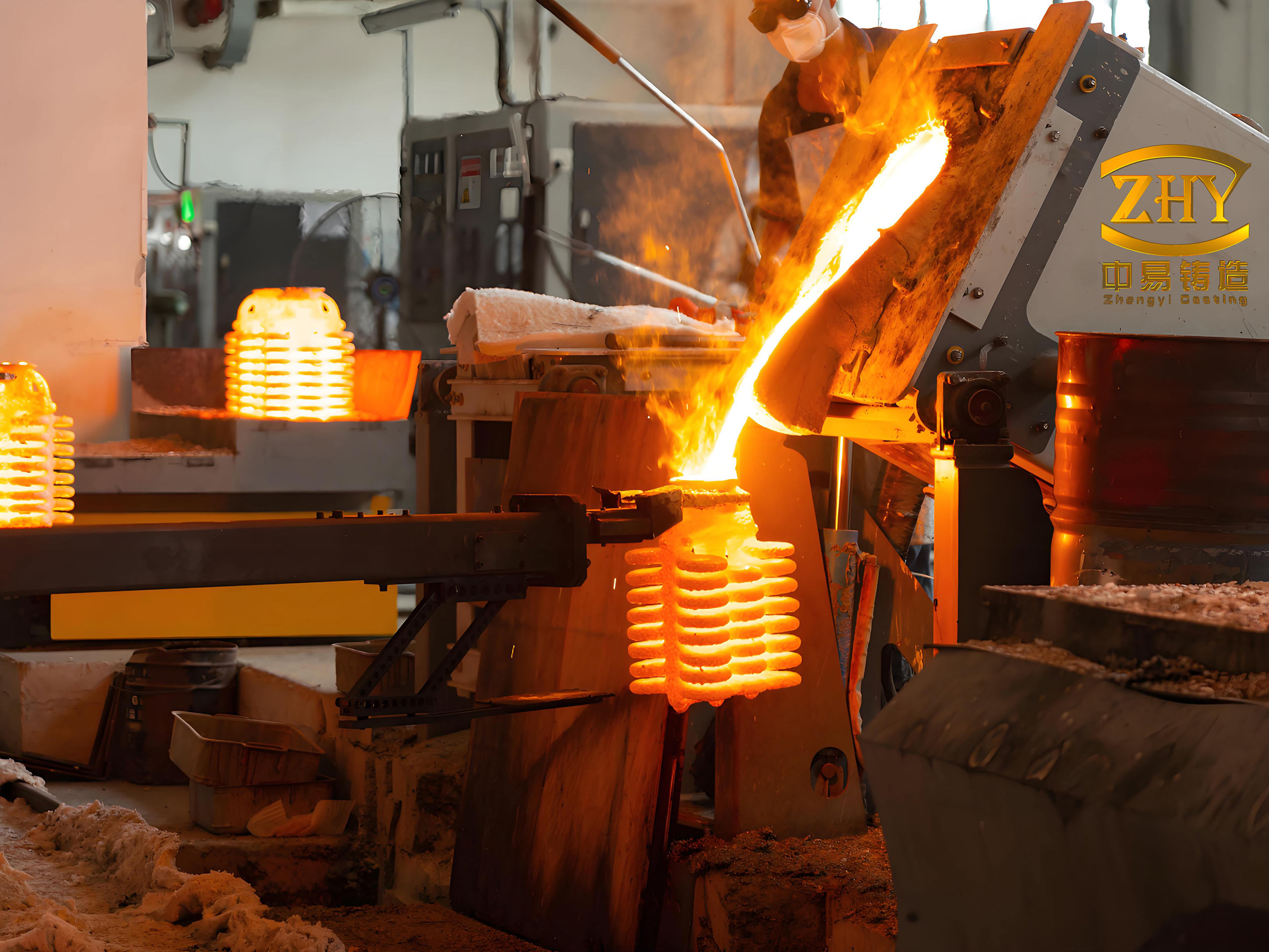
The shell build sequence and materials are specified below:
| Layer | Coating Type | Stucco Material & Grit | Drying Condition | Minimum Drying Time |
|---|---|---|---|---|
| 1 (Face Coat) | Alumina Flour Slurry | Alumina Sand, 90 mesh | 20-25°C, 50-70% RH | 20 hours (Still Air) |
| 2 & 3 (Transition) | Mullite Flour Slurry | Mullite Sand, 30-60 mesh | 20-28°C, 30-70% RH | 6 hours (Forced Air) |
| 4 & 5 (Back-up) | Mullite Flour Slurry | Mullite Sand, 16-30 mesh | 20-28°C, 30-70% RH | 6 hours (Forced Air) |
| 6 (Seal Coat) | Mullite Flour Slurry | None | 20-28°C, 30-70% RH | 6 hours (Forced Air) |
The prime coat slurry consisted of 30% silica sol binder, 320-mesh alumina flour, a wetting agent (∼0.2% by vol.), and a defoamer (∼0.1% by vol.), mixed to a viscosity of 25-40 seconds (Zahn cup #4). The mullite backup coats used a simpler slurry of silica sol and 320-mesh mullite flour, with a viscosity of 10-22 seconds. A small addition of graphite powder to the backup slurries enhanced shell permeability and reduced metal surface oxidation.
Drying kinetics are paramount. The first coat must dry slowly in still air to allow uniform gelation of the silica sol network, preventing defects like cracks or bubbles. Subsequent layers are dried aggressively with forced air to remove moisture efficiently and build shell strength. The total drying time for a 6-layer shell often exceeds 48 hours, a testament to the patience required for quality in precision lost wax casting.
Dewaxing, Firing, and Thermal Preparation
Dewaxing was performed using saturated steam in an autoclave at 0.6-0.8 MPa for 10 minutes. The rapid heating from the steam melts and expands the wax, cracking the shell and allowing ejection. Shells were then inspected; minor cracks could be repaired with slurry, while major fractures led to rejection.
Firing serves to remove residual wax, volatiles, and moisture, while also sintering the binder to develop high-temperature strength. Shells were loaded into a car-bottom furnace below 500°C, then heated to 820 ±10°C and held for 2 hours. This achieves two goals: first, complete calcination of organics, described by the general reaction for hydrocarbon removal:
$$ \mathrm{C_xH_y + O_2 \rightarrow CO_2 + H_2O} $$
Second, it sinters the silica network, forming strong siloxane bonds (Si-O-Si) between particles. The preheat temperature before pouring is equally critical, as it affects fluidity and solidification rate. After extensive DOE, the optimal preheat was found to be 450 ±5°C. A higher temperature reduced thermal shock but increased total solidification time, promoting shrinkage. A lower temperature risked premature freezing in thin sections.
Alloy Melting, Refining, and Precision Pouring
The melting practice for ZL208 is intricate due to its multiple alloying elements. The charge consisted of primary ingot, limited returns (<80%, Fe≤0.4%), and master alloys (AlCu50, AlMn10, AlNi10, AlZr4, AlTi5, AlCo5, AlSb4). The sequence is vital: elements with high melting points or prone to segregation (Mn, Ni, Co, Zr) are added first with the base aluminum. Cu (as AlCu50) and Sb are added later at 740°C to minimize loss. After complete homogenization at 770°C, the melt was grain refined with Al-Ti-B rods at 740-750°C.
Refining is a two-stage process to achieve the low gas content essential for aerospace integrity. First, hexachloroethane (C2Cl6, 0.6 wt.%) was plunged into the melt at 730-740°C. It decomposes, releasing chlorine bubbles that strip hydrogen via the reaction:
$$ \mathrm{2Al_{(l)} + 3Cl_{2(g)} \rightarrow 2AlCl_{3(g)}} $$
$$ \mathrm{AlCl_{3(g)} + H_{(in\ Al)} \rightarrow HCl_{(g)} + AlCl_{2(g)}} $$
This was followed by rotary degassing with high-purity argon at 10 L/min for 15 minutes, providing further cleansing and inclusion flotation. A reduced pressure test confirmed gas content suitability.
Pouring parameters were optimized through rigorous experimentation. The key interdependencies are summarized below:
| Parameter | Sub-Optimal Condition (High Defect Rate) | Optimized Condition for Precision Lost Wax Casting | Rationale |
|---|---|---|---|
| Shell Preheat Temp. | 480 ±5 °C | 450 ±5 °C | Balances fluidity with controlled solidification to minimize shrinkage. |
| Pouring Temperature | 730 ±5 °C | 715 ±5 °C | Lower temp reduces total heat content, shrinkage, and oxide formation. |
| Clusters per Pour | 8 | ≤4 | Ensures consistent, rapid pour for all clusters before heat loss. |
| Pouring Time per Shell | 8-10 s | 5-8 s | Fast fill prevents mistruns; controlled rate minimizes turbulence. |
The gravity pour was executed swiftly and uninterruptedly. The riser was topped up immediately after the initial pour to ensure adequate feed metal. This disciplined approach to thermal management during pouring is a hallmark of controlled precision lost wax casting.
Heat Treatment: Unlocking the Alloy’s Performance Potential
As-cast ZL208 possesses moderate properties. Its full potential is unlocked through a T7 heat treatment (solution heat treatment, quenching, and over-aging). The cycle was carefully designed based on the alloy’s phase stability.
Solution Treatment: Castings were heated to 540 ±5°C for 5.5-6 hours. This prolonged soak allows for the dissolution of soluble secondary phases (like Al2Cu, θ-phase) and the homogenization of alloying elements into the aluminum matrix. The time t for complete dissolution can be approximated by a diffusion-controlled process:
$$ x \approx \sqrt{D t} $$
where x is the diffusion distance (related to secondary phase spacing) and D is the diffusion coefficient, which is temperature-dependent via the Arrhenius equation: D = D0 exp(-Q/RT).
Quenching: Components were transferred from the furnace to a water quench bath in ≤15 seconds. This rapid cooling (quench rate > 100°C/s) aims to freeze the supersaturated solid solution (SSSS) achieved during solution treatment, preventing the precipitation of coarse equilibrium phases.
Artificial Aging (Over-Aging – T7): The quenched castings were aged at 215 ±5°C for 16-17 hours. Unlike a peak-aged (T6) condition, this extended, higher-temperature aging promotes the controlled growth of stable coherent and semi-coherent precipitates (like Al3Zr dispersoids and modified θ’ phases). These precipitates effectively pin dislocations and grain boundaries, providing exceptional thermal stability for high-temperature service, albeit with slightly lower room-temperature strength than a T6 temper. The resulting mechanical properties consistently met targets: Ultimate Tensile Strength ≥284 MPa and Elongation ≥2.6%.
Conclusion: A Synergistic Process for Demanding Applications
The successful production of the ZL208 end cap demonstrates that precision lost wax casting is more than a mere shaping process; it is a synergistic integration of materials science, thermal management, and meticulous process control. Key conclusions crystallize from this work:
- The silica sol shell process, with its strict drying regimen (≥20 hrs for Layer 1 in still air, ≥6 hrs for subsequent layers in forced air), provides the dimensional stability and surface finish foundation.
- The gating system must be engineered as a thermal management tool, using principles like Chvorinov’s rule to ensure directional solidification towards designed feeders.
- For ZL208, a tight thermal window exists: a shell preheat of 450 ±5°C and a pouring temperature of 715 ±5°C, with a maximum of 4 clusters per pour, are essential to balance fill integrity with soundness.
- The alloy-specific T7 heat treatment cycle (540°C/5.5-6h solution, ≤15s transfer, water quench, 215°C/16-17h age) is non-negotiable for developing the required high-temperature microstructure.
This holistic approach elevated the product yield from 30% to over 85%, proving the efficacy of the precision lost wax casting route. Future enhancements, such as the implementation of counter-gravity filling or pressure-assisted solidification, could further push the boundaries of quality and yield for such challenging alloys. The journey underscores that in precision lost wax casting, every parameter is a variable in a complex equation for quality, and solving it requires both scientific understanding and empirical rigor.