
The journey of spheroidal graphite cast iron (often called ductile iron) into a premier engineering material was significantly accelerated by the development of the austempering heat treatment. This process, rooted in the fundamental studies of isothermal transformation by Bain in the 1930s, was later applied to cast irons, culminating in the modern Austempered Ductile Iron (ADI). This material represents a paradigm shift, offering a combination of strength, ductility, and wear resistance that directly competes with forged and cast steels, truly realizing the potential for “substituting iron for steel.” This article delves into the production landscape, metallurgical principles, key properties, and diverse applications of this remarkable material.
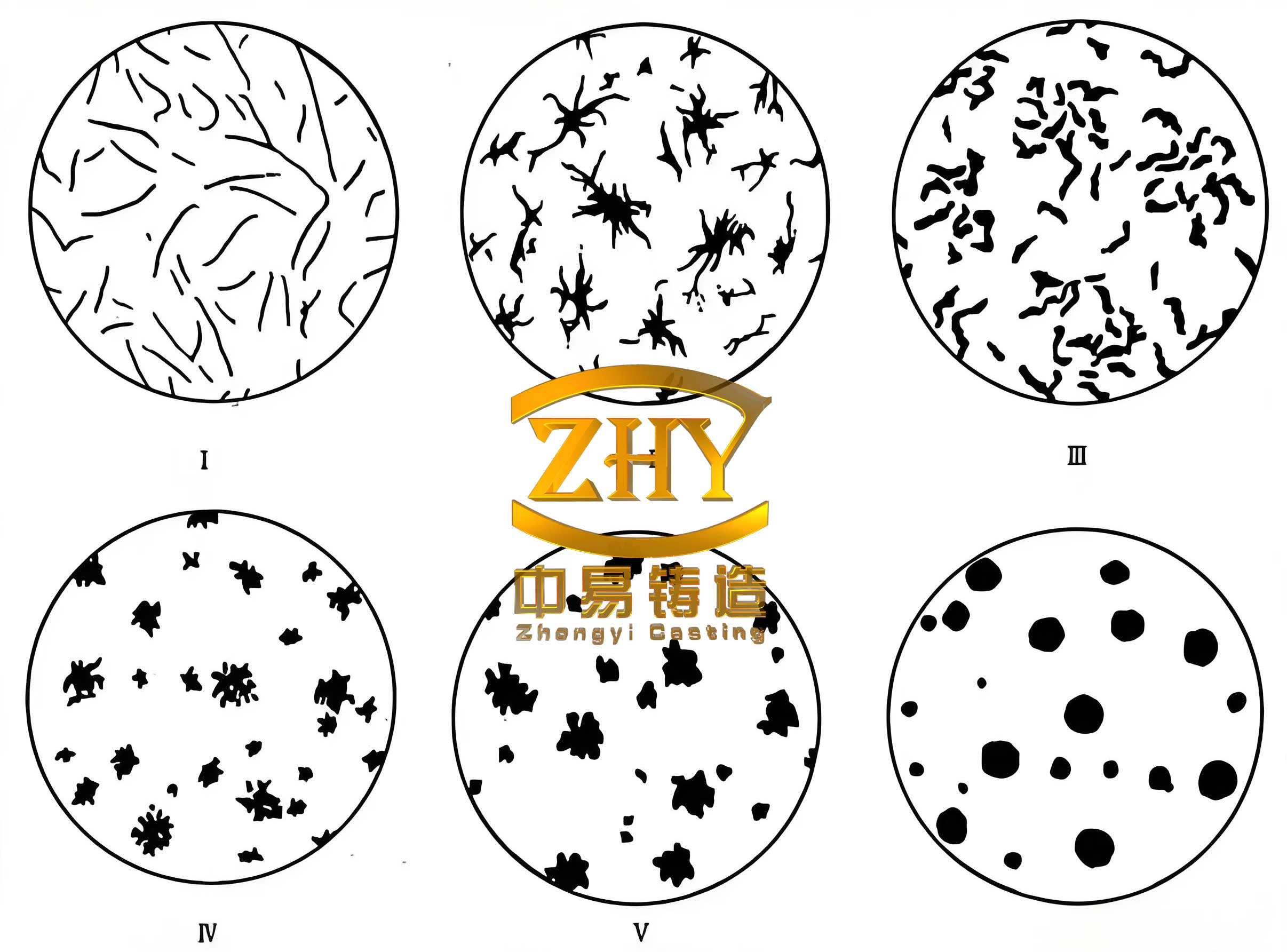
The defining characteristic of spheroidal graphite cast iron is, of course, its graphite morphology. The treatment of molten iron with elements like magnesium or cerium causes the graphite to precipitate as spheres rather than flakes. This spherical shape drastically reduces the stress-concentrating effect of graphite, transforming the brittle nature of gray iron into a tough and ductile material. The matrix of as-cast spheroidal graphite cast iron is typically ferritic, pearlitic, or a mixture thereof, which already provides good mechanical properties. However, the austempering heat treatment unlocks a completely different and superior matrix microstructure.
The production of high-quality ADI rests on two critical pillars: the consistent production of sound, high-integrity spheroidal graphite cast iron castings, and the precise control of the austempering heat treatment cycle. Recent advancements have significantly improved the stability of spheroidal graphite cast iron feed stock. The use of high-purity pig irons, advanced treatment techniques like the sandwich method or wire feeding for nodulizing and inoculation, and strict process control have led to castings with high nodule count, superior nodularity (often Grade 1-2), and a consistent ferritic/pearlitic matrix. This consistency is the essential foundation, as variations in the initial microstructure can significantly affect the response to subsequent heat treatment.
The heart of ADI technology is the austempering process, a two-stage heat treatment. The first stage is austenitization, where the casting is heated to a temperature within the range of $$850^\circ C$$ to $$950^\circ C$$, holding it until a homogeneous, carbon-saturated austenite ($\gamma$) matrix is achieved. The carbon content in this austenite, $C_\gamma$, is critical and is influenced by the austenitizing temperature $T_\gamma$ and the initial matrix composition. A simplified relationship can be expressed as:
$$C_\gamma \approx C_0 + k(T_\gamma – T_{eq})$$
where $C_0$ is the bulk carbon content, $k$ is a rate constant, and $T_{eq}$ is an equilibrium reference temperature. Following austenitization, the casting is rapidly quenched (to avoid the formation of pearlite) into a molten salt bath maintained at an isothermal transformation temperature typically between $$250^\circ C$$ and $$400^\circ C$$. It is held at this temperature for a sufficient time to allow the unique “ausferritic” transformation to occur.
This transformation is not a simple decomposition into ferrite and carbide, as in bainite in steel. Instead, it involves the diffusion-controlled precipitation of carbon-saturated, acicular ferrite ($\alpha$) from the high-carbon austenite. The carbon rejected from the forming ferrite enriches the surrounding austenite, stabilizing it to room temperature. The final microstructure is therefore a mixture of acicular ferrite and high-carbon, thermally stable retained austenite ($\gamma_{high-C}$). This microstructure is often called “ausferrite.” The volume fraction and carbon content of the retained austenite, which are crucial for properties, are governed by the isothermal transformation kinetics. The progress of the reaction can be modeled using an Avrami-type equation:
$$ f = 1 – \exp(-k t^n) $$
where $f$ is the transformed fraction, $t$ is the isothermal holding time, and $k$ and $n$ are temperature-dependent constants. Holding too long leads to the undesirable second stage of transformation where the enriched austenite decomposes into ferrite and carbide, embrittling the material.
| Property | Typical ADI Range | Comparison: Quenched & Tempered Steel | Key Influencing Factor |
|---|---|---|---|
| Tensile Strength, Rm (MPa) | 800 – 1600 | Similar or Superior | Isothermal Temperature (Lower T = Higher Strength) |
| Yield Strength, Rp0.2 (MPa) | 500 – 1100 | Similar | Matrix Structure, Retained Austenite Stability |
| Elongation, A (%) | 3 – 15 | Often Superior | Isothermal Temperature (Higher T = Higher Ductility) |
| Hardness (HBW) | 250 – 440 | Similar Range | Isothermal Temperature |
| Bending Fatigue Limit (MPa) | ~350 – 500 | Excellent, Comparable | Surface Integrity, Residual Stresses |
| Contact Fatigue Strength (MPa) | ~1600 – 2100 | Very Good | Hardness, Retained Austenite Content |
| Fracture Toughness, KIC (MPa√m) | ~60 – 100 | Good | High Austempering Temperature, High Purity Base Iron |
The mechanical properties of ADI are a direct consequence of its unique ausferritic microstructure. By adjusting the austempering temperature and time, a wide spectrum of properties can be achieved, allowing for the “design” of the material for specific applications. Lower isothermal transformation temperatures (e.g., $$250^\circ C – 320^\circ C$$) promote a finer acicular ferrite structure and lower retained austenite content, resulting in very high strength and hardness but lower ductility. Conversely, higher transformation temperatures (e.g., $$360^\circ C – 400^\circ C$$) produce a coarser ferrite structure with a larger volume fraction of stable retained austenite, yielding high ductility and toughness with good strength. The presence of this stable, high-carbon retained austenite is pivotal. It contributes to ductility and toughness through the TRIP (Transformation Induced Plasticity) effect, where it transforms to martensite under localized stress, absorbing energy and increasing strain hardening. The strength-to-weight ratio of ADI is exceptional, making it a prime candidate for lightweighting initiatives across industries.
The production scale for austempered components from spheroidal graphite cast iron has grown steadily. Annual production is significant, encompassing both engineered structural components and wear-resistant parts. The establishment of specialized, centralized austempering heat treatment facilities has been a key driver in commercializing this technology, following a successful model established abroad. These centers offer consistent, controlled processing for foundries. Furthermore, the development of automated production lines, including two-step austempering processes, has improved efficiency and reproducibility for high-volume components.
| Component Type | Austenitizing Temperature & Time | Isothermal Temperature & Time | Target Matrix / Properties | Key Alloying Elements (Typical) |
|---|---|---|---|---|
| Heavy Truck Suspension Parts (e.g., Spring Seat) | 880±10°C / 75-90 min | 300±10°C / 90-120 min | Fine Ausferrite; High Strength (Rm>1100 MPa), Good Wear Resistance | Cu, Mo |
| Gears, High-Toughness Parts | 900±10°C / 90-120 min | 370±10°C / 90-150 min | Coarse Ausferrite with High Retained Austenite; High Toughness (A>10%), Good Impact Strength | Ni, Mo |
| Wear Parts (CADI – Carbidic ADI) | 880±10°C / 60-90 min | 280±10°C / 120-180 min | Ausferrite + Hard Carbides; Extreme Abrasion Resistance | Cr, Mo, V |
| Lightweight Structural Components | 850±10°C / 60-75 min | 390±10°C / 90 min | Austenitic Ausferrite; Good Combination of Strength (Rm~850 MPa) and Ductility (A~15%) | Low alloy or unalloyed |
The application of austempered spheroidal graphite cast iron is vast and expanding. In the automotive sector, it is increasingly used for lightweight, high-performance components. These include suspension parts like control arms, knuckles, and spring seats, where its high strength and good fatigue resistance are invaluable. Gears, particularly differential and transmission gears, benefit from ADI’s high contact fatigue strength, pitting resistance, and damping capacity. The move towards electrification in vehicles also opens new opportunities for ADI in electric drive unit components where noise reduction and durability are key.
Beyond automotive, austempered spheroidal graphite cast iron finds heavy use in agricultural and construction machinery. Components like plowshares, tillage tools, and excavator bucket teeth are subjected to severe abrasion. Here, a variant known as Carbidic Austempered Ductile Iron (CADI) is often employed. CADI is produced from a higher alloyed spheroidal graphite cast iron that retains hard carbides in the matrix even after austempering. The resulting composite microstructure, combining the tough ausferritic matrix with hard, wear-resistant carbides, offers exceptional service life in abrasive environments. Similarly, grinding balls and liners for mining and milling operations are major applications for both ADI and CADI grades.
The process window for successfully austempering spheroidal graphite cast iron is defined by the need to avoid other phase transformations. The CCT (Continuous Cooling Transformation) and TTT (Time-Temperature-Transformation) diagrams are essential tools. The critical cooling rate $V_{crit}$ must be exceeded during the quench from the austenitizing temperature to the isothermal bath to avoid pearlite formation. $V_{crit}$ depends on the alloying content (Mn, Mo, Cu) of the spheroidal graphite cast iron. The relationship between the isothermal holding time $t$ and the start of the detrimental second stage transformation defines the practical processing window. Alloying extends this window, allowing thicker sections to be processed. The hardness and strength of ADI can be empirically related to the isothermal transformation temperature $T_{iso}$ by expressions such as:
$$ HV \approx A – B \cdot T_{iso} $$
where $A$ and $B$ are material constants. The strain hardening behavior, crucial for components under complex loads, is enhanced by the TRIP effect and can be modeled with an extended Hollomon equation incorporating the volume fraction of transformable retained austenite $V_\gamma$:
$$ \sigma = K \epsilon^n + \sigma_{TRIP}(V_\gamma, \epsilon) $$
Looking forward, the growth trajectory for components made from austempered spheroidal graphite cast iron is strongly positive. The global industrial trends towards lightweighting for energy efficiency and reduced emissions, demand for higher performance and longer component life, and the economic advantages of casting over forging for complex shapes all align perfectly with the strengths of ADI. Continued research is focused on further refining process control through digital monitoring and modeling, developing new alloy variants for specialized applications (e.g., high-temperature stability), and expanding the joining and surface engineering techniques suitable for this material. The inherent versatility and superior property set of austempered spheroidal graphite cast iron ensure its position as a critical advanced material for 21st-century engineering challenges.