
In my extensive career within the foundry and metallurgical engineering sector, I have dedicated considerable focus to the intricacies of producing high-performance wear-resistant components. Among these, high manganese steel casting stands out as a pivotal technology, particularly for large, thick-walled parts subjected to extreme impact and abrasion. This material, renowned for its unique work-hardening characteristics, transforms under severe service conditions to develop a surface hardness exceeding 500 HB while retaining a tough, austenitic core. The reliable performance of high manganese steel casting in applications like mining jaw plates, mill liners, and massive crusher hammers is not incidental; it is the direct result of meticulously controlled chemistry, precise solidification management, and disciplined thermal processing. This article distills my practical insights and technical knowledge into a detailed exploration of the entire manufacturing chain for large-section high manganese steel casting.
The fundamental appeal of high manganese steel casting lies in its paradoxical combination of toughness and hardness. Upon installation, the cast component possesses a relatively modest initial hardness, typically around 200-230 HB. However, when subjected to vigorous impact or high-stress grinding, the surface layer undergoes rapid plastic deformation, inducing a profound strain-hardening effect that can elevate hardness to 700 HB or more. This self-generating wear-resistant surface is backed by an austenitic matrix of exceptional toughness, providing unparalleled resistance to cracking and spalling. It is crucial to understand that this mechanism requires sufficient impact energy to activate. Consequently, larger components, which naturally experience greater kinetic forces in service, often demonstrate superior and more consistent wear life compared to smaller ones. The perceived failure of a high manganese steel casting is frequently a misapplication issue—using it in low-stress, purely abrasive conditions where the work-hardening response cannot be triggered.
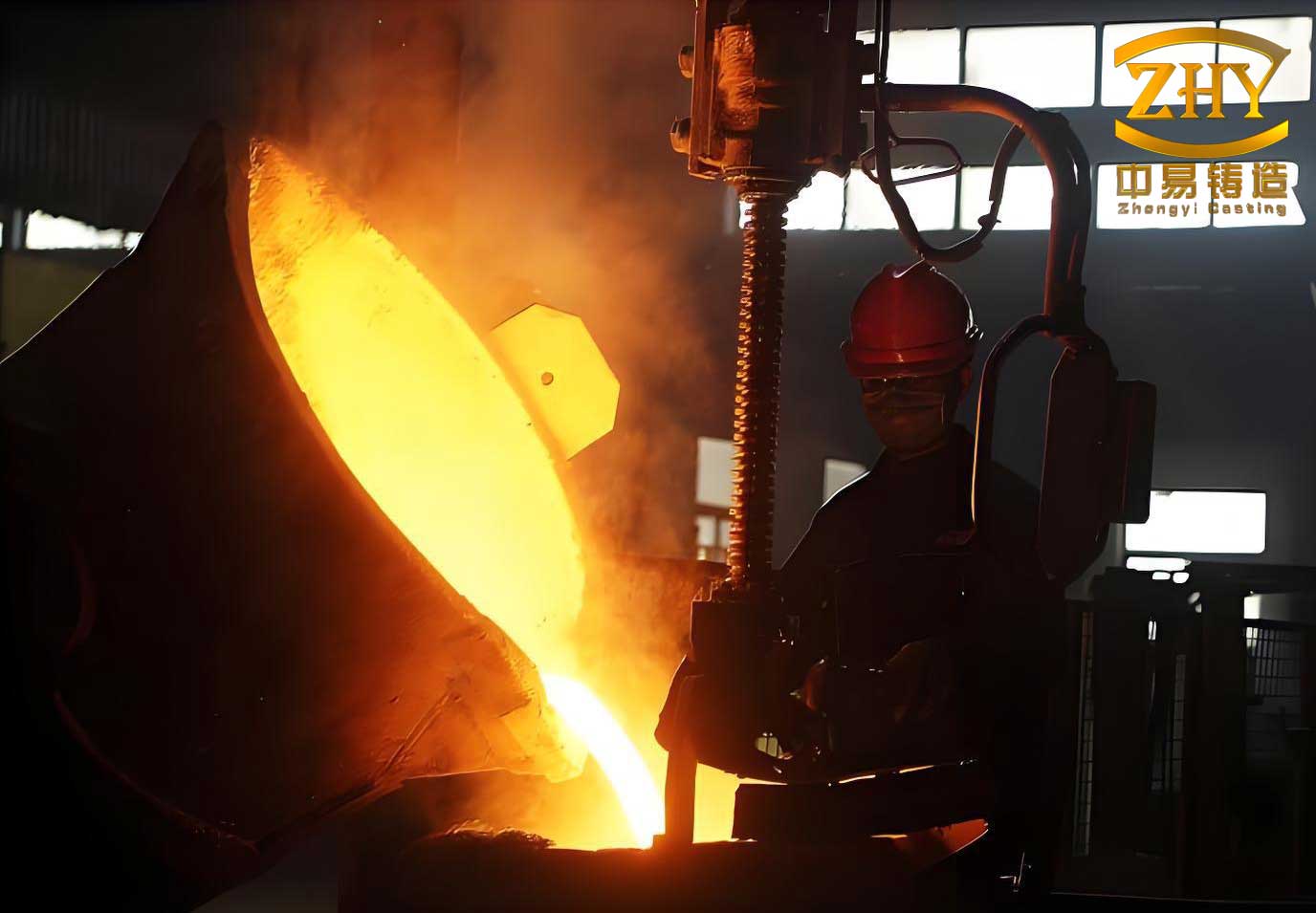
The journey of a successful high manganese steel casting begins with a deep analysis of its processability, governed by chemistry and solidification behavior. The chemical composition is the primary dictator of final properties. While standard grades like ASTM A128 specify ranges, the selection for large castings must be judiciously tailored.
| Element | Typical Range (%) | Primary Function & Effect | Critical Consideration for Large Castings |
|---|---|---|---|
| Carbon (C) | 0.9 – 1.35 | Austenite stabilizer; provides solid solution strengthening. Increases hardenability but promotes carbide formation. | Use lower range (0.9-1.1%) to minimize coarse as-cast carbides and maintain toughness in thick sections. |
| Manganese (Mn) | 11.0 – 14.0 (Standard) 14.0 – 24.0 (Super-high) | Essential austenite stabilizer. Enables the work-hardening capability. | Maintain ≥12% in standard grades. Super-high Mn (>18%) enhances stability for extreme conditions but requires precise control. |
| Silicon (Si) | < 0.5 – 0.8 | Deoxidizer. Improves fluidity but promotes carbide precipitation and segregation. | Strictly minimize (<0.5%). High Si catastrophically reduces impact toughness in thick sections. |
| Phosphorus (P) | < 0.07 (Aim <0.04) | Extremely harmful. Forms brittle phosphide eutectics at grain boundaries, promoting hot tearing. | Absolute priority: achieve ultra-low P (<0.04%) for complex, large castings to prevent cracking. |
| Chromium (Cr) | 0 – 2.5 | Increases yield strength and wear resistance but reduces ductility. | Use judiciously (1.5-2.0%) for added strength, balanced against potential for increased casting stress. |
The solidification of high manganese steel casting presents distinct challenges. Its intermediate freezing range, low thermal conductivity (approximately one-third that of carbon steel), and propensity for columnar grain growth demand strategic design. The relationship between feeding distance, cooling rate, and soundness can be conceptualized. The effective feeding distance (L) from a riser is influenced by the geometry and cooling conditions, which is particularly critical for large high manganese steel casting. One can consider a modified Chvorinov’s rule for relative solidification times, but the key is managing thermal gradients.
$$ t_f \propto \frac{V^2}{A^2} \cdot \frac{1}{\alpha} $$
Where \( t_f \) is the local solidification time, \( V \) and \( A \) are the volume and surface area of the section, and \( \alpha \) is the thermal diffusivity of the mold material. For high manganese steel, with its inherently low \( \alpha_{steel} \), the use of high-chill mold materials (e.g., chromite sand) becomes paramount to reduce \( t_f \) and refine structure. Large, thick-walled high manganese steel casting exhibits prolonged solidification, leading to pronounced shrinkage porosity and segregation if not properly fed. Therefore, a riser-assisted feeding system, often combined with chills, is non-negotiable, moving beyond the chill-only methods suitable for thinner sections.
The production of defect-free large high manganese steel casting hinges on executing several interconnected technical pillars with precision.
Foundry Practice and Gating/Riser Design
The mold design for a large high manganese steel casting must simultaneously promote directional solidification toward the risers, minimize stress concentration, and refine the as-cast structure. Riser design is critical: they must be adequately sized to provide sufficient feed metal and pressure. For a cylindrical riser on a large section, the minimum dimension often follows the modulus principle, ensuring its solidification time exceeds that of the casting hot spot. A practical relationship is:
$$ M_{riser} = k \cdot M_{casting\_hotspot} $$
with \( k \) typically between 1.1 and 1.2 for high manganese steel casting. To avoid the severe thermal notch and cracking risk associated with cutting a large conventional riser, the use of side risers or necked-down “washburn” tops is preferred. Chills, both external and (very cautiously) internal, are powerful tools. External chills must be sized and contoured to avoid creating abrupt thermal gradients that induce cracks. The spacing between multiple chills should be designed to create a uniform cooling front. Gating systems should be open and designed for quick, tranquil filling from multiple gates at thinner sections to minimize temperature differentials across the massive casting. A tilting pour or combined gate/riser system can significantly enhance feeding efficiency. The pattern allowance must account for the high total linear shrinkage (2.5-2.7%), and all mold and core materials must exhibit excellent collapsibility to avoid mechanical hindrance during contraction.
Melting, Refining, and Pouring Protocol
The molten metal quality for high manganese steel casting is paramount, especially for heavy sections where defects are magnified. While induction melting is possible, the basic electric arc furnace (EAF) oxidizing process offers superior control over dephosphorization and deoxidation—the two most critical metallurgical operations. The process flow and key reactions are summarized below:
| Stage | Objective | Key Actions & Chemical Principles |
|---|---|---|
| Melting & Oxidation | Melt charge, remove P, C, and gases. | Charge with low-P materials (<25% returns). Post-melt, blow oxygen to decarburize (~0.3% min). Oxidizing slag removes P: $$ 2P + 5FeO + 4CaO \rightarrow (CaO)_4\cdot P_2O_5 + 5Fe $$. Slag basicity (CaO/SiO₂) >2.5 is crucial. |
| Slag-Off & Reduction | Remove oxidizing slag, deoxidize thoroughly, add alloys. | Complete slag removal. Pre-deoxidize with Al/Mn/Si. Build new basic, reducing slag (CaC₂ or C+CaO). Diffusive deoxidation occurs from slag to metal: $$ (FeO)_{slag} + C \rightarrow [Fe] + {CO}_{gas} $$. Maintain strong reducing atmosphere. |
| Alloying & Finishing | Achieve final chemistry, temperature, and cleanness. | Add pre-heated Fe-Mn in batches to avoid thermal shock. Final adjustments with Fe-Si, Fe-Cr. Final Al addition for kill deoxidation, targeting >0.06% residual Al. Temperature target: 1480-1520°C for tapping. |
| Ladle Treatment & Pouring | Further clean metal, control pouring parameters. | Post-tap, argon stirring for 3-4 minutes to promote inclusion floatation. A minimum ladle holding time for temperature homogenization and inclusion removal. Pour at the lowest practical temperature (1410-1430°C) to reduce shrinkage and grain size, but rapidly to avoid mistruns. |
The deoxidation constant for the Mn-Si-Al system in high manganese steel casting is vital for predicting inclusion formation. The equilibrium can be represented by:
$$ [\%Si][\%O]^2 = K_{Si} \quad \text{and} \quad [\%Al]^2[\%O]^3 = K_{Al} $$
where the constants are temperature-dependent. Effective practice ensures oxygen activity is driven to a minimum before pouring, securing the high toughness inherent to proper high manganese steel casting.
Heat Treatment: The Water-Quenching (Solutionizing) Process
Heat treatment is the transformative step that dissolves the brittle, as-cast carbide network and establishes the homogeneous, tough austenitic matrix. For large high manganese steel casting, thermal stress management is as important as microstructure control. A three-stage cycle is recommended.
Stage 1: Pre-treatment (Stress Relief & Conditioning). Heat slowly (50-100°C/hr) to 600-650°C and hold. This relieves casting stresses and allows partial pearlitic transformation, creating nucleation sites for later austenite grain refinement upon heating.
Stage 2: Solutionizing. Heat to the critical range of 1050-1080°C. The holding time (t) is a function of section thickness (d) and can be approximated by:
$$ t = k \cdot d $$
where \( k \) is typically 1.0 to 1.5 minutes per millimeter of ruling section for large high manganese steel casting. The dissolution of carbides like (Fe,Mn)₃C must be complete. Overheating or excessive time leads to grain growth and surface decarburization.
Stage 3: Quenching. Rapid transfer to a agitated water bath (quench tank). The cooling curve must bypass the carbide precipitation zone (approximately 500-800°C) swiftly to retain carbon in super-saturated solid solution. The quench water must be circulated to maintain a temperature below 40°C for effective heat extraction. For some applications, a subsequent low-temperature aging (250-450°C) may be applied to precipitate fine, dispersed carbides for increased initial hardness, but this requires extreme caution to avoid embrittlement in the heat-affected zones of large high manganese steel casting.
Finishing, Inspection, and Reclaim
Post-heat treatment operations for high manganese steel casting require specific knowledge. Castings should be cooled in the mold to below 200°C before shakeout to prevent thermal cracking. Riser removal is best done via abrasive cutting or with the casting partially submerged in water to localize heat input and prevent the base metal from entering the carbide precipitation temperature range. Any required repair welding must use austenitic manganese steel electrodes and be performed post-water quenching. Pre-heating is generally avoided; instead, the weld area is kept cool, with frequent peening of weld passes to relieve stress. Non-destructive testing (NDT) like ultrasonic or magnetic particle inspection is essential for critical large high manganese steel casting. Mechanical testing coupons (separately cast but from the same heat) must confirm compliance with standards (e.g., tensile strength, elongation, impact energy). A unique advantage of high manganese steel casting is its ability to be re-solution treated if test results are subpar, restoring properties without significant degradation—a testament to its metallurgical stability.
In conclusion, mastering the manufacture of large, thick-walled high manganese steel casting is a multidisciplinary endeavor integrating metallurgy, thermodynamics, and mechanical design. The predictable and safe service life of these components, often with failure timing variances within ±5% of projected schedules, makes them indispensable in capital-intensive industries like mining and cement production. This reliability, coupled with ongoing advancements in alloy design and process control—from computer simulation of solidification to automated heat treatment lines—ensures that high manganese steel casting remains not only relevant but also a technology of choice for the most demanding applications. As global infrastructure pushes equipment towards larger scale and higher efficiency, the role of expertly produced high manganese steel casting will only become more pronounced, securing its place from traditional crushers to the advanced realms of material handling and beyond.