
In the manufacturing of machine tool castings, the pursuit of enhanced stiffness and precision stability has driven extensive research into optimizing material properties. As a researcher focused on improving the performance of machine tool castings, I have investigated the influence of the silicon-to-carbon (Si/C) ratio under controlled carbon equivalent (CE) conditions. Through systematic experimentation, I found that increasing the Si/C ratio significantly enhances tensile strength, hardness, hardness uniformity, and machining performance while reducing residual stress and defect rates in machine tool castings. This approach not only improves the overall quality of machine tool castings but also contributes to the durability and accuracy of the final machine tools. The following sections detail my methodology, results, and insights, supported by empirical data and analytical models.
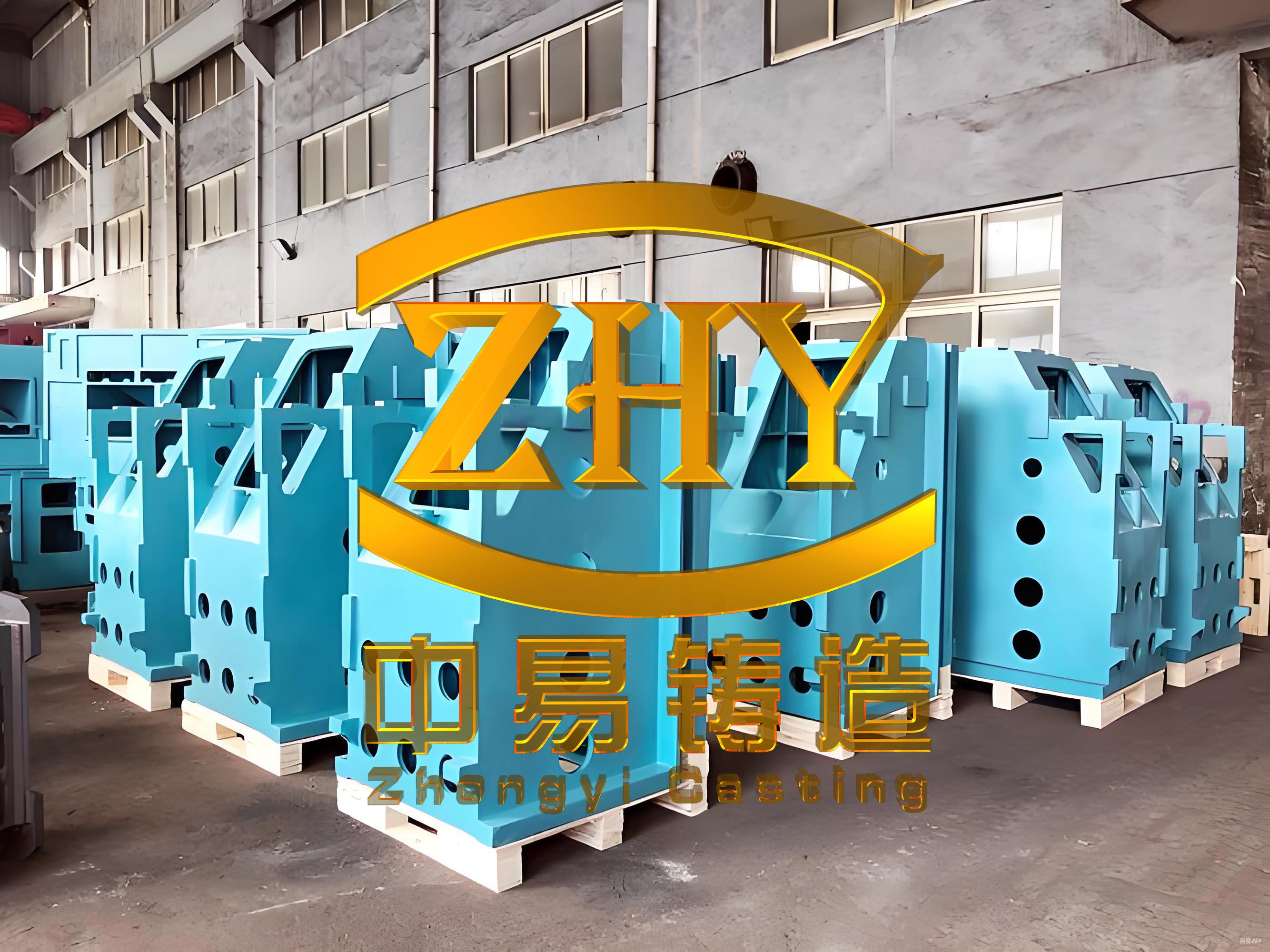
My study was conducted using a 3-ton-per-hour cupola furnace coupled with a mains-frequency forehearth, ensuring a dual-melting process for consistent iron melt quality. The molten iron was maintained at a temperature exceeding 1450°C during tapping, with a pouring temperature above 1340°C to facilitate proper fluidity and solidification in machine tool castings. Inoculation was performed at the furnace front using FeSi75 and FeSiRe27, with the total inoculation amount kept below 0.5% to control microstructure development. The carbon equivalent (CE) was carefully regulated between 3.7% and 3.9%, as this range is critical for balancing the mechanical properties of machine tool castings. For each heat, cylindrical test bars with a diameter of 30 mm were cast to evaluate mechanical properties and chemical composition, providing a reliable basis for analyzing the effects of Si/C variations.
The carbon equivalent is a fundamental parameter in gray iron metallurgy, defined by the formula: $$ CE = C + \frac{1}{3}Si $$ where C and Si represent the weight percentages of carbon and silicon, respectively. This equation accounts for the combined effect of carbon and silicon on the graphite formation and matrix structure in machine tool castings. By holding CE constant within the specified range, I could isolate the impact of the Si/C ratio on key performance metrics. The Si/C ratio is calculated as: $$ \text{Si/C} = \frac{Si}{C} $$ which influences the graphite morphology and matrix strengthening mechanisms. In my experiments, I varied the Si/C ratio from approximately 0.45 to 0.9 to observe its effects on tensile strength, hardness, residual stress, and processing characteristics of machine tool castings.
To quantify the relationship between Si/C and tensile strength (σ_b), I conducted multiple heats and recorded the chemical compositions and mechanical properties. The table below summarizes a subset of the data collected from 10 representative heats, illustrating the trends observed in machine tool castings.
| Heat No. | C (%) | Si (%) | Mn (%) | P (%) | S (%) | CE (%) | Si/C | σ_b (MPa) | HB |
|---|---|---|---|---|---|---|---|---|---|
| 1 | 3.27 | 1.53 | 0.81 | 0.050 | 0.041 | 3.73 | 0.468 | 223 | 217 |
| 2 | 3.32 | 1.63 | 0.67 | 0.042 | 0.052 | 3.81 | 0.490 | 210 | 207 |
| 3 | 3.18 | 1.76 | 0.56 | 0.045 | 0.052 | 3.71 | 0.553 | 237 | 215 |
| 4 | 3.16 | 1.71 | 0.90 | 0.043 | 0.036 | 3.67 | 0.541 | 268 | 231 |
| 5 | 3.11 | 2.02 | 0.72 | 0.038 | 0.038 | 3.72 | 0.649 | 276 | 229 |
| 6 | 3.07 | 2.09 | 0.76 | 0.046 | 0.044 | 3.70 | 0.681 | 292 | 217 |
| 7 | 2.99 | 2.33 | 0.82 | 0.045 | 0.045 | 3.69 | 0.779 | 297 | 227 |
| 8 | 3.10 | 2.32 | 0.59 | 0.042 | 0.060 | 3.80 | 0.748 | 305 | 223 |
| 9 | 3.10 | 2.24 | 0.86 | 0.045 | 0.062 | 3.77 | 0.723 | 285 | 221 |
| 10 | 2.99 | 2.38 | 0.78 | 0.046 | 0.052 | 3.70 | 0.796 | 292 | 231 |
Based on the data from 40 heats, I plotted the relationship between Si/C and tensile strength, which revealed a clear trend: as the Si/C ratio increased from 0.45 to 0.8, the tensile strength of machine tool castings improved significantly. For instance, at Si/C values between 0.65 and 0.8, the tensile strength exhibited a pronounced enhancement, reaching up to 305 MPa. This can be attributed to the reduction in graphite content and the solid solution strengthening of ferrite due to higher silicon levels. However, when the Si/C ratio exceeded 0.9, tensile strength began to decline, as observed through metallographic analysis that indicated an increase in ferrite content within the matrix. The relationship can be modeled using a quadratic equation: $$ \sigma_b = a \cdot (\text{Si/C})^2 + b \cdot (\text{Si/C}) + c $$ where a, b, and c are constants derived from regression analysis. For machine tool castings, optimizing the Si/C ratio is crucial to maximize strength without compromising other properties.
In terms of hardness, I measured Brinell hardness (HB) on the cylindrical test bars by taking three points at the mid-radius position of the cross-section and averaging the results. The data showed that under constant CE conditions, higher Si/C ratios led to slightly elevated hardness values, typically ranging between HB 200 and 230. Moreover, the hardness uniformity improved, with variations within HB 6 to 16 in production castings after machining. This consistency is vital for machine tool castings, as it ensures stable performance and reduces wear in critical components like guideways. The relative hardness (RH), defined as the ratio of measured hardness to a reference value, remained below 1.0 for Si/C ratios between 0.65 and 0.8, indicating favorable machinability. The hardness behavior can be expressed as: $$ HB = k_1 \cdot \text{Si/C} + k_2 $$ where k_1 and k_2 are material constants. This linear approximation highlights the direct influence of Si/C on the pearlitic matrix hardness in machine tool castings.
To assess hardness uniformity, I used step-shaped test blocks with thicknesses ranging from 20 mm to 80 mm, cast in green sand molds. After machining, hardness measurements were taken at multiple points, revealing hardness differences of only HB 10 to 24 across sections. This low sensitivity to wall thickness is a key advantage for machine tool castings, as it minimizes the risk of soft spots or hard areas that could affect precision. The improved uniformity stems from the refined pearlitic microstructure and reduced chilling tendency at higher Si/C ratios, which I confirmed through microscopic examination. For machine tool castings, this translates to better dimensional stability and longer service life.
Residual stress is another critical factor influencing the performance of machine tool castings. I evaluated the residual stress (σ_R) using standardized methods and found that it decreased with increasing Si/C ratio at constant CE. This reduction enhances the resistance to deformation and cracking, as evidenced by the decreased incidence of defects in complex castings like bed frames and tables. The relationship between Si/C and residual stress can be described by: $$ \sigma_R = m \cdot e^{-n \cdot \text{Si/C}} $$ where m and n are empirical constants. Lower residual stress in high Si/C machine tool castings contributes to improved accuracy retention in machine tools, as dimensional changes during service are minimized.
The casting and machining performance of machine tool castings also benefited from higher Si/C ratios. With increased silicon content, graphite formation was more complete, reducing shrinkage porosity and hot tearing defects. Additionally, the uniform gray iron structure even in thin sections prevented chill formation, facilitating easier machining. In production, this led to a decrease in tool wear and fewer rejects, allowing some components to forego stress-relief heat treatments. The overall improvement in processability underscores the economic advantages of optimizing Si/C for machine tool castings.
In conclusion, my research demonstrates that for gray iron machine tool castings with a carbon equivalent of 3.7% to 3.9%, a silicon-to-carbon ratio between 0.65 and 0.80 yields optimal mechanical properties, including high tensile strength, consistent hardness, low residual stress, and enhanced casting and machining characteristics. These improvements directly contribute to the stiffness and precision stability of machine tools, making high Si/C ratios a valuable strategy in foundry practices. Future work could explore the interplay with other alloying elements to further advance the performance of machine tool castings.