
The relentless pursuit of performance in the aerospace industry is fundamentally a quest for structural efficiency. This drive manifests in two core strategies: the adoption of integrated, complex structural designs to reduce part count and assembly weight, and the deployment of advanced materials that offer superior strength-to-weight ratios, particularly at elevated temperatures. In this context, titanium alloys have emerged as indispensable, prized for their unique combination of low density, high specific strength, excellent corrosion resistance, and good performance at moderate temperatures. For decades, these alloys have been the backbone of critical airframe and engine components, enabling significant weight savings and enhanced durability in demanding environments. However, the very properties that make titanium alloys attractive—high chemical reactivity, low thermal conductivity, and high strength—also render them challenging and costly to shape using conventional subtractive machining techniques, especially for the thin-walled, intricate geometries demanded by modern integrated designs.
This is where the art and science of lost wax investment casting becomes a transformative enabling technology. As a premier near-net-shape manufacturing process, lost wax investment casting offers a compelling solution for producing complex titanium components. Its advantages are manifold: it achieves high dimensional accuracy and superior surface finish directly from the mold; it can produce parts with extreme geometric complexity and large size ranges; it boasts high material utilization, minimizing the costly titanium scrap associated with machining from billet; and it is inherently scalable for batch production. The process has matured to the point where it can reliably produce structural components that confidently replace forgings in certain applications, a testament to its quality and cost-effectiveness. The widespread adoption of Hot Isostatic Pressing (HIP) as a standard post-processing step has further closed the porosity-related property gap with wrought products, expanding the application envelope of cast titanium parts. Today, it is estimated that over 90% of titanium castings for the aerospace sector are manufactured via the lost wax investment casting route, underscoring its dominance. This article, drawn from the perspective of ongoing industrial and academic research, will delve into the technological pillars of this field: the pivotal role of numerical simulation in process optimization and the frontier challenges and opportunities presented by advanced TiAl intermetallic alloys.
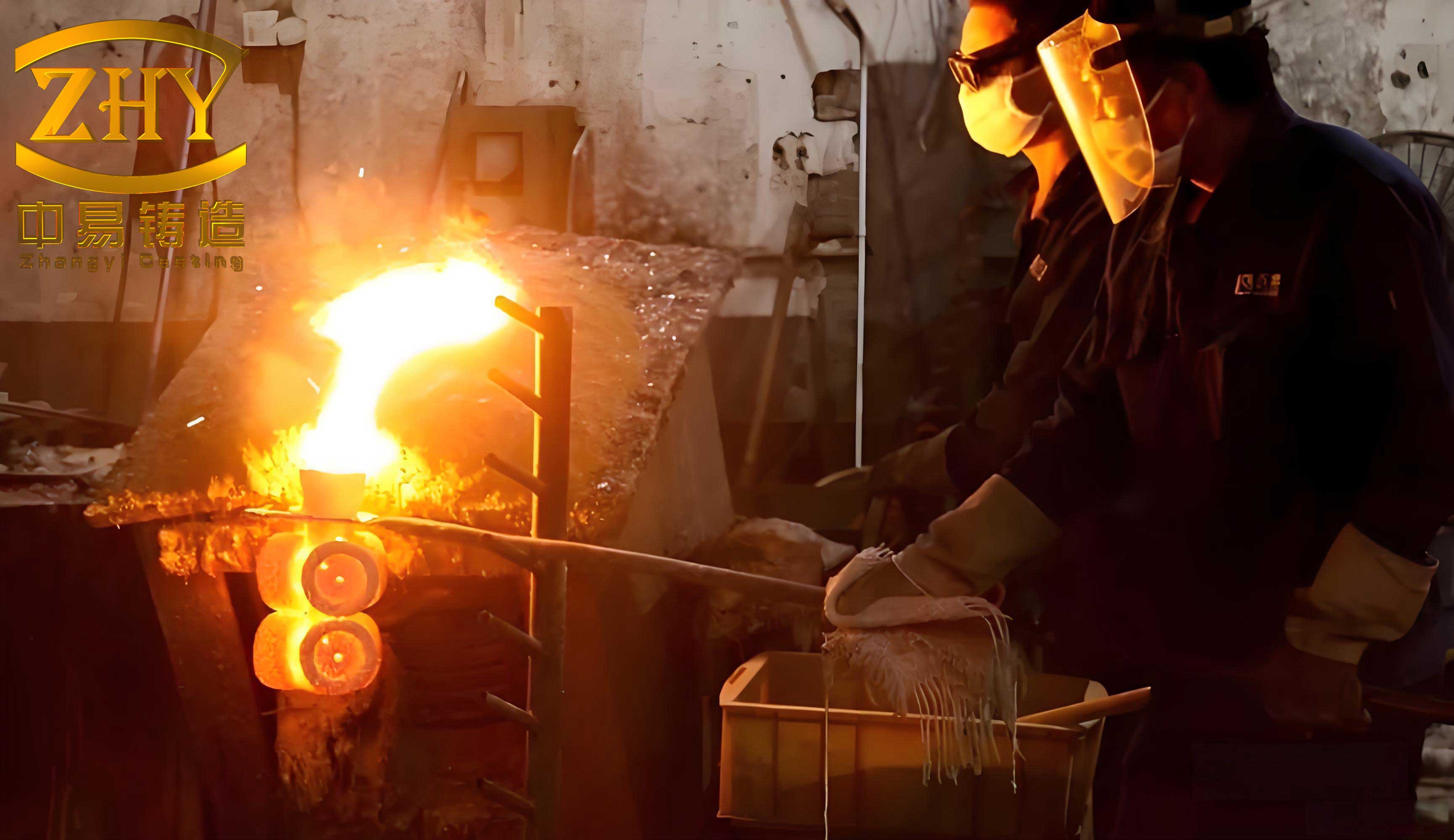
The journey of titanium lost wax investment casting is one of continuous material and process innovation. Early efforts grappled with fundamental incompatibilities. The extreme reactivity of molten titanium with most refractory materials led to severe surface contamination, or “alpha-case” formation, degrading mechanical properties. Initial shell systems based on graphite or tungsten, while refractory, were difficult to control and yielded poor surface finishes. The breakthrough came with the development and stabilization of oxide-based ceramic shells, particularly those utilizing yttria (Y₂O₃) as a face coat material. Yttria’s high thermodynamic stability minimizes interfacial reactions with the titanium melt, a critical factor described by the driving force for reaction:
$$ \Delta G_{reaction} = \Delta G^\circ + RT \ln(Q) $$
Where a highly negative $\Delta G^\circ$ for the formation of yttria makes its reduction by titanium less favorable compared to other oxides like silica or alumina. Concurrently, the shift from refractory-lined crucibles to water-cooled copper crucible (skull) melting eliminated another source of contamination, providing a clean, superheated alloy charge. These two advancements—inert ceramic shells and skull melting—formed the cornerstone of modern, reliable titanium investment casting.
The material palette for casting has also evolved. While workhorse alloys like Ti-6Al-4V (ZTC4 equivalent) and Ti-6.5Al-2Sn-4Zr-2Mo (ZTA15 equivalent) dominate for applications up to approximately 500°C, the push for higher operating temperatures and lower weight has driven the development of more advanced systems, most notably the titanium aluminide (TiAl) intermetallics, which will be discussed in detail later.
The Critical Role of Numerical Simulation in Process Advancement
Traditional development of a lost wax investment casting process is inherently serial and heavily reliant on empirical trial-and-error. Each step—wax pattern injection, shell building, dewaxing, firing, melting, pouring, solidification, and heat treatment—introduces variability. Errors can accumulate, leading to costly iterations, long lead times, and scrap. This paradigm is ill-suited for the rapid development of increasingly complex, high-integrity aerospace components. Consequently, the integration of computational numerical simulation has become indispensable for elevating the technology’s capability, efficiency, and predictability.
Modern simulation software suites (e.g., ProCAST, MagmaSoft, HuaZhu CAE) solve the governing equations of fluid flow, heat transfer, stress, and microstructure evolution during casting. The core physics is described by a set of coupled partial differential equations. The Navier-Stokes equations govern fluid flow during mold filling:
$$ \rho \left( \frac{\partial \mathbf{v}}{\partial t} + \mathbf{v} \cdot \nabla \mathbf{v} \right) = -\nabla p + \mu \nabla^2 \mathbf{v} + \rho \mathbf{g} + \mathbf{F}_{sv} $$
where $\rho$ is density, $\mathbf{v}$ is velocity, $p$ is pressure, $\mu$ is dynamic viscosity, $\mathbf{g}$ is gravity, and $\mathbf{F}_{sv}$ represents source terms like surface tension at the liquid-free surface interface, often tracked using a Volume-of-Fluid (VOF) method. The energy equation, coupled with the fluid flow, predicts temperature distribution:
$$ \rho C_p \left( \frac{\partial T}{\partial t} + \mathbf{v} \cdot \nabla T \right) = \nabla \cdot (k \nabla T) + \dot{Q}_{latent} + \dot{Q}_{boundary} $$
Here, $C_p$ is specific heat, $k$ is thermal conductivity, $\dot{Q}_{latent}$ is the latent heat release during solidification, and $\dot{Q}_{boundary}$ accounts for heat transfer across the metal-mold interface, a critical boundary condition in investment casting. The solidification path and phase formation are typically predicted using Scheil-Gulliver or back-diffusion models for microsegregation.
The practical application of these tools is vast. Simulation allows engineers to virtually “test” dozens of gating and risering schemes before ever building a mold. It can predict the location of shrinkage porosity (using criteria functions like the Niyama criterion), hot tears (via strain and stress analysis during solidification), mistruns, and inclusion trajectories. For titanium alloys, predicting and minimizing surface reaction layer depth by modeling the local thermal history at the metal-shell interface is a key application. Researchers have successfully applied these tools to optimize processes for complex titanium casings, simulating centrifugal casting effects and predicting defect bands with high accuracy.
The frontier of simulation lies in moving beyond single-process analysis towards Integrated Computational Materials Engineering (ICME) and platform-based solutions. An ICME approach links process simulation with microstructure prediction and subsequent mechanical property models, creating a digital thread from process parameters to component performance. Furthermore, next-generation platforms are integrating high-throughput computing, design-of-experiments (DOE) methods, machine learning for surrogate model generation, and multi-objective optimization algorithms. Such a platform can automatically explore the vast parameter space of lost wax investment casting (e.g., pour temperature, preheat temperature, gating geometry, alloy composition) to identify Pareto-optimal solutions that balance conflicting objectives like yield strength, fatigue life, and yield rate. This represents a paradigm shift from simulation-as-analysis to simulation-as-a-driver for intelligent, accelerated process development.
| Simulation Capability | Governing Physics/Model | Key Output & Purpose in Investment Casting |
|---|---|---|
| Mold Filling | Navier-Stokes + VOF, Turbulence models (k-ε, LES) | Visualizes flow fronts, predicts cold shuts, air entrapment, oxide film formation, and droplet splashing. |
| Solidification & Thermal Analysis | Energy Eq. with Latent Heat, Fixed Grid/CAFE | Predicts solidification sequence, local cooling rates, shrinkage porosity location (Niyama criterion), and macro-segregation tendency. |
| Stress & Distortion | Thermo-Elasto-Plastic Constitutive Models | Calculates residual stress field, predicts hot tearing susceptibility, and forecasts final component distortion/warpage. |
| Microstructure Prediction | Cellular Automaton (CA), Phase Field, JMAK Kinetics | Estimates grain size, morphology (columnar/equiaxed), and phase fractions (e.g., α lath size in Ti-6Al-4V). |
The Challenge and Promise of TiAl Intermetallic Alloys
While conventional titanium alloys serve superbly up to ~500°C, the thermal frontier for gas turbine engines and hypersonic vehicle structures lies far beyond. Nickel-based superalloys have been the traditional choice for these “hot section” components, but their high density (~8.2 g/cm³) imposes a significant weight penalty. Enter titanium aluminide (TiAl) intermetallic alloys, based primarily on the γ-TiAl phase. These materials offer a transformative property suite: density around 3.8-4.2 g/cm³ (nearly 50% lighter than Ni-superalloys), good specific strength and stiffness at high temperatures (700-900°C), and attractive oxidation and creep resistance. Enabling their use is pivotal for increasing the thrust-to-weight ratio of engines and the Mach number capability of aircraft.
However, TiAl alloys present formidable manufacturing challenges. Their ordered crystal structure grants them high-temperature capabilities but also results in low room-temperature ductility (typically <2% elongation) and poor fracture toughness. This inherent brittleness makes them nearly unmachinable via conventional means and very sensitive to internal defects and stress concentrations. Consequently, lost wax investment casting is not just a convenient option for TiAl; it is often the only viable near-net-shape manufacturing route for producing complex components like low-pressure turbine blades or turbocharger wheels.
The casting of TiAl alloys amplifies the difficulties encountered with conventional titanium. Key issues include:
- Poor Fluidity: The high melting point and latent heat characteristics of TiAl lead to rapid heat loss, reducing the metal’s ability to fill thin sections. The fluidity length $L_f$ can be modeled as proportional to the superheat and inversely proportional to a heat diffusion factor:
$$ L_f \propto \frac{\Delta T_{superheat} \cdot v_{pour}}{ \sqrt{\alpha_{mold} / \alpha_{metal}} } $$
where $\alpha$ is thermal diffusivity. - High Chemical Reactivity: TiAl melts are even more reactive than conventional Ti alloys, demanding ultra-stable mold face coats to prevent excessive alpha-case or other brittle interfacial reaction products.
- Substantial Solidification Shrinkage: TiAl alloys exhibit significantly higher volumetric shrinkage (often >3%) compared to Ti-6Al-4V (~1.5%). This dramatically increases the risk of shrinkage porosity and necessitates highly efficient risering systems, which simulation is critical to design.
The heart of TiAl investment casting technology lies in the shell system. The quest for the optimal face coat material is a central research theme. While Y₂O₃ remains the gold standard due to its minimal reactivity, its practical drawbacks—high cost, difficulty in slurry preparation, and hygroscopic nature—drive the search for alternatives or modifications. Al₂O₃ is a promising, lower-cost candidate. Although some interfacial reaction occurs, its high Al content may lower the oxygen activity at the interface, and its thermal expansion coefficient is a closer match to TiAl, potentially reducing thermal stress cracking during cooling. ZrO₂ (stabilized) offers another compromise. Research into dopants (e.g., YF₃, B₂O₃) or composite face coats (e.g., Y₂O₃ with Al₂O₃+ZrO₂) aims to improve sintering, lower cost, and maintain an effective diffusion barrier.
The interfacial reaction kinetics are critical. The reaction layer thickness $x$ often follows a parabolic growth law, indicating diffusion-controlled kinetics:
$$ x^2 = k_p \cdot t $$
where $k_p$ is the parabolic rate constant, exponentially dependent on temperature ($k_p \propto e^{-Q/RT}$). The goal is to minimize $k_p$ through thermodynamic and kinetic stabilization of the face coat material.
| Face Coat Material | Key Advantages | Key Challenges | Typical Reacted Layer Thickness (μm) |
|---|---|---|---|
| Yttria (Y₂O₃) | Highest thermodynamic stability, minimal interfacial reaction. | Very high cost, difficult slurry rheology, hygroscopic. | 10 – 30 |
| Alumina (Al₂O₃) | Lower cost, good sintering, lower thermal expansion mismatch. | Moderate interfacial reaction, potential for Al contamination. | 30 – 60 |
| Zirconia (ZrO₂ – stabilized) | Good refractoriness, established processing. | Potential for Zr pick-up, phase stability issues. | 15 – 40 |
| Modified/Composite Systems (e.g., Y₂O₃ + additives) | Tailorable properties, potentially lower cost than pure Y₂O₃. | Complex formulation, need for rigorous characterization. | 5 – 20 |
Alloy design for castability is equally important. The pioneering alloys, General Electric’s Ti-48Al-2Cr-2Nb (4822) and Howmet’s Ti-47Al-2Mn-2Nb-0.8TiB₂ (47XD), established the baseline. Current research focuses on enhancing high-temperature strength, oxidation resistance, and room-temperature damage tolerance through strategic alloying. High-Nb additions (5-10 at.%) are highly effective for solid solution strengthening and oxidation improvement. Additions of Ta, Mo, and W also contribute to high-temperature performance. Boron (as TiB₂) is a potent grain refiner, crucial for improving the uniformity of as-cast microstructure and mechanical properties. The balance of Al content is critical: lower Al promotes more ductile phases but can harm oxidation resistance; higher Al improves oxidation but increases brittleness. This is often represented on a pseudo-binary phase diagram where the target microstructure (fully lamellar, duplex, etc.) is chosen based on property requirements.
Summary and Industrial Outlook
The field of aerospace titanium lost wax investment casting stands at an exciting juncture, driven by digital integration and material innovation. The future trajectory points toward two dominant, interconnected themes.
1. The Digital Transformation through Advanced Numerical Simulation:
The evolution from standalone casting simulation to full-process digital twins and ICME platforms will define the next decade. The vision is a closed-loop, intelligent system where simulation does not just predict but prescribes. Future platforms will leverage high-fidelity multi-physics models, integrated with real-time sensor data from the foundry floor, to enable adaptive control and continuous process optimization. Machine learning algorithms will digest historical production data and simulation results to identify hidden correlations and predict quality outcomes from upstream parameters. This digital thread will link the entire value chain—from alloy design based on computational thermodynamics (e.g., CALPHAD), through optimized investment casting process parameters, to predicted in-service performance—dramatically reducing development cost, time, and risk for next-generation components.
2. Mastering the Manufacture of TiAl Alloy Components:
For TiAl alloys to fully realize their potential in next-generation engines, the lost wax investment casting process must achieve new levels of consistency, quality, and cost-effectiveness. This is a systems engineering challenge encompassing:
- Robust, Low-Cost Shell Systems: Continued R&D into modified and composite face coat materials to provide reliable performance at a sustainable cost.
- Alloy & Process Co-Design: Developing new alloy compositions specifically tailored for enhanced castability—better fluidity, reduced hot-tearing tendency, and tolerance to minor impurities—while maintaining target mechanical properties.
- Integrated Post-Processing: Perfecting the synergy between casting, Hot Isostatic Pressing (HIP), and tailored heat treatment cycles to consistently produce defect-free components with engineered microstructures (e.g., controlled lamellar colony size).
The successful industrialization of TiAl casting will unlock a new realm of lightweight, high-temperature capabilities, enabling more efficient and powerful aerospace propulsion systems.
In conclusion, lost wax investment casting has matured from a specialized craft into a sophisticated, digitally-enhanced manufacturing discipline central to aerospace advancement. Its ability to translate innovative, lightweight designs into reliable titanium and TiAl alloy components will remain a cornerstone of aerospace manufacturing strategy. The convergence of computational power, materials science, and process engineering promises not only to optimize existing production but to pioneer the manufacture of components for aerospace systems yet to be imagined.