
As a seasoned expert in the casting industry, I have dedicated my career to advancing the field of steel castings, witnessing firsthand the transformative shifts that are reshaping our sector. Steel castings form the backbone of critical infrastructure, from energy generation to heavy machinery, and their quality and innovation directly impact global industrial progress. In recent years, the emphasis on technological standardization, foundational research, and strategic partnerships has propelled steel castings into a new era of excellence. This article, from my perspective, delves into these key areas, highlighting how they collectively drive the future of steel castings. I will explore the latest technical specifications, the imperative for basic research, and the synergistic ecosystems fostering growth, all while integrating analytical tools like tables and formulas to provide a comprehensive overview. The goal is to underscore the pivotal role of steel castings in modern engineering and the continuous efforts needed to elevate their standards.
The development of steel castings has always been intertwined with precision and reliability. Recently, a series of group technical standards have been introduced, setting new benchmarks for manufacturing and验收. These standards, which took effect in August 2021, address specific applications such as large gear rings, Francis turbine runners, and hydraulic turbine ball valves. For instance, the standard for large gear ring steel castings applies to components with diameters exceeding 3 meters, detailing overall requirements, technical specifications, manufacturing processes, and testing methods. Similarly, the standards for Francis turbine integral runner steel castings and hydraulic turbine ball valve steel castings outline similar rigorous frameworks, ensuring that these critical steel castings meet elevated performance criteria. To summarize these standards effectively, I have compiled a table that captures their core elements:
| Standard Code | Primary Scope | Key Technical Aspects | Applicable Steel Castings Type |
|---|---|---|---|
| T/CFA 020101163—2021 | Large gear ring steel castings with diameter ≥3m | Overall requirements, manufacturing工艺, testing methods, inspection rules, quality certification | Gear ring steel castings for heavy machinery |
| T/CFA 020101224—2021 | Francis turbine integral runner steel castings | Technical specifications,制造工艺,试验方法,检验规则, packaging and transport | Runner steel castings for hydroelectric turbines |
| T/CFA 020101223—2021 | Hydraulic turbine ball valve steel castings | General requirements, technical demands, manufacturing processes, quality proof,标识和防护 | Ball valve steel castings for water turbine systems |
These standards are not merely regulatory documents; they represent a commitment to excellence in steel castings production. By adhering to such specifications, manufacturers can enhance the durability and efficiency of steel castings, which are essential in sectors like renewable energy and industrial automation. The implementation of these standards often involves complex engineering calculations. For example, the stress analysis in large gear ring steel castings can be modeled using the formula for von Mises stress, which is crucial for ensuring structural integrity: $$ \sigma_v = \sqrt{ \frac{(\sigma_1 – \sigma_2)^2 + (\sigma_2 – \sigma_3)^2 + (\sigma_3 – \sigma_1)^2}{2} } $$ where $\sigma_1, \sigma_2, \sigma_3$ are the principal stresses. Such formulas are integral to the design and validation of steel castings, underscoring the technical depth required in this field.
Beyond standardization, the advancement of steel castings hinges on foundational research. A national leader recently emphasized that we are at a critical juncture where strengthening basic research is paramount. This sentiment resonates deeply within the steel castings community. While applied technologies in steel castings have seen remarkable progress, with some areas leading globally, our foundational knowledge in materials science and原始创新 remains a bottleneck. Basic research in steel castings involves exploring fundamental properties like microstructure evolution, which can be described using phase transformation equations. For instance, the kinetics of austenite decomposition in steel castings can be expressed with the Johnson-Mehl-Avrami-Kolmogorov (JMAK) equation: $$ f = 1 – \exp(-k t^n) $$ where $f$ is the transformed fraction, $k$ is the rate constant, $t$ is time, and $n$ is the Avrami exponent. Investing in such research is vital for developing next-generation steel castings with superior performance. To illustrate the focus areas, here is a table outlining key research domains for steel castings:
| Research Domain | Description | Relevance to Steel Castings | Potential Impact |
|---|---|---|---|
| Materials Characterization | Studying microstructural features and defects in steel castings | Improves fatigue resistance and toughness of steel castings | Longer lifespan for critical components |
| Process Modeling | Simulating casting processes using computational methods | Optimizes pouring and solidification of steel castings | Reduces waste and enhances quality |
| Alloy Development | Designing new steel alloys for specific casting applications | Enables定制 steel castings with unique properties | Expands application range in aerospace and energy |
| Corrosion Studies | Investigating degradation mechanisms in steel castings | Enhances durability of steel castings in harsh environments | Lower maintenance costs for infrastructure |
Fostering this research requires a conducive ecosystem, which brings me to the importance of collaboration. Strategic partnerships between industry associations and governmental bodies have proven instrumental in elevating the steel castings sector. For example, a recent agreement between a major casting association and a municipal government aims to drive industrial upgrading through technical guidance and resource integration. This collaboration focuses on helping local enterprises, particularly those involved in steel castings production, meet modern environmental and safety standards while fostering innovation. The synergy is not limited to large corporations; it extends to small and medium-sized enterprises (SMEs) that specialize in niche areas of steel castings. The concept of an integrated development生态, where large and small firms coexist and co-innovate, is gaining traction. In this context, the recognition of “specialized, refined, distinctive, and innovative” SMEs—often referred to as “little giants”—highlights the diversity within the steel castings industry. These firms often contribute specialized expertise, such as precision casting for intricate steel castings components. To depict this ecosystem, consider the following table showcasing the roles of different enterprise types in the steel castings value chain:
| Enterprise Type | Primary Focus | Contribution to Steel Castings | Collaboration Examples |
|---|---|---|---|
| Large Manufacturers | Mass production of heavy steel castings for industries like automotive and energy | Provide scale and advanced manufacturing capabilities for standard steel castings | Joint R&D projects with research institutes on alloy development |
| Specialized SMEs (“Little Giants”) | Niche applications, e.g., high-precision or custom steel castings for aerospace | Offer agility and innovation in producing complex steel castings components | Supply chain integration with large firms for specialized steel castings parts |
| Research Institutions | Basic and applied research on materials and processes for steel castings | Generate knowledge and new technologies to improve steel castings quality | Collaborative grants and publications with industry partners |
| Government Bodies | Policy formulation and infrastructure support for the steel castings industry | Create favorable regulatory and funding environments for steel castings innovation | Funding programs and standardization initiatives for steel castings |
In the midst of these discussions, visual aids can greatly enhance understanding. Below is an image that exemplifies the advanced equipment used in modern steel castings production, highlighting the technological sophistication involved. This serves as a reminder of the tangible advancements in our field.
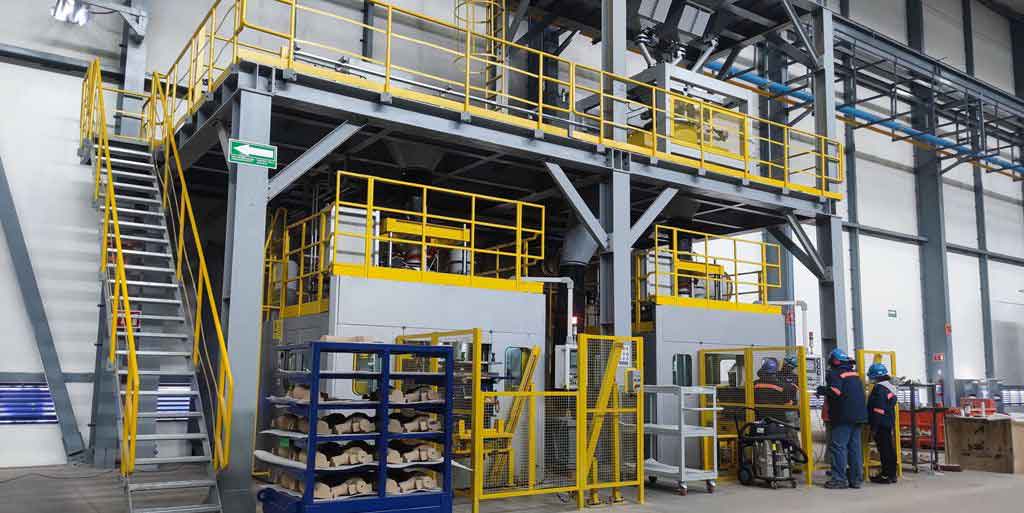
The integration of such equipment with the standards and research mentioned earlier is crucial. For instance, the manufacturing processes for steel castings, as outlined in the new standards, often rely on precise control of parameters like temperature and cooling rates. These can be modeled using heat transfer equations, such as the Fourier’s law for conduction in steel castings during solidification: $$ q = -k \frac{dT}{dx} $$ where $q$ is the heat flux, $k$ is the thermal conductivity of the steel, and $\frac{dT}{dx}$ is the temperature gradient. Optimizing these parameters through research leads to higher-quality steel castings with fewer defects. Moreover, the collaborative efforts between associations and governments often focus on disseminating such knowledge, ensuring that even smaller producers of steel castings can adopt best practices. This holistic approach—combining standards, research, and partnership—creates a virtuous cycle that propels the entire industry forward.
Looking ahead, the future of steel castings is bright but demands sustained effort. We must continue to champion basic research, as it is the bedrock upon which innovative steel castings are built. This involves not only funding but also cultivating a culture of curiosity and resilience among researchers. Equations like the Hall-Petch relationship, which describes the strength of steel castings based on grain size, underscore the importance of微观结构研究: $$ \sigma_y = \sigma_0 + k_y d^{-1/2} $$ where $\sigma_y$ is the yield strength, $\sigma_0$ is the friction stress, $k_y$ is the strengthening coefficient, and $d$ is the average grain diameter. By deepening our understanding of such principles, we can design steel castings that are stronger, lighter, and more durable. Additionally, the expansion of collaborative networks will be vital. As more regions engage in strategic agreements, the exchange of expertise in steel castings manufacturing will accelerate, leading to global benchmarks for quality. I envision a world where steel castings are not just components but enablers of sustainable development, powering everything from clean energy systems to smart infrastructure.
In conclusion, as someone deeply involved in this field, I believe that the convergence of technical standards, foundational research, and industrial synergy is reshaping the landscape of steel castings. The recent standards provide a framework for excellence, while the push for basic research addresses core challenges. Collaborative ecosystems ensure that knowledge and resources flow seamlessly, benefiting all players in the steel castings industry. By embracing these elements, we can overcome bottlenecks and unlock new potentials for steel castings. Let us continue to innovate, collaborate, and elevate steel castings to new heights, ensuring they remain indispensable to technological progress. The journey is ongoing, and with each advancement in steel castings, we move closer to a more efficient and resilient industrial future.