
For many years, my research has been dedicated to overcoming the inherent limitations of metallic materials. The quest to combine the high strength, hardness, and wear resistance of steel with the cost-effective castability of iron has been a persistent challenge in materials science. Traditional methods for improving the properties of white cast iron, primarily heat treatment or alloying, have achieved notable success. Heat treatments produce malleable cast iron, while alloying with elements like magnesium or cerium yields ductile iron. Recent advancements have also utilized high chromium contents alongside other elements. However, a fundamental limitation remains: these methods often fail to deliver a dramatic, order-of-magnitude improvement in toughness. The pervasive notion that “cast iron cannot be forged” has long confined white cast iron to static cast components, limiting its potential in demanding applications.
This perspective, however, is more a historical convention than an absolute truth. Archaeological evidence suggests practices of forging high-carbon iron as early as 500 BC. Building on pioneering work from the mid-20th century on the hot working of ductile iron and more recent international studies on forging white cast iron rolls, my extensive experimental work has systematically explored the forging and rolling of low-alloy white cast iron. The results unequivocally demonstrate that plastic deformation is a straightforward and highly effective shortcut to refining the microstructure, enhancing mechanical properties, and unlocking the latent potential of this material. This process has successfully transitioned from laboratory research to industrial production, offering a new pathway for wear-resistant materials in my country.
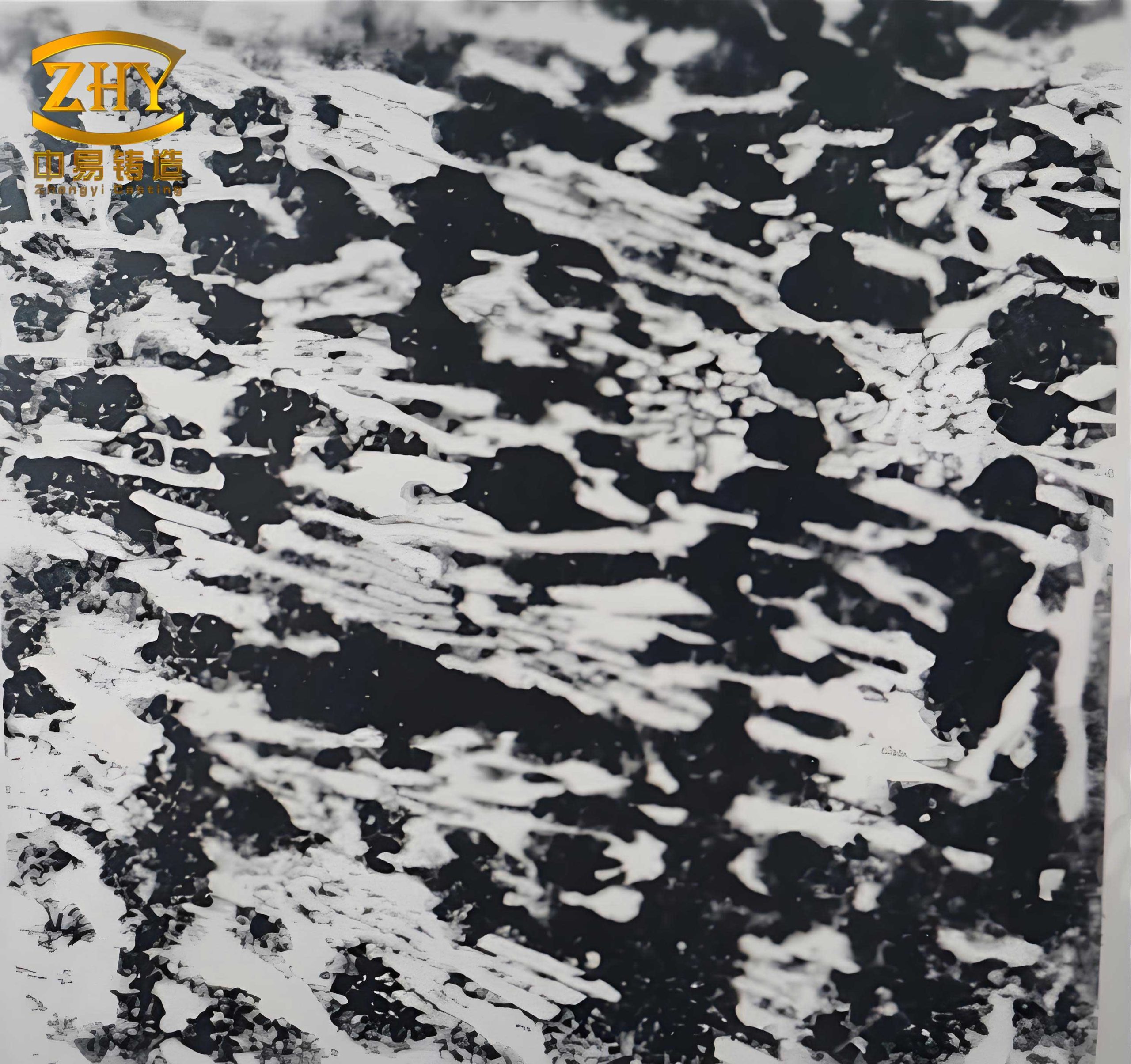
I. Process Characteristics of Forging and Rolling White Cast Iron
The successful hot working of white cast iron hinges on understanding its unique process window, which is notably narrower than that of carbon steels.
1. Forging/Rolling Temperature Range and Heating Protocol
The plasticity of white cast iron is highly temperature-dependent. Using cylindrical compression tests, the critical deformation before surface cracking ($\varepsilon_c$) was measured across a range of temperatures. The deformation degree is calculated as:
$$
\varepsilon_c = \frac{\Delta h}{h_0} = \frac{h_0 – h_1}{h_0}
$$
where $h_0$ is the initial height and $h_1$ is the height after deformation. The temperature-plasticity curve reveals an optimal forging and rolling window between 1050°C and 1150°C. Exceeding this range risks overheating or burning, while temperatures below 950°C lead to a sharp drop in plasticity and a high risk of cracking during deformation.
Given its low thermal conductivity and inherent brittleness, a careful heating schedule is mandatory for white cast iron. Preheating and holding at approximately 600°C is essential to prevent thermal shock and cracking. A second hold at 800-850°C ensures uniform phase transformation throughout the cross-section before rapidly heating to the starting deformation temperature of 1150°C. High-temperature soaking time should be minimized to just what is required for through-heating, as prolonged exposure leads to grain coarsening and, critically, the precipitation of graphite, which severely degrades both plasticity and post-forging mechanical properties.
2. The Influence of Stress State on Plasticity
The as-cast microstructure of white cast iron, characterized by a continuous network of brittle carbides and inherent casting defects like shrinkage porosity, makes it exceptionally sensitive to stress state. For example, drawing out a cylindrical white cast iron billet between flat dies often induces longitudinal cracks, and heavy blows can cause fatal cross-shaped internal cracks. Therefore, the forging of white cast iron must follow principles similar to those for high-alloy steels: initial light blows, followed by heavier deformation once the material is uniformly plastic, avoiding repeated heavy impact on a single location. The use of shaped dies or closed-die forging generally prevents cracking. In rolling, plate rolling is prone to edge cracking, while the rolling of round bars is more forgiving.
3. The Influence of Chemical Composition on Workability
The hot workability of white cast iron is profoundly affected by its chemical makeup:
- Carbon (C): As the primary constituent of cementite, carbon content directly dictates the volume fraction and coarseness of carbides. Within the range of 2.2% to 3.0%, increasing carbon reduces hot plasticity. For successful forging and rolling, the carbon content should be restricted to produce a hypoeutectic structure, typically below 3.0%.
- Silicon (Si): A potent graphitizer, silicon promotes the separation of carbon as free graphite. When Si exceeds 1.2%, holding at 900°C can cause spheroidal graphite precipitation, leading to “mottled” iron and a detrimental loss of hardness and wear resistance. Therefore, Si should be limited to below 1.0% for white cast iron destined for hot working.
- Sulfur (S) and Phosphorus (P): These are detrimental impurities. When present in amounts exceeding 0.05% each, low-melting-point sulfides and phosphides segregate at grain boundaries, causing intergranular melting within the hot-working temperature range and a complete loss of plasticity. Contents must be strictly controlled below 0.05%.
- Alloying Elements (Cr, Mo, Ni, Cu): Elements like chromium and molybdenum stabilize carbides, refine grain structure, and increase hardenability and wear resistance. Within reasonable limits, they do not adversely affect hot plasticity. Their addition is governed by the required service performance and cost considerations.
The compositional ranges for experimental heats are summarized in the table below.
| Group | C (%) | Si (%) | Mn (%) | Cr (%) | Mo (%) | Other |
|---|---|---|---|---|---|---|
| A | 2.4 – 2.8 | 0.6 – 0.9 | 0.6 – 1.0 | 1.5 – 2.5 | 0.3 – 0.6 | – |
| B | 2.6 – 3.0 | 0.5 – 0.8 | 0.8 – 1.2 | 2.0 – 3.0 | 0.4 – 0.8 | Ni, Cu |
4. Hot Plastic Deformation Mechanism of White Cast Iron
Within the 1050-1150°C range, the microstructure consists of austenite and a network of eutectic cementite. During plastic deformation under stress, the austenite matrix flows plastically. The brittle cementite network is first fractured and then progressively broken into fragments. With further deformation, the flowing austenite matrix fills the gaps between these fragments, effectively destroying the continuous network and dispersing the carbides as particles or blocks within the matrix.
The degree of carbide fragmentation is directly governed by the amount of plastic strain (forging ratio, rolling reduction). Experiments show that with a forging ratio ($\phi$) below 2, the network breaking is minimal. At $\phi$ = 3-4, carbides appear as elongated blocks. When $\phi$ > 5, carbides become finely dispersed particles. A forging ratio of 2-4 is often a practical compromise. Similarly, rolling reductions greater than 70% result in significant carbide fragmentation and directional alignment. Beyond refining carbides, hot working also refines the as-cast grain structure, heals casting defects, and mitigates segregation.
II. Microstructure and Properties of Forged and Rolled White Cast Iron
Hot plastic deformation induces a transformative change in white cast iron, particularly in its impact toughness, challenging its reputation as a fundamentally brittle material.
1. Microstructural Evolution
- As-Cast State: The room-temperature microstructure of hypoeutectic white cast iron is pearlite + ledeburite (network) + proeutectic carbides. The fracture surface reveals coarse grains, dendritic solidification structure, and visible shrinkage porosity.
- Forged State: After forging, the microstructure transforms to pearlite + fragmented blocky primary carbides + secondary carbides. The fracture surface is significantly refined and densified. The dendritic structure is broken up, and deformed carbides are evident.
- Rolled State: Rolling produces a structure of pearlite + elongated primary carbides + secondary granular carbides. The grain structure is refined and dense, with clear evidence of carbide deformation and alignment.
2. Mechanical and Wear Properties
The properties of worked white cast iron depend on the matrix structure, and the content, distribution, and morphology of carbides.
a) Mechanical Properties: The range of properties achievable through forging or rolling followed by appropriate heat treatment is broad, as summarized below. The matrix can be tailored from tough pearlite to hard martensite, offering various combinations of strength and toughness.
| Material State | Heat Treatment | Tensile Strength, $\sigma_b$ (MPa) | Bend Strength, $\sigma_{bb}$ (MPa) | Impact Toughness, $a_k$ (J/cm²) | Hardness, HRC |
|---|---|---|---|---|---|
| As-Cast | – | 300 – 450 | 550 – 750 | 3 – 6 | 45 – 55 |
| Forged | Annealed | 500 – 650 | 900 – 1200 | 8 – 15 | 40 – 48 |
| Forged | Quenched & Tempered | 700 – 900 | 1100 – 1400 | 6 – 12 | 55 – 62 |
| Rolled | Austempered | 850 – 1100 | 1300 – 1600 | 10 – 18 | 48 – 58 |
b) Wear Performance: Low-stress abrasive wear tests comparing as-cast and forged white cast iron of similar composition and hardness consistently show superior performance for the forged material. The wear loss and volume loss are lower, and the wear resistance coefficient ($K$), defined as the ratio of standard sample wear loss to test material wear loss ($K = W_{std} / W_{test}$), is higher for forged white cast iron.
3. Factors Influencing Properties
For forged or rolled white cast iron, properties are governed by two interconnected factors:
- Carbide Morphology and Distribution: This is the primary consequence of plastic deformation. The forging ratio ($\phi$) or rolling reduction ($\epsilon$) is the key process variable determining the degree of carbide fragmentation and dispersion. The relationship can be conceptually described as carbide size being inversely proportional to the applied strain: $d_{carbide} \propto 1/\epsilon$. Finer, more dispersed carbides lead to better mechanical properties.
- Matrix Structure: Once the carbide dispersion is set by deformation, the matrix acts as the governing “background” for mechanical properties. Heat treatment allows selection of the matrix:
- Pearlite: Lower hardness, higher toughness.
- Martensite: Higher hardness, lower toughness.
- Austenite/Bainite: Intermediate properties, often with an excellent toughness/hardness balance.
The choice depends on component geometry and service requirements (e.g., high impact vs. pure abrasion).
Therefore, the core principle for optimizing forged white cast iron components is to use sufficient plastic strain to achieve the desired carbide dispersion and then apply a tailored heat treatment to obtain the matrix structure that provides the optimal hardness-toughness synergy for the specific application.
III. Production Application and Case Studies
The transition of forged and rolled white cast iron from the laboratory to industrial production validates its economic and technical merits. Industries such as mining, cement, power generation, and abrasive processing consume vast quantities of wear parts like grinding media, crusher liners, and slurry pump components. The application of this material offers a cost-effective alternative to more expensive high-chromium cast irons or work-hardening steels.
Forged white cast iron grinding balls, crusher hammers, and rolling mill guides have been successfully batch-produced. Two compelling case studies illustrate the performance gains:
Case Study 1: Crusher Hammers in a Glass Plant. Hammers in a feldspar crusher were trialed using both standard high-manganese steel and forged white cast iron hammers in mixed and separate configurations.
| Material | Number Tested | Total Ore Crushed (tons) | Average Service Life per Hammer (tons) | Relative Life Ratio |
|---|---|---|---|---|
| High-Mn Steel | 12 | 432 | 36 | 1.0 |
| Forged White Cast Iron | 12 | 864 | 72 | 2.0 |
| Material | Number Tested | Total Ore Crushed (tons) | Average Service Life per Hammer (tons) | Relative Life Ratio |
|---|---|---|---|---|
| High-Mn Steel | 24 | 960 | 40 | 1.0 |
| Forged White Cast Iron | 24 | 1920 | 80 | 2.0 |
The forged white cast iron hammers lasted twice as long as their high-manganese steel counterparts. While the initial cost per hammer was similar, the dramatic reduction in replacement frequency and downtime, coupled with less iron contamination of the crushed product, resulted in significant annual savings.
Case Study 2: Shot Blasting Machine Blades. Blades in shot blast machines endure severe impact and abrasion. Standard as-cast white iron blades typically last 40-60 hours.
| Material Type | Processing Method | Test Duration (h) | Weight Loss (g) | Weight Loss per Hour (g/h) | Wear Resistance Coefficient, K |
|---|---|---|---|---|---|
| Low-Cr White Iron | As-Cast | 48 | 42.5 | 0.885 | 1.0 (Reference) |
| Low-Cr White Iron | Rolled | 48 | 28.3 | 0.590 | 1.5 |
| Medium-Cr White Iron | Forged | 48 | 22.1 | 0.460 | 1.92 |
Rolled white cast iron blades showed a 50% improvement in wear resistance over as-cast blades of similar composition, while forged blades performed nearly twice as well. Although the rolling/forging process adds a step, the higher productivity, lower rejection rate, and vastly extended service life deliver compelling overall economics.
Conclusion
My extensive research and subsequent industrial application lead to several definitive conclusions. Firstly, the successful forging and rolling of low-alloy white cast iron definitively refutes the long-held view that “cast iron cannot be forged.” Secondly, this plastic deformation process fundamentally refines the microstructure of white cast iron, particularly by breaking up the brittle carbide network. This transformation preserves the inherent wear resistance of the material while dramatically enhancing its toughness and strength, enabling its use in applications involving moderate impact. Finally, the practical implementation of components like hammers, blades, and grinding media demonstrates that forged and rolled white cast iron offers a technically superior and economically viable new avenue for wear-resistant materials, effectively bridging the gap between cost-effective casting and high-performance forged components. The potential of white cast iron, once limited by its brittleness, is now significantly expanded through the strategic application of hot plastic working.