
In the demanding environment of a manganese steel casting foundry, producing high-integrity components free from surface defects is a perpetual challenge. Manganese steel, typically containing approximately 11-14% Mn, is a critical material for applications involving severe impact and abrasion, such as liners for grinding mills, crusher parts, and railway components. Its unique work-hardening capability under impact provides exceptional wear resistance. However, this very characteristic, coupled with the steel’s basic nature at high temperatures, presents significant difficulties during the casting process, primarily manifested as severe chemical burn-on or penetration on the cast surface when conventional silica sands are used.
The core of the problem lies in the metallurgical interaction at the metal-mold interface. High manganese steel melt, prone to secondary oxidation, contains substantial amounts of basic oxides like MnO and FeO. When this basic melt contacts the acidic silica (SiO₂) present in quartz-based molding sands, a vigorous chemical reaction occurs, forming low-melting-point silicate slags. The reaction can be summarized as:
$$ \text{MnO (from steel)} + \text{SiO}_2\text{ (from sand)} \rightarrow \text{MnO·SiO}_2 \text{ (low-melting slag)} $$
$$ \text{FeO} + \text{SiO}_2 \rightarrow \text{FeO·SiO}_2 $$
These fluid reaction products readily penetrate the interstices between sand grains, fusing them together and cementing them tenaciously to the casting surface upon solidification. This results in a rough, sintered surface that is extremely difficult to remove, often requiring extensive and costly chipping or grinding, and in severe cases, leading to the scrapping of otherwise sound castings. In our initial production phase using quartz-based sands (both synthetic and natural), the reject rate due to this chemical burn-on averaged a staggering 15-20%, with peaks reaching 30-40%, representing a major economic and operational hurdle for the manganese steel casting foundry.
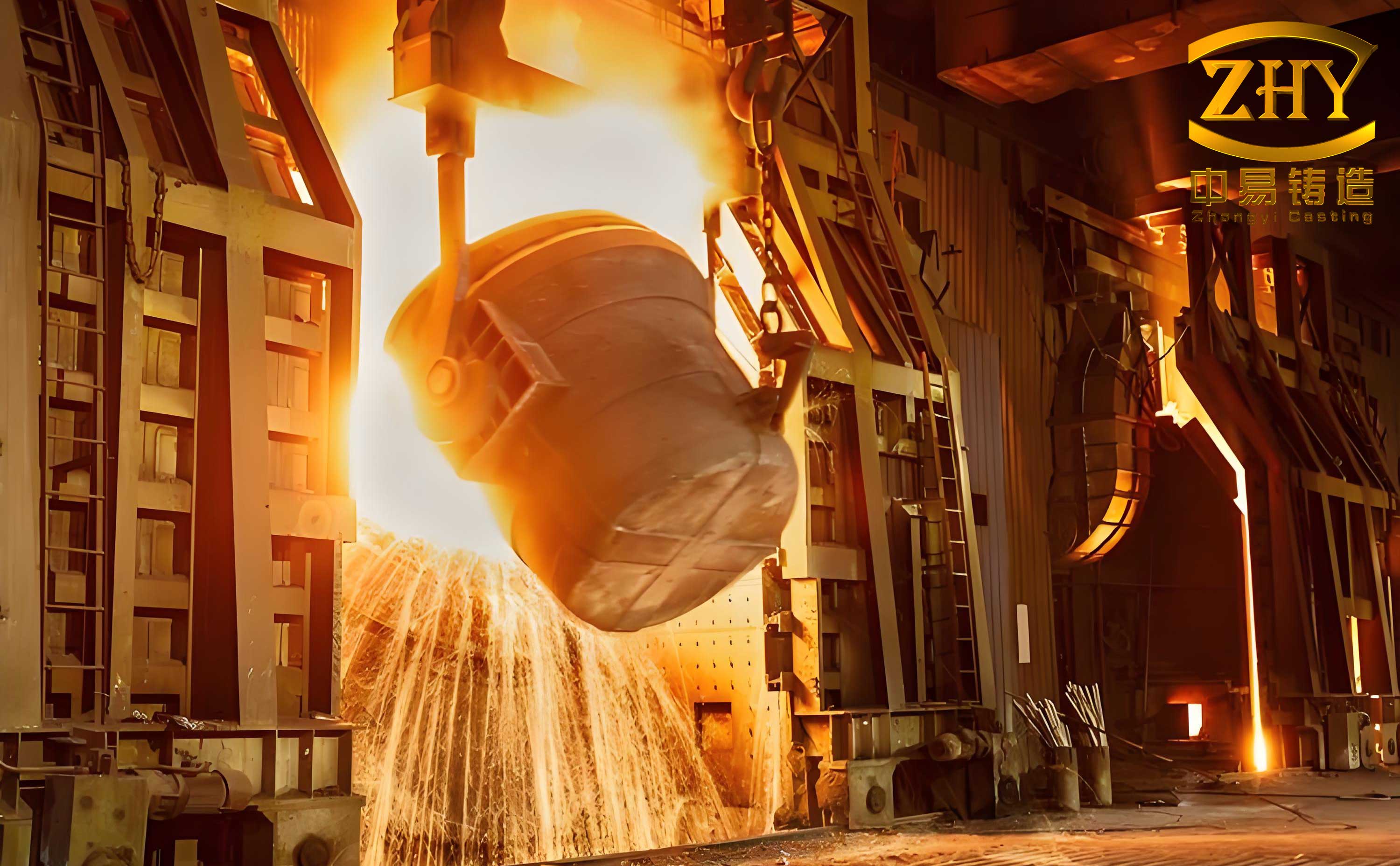
To overcome this persistent issue, a shift towards a chemically neutral molding aggregate was imperative. Our focus turned to forsterite sand (also known as olivine sand). Forsterite sand is a solid-solution mineral composed primarily of magnesium silicate (Mg₂SiO₄, forsterite) and iron silicate (Fe₂SiO₄, fayalite). Its chemical neutrality is its paramount advantage for a manganese steel casting foundry. Unlike silica sand, it contains no free silica (SiO₂) to react with the basic oxides in the manganese steel melt. Its key properties are summarized below.
| Chemical Component | Content (wt.%) | Role/Property |
|---|---|---|
| MgO | 45 – 49 | Primary constituent, provides basicity. |
| SiO₂ | 40 – 43 | Bound in the forsterite structure, non-reactive. |
| Fe₂O₃ | 7 – 9 | Present as fayalite; affects refractoriness. |
| Al₂O₃, CaO, etc. | < 2 | Minor impurities. |
The refractory performance is directly related to its mineralogical composition. Pure forsterite (Mg₂SiO₄) has a melting point around 1890°C. However, natural forsterite sand contains fayalite (Fe₂SiO₄), which forms a solid solution, lowering the practical refractory point. The liquidus temperature (T_l) of the forsterite-fayalite solid solution can be estimated based on the composition, but generally, commercial forsterite sands for foundry use exhibit a consistent refractoriness above 1700°C, which is more than sufficient for the pouring temperatures of manganese steel, typically around 1450-1500°C. Furthermore, it exhibits low and linear thermal expansion without the disruptive phase transformations associated with silica (e.g., the α- to β-quartz transition at 573°C), significantly reducing risks of veining or rat-tail defects. Its chemical stability prevents the formation of low-melting reaction products, thereby fundamentally eliminating the root cause of chemical burn-on in a manganese steel casting foundry.
The transition required systematic experimentation to develop a robust sand formulation and application practice. We sourced forsterite sand with an AFS Grain Fineness Number (GFN) of approximately 50-55, corresponding to a grain size distribution similar to 50/70 mesh. Calcium bentonite was used as the primary binder. Initial trials focused on determining the optimal binder content to achieve adequate green strength without compromising permeability and knock-out properties.
| Mix No. | Formulation (parts by weight) | Mulling Time (min) | Green Compression Strength (kPa) | Green Permeability | Moisture Content (%) |
|---|---|---|---|---|---|
| 1 | Forsterite Sand: 100, Bentonite: 8, Water: 3.5 | 8 | 70 – 80 | 90 – 110 | 3.2 – 3.8 |
| 2 | Forsterite Sand: 100, Bentonite: 6, Water: 3.0 | 8 | 50 – 60 | 110 – 130 | 2.8 – 3.3 |
| 3 | Forsterite Sand: 100, Bentonite: 4, Water: 2.5 | 8 | 30 – 40 | 130 – 150 | 2.4 – 2.9 |
These mixes were used as facing sand (approximately 20-30 mm thick) for different casting types in the manganese steel casting foundry: smaller liner plates (weight ~15 kg, section thickness ~50 mm) and larger扇形 end liners (weight ~80 kg, section thickness ~100 mm). The backing sand remained conventional clay-bonded silica sand. The molds were coated with a refractory wash, initially a water-based magnesite coating, later also trialed with forsterite-based coatings. Melting was conducted in a basic-lined electric arc furnace, and pouring temperature was controlled at approximately 1450°C.
The results were immediately and remarkably different from previous experience with silica sand. Upon shakeout, all castings showed dramatically improved surface finish. The sand mold facing separated cleanly. The casting surface was covered with a thin, dark, and friable layer that spalled off easily during cooling or with minimal mechanical vibration, revealing an underlying surface that was smooth and precise, akin to the quality often associated with investment casting. Crucially, the used forsterite sand facing was not vitrified or sintered; it retained its granular structure, albeit coated with a dark glaze, indicating its potential for reclamation and reuse. Observations from the initial mixes were instructive: Mix 1 (8% bentonite) sometimes led to slightly harder knock-out, Mix 2 (6%) provided an excellent balance of easy cleaning and surface finish, while Mix 3 (4%) occasionally showed minor mold wall instability (scabbing) though the cast surface remained clean.
Based on this analysis, a standardized and optimized formulation was developed for full-scale production in the manganese steel casting foundry. Recognizing that forsterite sand has a higher specific gravity (~3.2 g/cm³) than silica sand (~2.6 g/cm³), adjustments to water and binder requirements were necessary. The final production-ready mix specification is:
Optimized Production Mix: Forsterite Sand: 100 parts; Calcium Bentonite: 5.0 – 5.5 parts; Water: 2.8 – 3.2 parts; Additive (Sodium Carbonate, Na₂CO₃ for activation): 0.3 – 0.5 parts. Mulling time: 8-10 minutes.
The addition of sodium carbonate (Na₂CO₃) serves to activate the calcium bentonite, exchanging Ca²⁺ ions with Na⁺ ions to enhance the clay’s swelling capacity and wet tensile strength, which can be represented conceptually by the ion-exchange reaction:
$$ \text{Clay-Ca} + 2\text{Na}_2\text{CO}_3 \rightarrow \text{Clay-(Na)}_2 + \text{CaCO}_3 \downarrow $$
This modification improved the durability of the mold surface, eliminating the scabbing issues observed with low-binder mixes, while maintaining excellent permeability and knock-out characteristics. The controlled moisture content is critical; excessive water leads to poor strength and dense steam generation, while insufficient water fails to develop adequate bond strength.
The implementation of this optimized forsterite sand system across the manganese steel casting foundry’s product range—including various liner plates, lifter bars, and other wear parts—has been a resounding success. The rejection rate due to surface burn-on has been reduced to nearly zero, specifically to less than 1%. The economic and operational benefits are substantial and multi-faceted.
First, the dramatic improvement in casting quality and yield is the most direct benefit. Second, significant cost savings are achieved through optimized sand usage. We established that a facing sand thickness of 20-25 mm is generally sufficient for most castings to ensure perfect surface quality. For heavy sections, strategic use of chills is more effective than arbitrarily increasing sand thickness. Only complex corners or undercuts require a slightly thicker application. This practice conserves the more expensive forsterite sand. Furthermore, core sands for bolt holes in liner plates can also be successfully produced using a slightly richer forsterite sand mix (e.g., 6-7% bentonite) to ensure core strength and clean interior surfaces.
Third, the potential for sand reclamation presents another avenue for cost reduction. Unlike silica sand, which becomes heavily sintered and vitrified after contact with manganese steel, forsterite sand remains granular. Although the “glazed” used sand may not be suitable for direct reuse as high-quality facing sand without processing, it can be effectively crushed, screened, and reintroduced into the system as backing sand or after proper reconditioning. This reduces new sand consumption and associated disposal costs. Moreover, the absence of free silica eliminates the risk of silicosis, contributing to a healthier and more environmentally compliant foundry operation—a critical consideration for any modern manganese steel casting foundry.
Fourth, complementary material savings were identified. The refractory coating can be formulated using forsterite flour instead of magnesite. While both are effective in creating a barrier, forsterite-based coatings offer excellent compatibility with the forsterite sand mold, potentially better sintering behavior, and can be more cost-effective. Although alcohol-based (quick-drying) coatings provided a marginally superior finish for very heavy castings, water-based forsterite coatings proved entirely satisfactory for the vast majority of applications at roughly half the cost, representing the optimal economic choice for the manganese steel casting foundry.
In conclusion, the adoption of forsterite sand as the primary molding aggregate for manganese steel castings represents a fundamental and highly effective solution to the pervasive problem of chemical burn-on. Its chemical neutrality halts the deleterious reaction between the basic steel melt and acidic mold materials. Through systematic formulation development focusing on binder level, moisture control, and clay activation, we established a robust sand system that delivers exceptional as-cast surface finish, dimensional accuracy, and high yield. The technical success is matched by tangible economic benefits: drastic reduction in scrap, optimized material usage, potential for sand reclamation, improved workplace safety, and lower overall production costs. For any manganese steel casting foundry struggling with surface quality issues, the transition to forsterite sand is not merely an option but a definitive strategic upgrade towards reliable, high-quality, and cost-efficient production.