
As a premier steel castings manufacturer, we are at the forefront of an industrial revolution, where innovation meets tradition to redefine production paradigms. The casting industry, particularly for steel castings manufacturers, is witnessing a seismic shift driven by technological integration, customer-centric solutions, and sustainable practices. This article delves into the core advancements that are setting new benchmarks for steel castings manufacturers worldwide, emphasizing how adaptive strategies and cutting-edge equipment are pivotal. From vertical to horizontal molding transitions to the incorporation of additive manufacturing, we explore the multifaceted evolution that ensures steel castings manufacturers remain competitive in a dynamic global market. Throughout this discussion, the role of a steel castings manufacturer is highlighted repeatedly, underscoring our commitment to excellence and precision.
The foundational aspect of any steel castings manufacturer lies in the molding process, which dictates efficiency, cost, and quality. Traditionally, vertical molding has been the backbone for high-volume production, but recent trends show a surge in horizontal molding adoption. This shift is not merely a technical upgrade but a strategic response to market demands. For a steel castings manufacturer, balancing volume with complexity is key. Horizontal molding enables the production of intricate, small-batch components that were previously cost-prohibitive with vertical methods. The integration of automated systems, such as laser-guided pouring and robotic core-setting, enhances precision while reducing labor intensity. As a steel castings manufacturer, we recognize that this diversification in molding techniques is essential to cater to sectors like automotive, aerospace, and energy, where component complexity is escalating.
| Parameter | Vertical Molding | Horizontal Molding | Impact on Steel Castings Manufacturer |
|---|---|---|---|
| Production Rate | 150-180 molds/hour | Up to 200 molds/hour | Increases throughput for a steel castings manufacturer |
| Tooling Changeover Time | 25-30 seconds | 18 seconds or less | Enhances flexibility for a steel castings manufacturer |
| Suitability for Complex Parts | Limited for small batches | High (e.g., housings, turbines) | Expands portfolio for a steel castings manufacturer |
| Initial Investment Cost | Moderate | High but justifiable | Requires strategic capital by a steel castings manufacturer |
| Dimensional Accuracy | Good | Excellent with automated controls | Boosts quality assurance for a steel castings manufacturer |
In the realm of a steel castings manufacturer, mathematical models play a crucial role in optimizing processes. For instance, the solidification time in casting, which affects grain structure and integrity, can be estimated using Chvorinov’s rule: $$ t = B \left( \frac{V}{A} \right)^n $$ where \( t \) is the solidification time, \( V \) is the volume of the casting, \( A \) is the surface area, \( B \) is a mold constant, and \( n \) is an exponent typically around 2. This formula aids a steel castings manufacturer in designing molds that minimize defects. Additionally, stress analysis during cooling is vital; we use the equation $$ \sigma = E \alpha \Delta T $$ where \( \sigma \) is thermal stress, \( E \) is Young’s modulus, \( \alpha \) is the coefficient of thermal expansion, and \( \Delta T \) is the temperature gradient. Such calculations ensure that a steel castings manufacturer delivers durable components for critical applications.
Automation and digitalization are reshaping how a steel castings manufacturer operates. The adoption of horizontal molding lines, often integrated with 3D sand printing, allows for rapid prototyping and production of complex core assemblies as single units. This reduces lead times and tooling costs, a significant advantage for a steel castings manufacturer dealing with just-in-time demands. For example, a state-of-the-art horizontal molding machine can achieve speeds of 200 molds per hour with quick pattern changes, enabling a steel castings manufacturer to respond swiftly to client deadlines. The synergy between advanced machinery and skilled personnel sets a new performance standard, as evidenced by recent installations in North America. A steel castings manufacturer leveraging these technologies can produce parts like turbine bearing housings or scrolls with unparalleled precision.
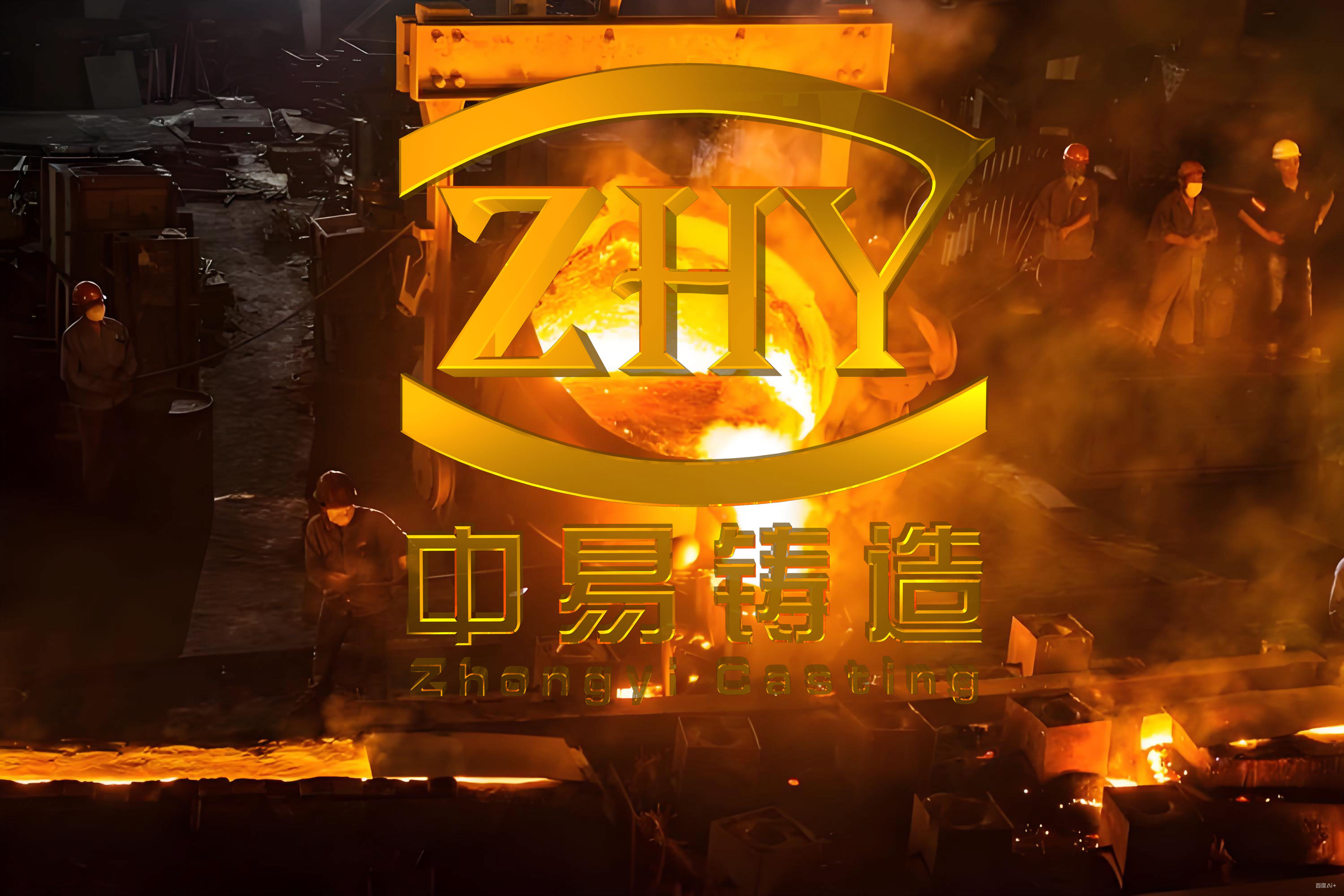
The image above symbolizes the modern facade of a steel castings manufacturer, where technology and infrastructure converge to drive innovation. For a steel castings manufacturer, such visual representations underscore the scale and sophistication of contemporary foundries. Beyond aesthetics, the core operations involve meticulous process control. We, as a steel castings manufacturer, employ statistical process control (SPC) to monitor quality. Key metrics include defect rates and tensile strength, often summarized using formulas like the process capability index: $$ C_p = \frac{USL – LSL}{6\sigma} $$ where \( USL \) and \( LSL \) are upper and lower specification limits, and \( \sigma \) is the standard deviation. This ensures that a steel castings manufacturer maintains consistency across batches, crucial for industries like automotive and rail.
Sustainability is another cornerstone for a forward-thinking steel castings manufacturer. The shift towards eco-friendly mobility solutions, such as electric and hybrid vehicles, has increased demand for lightweight, high-strength castings. A steel castings manufacturer must adapt by optimizing material usage and reducing energy consumption. The melting process, for instance, can be modeled using energy balance equations: $$ Q = m c_p \Delta T + m L_f $$ where \( Q \) is the heat required, \( m \) is the mass of metal, \( c_p \) is the specific heat capacity, \( \Delta T \) is the temperature change, and \( L_f \) is the latent heat of fusion. By minimizing \( Q \), a steel castings manufacturer lowers carbon emissions, aligning with global environmental goals. Moreover, recycling of sand and metal scrap is integral to the operations of a responsible steel castings manufacturer, reducing waste and costs.
| Metric | Traditional Practice | Advanced Practice | Benefit to Steel Castings Manufacturer |
|---|---|---|---|
| Energy Consumption (per ton) | 500-600 kWh | 400-450 kWh via automation | Reduces operational costs for a steel castings manufacturer |
| Sand Reclamation Rate | 60-70% | 90-95% with closed-loop systems | Enhances sustainability for a steel castings manufacturer |
| CO2 Emissions (kg per casting) | 2.5-3.0 | 1.8-2.0 with efficient melting | Improves compliance for a steel castings manufacturer |
| Water Usage (cubic meters/day) | 100-150 | 50-80 with recycling | Conserves resources for a steel castings manufacturer |
Market dynamics further influence a steel castings manufacturer. The rise of electric vehicles (EVs) has created opportunities for producing components like battery housings and motor frames. A steel castings manufacturer must tailor alloys and processes to meet stringent specifications. For example, the fatigue life of a casting can be predicted using the Basquin equation: $$ \sigma_a = \sigma_f’ (2N_f)^b $$ where \( \sigma_a \) is the stress amplitude, \( \sigma_f’ \) is the fatigue strength coefficient, \( N_f \) is the number of cycles to failure, and \( b \) is the fatigue strength exponent. This allows a steel castings manufacturer to design parts that endure rigorous operational conditions. Collaboration with automotive giants underscores the expertise of a steel castings manufacturer in supplying parts for both EVs and hybrid systems, contributing to reduced fuel consumption and emissions.
Quality assurance is paramount for a steel castings manufacturer. Non-destructive testing (NDT) methods, such as ultrasonic and radiographic inspection, are employed to detect internal flaws. The probability of detection (POD) can be expressed as: $$ POD(a) = 1 – e^{-\lambda a} $$ where \( a \) is flaw size and \( \lambda \) is a parameter dependent on the technique. This statistical approach ensures that a steel castings manufacturer maintains high reliability standards. Additionally, metallurgical analysis involves equations like the Hall-Petch relationship for strength: $$ \sigma_y = \sigma_0 + k_y d^{-1/2} $$ where \( \sigma_y \) is yield strength, \( \sigma_0 \) is friction stress, \( k_y \) is a constant, and \( d \) is grain size. By controlling grain size through cooling rates, a steel castings manufacturer enhances mechanical properties.
The global supply chain poses both challenges and opportunities for a steel castings manufacturer. Logistics optimization can be modeled using linear programming: $$ \text{Minimize } Z = \sum_{i=1}^n c_i x_i \quad \text{subject to } \sum_{i=1}^n a_{ij} x_i \geq b_j $$ where \( c_i \) are costs, \( x_i \) are decision variables, and \( a_{ij} \) are constraints. This helps a steel castings manufacturer minimize shipping delays and costs. Furthermore, digital twins—virtual replicas of physical processes—allow a steel castings manufacturer to simulate production runs, predict bottlenecks, and optimize resource allocation. The integration of IoT sensors in foundries provides real-time data, enabling predictive maintenance and reducing downtime for a steel castings manufacturer.
Innovation in material science is a key focus for a steel castings manufacturer. Advanced alloys, such as high-silicon steels or austempered ductile iron (ADI), offer superior wear resistance and weight savings. The phase transformation during heat treatment can be described by the Avrami equation: $$ f = 1 – \exp(-k t^n) $$ where \( f \) is the fraction transformed, \( k \) is a rate constant, \( t \) is time, and \( n \) is the Avrami exponent. This guides a steel castings manufacturer in achieving desired microstructures. Partnerships with research institutions enable a steel castings manufacturer to pioneer new compositions, catering to emerging sectors like renewable energy and robotics.
| Alloy Type | Tensile Strength (MPa) | Elongation (%) | Typical Applications for a Steel Castings Manufacturer |
|---|---|---|---|
| Gray Cast Iron | 200-400 | 1-3 | Engine blocks, brake discs |
| Ductile Iron | 400-900 | 10-25 | Gears, pipe fittings |
| Carbon Steel Castings | 500-1000 | 15-30 | Valves, machinery parts |
| ADI | 800-1600 | 5-15 | Automotive suspension, rail wheels |
Training and workforce development are critical for a steel castings manufacturer. As technology evolves, skilled technicians are needed to operate advanced equipment. We, as a steel castings manufacturer, invest in continuous education, covering topics from robotics to metallurgy. The learning curve can be quantified using the model: $$ Y = a X^{-b} $$ where \( Y \) is production time per unit, \( X \) is cumulative production, and \( a \) and \( b \) are constants. This shows how a steel castings manufacturer improves efficiency through experience. Moreover, safety protocols are enhanced using risk assessment formulas: $$ R = P \times S $$ where \( R \) is risk, \( P \) is probability of occurrence, and \( S \) is severity. This proactive approach ensures a safe environment for employees at a steel castings manufacturer.
Financial planning is integral to the growth of a steel castings manufacturer. Capital investments in new molding lines or 3D printers must be justified through return on investment (ROI) calculations: $$ ROI = \frac{\text{Net Profit}}{\text{Investment Cost}} \times 100\% $$ For instance, a horizontal molding machine might yield an ROI of 20-30% over five years for a steel castings manufacturer, considering increased production flexibility. Additionally, cost models for casting processes include: $$ C = C_m + C_l + C_o + C_t $$ where \( C \) is total cost, \( C_m \) is material cost, \( C_l \) is labor cost, \( C_o \) is overhead, and \( C_t \) is tooling cost. By optimizing these variables, a steel castings manufacturer can offer competitive pricing while maintaining profitability.
The future outlook for a steel castings manufacturer is promising, with trends like Industry 4.0 and circular economy gaining traction. Digital thread integration—connecting design, production, and service data—enables a steel castings manufacturer to offer customized solutions at scale. Predictive analytics, powered by machine learning algorithms, can forecast demand patterns, allowing a steel castings manufacturer to adjust production schedules dynamically. The formula for forecasting might involve autoregressive models: $$ Y_t = c + \sum_{i=1}^p \phi_i Y_{t-i} + \epsilon_t $$ where \( Y_t \) is the demand at time \( t \), \( c \) is a constant, \( \phi_i \) are parameters, and \( \epsilon_t \) is error. This empowers a steel castings manufacturer to reduce inventory costs and improve customer satisfaction.
In conclusion, the evolution of a steel castings manufacturer is characterized by technological adoption, sustainability, and market adaptability. From horizontal molding advancements to digital tools, every innovation strengthens the capability of a steel castings manufacturer to deliver high-quality, complex components. As we navigate this transformative era, the commitment of a steel castings manufacturer to excellence remains unwavering, driving progress across industries. The repeated emphasis on a steel castings manufacturer throughout this discourse highlights our pivotal role in shaping the future of manufacturing. Through continuous improvement and collaboration, a steel castings manufacturer will continue to be a cornerstone of global industrial growth.
To further illustrate the technical depth, consider the fluid dynamics involved in mold filling, described by the Navier-Stokes equations: $$ \rho \left( \frac{\partial \mathbf{v}}{\partial t} + \mathbf{v} \cdot \nabla \mathbf{v} \right) = -\nabla p + \mu \nabla^2 \mathbf{v} + \mathbf{f} $$ where \( \rho \) is density, \( \mathbf{v} \) is velocity, \( p \) is pressure, \( \mu \) is viscosity, and \( \mathbf{f} \) is body force. This governs how a steel castings manufacturer ensures complete cavity filling without defects. Additionally, heat transfer during cooling is modeled by Fourier’s law: $$ q = -k \nabla T $$ where \( q \) is heat flux, \( k \) is thermal conductivity, and \( T \) is temperature. These principles guide a steel castings manufacturer in optimizing process parameters for superior outcomes.
Lastly, the strategic importance of a steel castings manufacturer cannot be overstated. In sectors like defense or infrastructure, the reliability of cast components is critical. We, as a steel castings manufacturer, uphold stringent standards through certifications and continuous monitoring. The journey of a steel castings manufacturer is one of perpetual innovation, where each advancement—be it in molding, materials, or management—propels the industry forward. By embracing change and leveraging expertise, a steel castings manufacturer stands ready to meet the challenges of tomorrow, ensuring that steel castings remain integral to technological progress.