
In industrial applications involving high-temperature and high-pressure environments, such as steam turbines, the integrity of cast components is paramount. G17CrMoV5-10 steel is a critical material for such demanding service conditions due to its excellent thermal strength at elevated temperatures. However, casting defects are inevitable, necessitating repair via welding. The post-weld heat treatment (PWHT) process plays a decisive role in determining the final mechanical properties of the repaired zone. Incorrect heat treatment can lead to significant heat treatment defects, such as inadequate hardness or undesirable microstructures, compromising component performance and safety. This study investigates the effects of two common PWHT methods—stress relief and full quenching and tempering—on the hardness and microstructure of weld-deposited metal on G17CrMoV5-10 substrates, focusing on identifying conditions that avoid heat treatment defects.
The base material used in this investigation was G17CrMoV5-10 cast steel, with its nominal composition provided in Table 1. For weld repair, a low-carbon, low-alloy electrode, FOX DCMV, was selected based on an “equal-strength matching” principle. Its chemical composition is also detailed in Table 1. The intentional reduction in carbon content in the filler metal compared to the base metal is a key variable influencing the response to heat treatment.
| Element | Base Metal (G17CrMoV5-10) | Deposited Metal (FOX DCMV) |
|---|---|---|
| C | 0.19 | 0.08 |
| Si | 0.48 | 0.28 |
| Mn | 0.81 | 0.80 |
| P | 0.015 | 0.006 |
| S | 0.002 | 0.004 |
| Cr | 1.44 | 1.30 |
| Mo | 0.99 | 1.18 |
| V | 0.22 | 0.23 |
The welding procedure involved Shielded Metal Arc Welding (SMAW) using a 5.0 mm diameter electrode. A preheating temperature of 250°C was maintained, and interpass temperature was controlled not to exceed 350°C. The key welding parameters are summarized in Table 2. After depositing a 30 mm thick weld layer on a prepared G17CrMoV5-10 block, the specimen was sectioned into two parts for separate heat treatment cycles.
| Parameter | Value/Specification |
|---|---|
| Welding Method | Shielded Metal Arc Welding (SMAW) |
| Polarity | Direct Current Electrode Positive (DCEP) |
| Electrode Diameter | 5.0 mm |
| Current | 130 – 180 A |
| Voltage | 22 – 26 V |
The first specimen (Specimen 1) underwent a post-weld stress relief heat treatment at 690°C for 12 hours, followed by furnace cooling. This temperature is typically at least 10°C below the original tempering temperature of the base metal to minimize over-tempering. The second specimen (Specimen 2) was subjected to a full re-austentization and quenching and tempering cycle: austenitizing at 950°C followed by oil quenching, and then tempering at 700°C with furnace cooling. The热处理 schedules are concise but critical; deviations can directly induce heat treatment defects.
Hardness was measured using a Vickers hardness tester (HVS-5 type) with a 5 kgf load (HV5). The hardness value is derived from the applied load (F) and the surface area of the indentation (A). The relationship is given by:
$$HV = \frac{F}{A} \approx \frac{1.8544 \cdot F}{d^2}$$
where \(d\) is the mean diagonal length of the indentation in millimeters. Microstructural analysis was performed using optical microscopy.
The results for Specimen 1 after the 690°C stress relief are presented in Table 3. Both the base metal and the weld metal exhibited hardness values within the acceptable range specified by relevant standards. The microstructure of the base metal consisted of tempered bainite, while the weld metal showed tempered bainite with a small amount of ferrite. The slightly lower hardness in the weld metal can be attributed to its lower carbon content and the specific thermal cycle of welding and subsequent stress relief. The formation of ferrite is often linked to localized variations in cooling rates within the weld pool and the cyclic thermal input during multi-pass welding. This condition does not represent a critical heat treatment defect as the properties remain within specification.
| Region | Hardness (HV5) | Predominant Microstructure |
|---|---|---|
| Base Metal | 219, 220, 208 (Avg. ~216) | Tempered Bainite |
| Weld Metal (Deposited Metal) | 209, 191, 210 (Avg. ~203) | Tempered Bainite + Minor Ferrite |
In contrast, the results for Specimen 2 after the full quenching and tempering treatment revealed a significant issue. As shown in Table 4, while the base metal hardness recovered to meet the standard requirements, the hardness of the weld metal fell below the specified minimum. This constitutes a clear heat treatment defect, where the repaired zone becomes the weak link in the component. The microstructures of both regions were primarily bainitic after tempering.
| Region | Hardness (HV5) | Predominant Microstructure |
|---|---|---|
| Base Metal | 202, 202, 190 (Avg. ~198) | Tempered Bainite |
| Weld Metal (Deposited Metal) | 174, 172, 166 (Avg. ~171) | Tempered Bainite |
The core reason for this heat treatment defect lies in the compositional difference, primarily the lower carbon content in the weld metal (0.08 wt.% vs. 0.19 wt.% in the base metal). During the quenching and tempering process, hardness and strength are largely governed by the martensitic or bainitic transformation and the subsequent precipitation of fine carbides during tempering. The strength contribution from solid solution strengthening and precipitation hardening can be approximated for low-alloy steels. The yield strength (\(\sigma_y\)) can be expressed as a sum of various strengthening mechanisms:
$$\sigma_y = \sigma_0 + \sigma_{ss} + \sigma_{ppt} + \sigma_{disl} + k_y \cdot d^{-1/2}$$
where \(\sigma_0\) is the lattice friction stress, \(\sigma_{ss}\) is solid solution strengthening, \(\sigma_{ppt}\) is precipitation hardening, \(\sigma_{disl}\) is dislocation strengthening, and the last term represents grain boundary strengthening (Hall-Petch relationship) with \(d\) as the grain diameter and \(k_y\) a material constant.
For the weld metal, the lower carbon content drastically reduces the potential for carbide formation during tempering (\(\sigma_{ppt}\)). Carbon is a potent solid solution strengthener in ferrite, so lower carbon also decreases \(\sigma_{ss}\). Furthermore, during the bainitic transformation, which likely occurred during continuous cooling after austenitizing, the transformation kinetics and resulting microstructure are sensitive to carbon. The bainite start temperature (\(B_s\)) can be empirically estimated for low-alloy steels. One common formula is:
$$B_s (°C) \approx 830 – 270(\%C) – 90(\%Mn) – 37(\%Ni) – 70(\%Cr) – 83(\%Mo)$$
While not perfectly accurate for all alloys, it illustrates that lower carbon raises \(B_s\). A higher \(B_s\) means the transformation occurs at a higher temperature, leading to a coarser bainitic structure with lower dislocation density and less supersaturation of carbon in ferrite, thereby reducing \(\sigma_{disl}\) and overall strength. This directly links the compositional mismatch to the observed heat treatment defect of insufficient hardness after quenching and tempering.
The phenomenon of hardness drop in the weld zone after re-austentization is a classic example of a heat treatment defect arising from improper procedure selection for dissimilar material combinations. To quantify the tempering response, the tempering parameter (\(P\)) can be used, often expressed as the Hollomon-Jaffe parameter:
$$P = T \cdot (\log t + C)$$
where \(T\) is the absolute temperature in Kelvin, \(t\) is time in hours, and \(C\) is a constant (often around 20 for many steels). For a given \(P\) value, a steel with lower carbon and alloy content will generally exhibit a greater softening effect. This explains why the weld metal softened more than the base metal during the 700°C tempering cycle.
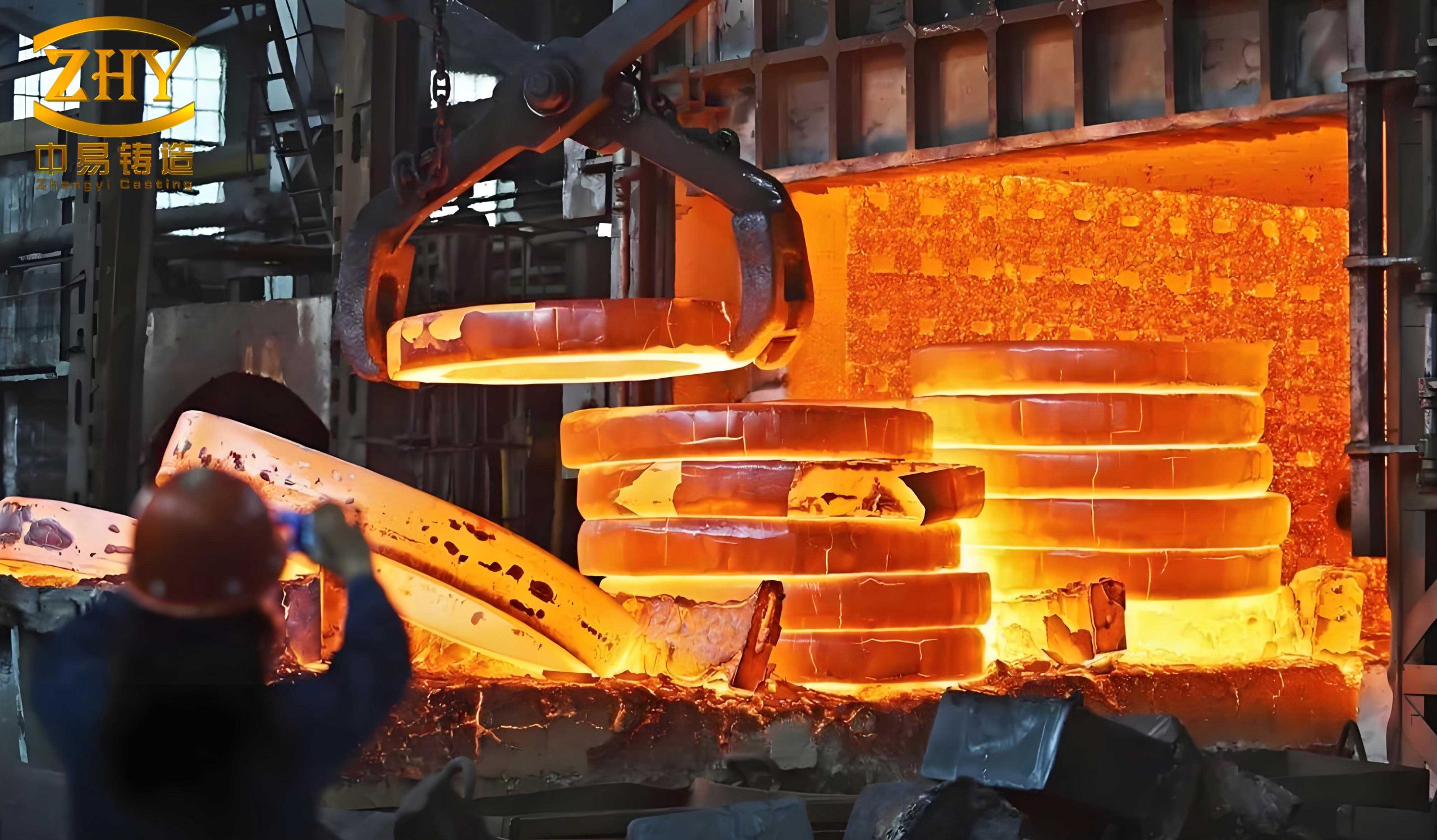
Visual evidence of such mismatches often reveals microstructural anomalies. The image above illustrates potential manifestations of heat treatment defects, such as soft zones, which can be analogous to the low-hardness weld metal region observed in this study. Preventing these heat treatment defects requires a holistic approach to procedure specification.
To further generalize the findings, Table 5 compares the key factors influencing the final hardness under the two PWHT regimes. This highlights the critical interaction between material composition and heat treatment cycle.
| Factor | Stress Relief at 690°C | Full Quenching & Tempering |
|---|---|---|
| Primary Metallurgical Process | Tempering/Recovery, Stress Relaxation | Re-austentization, Phase Transformation, Tempering |
| Key Driver for Hardness | Initial As-welded microstructure, minimal phase change. | Hardenability (CCT behavior), Carbide precipitation. |
| Sensitivity to Carbon Content | Moderate (affects tempering resistance). | Very High (directly controls transformation hardening). |
| Risk of Heat Treatment Defect | Low if temperature is well-controlled below Ac1. | High if filler metal composition mismatches base metal hardenability. |
| Typical Application | Dimensional stability, residual stress reduction. | Restoration of full mechanical properties in the heat-affected zone and weld. |
The formation of ferrite in the stress-relieved weld metal, while not detrimental in this specific case, can be a precursor to other heat treatment defects under different conditions. Ferrite, being softer and having different corrosion and creep properties than bainite/martensite, could lead to localized weakness. The volume fraction of ferrite (\(V_f\)) can be estimated using thermodynamic models or empirical diagrams like the Schaeffler diagram for weld metals, though it’s more applicable to stainless steels. For low-alloy steels, the cooling time between 800°C and 500°C (\(\Delta t_{8/5}\)) is crucial. A simplified relationship for the start of pro-eutectoid ferrite formation can be linked to the critical cooling rate. Avoiding excessive ferrite requires controlling the thermal cycle, which is part of managing heat treatment defects in welded structures.
In practice, selecting the correct post-weld heat treatment is essential to avoid costly heat treatment defects. For repair welding of G17CrMoV5-10 castings with the FOX DCMV electrode, the study conclusively shows that only a sub-critical stress relief treatment is appropriate. A full re-quenching and tempering cycle, while beneficial for the base metal, induces a severe heat treatment defect in the weld metal due to its lower hardenability. This principle can be extended to other material pairs. Engineers must evaluate the hardenability match using calculated parameters like the ideal critical diameter (\(D_I\)) or carbon equivalent (CE) formulas. A common carbon equivalent formula for hardenability is:
$$CE = C + \frac{Mn}{6} + \frac{Cr+Mo+V}{5} + \frac{Ni+Cu}{15}$$
If the CE of the weld metal is significantly lower than that of the base metal, a full re-austentization heat treatment will likely result in a heat treatment defect characterized by a soft heat-affected zone or weld metal.
To model the tempering kinetics and predict hardness loss, the following generalized equation can be applied, illustrating the time-temperature dependence of softening:
$$H = H_0 \cdot \exp(-k \cdot P^m)$$
where \(H\) is the hardness after tempering, \(H_0\) is the initial as-quenched hardness, \(k\) and \(m\) are material-dependent constants, and \(P\) is the tempering parameter defined earlier. For the weld metal with lower \(H_0\) (due to lower carbon), the final hardness \(H\) after a given tempering cycle will be lower, quantitatively explaining the heat treatment defect.
In conclusion, this investigation underscores the profound influence of post-weld heat treatment selection on the performance of repaired high-temperature cast components. The mismatch in chemical composition, particularly carbon content, between the base metal G17CrMoV5-10 and the FOX DCMV weld metal dictates that only stress relief heat treatment is suitable. Any attempt to apply a full quenching and tempering cycle will inevitably lead to a heat treatment defect manifesting as unacceptable low hardness in the deposited metal. This work highlights the necessity of integrated material and process design to prevent such heat treatment defects, ensuring the long-term reliability and safety of critical industrial equipment. Future work could involve developing optimized filler metal compositions or graded heat treatment procedures to enable more flexible repair strategies without introducing these detrimental heat treatment defects.