
The pursuit of superior metallurgical quality in cast components is a perpetual endeavor in foundry engineering. Among the various techniques explored, the application of vibration during solidification has long held promise. Historical studies, predominantly focused on non-ferrous alloys like aluminum cast within permanent molds, have demonstrated benefits such as the refinement of columnar zones, promotion of equiaxed growth, enhanced chemical homogeneity, reduced hot tearing tendency, and consequently, improved density and mechanical properties. However, the practical adoption of these methods, often reliant on complex systems like alternating magnetic fields or electromagnetic shakers within rigid mold environments, has been limited. This study investigates the effects of a more industrially accessible method—low-frequency mechanical vibration—on the solidification structure of iron-carbon alloys under the ubiquitous condition of ordinary green sand molding. The objective is to elucidate the potential for microstructural improvement in common ferrous sand castings through a simple and potentially scalable process.
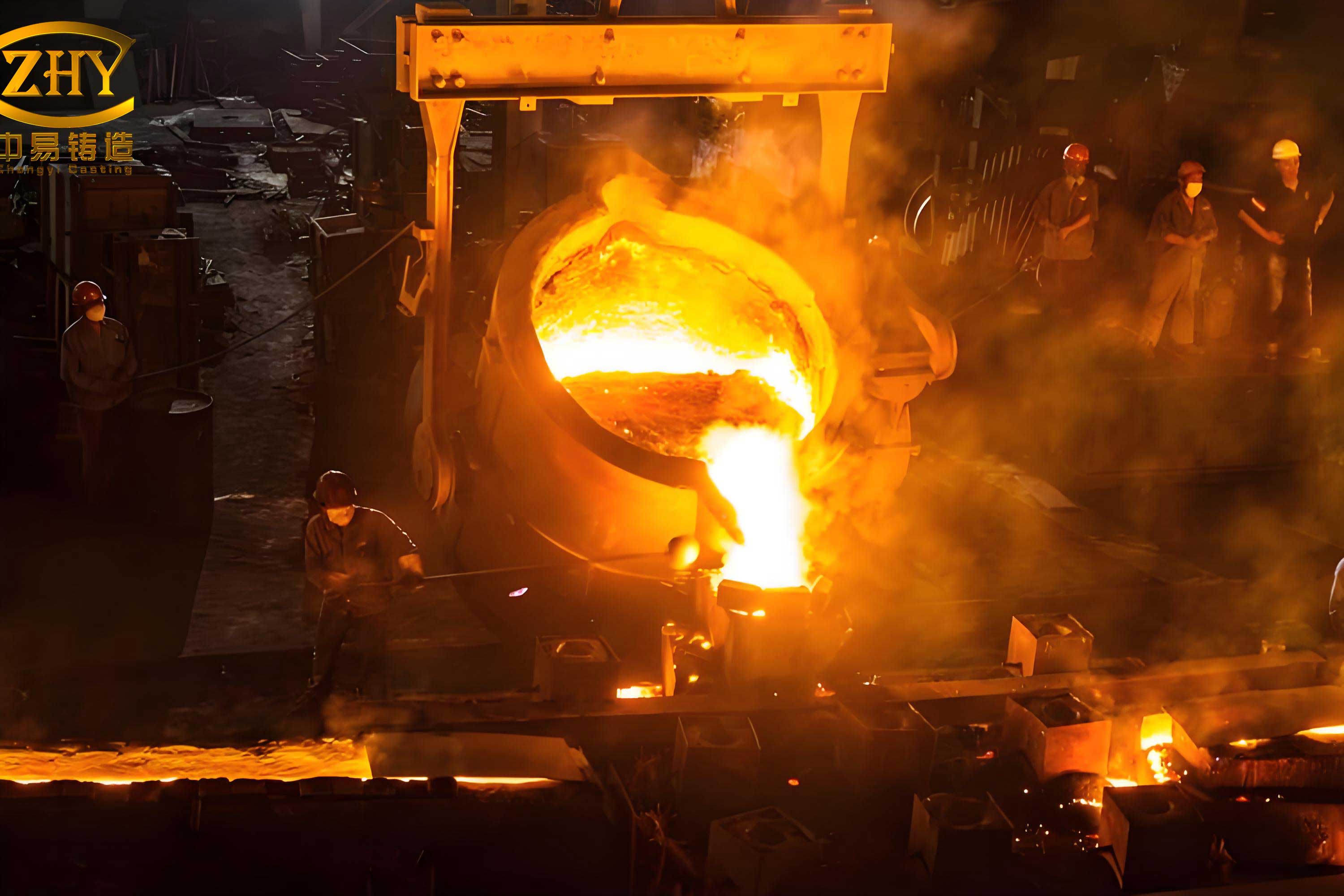
The experiments were conducted using two representative Fe-C alloys: a hypoeutectic gray iron and a medium-carbon steel. Melting was carried out in a medium-frequency induction furnace. For the gray iron, the pouring temperature was maintained at 1300°C into conventional green sand castings molds. The steel was poured at 1550°C into sodium silicate-bonded sand molds. To isolate the vibration effect, each melt was used to produce both vibrated and static (non-vibrated) reference specimens. The vibration setup consisted of a standard pneumatic vibrating table operating at a frequency of 50 Hz and an amplitude of 0.5 mm. For the iron specimens, the sand mold was securely fastened to the table, vibration was initiated prior to pouring, and continued until complete solidification. For the steel specimens, vibration commenced immediately after pouring was completed. The test specimens were cylindrical with diameters of φ15 mm, φ30 mm, and φ45 mm for detailed microstructural analysis.
The results revealed profound and consistent changes induced by the vibrational energy input into the solidifying sand castings.
1. Influence on Dendritic Morphology and Grain Refinement
Microstructural examination of the hypoeutectic gray iron showed a stark contrast. The static specimen exhibited the typical coarse, well-developed austenite dendrites with strong directionality, a direct consequence of the thermal gradient inherent in sand castings. In contrast, the vibrated specimen’s microstructure was characterized by a notably refined, almost granular appearance, with no discernible, intact dendritic networks. A similar transformation was observed in the medium-carbon steel. While the static sample showed directional austenitic dendrites, the vibrated sample displayed a matrix of fine, equiaxed grains containing only occasional, fragmented dendritic segments.
This dramatic alteration is attributed to the mechanism of dendrite fragmentation and multiplication. The sustained low-frequency vibration induces severe agitation and forced convection within the molten metal. This creates relative motion, or “slip,” between the liquid and the initially formed solid phases, as well as between the liquid and the mold wall. A shear stress field is established. Any fragile, nascent dendrite arm growing into the liquid is susceptible to being severed by this shearing action. Furthermore, crystal nuclei and fragmented dendrites are carried by the turbulent flow, leading to frequent collisions. These processes continuously disrupt the stable diffusion field necessary for dendritic tip growth and prevent the development of extensive dendritic skeletons. The fragmented dendrites act as potent new nucleation sites, leading to a cascade of grain refinement. The final structure in these ferrous sand castings thus shifts from dendritic to a more granular, equiaxed morphology. This can be conceptually linked to an effective increase in the nucleation rate (N) and a reduction in the crystal growth velocity (V), favoring an equiaxed zone. The grain size (d) can be related to these parameters by a relationship of the form:
$$ d \propto \left( \frac{V}{N} \right)^{1/4} $$
where vibration increases N and may also impede V through fluid shear, thereby significantly reducing d.
2. Modification of Graphite Morphology in Gray Iron
The vibration treatment significantly altered the characteristic graphite morphology in the gray iron sand castings. In static specimens, the graphite appeared as long, coarse, type-A flakes. In vibrated specimens, the graphite flakes were noticeably thinner, shorter, and more numerous. Their distribution was more uniform, and the directional alignment observed in the static samples was markedly weakened. Isolated, chunky graphite nodules were also occasionally present.
This refinement is intrinsically connected to the refinement of the eutectic cells. The graphite in gray iron grows within the austenite-graphite eutectic colony. Vibration promotes a substantial increase in the number of eutectic nucleation sites, resulting in a greater number of smaller eutectic cells. The growth space and available carbon for each graphite flake within a cell are consequently reduced, leading to the observed finer and shorter flakes. The following table summarizes the quantitative effect of vibration on eutectic cell count for different specimen sizes, demonstrating a clear enhancement, particularly pronounced in larger sections typical of industrial sand castings.
| Specimen Diameter (mm) | Eutectic Cell Count (Static) | Eutectic Cell Count (Vibrated) | Increase (%) |
|---|---|---|---|
| 15 | 85 | 112 | ~32 |
| 30 | 48 | 78 | ~63 |
| 45 | 31 | 60 | ~94 |
The appearance of chunky graphite is hypothesized to be related to the possible formation of primary graphite under certain conditions, whose growth is also constrained by the prolific nucleation environment created by vibration.
3. Effects on Solidification Kinetics and Layer Growth
A pivotal finding concerns the impact on solidification dynamics within the sand castings mold. The progression of the solid shell (solidified layer thickness, s) over time (t) was tracked using an interrupted quenching technique on φ30 mm gray iron specimens. The results plotted the growth of the gray iron layer against time.
The static solidification curve followed a trend approximating the parabolic growth law: $$ s = k_s \sqrt{t} $$ where \( k_s \) is the solidification constant for static conditions. Initially, a rapid chill layer formed (~1.2 mm in 10s), followed by a period of slower growth due to the thermal resistance of the growing sand mold interface and reduced temperature gradient.
In stark contrast, the vibrated specimen exhibited a distinct kinetic profile. The initial shell formation was significantly inhibited; the solidified layer was only about 0.7 mm after 15 seconds and 1.5 mm after 45 seconds, lagging behind the static case. This suggests vibration disrupts the stable initial nucleation and attachment of crystals at the mold wall, impeding the early stages of shell formation. However, after this initial delay, the solidification rate accelerated dramatically, eventually overtaking the static specimen. The total solidification time was reduced from approximately 90 seconds (static) to 75 seconds (vibrated), a 17% reduction.
This phenomenon can be interpreted through a dual mechanism: 1) Initial shell growth retardation due to fluid shear detaching crystals from the wall, and 2) Massive internal nucleation enhancement (as seen in microstructures) which catalyzes bulk solidification once a critical undercooling is achieved. The overall solidification time (\( t_f \)) can be conceptually modeled by considering an enhanced effective heat diffusion coefficient (\( D_{\text{eff}} \)) due to convection: $$ D_{\text{eff}} = D + D_{\text{vib}} $$ where D is the thermal diffusivity and \( D_{\text{vib}} \) represents the contribution from vibration-induced fluid flow. The solidification time is inversely related to \( D_{\text{eff}} \): $$ t_f \propto \frac{R^2}{D_{\text{eff}}} $$ where R is a characteristic casting dimension. Vibration increases \( D_{\text{eff}} \), thereby reducing \( t_f \), despite the initial shell delay.
4. Discussion of Underlying Mechanisms and Implications
The cumulative evidence indicates that low-frequency vibration acts as a powerful physical modifier for the solidification of Fe-C alloy sand castings. The primary mechanisms can be summarized as follows:
- Enhanced Heat and Mass Transfer: Agitation improves thermal exchange, potentially reducing local superheating and creating more uniform temperature fields, which can minimize large-scale segregation.
- Promotion of Heterogeneous Nucleation: Vibration likely facilitates the wetting and activation of inherent inoculant particles or mold wall sites, increasing the effective nucleus count (N). This is the fundamental driver for grain and eutectic cell refinement.
- Dendrite Fragmentation: Shear forces from the relative liquid-solid motion fracture growing dendrites. These fragments are transported to hotter regions where they may partially remelt, but often survive to become new, potent growth centers in slightly undercooled liquid, a process central to grain refinement. The criterion for fragmentation can be related to the shear stress (\( \tau \)) exceeding the mechanical strength of the dendritic interface at the solidification temperature.
- Disruption of Diffusion Layers: Forced convection thins the solute boundary layer ahead of the solid-liquid interface, which can modify growth morphologies and suppress detrimental solute pile-up.
The practical implications for producing ferrous sand castings are significant. The transition from coarse, directional dendrites to fine, equiaxed grains typically enhances mechanical properties such as yield strength, toughness, and fatigue resistance according to the Hall-Petch relationship: $$ \sigma_y = \sigma_0 + k_y d^{-1/2} $$ where \( \sigma_y \) is the yield strength, \( \sigma_0 \) and \( k_y \) are material constants, and d is the average grain diameter. Finer graphite in gray iron improves tensile strength, machinability, and reduces stress concentration factors. Furthermore, the more uniform and isotropic structure reduces the risk of anisotropy in properties. The observed shortening of total solidification time can potentially increase production throughput in certain casting applications.
The following table consolidates the key effects observed in this study on Fe-C alloy sand castings:
| Aspect of Solidification | Static Condition | Under Low-Frequency Vibration | Main Consequence |
|---|---|---|---|
| Macrostructure / Grain Morphology | Coarse, columnar/ dendritic | Fine, equiaxed/ granular | Grain refinement, isotropy |
| Gray Iron: Graphite | Long, coarse, oriented flakes | Short, thin, random flakes | Improved mechanical properties |
| Gray Iron: Eutectic Cells | Few, large | Many, small | Microstructural homogeneity |
| Solidification Shell Growth | Parabolic, faster initial chill | Delayed initial growth, faster later stage | Altered thermal history |
| Total Solidification Time | Longer | Shorter | Potential for higher productivity |
In conclusion, this investigation demonstrates that applying low-frequency mechanical vibration during the solidification of iron-carbon alloys in ordinary sand molds—the most common foundry practice—effectively refines the microstructure, modifies graphite morphology, and alters solidification kinetics. The technique promotes an equiaxed, fine-grained structure through mechanisms of dendrite fragmentation and enhanced nucleation. The resultant improvement in the metallurgical quality of sand castings, coupled with the simplicity of the required equipment (a standard vibrating table), presents a compelling case for its further exploration and potential adoption in foundries to enhance the performance of cast iron and steel components without significant changes to existing molding practice. Future work could productively focus on optimizing vibration parameters (frequency, amplitude, duration) for specific alloy grades and casting geometries, and quantitatively correlating the microstructural changes with enhancements in mechanical properties such as tensile strength, impact toughness, and fatigue life.