
In my extensive experience developing automotive powertrains, the design of the transmission housing, or the shell casting, stands as one of the most complex and critical endeavors. It is the foundational component that dictates the performance, reliability, and manufacturability of the entire transmission system. A successful design is not merely a three-dimensional model meeting spatial constraints; it is a holistic solution born from the seamless integration of system functionality, structural integrity, and every facet of the manufacturing process. This article delves into the comprehensive design journey of transmission shell castings, emphasizing the indispensable marriage between engineering design and production工艺.
The Holistic Design and Development Workflow
The genesis of a robust transmission housing lies in a methodical, iterative process. It begins not with CAD software, but with a thorough understanding of constraints and requirements. The workflow I follow can be summarized as a continuous cycle of synthesis, analysis, and validation, as outlined below:
- Boundary Definition & Concept Synthesis: This initial phase involves gathering all external and internal constraints. Key inputs include the mating interface with the engine (bolt pattern, shaft centerlines), the spatial envelope defined by the vehicle’s underbody, and the precise layout of all internal components (gears, shafts, clutches, valves). A preliminary 3D concept of the shell casting is developed to envelop these components, providing necessary clearances and preliminary mounting features.
- Integrated Analysis &工艺 Review: This is the core phase where design and manufacturing dialogues are formalized. The conceptual model undergoes several parallel assessments:
- Topology Optimization: Using Finite Element Analysis (FEA) software, material is strategically removed from non-critical areas to achieve an optimal stiffness-to-weight ratio. The goal is to define the most efficient load paths. The objective function is often to minimize compliance (maximize stiffness) under given loads with a mass constraint:
$$ \text{Minimize: } C(\rho) = \mathbf{U}^T \mathbf{K}(\rho) \mathbf{U} $$
$$ \text{Subject to: } V(\rho) \leq V_{\text{target}}, \quad 0 < \rho_{\min} \leq \rho \leq 1 $$
where $C$ is compliance, $\mathbf{K}$ is the global stiffness matrix, $\mathbf{U}$ is the displacement vector, $\rho$ is the material density design variable, and $V$ is volume. - Strength & Durability Verification: Static and fatigue analyses are performed using simulated loads from gears, shafts, and mounting points. Stress concentrations are identified and mitigated through geometric refinement.
- Manufacturability Analysis (DFM): This is crucial for shell castings. We assess castability—ensuring uniform wall thickness to prevent defects like porosity and shrinkage. We also plan for draft angles, parting lines, and the feasibility of core designs for internal features.
- Machinability Analysis (DFA): Potential machining setups are planned. Critical datum features (primary, secondary, tertiary) are selected to allow for “one-time setup” machining, minimizing cumulative tolerances.
- Assembly Sequence Analysis: The design is checked for ease of assembly, including component insertion paths, bolt accessibility, and sealant application.
- Topology Optimization: Using Finite Element Analysis (FEA) software, material is strategically removed from non-critical areas to achieve an optimal stiffness-to-weight ratio. The goal is to define the most efficient load paths. The objective function is often to minimize compliance (maximize stiffness) under given loads with a mass constraint:
- Prototype & Validation: Based on the analyzed model, a prototype shell casting is produced, often via rapid casting techniques. This physical part undergoes rigorous testing—leak tests, burst pressure tests, and dimensional checks—to validate the digital models.
- Optimization Loop: Test results feed back into the digital model. The design is refined to address any discrepancies, closing the loop and incrementally improving the product until all targets are met.
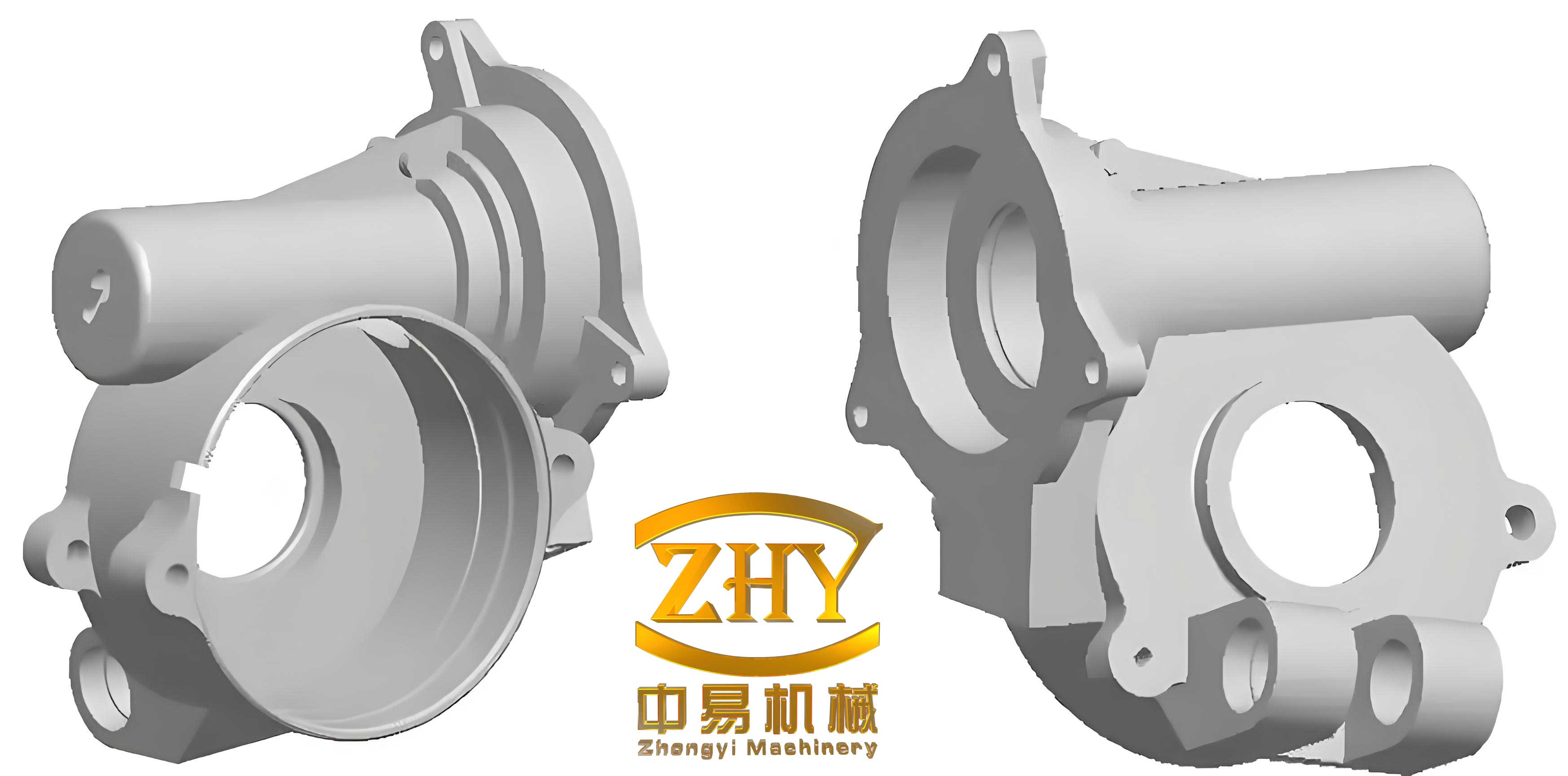
System-Level Integration and Functional Embodiment
The transmission shell casting is far more than a passive container; it is an active participant in the system’s function. My design must incorporate features that enable the transmission to operate seamlessly.
- Bearing Bore Alignment: For multi-piece housings, the alignment of bearing bores across separate shell castings is paramount for gear meshing quality and bearing life. I achieve this through strategically placed, high-precision dowel pins. The positional tolerance of these pin bores and the bearing bores relative to them is tightly controlled, typically within a 0.06 mm positional tolerance zone. The resultant misalignment error $\Delta$ between two bores can be modeled as the root sum square of individual tolerances:
$$ \Delta = \sqrt{T_{\text{bore1}}^2 + T_{\text{dowel}}^2 + T_{\text{bore2}}^2} $$
where $T$ represents the positional tolerance for each feature. - Integrated Lubrication Management: The internal walls of the shell casting are sculpted to form oil galleries, weirs, and drains. Baffles or oil guides are often designed as cast-in features or mounting points to control oil flow, prevent windage loss from rotating components like the differential, and ensure critical components like bearings are properly lubricated. The design must account for oil dynamics under various vehicle attitudes.
Embracing High-Pressure Die Casting (HPDC) in Design
The predominant manufacturing method for aluminum transmission shell castings is High-Pressure Die Casting (HPDC). My design choices are heavily influenced by the capabilities and limitations of this process.
Wall Thickness Uniformity: This is the cardinal rule. Inconsistent wall thickness leads to differential cooling rates, resulting in shrinkage porosity and warpage. I aim for uniform nominal wall thickness, typically between 3.5mm and 5.0mm for automotive transmissions. Sudden transitions are avoided. Where thickening is necessary for strength (e.g., around bolt bosses), it is done gradually with generous fillets. The solidification time $t_s$ for a simple shape can be approximated by Chvorinov’s rule:
$$ t_s = k \left( \frac{V}{A} \right)^n $$
where $V$ is volume, $A$ is surface area, $n$ is an exponent (~2), and $k$ is a mold constant. A uniform $V/A$ ratio promotes simultaneous solidification.
| Design Feature | Recommended Guideline | Rationale |
|---|---|---|
| Nominal Wall Thickness | 3.5 – 5.0 mm | Balances strength, weight, and castability. |
| Draft Angle (External/Internal) | 1° – 3° / 1.5° – 5° | Ensures part ejection without drag marks. |
| Fillet Radius (general) | R > 1.0 mm | Reduces stress concentration and improves metal flow. |
| Max. Depth of Unsleeved Holes | ~4x Diameter | Limits core deflection and breakage during casting. |
| Rib-to-Wall Thickness Ratio | 0.6 – 0.8 | Prevents hot spots and shrinkage at the junction. |
Simulation-Driven Design: Before tooling is cut, I rely on Mold Flow Analysis (MFA) software. This simulation predicts the flow of molten aluminum, temperature gradients, and potential defect locations (air entrapment, cold shuts). Based on the results, I can modify gating designs, add or relocate overflows (also called vents or渣包), and adjust wall sections to ensure a sound casting. The Reynolds number $Re$ for metal flow in the runner gives insight into flow characteristics:
$$ Re = \frac{\rho v D_h}{\mu} $$
where $\rho$ is density, $v$ is velocity, $D_h$ is hydraulic diameter, and $\mu$ is dynamic viscosity. A turbulent flow ($Re > 4000$) is typically desired to prevent early freezing but must be controlled to avoid air entrainment.
Designing for Precision Machining
The “as-cast” shell casting is a near-net-shape part; precision machining establishes the final functional geometry. My design must facilitate accurate and efficient machining.
Datum Strategy: I adhere strictly to the “Datums of Design” principle. The primary locating datum is a large, stable, machined surface. Secondary and tertiary datum features (often precisely machined holes or edges) complete the 3-2-1 locating scheme. This datum reference frame (DRF) is established in the first machining operation and is used for all subsequent operations, ensuring feature-to-feature relationships are maintained. The tolerance stack-up for a bore position relative to this DRF is meticulously controlled.
Feature Accessibility & Tooling: I design features to be machinable with standard tooling. Deep, small-diameter holes are avoided where possible. Sealing surfaces for gaskets or O-rings are designed as flat, continuous lands wide enough for a proper seal (typically >3mm around bolt holes, >5mm general width). Their surface finish specification (e.g., Ra ≤ 3.2 µm) is directly called out on the drawing. Complex contours that would require expensive custom form tools are minimized unless absolutely necessary for function.
Facilitating Robust Assembly
The design of the shell casting directly impacts the ease, speed, and quality of transmission assembly on the production line.
Handling and Fixturing Features: I incorporate dedicated, non-functional lifting lugs or locating pads on the壳体. Their placement is calculated so that the line connecting them passes close to the assembly’s center of gravity, ensuring stable lifting and transfer without tipping. Similarly, support points on the assembly pallet are designed to cradle the transmission stably under this center of gravity.
Bolt Joint Design for Sealing: The flange joints between housing segments are critical for containing fluid. The bolt pattern is designed so that the “pressure lines” between bolts fall within the seal land. Bolts are spaced evenly to create a uniform clamping pressure, preventing leaks. A simple guideline is to keep the bolt spacing $s$ relative to the total flange width $W$ and bolt diameter $d$:
$$ s \leq (8 \text{ to } 10) \times d \quad \text{and} \quad W \geq (1.5 \text{ to } 1.8) \times s $$
For critical seals, I design concentric grooves or “glue channels” on the flange face. These channels control the flow of liquid gasket (FIPG), contain it, and prevent it from being squeezed into the transmission interior where it could interfere with rotating components.
Conclusion
Designing an automotive transmission shell casting is a quintessential exercise in multidisciplinary engineering. It demands a profound understanding that extends beyond CAD modeling into the realms of material science, fluid dynamics, structural mechanics, and detailed manufacturing processes. The most elegant and successful designs are those where the boundaries between design and工艺 dissolve. By proactively engaging with topology optimization, die-casting simulations, machining sequence planning, and assembly logistics from the earliest conceptual stages, I can develop a shell casting that is not only structurally sound and functionally perfect but also cost-effective to produce and reliable in service. This synthesis is the ultimate benchmark of excellence in automotive component design.