
The pursuit of high-performance components for the most demanding applications, such as aerospace engines and industrial gas turbines, has long been driven by the exceptional high-temperature capabilities of superalloys. My research focus lies at the critical junction where advanced metallurgy meets manufacturing precision. Central to this is precision investment casting, the dominant and often sole viable process for producing intricate, thin-walled components like single-crystal turbine blades. The success of this entire endeavor hinges on a silent yet crucial participant: the ceramic shell. This mold must be more than a passive container; it is an engineered system that must withstand immense thermal and mechanical stresses while maintaining supreme dimensional fidelity and, most challengingly, remain chemically inert against the reactive superalloy melt. In recent years, the evolution of ceramic shell technology and a deeper understanding of its interfacial interactions with alloys have been pivotal. This article consolidates key advancements from a first-person perspective, focusing on material innovations, process understanding, and the complex physicochemical dance at the alloy-ceramic interface.
Ceramic Shells for Precision Investment Casting: Material Foundations and Innovations
The performance of a ceramic shell in precision investment casting is dictated by a stringent set of requirements: sufficient green and fired strength, excellent dimensional stability, high temperature creep resistance, appropriate thermal conductivity, and controlled permeability. Achieving this balance is a multi-faceted materials science challenge.
Refractory Matrix Materials
The choice of refractory filler, constituting over 90 wt.% of the shell, forms the backbone. Alumina (Al2O3) remains a cornerstone due to its high melting point, good thermal conductivity, and relatively matched thermal expansion with many superalloys. However, monolithic oxides often fall short. Composite or modified systems show greater promise. For instance, the addition of kyanite (Al2SiO5) to alumina-based systems leads to in-situ mullite formation during sintering, significantly enhancing mechanical strength, creep resistance, and porosity while reducing shrinkage, as summarized in the data below.
| Material System | Key Property Enhancement | Mechanism |
|---|---|---|
| Al2O3 – Kyanite Blend | Increased bending strength, Reduced creep deformation, Lowered sintering shrinkage, Higher apparent porosity. | In-situ formation of mullite (3Al2O3·2SiO2) needles during firing, which reinforces the matrix. |
Other common refractories include zircon (ZrSiO4), silica (SiO2), and mullite itself. Their selection is a critical compromise, as their inherent chemical stability varies drastically when in contact with molten superalloys containing reactive elements.
The Critical Role of Binders
The binder system consolidates the refractory particles. Colloidal silica binders are ubiquitous, providing green strength via the formation of siloxane (Si-O-Si) networks as water evaporates. The size of the silica colloids is a key parameter, influencing slurry viscosity, shell permeability, and de-binding behavior. A significant challenge, however, is the inherent reactivity of the SiO2 introduced by these binders. During precision investment casting of high-temperature alloys, this silica can participate in deleterious interfacial reactions. This has spurred research into non-silicate binder systems based on Al2O3, ZrO2, or Y2O3 colloids to enhance interfacial inertness.
Reinforcement and Modification with Fibers
A major innovation in shell technology is fiber reinforcement. The traditional trade-off between shell thickness (for strength) and thermal conductivity (for desired solidification gradients) can be mitigated by incorporating fibers. These materials enhance strength and toughness, allowing for thinner shells that improve heat extraction—a vital factor in directional solidification for single-crystal growth. The table below summarizes common fiber modifications.
| Fiber Material | Primary Benefit | Consideration |
|---|---|---|
| Nylon/Polypropylene | Burns out to create micro-porosity, enhancing shell permeability and reducing weight. | Directional control of burnout pores is difficult; they can act as crack initiators if oriented parallel to stress. |
| Ceramic (e.g., ZrO2, Aluminosilicate) | Direct reinforcement at high temperatures, improving fired strength and creep resistance. | Higher cost; potential for introducing chemical impurities. |
| Carbon Fiber | Significantly improves thermal conductivity, aiding heat dissipation. | Can oxidize during pre-heat if atmosphere is not controlled, potentially weakening the shell. |
The Precision Investment Casting Process
Understanding the context in which the shell operates is essential. Precision investment casting is a multi-step, precision-driven sequence. It begins with the fabrication of a wax or polymer pattern, which is assembled into a cluster. This cluster is repeatedly dipped into ceramic slurries and stuccoed with coarse refractory grains to build up the shell thickness. Following drying, the pattern is removed via autoclaving or flash firing, leaving a precise ceramic negative. The shell is then fired at high temperature to develop strength and eliminate residual volatiles before the superalloy melt is poured. The solidified casting is finally liberated by mechanical or chemical shell removal.
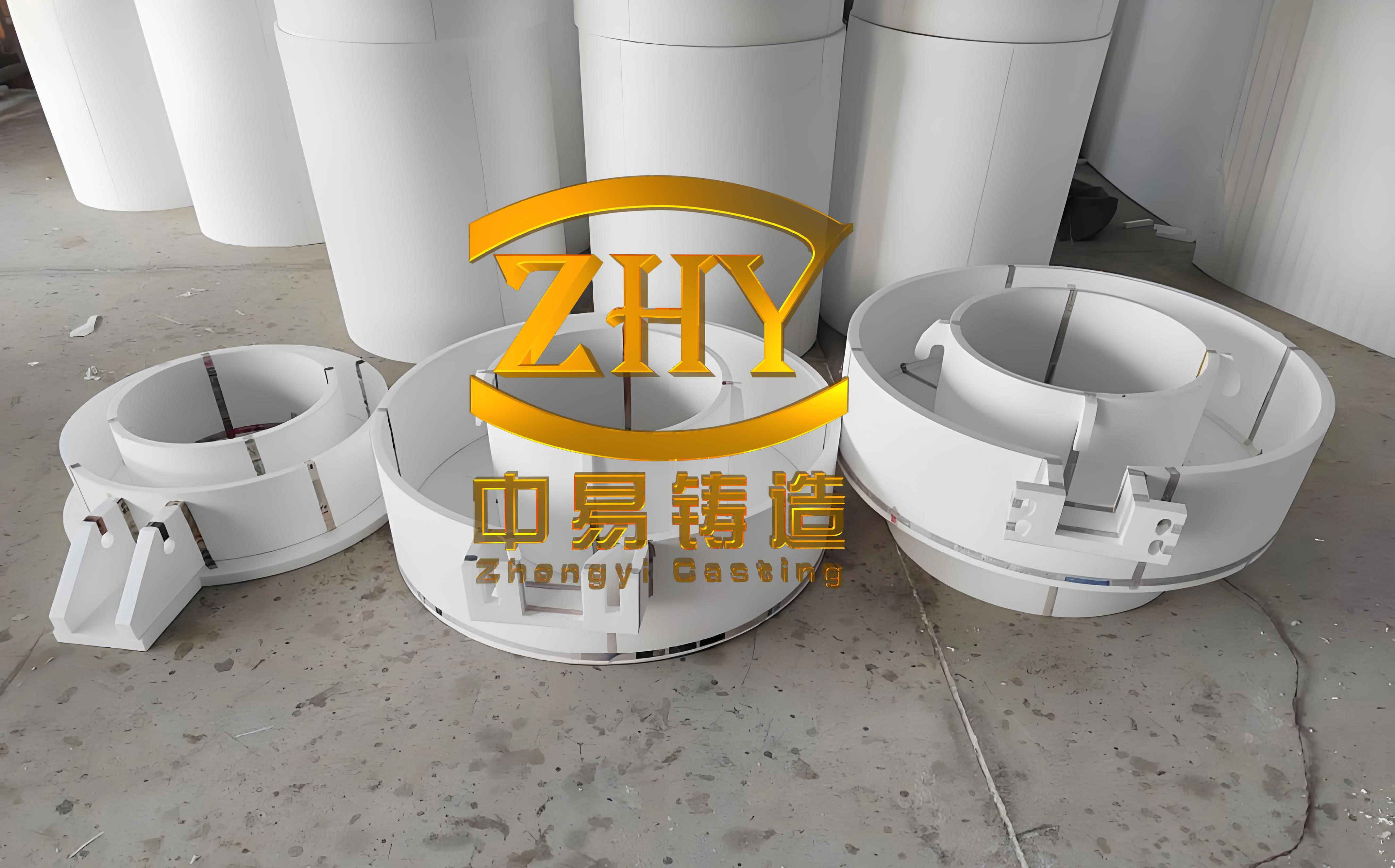
Each step—slurry rheology, drying kinetics, firing cycle—profoundly affects the final shell microstructure and its performance during metal pouring. The complexity of this process underscores why interfacial defects remain a significant yield-limiting factor.
Interfacial Reactions Between Ceramic Shell and Superalloy Melt
The heart of the challenge in advanced precision investment casting lies at the interface. As alloy melting points increase and component sizes grow, leading to longer contact times at extreme temperatures, the propensity for chemical interaction escalates. This often manifests as “chemical sand bonding,” where reaction products fuse the shell to the casting, severely degrading surface finish and dimensional accuracy.
Mechanisms of Chemical Interaction
The interfacial chemical processes are complex but can be categorized. They often begin with the dissociation of the ceramic oxide at the interface, followed by dissolution of the species into the melt, interdiffusion, and subsequent reaction. The primary reaction pathways can be represented as follows:
1. Decomposition/Dissolution: $$ \text{M}_x\text{O}_y (\text{s}) \rightleftharpoons x\text{M} (\text{dissolved}) + y\text{O} (\text{dissolved}) $$
2. Displacement/Redox Reaction: $$ \text{M}_x\text{O}_y (\text{s}) + z\text{M}_A (\text{dissolved}) \rightarrow \text{M}_{A_z}\text{O}_y (\text{s/g}) + x\text{M} (\text{dissolved}) $$ where MA is a reactive alloying element (e.g., Al, Cr, Hf, Y).
3. Formation of Complex Compounds: $$ \text{M}_x\text{O}_y (\text{s}) + z\text{M}_A (\text{dissolved}) \rightarrow \text{M}_{A_z}\text{M}_{x-w}\text{O}_y (\text{s}) + w\text{M} (\text{dissolved}) $$
4. Liquefaction: $$ \text{M}_x\text{O}_y (\text{s}) \rightarrow \text{M}_x\text{O}_y (\text{l}) $$ While not a chemical change, liquefaction of grain boundaries or phases (e.g., SiO2 in zircon) drastically increases reactivity and metal penetration.
Influence of Ceramic Material
The shell chemistry is a primary dictator of reactivity. Silica-containing materials (SiO2, ZrSiO4, aluminosilicates) are generally more susceptible to attack by elements like Al, Hf, and Y. For example, zircon decomposes at casting temperatures, releasing reactive SiO2 which can lead to localized “reaction pit” formation. In contrast, pure oxides like Al2O3, Y2O3, and MgO show higher inherent stability. Wettability studies using the sessile drop method consistently show non-wetting behavior for Ni-based alloys on these oxides, with Y2O3 often exhibiting the lowest degree of interfacial reaction.
The Pivotal Role of Alloying Elements
The superalloy’s composition is the other critical variable in the interfacial equation. Key reactive elements include:
| Element | Role in Alloy | Impact on Interface |
|---|---|---|
| Chromium (Cr) | Essential for oxidation/corrosion resistance. | Can react with silica-based ceramics. At very high temperatures (>1500°C), it may accelerate SiO2 reduction: $$ 3\text{SiO}_2 + 4[\text{Cr}]_{\text{melt}} \rightarrow 2\text{Cr}_2\text{O}_3 + 3[\text{Si}]_{\text{melt}} $$ |
| Hafnium (Hf) | Improves castability and creep strength. | Highly reactive. Often the dominant element forming interfacial HfO2 layers with both Al2O3 and SiO2-based shells. Content directly scales with reaction layer thickness and complexity. |
| Yttrium (Y) | Trace addition for enhanced oxidation resistance. | Extremely reactive. Forms a sequence of yttrium-aluminates (YAG – Y3Al5O12, YAM – Y4Al2O9) with Al2O3 shells. The specific product depends on local Y/Al ratio at the interface. |
| Rhenium (Re) | Potent solid-solution strengthener. | Chemically stable; does not directly participate in reactions. Interestingly, higher Re content has been observed to reduce wettability and seemingly suppress the extent of interfacial reaction, possibly by altering melt surface tension or diffusion kinetics. |
Wettability and Its Interplay with Reaction
The wetting behavior of the alloy melt on the ceramic is not merely a physical phenomenon; it is intrinsically linked to chemical interaction. We can distinguish two regimes:
| Wetting Type | Driving Force | Timescale | Consequence for Casting |
|---|---|---|---|
| Non-reactive Wetting | Van der Waals / Dispersive forces | Very fast (<10-3 s) | Poor wetting can hinder mold filling. Good wetting without reaction can lead to metal penetration. |
| Reactive Wetting | Interfacial Chemical Reaction | Slow (10-1 to 104 s) | Reaction products alter the local chemistry and topology, dynamically changing the contact angle. Usually improves wetting but causes chemical contamination. |
In precision investment casting, the ideal scenario is often controlled, non-reactive wetting. However, the presence of reactive elements like Hf, Y, and C typically induces reactive wetting. The reaction product layer itself changes the effective “substrate,” making the wetting process dynamic. Studies show that the final wettability and the severity of the interface reaction are co-dependent outcomes of the same thermodynamic and kinetic drivers. For instance, an increase in Re content, while not directly reactive, leads to a higher observed contact angle on Al2O3 and is correlated with a thinner, less complex interfacial reaction layer.
Conclusions and Future Perspectives
The journey towards flawless precision investment casting of next-generation superalloys is fundamentally a quest for interfacial stability. From my perspective, recent progress has illuminated the path but also revealed its complexity. We have moved from simple, single-oxide refractories to engineered composite matrices, from purely silica-based binders to explorations of more inert alternatives, and from passive shells to actively reinforced structures with fibers. Our understanding of the interface has evolved from observing defects to modeling reaction kinetics and wettability dynamics.
Looking forward, several key directions emerge as critical:
1. Advanced Ceramic Composites: The future lies in purpose-designed, multi-phase refractories and compatible binder systems that offer an optimal balance of thermomechanical properties and chemical inertness, possibly leveraging stable rare-earth oxides.
2. Additive Manufacturing (AM) of Shells: AM has the potential to revolutionize shell fabrication by enabling complex, graded architectures (e.g., dense inner faces with porous, reinforced backups), reducing material usage, and allowing precise control over wall thickness to optimize thermal management.
3. Quantitative Modeling of Interfacial Phenomena: Current understanding is often qualitative. There is a pressing need for coupled thermodynamic-kinetic models that can predict reaction layer formation, composition, and thickness based on alloy/shell chemistry and process parameters (time, temperature). This would transition shell design from empirical to predictive.
4. Integrated Study of Wettability and Reaction: These two phenomena must be studied in tandem, not isolation. Systematic investigations into how specific alloying elements modify melt surface tension and interfacial energy, and how nascent reaction layers subsequently alter wetting dynamics, are essential for a complete mechanistic picture.
The ceramic shell in precision investment casting is far from a mundane mold; it is a sophisticated, reactive barrier whose performance dictates the quality of the most critical components in high-temperature engineering. Mastering its interaction with the superalloy melt remains one of the most significant challenges and opportunities in the field.