
In the realm of engineering materials, wear remains a formidable challenge, leading to the premature failure of components and significant economic losses. Enhancing wear resistance is thus paramount for reliability and longevity. While conventional lubrication strategies are effective, they impose design constraints and maintenance burdens. This has spurred interest in self-lubricating materials, where solid lubricants are integrated into a metal matrix. Among these, Austempered Ductile Iron (ADI), derived from spheroidal graphite cast iron, stands out. Its unique microstructure, termed ausferrite, combined with the innate lubricity of spherical graphite nodules, grants it an exceptional combination of strength, ductility, and wear resistance. The journey to high-performance ADI begins with austenitization, a critical step where the matrix transforms, setting the stage for the subsequent isothermal quenching. In this investigation, we explore how varying this initial austenitizing temperature fundamentally alters the microstructure of ADI, and in turn, dictates its mechanical and, most importantly, its tribological response.
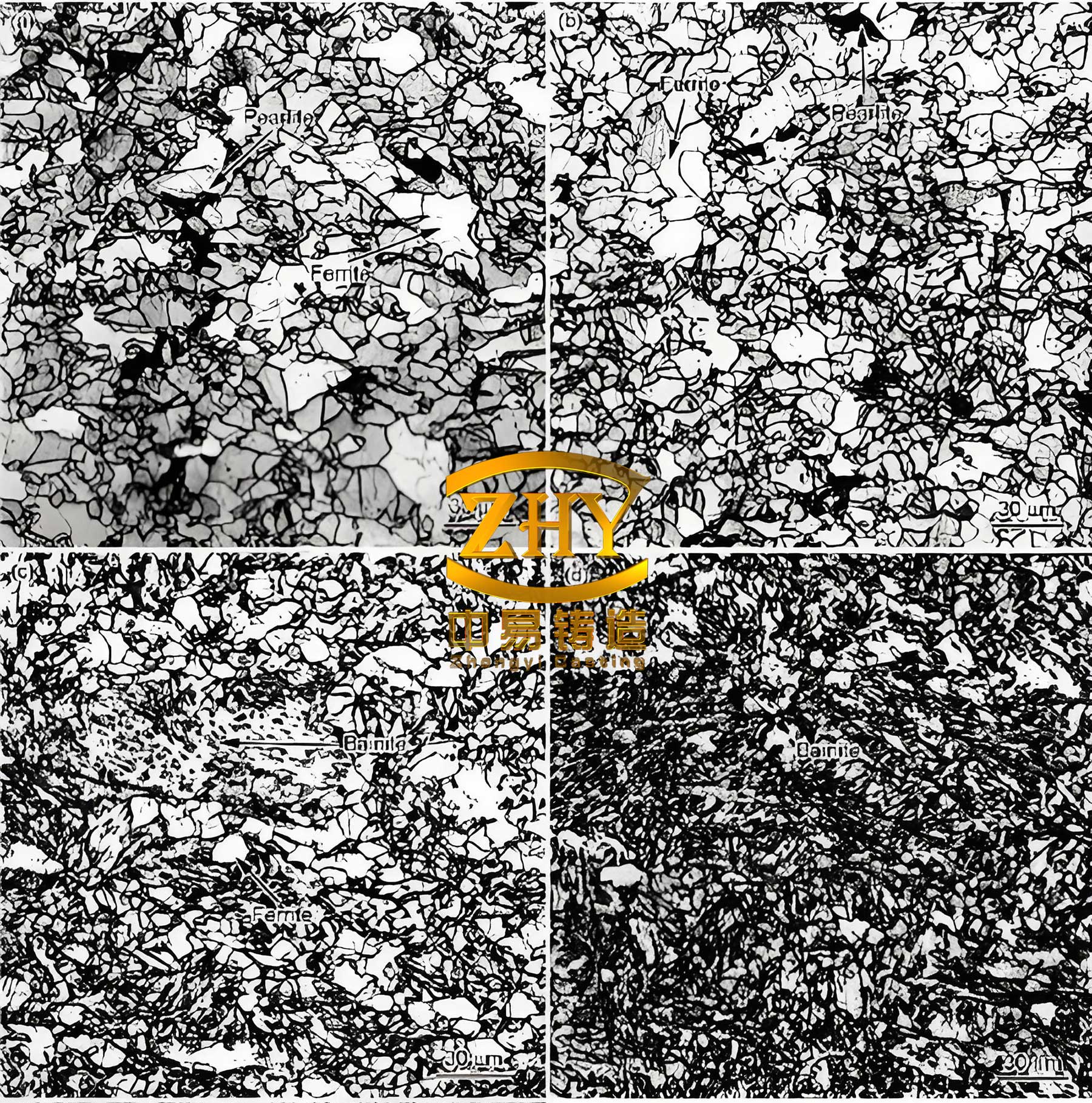
The foundational material for our study was a continuously cast spheroidal graphite cast iron bar. Continuous casting was chosen to minimize casting defects like slag inclusions and porosity, which are detrimental to wear performance, and to promote a fine, uniform distribution of graphite nodules—a key factor for effective self-lubrication. The chemical composition of the base iron is summarized in Table 1.
| Element | C | Si | Mn | S | P | Fe |
|---|---|---|---|---|---|---|
| Wt.% | 3.5 | 2.4 | 0.17 | 0.01 | 0.05 | Bal. |
Table 1: Chemical composition (wt.%) of the base spheroidal graphite cast iron.
Specimens were subjected to a two-stage heat treatment. The first, and the variable of interest, was austenitization. We employed three distinct temperatures: 900°C, 950°C, and 1050°C, each held for 90 minutes to ensure complete homogenization. Following this, the samples were rapidly quenched into a salt bath at 300°C for isothermal transformation (austempering) for 90 minutes, before being air-cooled to room temperature. The process parameters are consolidated in Table 2.
| Process Step | Parameter 1 | Parameter 2 | Parameter 3 |
|---|---|---|---|
| Austenitizing | 900°C, 90 min | 950°C, 90 min | 1050°C, 90 min |
| Austempering | 300°C, 90 min | ||
Table 2: Summary of heat treatment parameters for the spheroidal graphite cast iron.
The microstructural evolution was characterized using optical and scanning electron microscopy (SEM). Graphite parameters were statistically analyzed. Phase constituents were identified via X-ray diffraction (XRD), which also allowed for the calculation of retained austenite volume fraction and its carbon content using established methods. Mechanical properties were assessed through hardness measurements and tensile testing. The core of our investigation, the tribological behavior, was evaluated using a pin-on-disk tribometer under applied loads of 5 N and 10 N. The wear rate, a critical metric, was calculated using the standard formula:
$$ k = \frac{V}{F \times S} $$
where \( k \) is the wear rate, \( V \) is the wear volume, \( F \) is the applied load, and \( S \) is the total sliding distance.
The initial microstructure of the as-cast spheroidal graphite cast iron showed a uniform distribution of highly spherical graphite nodules within a ferritic-pearlitic matrix. After austempering, the matrix transformed into the characteristic ausferritic structure. However, the scale and nature of this structure were profoundly influenced by the prior austenitizing temperature. At 900°C, the ausferrite was fine and densely populated with acicular ferrite laths interspersed with stabilized, carbon-enriched austenite films. As the austenitizing temperature increased to 950°C and further to 1050°C, a clear coarsening of the microstructure was observed. The ferrite laths became longer and more needle-like, and the regions of blocky, untransformed retained austenite increased significantly.
This evolution is directly linked to the thermodynamics of the process. A higher austenitizing temperature increases the driving force for carbon diffusion from the graphite nodules into the austenitic matrix, described by Fick’s laws. The equilibrium carbon concentration in austenite, \( C_{\gamma} \), at a temperature \( T \) can be approximated from the Fe-C phase diagram. The resulting carbon enrichment enhances the stability of the austenite, lowering its martensite start temperature, \( M_s \), which can be estimated by equations such as:
$$ M_s (°C) = 539 – 423C_{\gamma} – 30.4Mn – 7.5Si + 30Al $$
During the subsequent isothermal quenching at 300°C, this high-carbon, stable austenite offers a reduced driving force for the nucleation of bainitic ferrite. Consequently, fewer ferrite nuclei form, and those that do can grow more extensively, leading to the observed coarser, elongated ferrite morphology and larger pools of retained austenite. The quantitative data on graphite and phase composition are presented in Tables 3 and 4.
| Austenitizing Temp. (°C) | Graphite Density (nodules/mm²) | Graphite Vol.% | Graphite Roundness |
|---|---|---|---|
| 900 | ~480 | ~9.5 | ~0.82 |
| 950 | 462 | 9.2 | 0.80 |
| 1050 | 337 | 7.2 | 0.79 |
Table 3: Statistical analysis of graphite features in the austempered spheroidal graphite cast iron.
| Austenitizing Temp. (°C) | Retained Austenite Vol.% | Carbon in Austenite (wt.%) | Estimated Total Matrix C (wt.%) |
|---|---|---|---|
| 900 | ~30 | ~1.75 | ~0.53 |
| 950 | 34 | 1.82 | 0.62 |
| 1050 | 45 | 1.90 | 0.86 |
Table 4: Phase composition and carbon content derived from XRD analysis.
The changes in microstructure had a direct and predictable impact on the mechanical properties. The hardness and strength of the spheroidal graphite cast iron decreased monotonically with increasing austenitizing temperature. The sample treated at 950°C exhibited a hardness of approximately 508 HV and a tensile strength of 1354 MPa, while the sample treated at 1050°C showed a significant drop to about 433 HV and 1028 MPa. This decline can be attributed to two main factors: the coarsening of the ferrite laths (reducing dispersion strengthening) and the substantial increase in the volume fraction of the softer, blocky retained austenite. The relationship between hardness and microstructure can be conceptualized by a rule-of-mixtures:
$$ H_{ADI} \approx f_{\alpha} \cdot H_{\alpha} + f_{\gamma} \cdot H_{\gamma} $$
where \( H_{ADI} \) is the composite hardness, \( f_{\alpha} \) and \( f_{\gamma} \) are the volume fractions of ferrite and austenite, and \( H_{\alpha} \) and \( H_{\gamma} \) are their respective intrinsic hardness values. As \( f_{\gamma} \) increases and the ferrite coarsens (potentially lowering \( H_{\alpha} \)), the overall hardness decreases. Ductility, as measured by elongation, also suffered at the highest temperature, falling from 3.2% at 950°C to 1.5% at 1050°C, likely due to the brittle nature of the very coarse, high-carbon austenite regions. The mechanical property data is consolidated in Table 5.
| Austenitizing Temp. (°C) | Hardness (HV) | Yield Strength (MPa) | Tensile Strength (MPa) | Elongation (%) |
|---|---|---|---|---|
| 900 | ~525 | ~1120 | ~1400 | ~3.5 |
| 950 | 507.8 | 1083.8 | 1354.3 | 3.2 |
| 1050 | 432.7 | 834.7 | 1027.8 | 1.5 |
Table 5: Mechanical properties of the austempered spheroidal graphite cast iron.
The friction and wear behavior presented a more nuanced picture, revealing the complex interplay between hardness, lubricity, and microstructural stability. Under a low load of 5 N, the steady-state coefficient of friction was slightly lower for the higher-temperature (softer) samples. We postulate that the softer matrix facilitated the smearing and formation of a graphite lubricating film from the nodules of the spheroidal graphite cast iron. According to the Archard wear equation, wear volume is inversely proportional to hardness:
$$ V = k \cdot \frac{F \cdot S}{H} $$
where \( H \) is the hardness. However, at 5 N, the wear rates for all conditions were similar. This suggests a counterbalance: the softer samples (higher wear per Archard) benefited from better lubrication (lower friction and potentially lower wear), resulting in comparable net wear rates.
The scenario changed markedly under a higher load of 10 N. Here, the sample austenitized at 950°C demonstrated the lowest friction coefficient and the lowest wear rate. The higher load ensured sufficient graphite film formation even on the harder surface. Conversely, the sample austenitized at 1050°C, despite its softness, performed poorly. Its low hardness made the matrix prone to severe plastic deformation and the generation of abrasive wear debris. These debris particles, often oxidized, acted as third-body abrasives, accelerating wear and increasing friction, effectively destroying any protective graphite film. This highlights that excessive softness is detrimental under high contact stresses.
A key tribological mechanism in ADI is the potential for strain-induced transformation of metastable retained austenite into hard martensite during wear, a transformation hardening phenomenon. However, our XRD analysis of the wear tracks revealed that this beneficial effect was minimal in the sample austenitized at 1050°C. The retained austenite in this condition had a very high carbon content (≈1.9 wt.%), rendering it extremely stable. Its martensite start temperature, \( M_s \), was far below room temperature and likely below the flash temperatures in the wear contact. Therefore, it resisted transformation, depriving the material of this crucial wear-hardening capability. In contrast, the austenite in the sample treated at 950°C, with lower carbon content, possessed higher metastability and a greater propensity for beneficial stress-induced transformation. The tribological data is summarized in Table 6.
| Austenitizing Temp. (°C) | Steady-State μ (5 N) | Wear Rate, k (5 N) [10⁻⁶ mm³/Nm] | Steady-State μ (10 N) | Wear Rate, k (10 N) [10⁻⁶ mm³/Nm] |
|---|---|---|---|---|
| 900 | ~0.52 | ~5.8 | ~0.38 | ~4.1 |
| 950 | 0.54 | 6.1 | 0.35 | 3.7 |
| 1050 | 0.49 | 6.0 | 0.43 | 7.5 |
Table 6: Summary of tribological properties for the austempered spheroidal graphite cast iron.
In conclusion, our systematic investigation into the effect of austenitizing temperature on the properties of austempered spheroidal graphite cast iron reveals a critical processing window. Elevating the austenitizing temperature promotes carbon diffusion, leading to a coarser ausferrite, a higher volume fraction of blocky retained austenite, and a consequent reduction in hardness and strength. While moderate increases can slightly improve lubricity under mild loads, excessively high temperatures (e.g., 1050°C) are detrimental. They produce a microstructure that is too soft to resist deformation under high loads and contains overly stable austenite incapable of strain-induced hardening. This combination leads to poor wear resistance dominated by adhesive and abrasive mechanisms. Therefore, to achieve an optimal balance of mechanical strength and superior tribological performance—where adequate hardness supports load-bearing capacity and metastable austenite provides transformation hardening—the austenitizing temperature for this grade of spheroidal graphite cast iron should be carefully controlled and should not exceed 950°C. This finding provides a essential guideline for tailoring ADI components intended for demanding wear-resistant applications.