
In my extensive experience within the foundry industry, particularly focusing on aluminum alloy castings, the persistent and costly issue of internal voids remains a primary concern affecting product integrity, mechanical performance, and overall yield. These voids, universally termed porosity in casting, manifest as discontinuities within the metal matrix that can severely compromise a component’s fatigue strength, pressure tightness, and machinability. The journey of molten metal from furnace to final solidification is fraught with opportunities for gas entrapment and pore formation. This article provides a comprehensive, first-principles analysis of the origins, distinct characteristics, and underlying physics of various porosity types, with a dedicated focus on non-ferrous alloys. The goal is to furnish a theoretical and practical framework for diagnosing and mitigating these defects, thereby enhancing casting quality and reliability. A profound understanding of porosity in casting is not merely academic; it is the cornerstone of robust manufacturing practice.
The fundamental prerequisite for pore formation is the presence of gas within the liquid metal. This gas can originate from three primary, and often interacting, sources: the metal itself, the molding environment, or internal chemical reactions. Consequently, porosity in casting is systematically classified into three major categories based on its formation mechanism: gas precipitation porosity, gas invasion porosity, and reaction-induced porosity. Each type possesses unique formative conditions, morphological signatures, and preferred locations within a casting, making accurate identification the first critical step toward effective control.
1. Gas Precipitation Porosity: The Challenge of Solubility Reversal
This form of porosity in casting arises from gases originally dissolved in the molten metal exceeding their solubility limit upon cooling and solidification. The most prevalent and troublesome gas in aluminum and many other alloys is hydrogen, due to its high diffusivity and significant solubility differential between liquid and solid states.
1.1 Formation Mechanism: Absorption, Diffusion, and Nucleation
The process begins with the absorption of gas at the melt surface. This is a two-stage kinetic process:
- Adsorption: Gas molecules collide with and adhere to the melt surface.
- Physical Adsorption: Governed by van der Waals forces, this is predominant at lower temperatures and higher gas pressures. The adsorption energy is relatively low, typically $$E_{phys} \approx 5-40 \text{ kJ/mol}$$.
- Chemical Adsorption: Involves the formation of chemical bonds (e.g., dissociation of H₂ into atomic hydrogen at the Al surface). This process has a higher activation energy and becomes dominant at elevated melting temperatures: $$E_{chem} > 40 \text{ kJ/mol}$$. The rate increases with temperature.
- Diffusion: The adsorbed atoms then diffuse into the bulk liquid metal. Fick’s first law describes this transport:
$$J = -D \frac{\partial C}{\partial x}$$
where \( J \) is the diffusion flux, \( D \) is the temperature-dependent diffusion coefficient, and \( \frac{\partial C}{\partial x} \) is the concentration gradient. The high temperature of the melt accelerates this process (\( D \) increases exponentially with \( T \)).
Sievert’s Law governs the equilibrium solubility of diatomic gases like hydrogen in metals:
$$S = k \sqrt{p_{H_2}}$$
where \( S \) is the solubility (e.g., in cm³/100g), \( k \) is a temperature-dependent equilibrium constant, and \( p_{H_2} \) is the partial pressure of hydrogen in the atmosphere above the melt. Crucially, \( k \) decreases dramatically upon solidification. For aluminum, solubility in the liquid state can be over 20 times that in the solid state.
During solidification, the rejected hydrogen accumulates at the solid-liquid interface. A bubble will nucleate and grow if the sum of the partial pressures of gases inside a potential bubble nucleus exceeds the external pressures confining it:
$$\sum P_{gas} > P_{atm} + P_{hyd} + \frac{2\sigma}{r}$$
where:
- \(\sum P_{gas}\) = Partial pressure of hydrogen (and other gases) in the bubble.
- \(P_{atm}\) = Atmospheric pressure.
- \(P_{hyd}\) = Hydrostatic pressure of the liquid metal (\( \rho g h \)).
- \(\frac{2\sigma}{r}\) = Pressure due to surface tension (\(\sigma\)), which is significant for a small bubble radius (\(r\)).
If the solidification front advances too rapidly for these bubbles to float out, they become trapped as gas precipitation porosity.
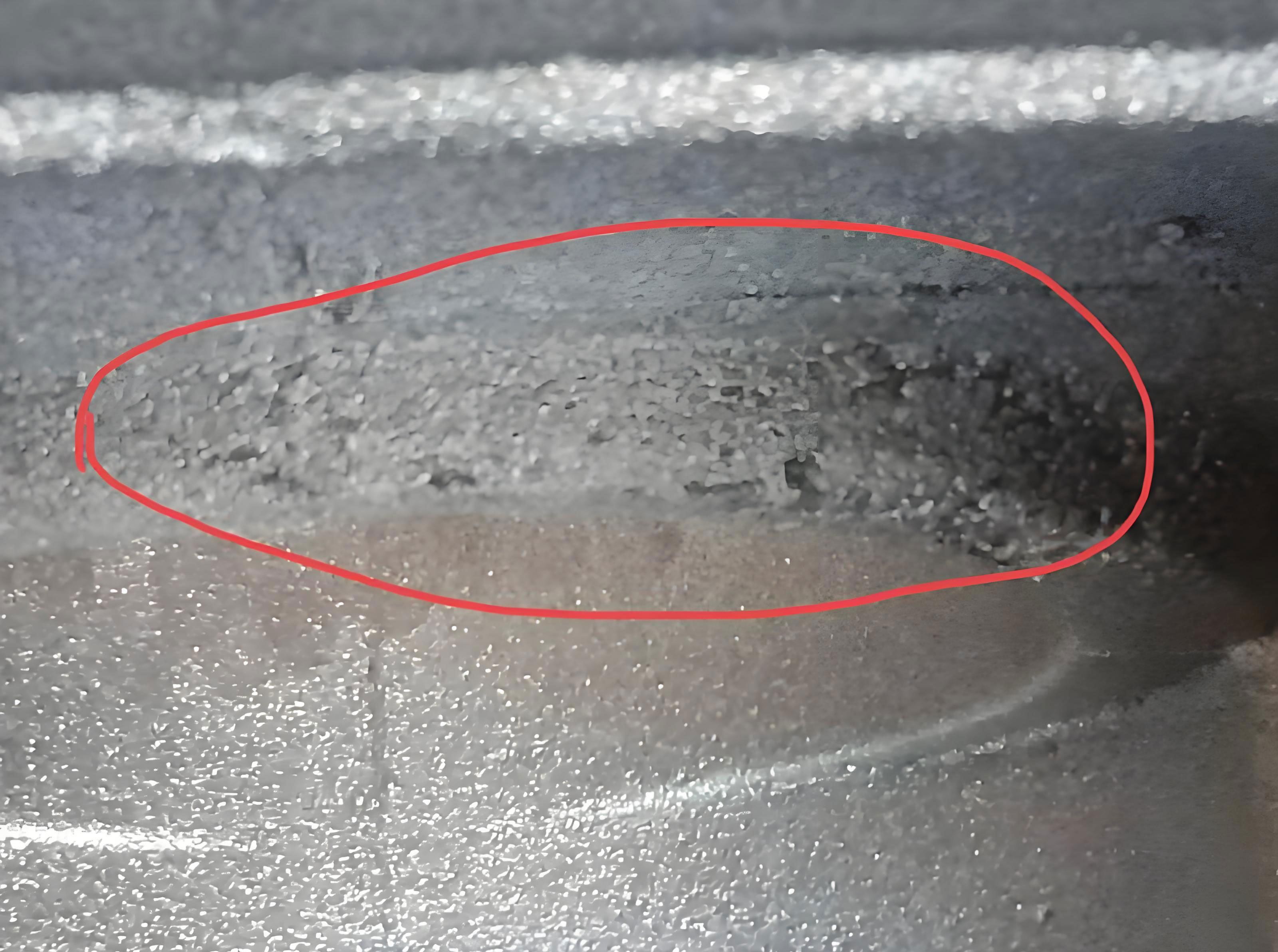
1.2 Defining Characteristics
The morphology and distribution of this porosity in casting are telling.
| Characteristic | Description | Notes |
|---|---|---|
| Shape | Varies with gas concentration. At low levels: irregular, often polygonal or interdendritic. At high levels: spherical or elongated spherical (“pear-shaped”) pores with smooth walls. | The shape is dictated by growth under constrained conditions between dendrite arms. |
| Surface Appearance | Walls are typically bright and metallic if exposed by machining; may have a slight oxide film if connected to the surface. | Distinct from the heavily oxidized walls of some reaction pores. |
| Distribution & Location | Generally uniformly scattered throughout the casting. Most dense in the last-to-freeze regions: thermal centers, under feeders (risers), and areas of slow cooling. | This systemic distribution is a key diagnostic. An entire batch from a single contaminated melt will show similar defects. |
| Size | Can range from microscopic (micron-scale) to several millimeters. In aluminum, it often appears as fine, diffuse pinholes. | Also known as “microporosity.” |
2. Gas Invasion Porosity: External Gas Entrapment
This category of porosity in casting is not caused by gas from within the melt, but by gas from the external environment being mechanically entrapped or forced into the metal.
2.1 Formation Mechanism: The Pressure Imbalance
During mold filling, gases generated from the mold/core (water vapor, CO, CO₂, hydrocarbons from binders) or ambient air can be engulfed by the advancing metal stream (turbulent filling) or can invade the metal from the mold wall. For invasion to occur, a critical pressure condition must be met at the metal-mold interface:
$$P_{gas} > P_{metal} + P_{res} + P_{atm}$$
where:
- \(P_{gas}\): Pressure of the gas generated at the mold/metal interface.
- \(P_{metal}\): Local hydrostatic pressure of the liquid metal (\( \rho g h \)).
- \(P_{res}\): Resistance pressure due to metal surface tension and capillary effects in the mold wall.
- \(P_{atm}\): Pressure in the mold cavity ahead of the metal front.
When this inequality holds, gas bubbles can penetrate the liquid metal. If the metal solidifies before these bubbles escape, gas invasion porosity is formed.
2.2 Defining Characteristics
| Characteristic | Description | Notes |
|---|---|---|
| Shape | Often large, spherical, elliptical, or distinctly pear-shaped/teardrop-shaped. The “tail” of the teardrop points toward the source of the invading gas (the mold wall). | The elongated form indicates directional growth as the bubble tried to rise. |
| Surface Appearance | Walls are usually smooth but may be oxidized if the invading gas was air or an oxidizing agent. | Can be difficult to distinguish from large precipitation pores visually. |
| Distribution & Location | Localized and irregular. Typically found near the point of gas ingress: in the upper surfaces of the casting (buoyancy), adjacent to mold or core surfaces, or along turbulent filling paths. Not uniformly distributed. | Location is the primary diagnostic vs. precipitation porosity. |
| Size | Tends to be larger than typical precipitation pores, often macroscopic and sometimes singular. | Can be a major stress concentrator. |
3. Reaction-Induced Porosity: Chemical Genesis
This form of porosity in casting results from in-situ chemical reactions that produce gas within the solidifying metal. These reactions can occur at the metal-mold interface or within the melt itself between dissolved elements or impurities.
3.1 Formation Mechanism
a) Metal-Mold Reaction: A classic example is “pinholing” in steel or cast iron castings in green sand molds. At high temperatures, moisture from the mold decomposes: \( H_2O_{(g)} \rightarrow 2H + O \). The atomic hydrogen dissolves into the metal surface. As the surface layer solidifies and cools, the solubility drops, and hydrogen recombines to form molecular gas bubbles trapped just below the surface, creating “subsurface pinholes.” A similar reaction can occur in aluminum with moist molds or cores.
b) Intrametallic Reaction: Within the melt, dissolved elements can react to form gas. For example, in aluminum alloys containing dissolved hydrogen and oxide inclusions (\(Al_2O_3\)), a reduction reaction can occur at the inclusion-matrix interface during solidification:
$$2Al + 3H_2O_{(from oxide)} \rightarrow Al_2O_3 + 6H$$
The hydrogen produced can immediately form bubbles. Another critical reaction in carbon-containing alloys (steel, cast iron) is:
$$C + FeO \rightarrow Fe + CO_{(g)}$$
The carbon monoxide gas formed creates pores, often in the form of a spongy, intercellular network.
3.2 Defining Characteristics
| Characteristic | Description | Examples & Location |
|---|---|---|
| Shape | Highly variable. Subsurface pinholes are often small, spherical, or elongated perpendicular to the surface. Intrametallic reaction pores (e.g., CO) can form a continuous, inter-dendritic, honeycomb-like network. | Shapes are intimately linked to the reaction site and solidification structure. |
| Surface Appearance | Often heavily oxidized or contain non-metallic reaction products (e.g., \(Al_2O_3\) films) on the pore walls. | This is a key diagnostic feature distinguishing it from cleaner precipitation pores. |
| Distribution & Location | Highly specific to the reaction type.
|
The location is a direct map of the reaction’s driving forces (temperature gradient, concentration gradient). |
4. A Comparative Synthesis and Practical Mitigation Framework
Effective control of porosity in casting requires a holistic strategy that addresses each potential source. The following table summarizes the key discriminators and primary countermeasures for each porosity type.
| Porosity Type | Primary Source | Key Diagnostic Features | Primary Mitigation Strategies |
|---|---|---|---|
| Gas Precipitation | Gas (H₂, N₂) dissolved in the melt. | Uniform distribution, smooth walls, located in thermal centers/last-to-freeze zones. |
|
| Gas Invasion | Gas from mold/core or turbulence. | Localized near surfaces/cores, often large & pear-shaped, may have oxidized walls. |
|
| Reaction-Induced | Chemical reactions producing gas. | Subsurface or intercellular, oxidized pore walls, honeycomb structure (CO). |
|
4.1 Foundry Process Control: An Integrated View
From my operational perspective, controlling porosity in casting is not about applying a single fix but managing an interconnected process chain:
- Melt Preparation & Treatment: This is the first line of defense, especially against precipitation porosity. Implementing strict melt handling protocols, regular hydrogen monitoring (e.g., Reduced Pressure Test), and consistent degassing cycles are non-negotiable. The efficiency of a degassing process can be modeled by first-order kinetics:
$$C_t = C_0 \cdot e^{-kt}$$
where \( C_t \) is the gas concentration at time \( t \), \( C_0 \) is the initial concentration, and \( k \) is a rate constant dependent on gas diffusion, bubble surface area, and melt agitation. - Mold & Core Engineering: Gating and venting design is a science aimed at managing fluid flow and gas evacuation. Computational Fluid Dynamics (CFD) simulations are invaluable for predicting turbulent zones prone to air entrainment. The permeability of the mold material (\( K \)) is critical and is defined by Darcy’s Law for gas flow:
$$v = \frac{K}{\mu} \frac{\Delta P}{L}$$
where \( v \) is the superficial velocity, \( \mu \) is the gas viscosity, and \( \frac{\Delta P}{L} is the pressure gradient over length \( L \). Higher permeability facilitates easier escape of generated gases, reducing invasion potential. - Solidification Control: Directional solidification, guided by chills and risers, serves a dual purpose: it feeds shrinkage and also forces dissolved gases to migrate toward the riser, where they can be vented. A steep thermal gradient (\( G \)) and a high solidification rate (\( R \)) reduce the critical pore nucleation time and limit the distance gases can diffuse. The local solidification time (\( t_f \)) is a key parameter:
$$t_f \propto \frac{V}{A}^n$$
where \( V \) is volume, \( A \) is surface area, and \( n \) is a constant (~1.5 to 2). Thicker sections (high V/A) have longer \( t_f \), allowing more time for pore growth, making them prime candidates for porosity in casting.
In conclusion, porosity in casting is a complex defect with multiple, distinct genealogies. While precipitation porosity, chiefly from hydrogen, is the most pervasive challenge in aluminum casting, a holistic quality assurance program cannot afford to ignore the potential for invasion or reaction porosity. Success lies in systematic process control—from raw material selection and melt treatment through to mold design and solidification management. By understanding the precise formation mechanisms and characteristic “fingerprints” of each porosity type outlined here, foundry engineers can move from reactive troubleshooting to proactive prevention, significantly elevating product quality, performance, and yield. The battle against porosity in casting is won through meticulous science applied with practical rigor.