
In the realm of metallurgy and materials engineering, the pursuit of high-integrity cast components is perpetually challenged by internal defects, among which porosity stands as one of the most pervasive and detrimental. The formation of porosity in casting, particularly in light alloys such as those based on aluminum and zirconium, critically undermines mechanical properties, fatigue resistance, and corrosion performance, often serving as initiation sites for catastrophic failure. This article delves into the fundamental mechanisms driving pore formation, synthesizing theoretical models with experimental observations to build a predictive framework. My focus will be on elucidating the interplay between solute redistribution, gas content, and solidification parameters, presenting a comprehensive analysis supported by mathematical formulations and empirical data.
The genesis of porosity in casting is intrinsically linked to the rejection of dissolved gases during the liquid-to-solid transformation. For aluminum alloys, hydrogen is the primary culprit due to its significant solubility difference between the liquid and solid states. In the molten phase, hydrogen dissolves atomically, but its solubility plummets upon solidification. If the rejected hydrogen cannot diffuse to the surface and escape, it supersaturates the liquid at the solidification front and may precipitate as molecular hydrogen gas, forming pores. This process is not merely a function of total gas content but is governed by the dynamics of the solidifying interface, making the study of solute redistribution paramount.
The theoretical bedrock for analyzing this phenomenon is the model of solute redistribution at a planar solid-liquid interface. Assuming no convection in the liquid and negligible diffusion in the solid, the concentration of a solute (like hydrogen) in the liquid ahead of the interface, $C_L$, as a function of distance $x$ from the interface, is described by the classic Tiller-Chalmers equation:
$$
C_L = C_0 \left[ 1 + \frac{1-k}{k} \exp\left(-\frac{v x}{D}\right) \right]
$$
where $C_0$ is the initial bulk concentration of the solute in the melt, $k$ is the equilibrium partition coefficient (for hydrogen in Al, $k << 1$), $v$ is the velocity of the solidification front (growth rate), and $D$ is the diffusivity of the solute in the liquid. This equation reveals that solute (hydrogen) is enriched in the liquid at the interface, reaching a maximum value of $C_0 / k$ at $x=0$. When this enriched concentration exceeds the solubility limit of hydrogen in the liquid at that temperature and pressure, $S_L$, conditions become favorable for pore nucleation.
The critical region where $C_L > S_L$ defines a constitutional super-saturation zone. The width of this zone, $\Delta x$, is crucial as it dictates the spatial domain available for pore nucleation. It can be derived by setting $C_L = S_L$ in the equation above and solving for $x$:
$$
\Delta x = \frac{D}{v} \ln\left[ \frac{1-k}{k} \left( \frac{S_L}{C_0} – 1 \right) \right]
$$
Furthermore, the time $\Delta t$ for which a given point in the liquid remains within this super-saturated zone as the interface advances is:
$$
\Delta t = \frac{\Delta x}{v} = \frac{D}{v^2} \ln\left[ \frac{1-k}{k} \left( \frac{S_L}{C_0} – 1 \right) \right]
$$
These two parameters, $\Delta x$ and $\Delta t$, are fundamental predictors for the severity of porosity in casting. A larger $\Delta x$ provides a broader region for nucleation, increasing the number of potential pore sites. A longer $\Delta t$ allows nucleated bubbles more time to grow by diffusion of gas into them, leading to larger pore sizes. The following table summarizes how key solidification variables influence these predictors and the resulting porosity.
| Variable | Increase in Variable | Effect on $\Delta x$ | Effect on $\Delta t$ | Predicted Effect on Porosity in Casting |
|---|---|---|---|---|
| Initial Gas Conc., $C_0$ | Higher | Increases | Increases | More numerous and larger pores. |
| Solidification Rate, $v$ | Faster (e.g., metal mold) | Decreases | Decreases sharply ($\propto 1/v^2$) | Finer, fewer pores. |
| Partition Coefficient, $k$ | Larger (theoretically) | Decreases | Decreases | Reduced tendency for pore formation. |
| Liquid Solubility Limit, $S_L$ | Higher | Decreases | Decreases | Reduced tendency for pore formation. |
Experimental observations robustly support this model. For instance, in Al-Si alloys like ZL102, casts made in sand molds (slow cooling, low $v$) exhibit significantly larger and more abundant pores compared to identical pours in water-cooled copper molds (rapid cooling, high $v$), holding the initial hydrogen content $C_0$ constant. Similarly, for a fixed mold type and cooling rate, melts with higher initial hydrogen content, measured via reduced density tests or other techniques, yield castings with exacerbated porosity. This direct correlation underscores the predictive power of the $\Delta x$ and $\Delta t$ framework for managing porosity in casting.
The morphology of porosity in casting is also instructive. Under conditions of slow growth and high gas content, pores can grow relatively uninhibited, often assuming a spherical shape. In contrast, under directional solidification or in the presence of interdendritic liquid flow, pores may become elongated or take on irregular, crack-like shapes as they form in the constrained spaces between dendrite arms. The visualization of these features is critical for diagnosis.
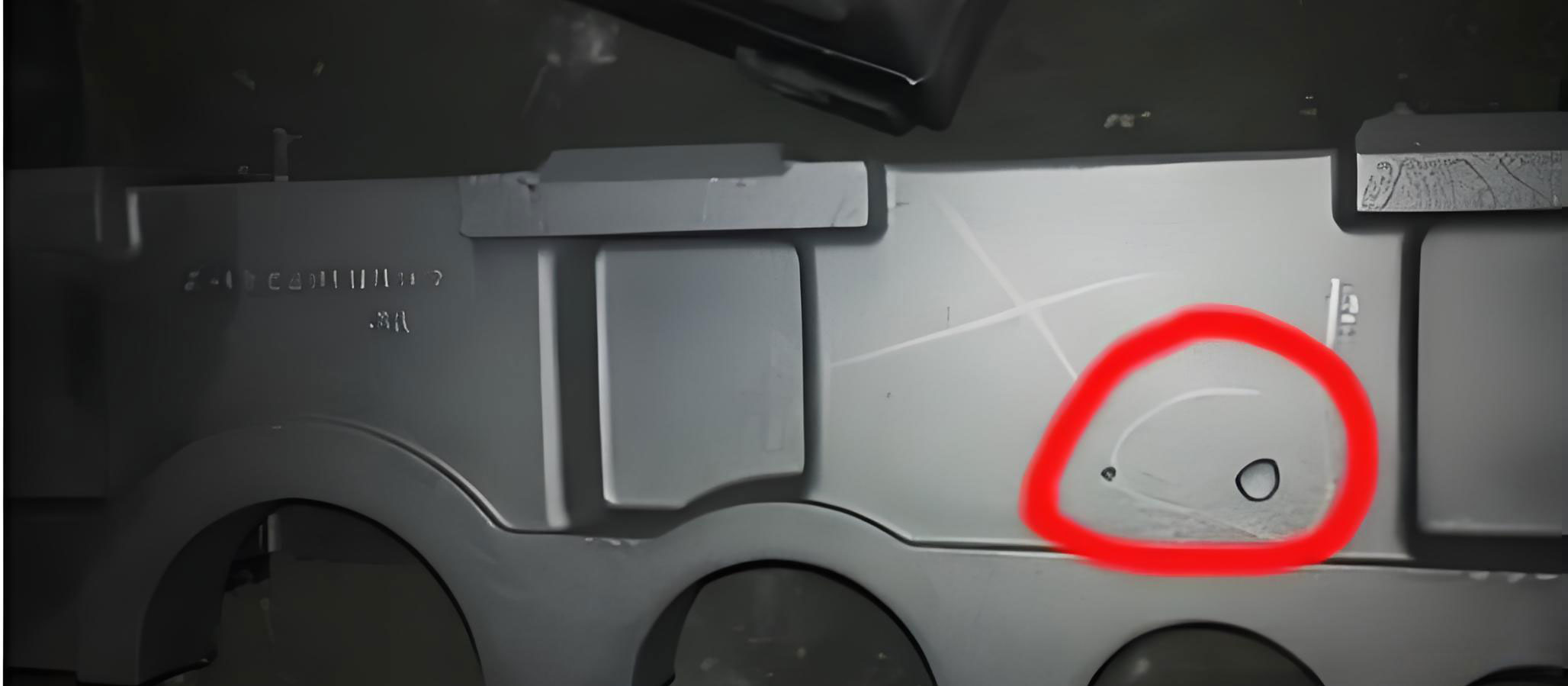
Beyond hydrogen porosity, shrinkage during solidification can interact with gas precipitation to form complex pore structures. The combined action of gas pressure and volumetric contraction can lead to pores that are larger than those formed by either mechanism alone. The pressure balance for a spherical pore nucleus of radius $r$ is given by:
$$
P_g \geq P_{atm} + \rho g h + \frac{2\gamma}{r} – P_{met}
$$
where $P_g$ is the internal gas pressure, $P_{atm}$ is atmospheric pressure, $\rho g h$ is the metallostatic head, $\gamma$ is the liquid metal surface tension, and $P_{met}$ is the local metal pressure which can become negative due to shrinkage. A negative $P_{met}$ (tensile stress in the liquid) significantly lowers the threshold for pore nucleation and growth, exacerbating the problem of porosity in casting.
Shifting focus to zirconium-based bulk metallic glasses (BMGs), the challenge of porosity in casting manifests differently but is equally critical. For glass-forming alloys like $(Zr_{71}Fe_{14}Cu_{15})_{100-x}B_x$, the goal is to achieve a fully amorphous structure, free of crystalline phases and casting defects. The addition of small metalloid elements like Boron (B) is known to enhance glass-forming ability (GFA) by destabilizing competing crystalline compounds and increasing the liquid’s stability. However, the casting process itself must be rapid enough to bypass crystallization, often using methods like copper mold suction casting. Any entrapped gas or shrinkage void within the as-cast BMG rod acts as a stress concentrator, drastically reducing the effective fracture strength and fatigue limit. Therefore, understanding and controlling the factors that lead to porosity in casting is essential for realizing the superior theoretical properties of these advanced amorphous alloys.
The experimental methodology for investigating porosity in casting involves a multi-pronged approach. For aluminum alloys, melt treatment is the first line of defense. Techniques like rotary impeller degassing with argon or nitrogen are highly effective. The efficiency of degassing can be monitored by measuring the density of a solidified sample under reduced pressure (e.g., the Straube-Pfeiffer test) or using direct hydrogen analysis probes. The relationship between measured density $\rho_{sample}$ and hydrogen content is often empirically calibrated. For a given alloy, a higher final density correlates with lower hydrogen content and, consequently, a lower propensity for porosity in casting. Post-solidification, quantitative metallography is performed on prepared cross-sections. Image analysis software can measure pore area fraction, size distribution, and shape factors, providing hard data to correlate with process variables. These metrics can be compiled into comprehensive tables for analysis.
| Mold Type | Section Thickness (mm) | Melt Density Post-Treatment (g/cm³) | Estimated $C_0$ (relative) | Avg. Pore Area Fraction (%) | Max Pore Diameter (µm) | Predicted $\Delta t$ (relative units) |
|---|---|---|---|---|---|---|
| Sand | 15 | 2.61 | Low | 0.15 | 50 | 1.0 |
| Sand | 25 | 2.61 | Low | 0.42 | 120 | 2.8 |
| Sand | 40 | 2.61 | Low | 0.85 | 250 | 7.1 |
| Metal (Copper) | 40 | 2.61 | Low | 0.08 | 30 | 0.2 |
| Sand | 25 | 2.49 | High | 1.35 | 180 | 5.5 |
The data in the table above clearly illustrate the dual dominance of cooling rate (via mold type and section thickness) and initial hydrogen content. The predicted relative $\Delta t$, calculated using the inverse square of an estimated growth rate $v$ (slower for thicker sections) and adjusted for $C_0$, shows a strong qualitative correlation with the measured pore area fraction. This validates the model’s utility for predicting trends in porosity in casting.
For BMGs, characterization focuses on verifying the absence of crystalline phases using X-ray diffraction (XRD) and then assessing mechanical properties via compression or nanoindentation tests. A sudden, catastrophic fracture with a vein-like pattern is typical for monolithic BMGs. However, the presence of internal porosity in casting can cause significant scatter in fracture strength values and promote shear band initiation at these internal defects, leading to lower-than-expected strength. While the primary research on BMGs often highlights compositional optimization for GFA (like the peak at $x=3$ B addition in the Zr-Fe-Cu-B system), the quality of the casting process itself, which minimizes porosity, is a critical but sometimes under-reported factor in achieving the reported high strengths (~1.4 GPa in that system).
Moving towards predictive control, the ultimate goal is to integrate these models into casting simulation software. By solving the coupled equations for heat flow, fluid flow, and solute diffusion (including gas species), modern simulation packages can predict the location and approximate size of macro- and micro-porosity in casting. The key input parameters are the alloy’s thermodynamic data (including $k$ and $D$ for hydrogen), the initial gas content, and the boundary conditions defining cooling. The nucleation and growth of pores can be modeled using criteria based on the local super-saturation and pressure conditions derived from the equations discussed. The output is a visual map of predicted porosity, allowing foundry engineers to modify gating systems, riser placement, or cooling conditions before ever making a tool.
In conclusion, the formation of porosity in casting is a complex but decipherable phenomenon rooted in the fundamentals of solidification science. The interaction between rejected solute gas and the advancing solidification front creates a constitutional super-saturation zone, the characteristics of which ($\Delta x$ and $\Delta t$) determine the severity of the defect. These characteristics are controlled primarily by the initial melt gas content ($C_0$) and the solidification kinetics ($v$), as powerfully described by the Tiller-Chalmers model and its derivatives. Whether in conventional aluminum foundry alloys or advanced zirconium-based metallic glasses, the detrimental impact of porosity in casting on mechanical performance is unequivocal. Therefore, a dual strategy is essential: proactive melt purification to minimize $C_0$, and intelligent process design to maximize $v$ (where appropriate) and manage solidification feeding. By combining robust theoretical models, careful experimental validation, and increasingly sophisticated numerical simulation, the goal of producing sound, high-integrity castings with minimized porosity is steadily becoming an attainable standard in precision metallurgy.